
An analysis of over 600,000 LinkedIn posts by researcher Nathanial Bibby in 2026 found that organic reach has dropped by up to 62% since Q4 2025, with average engagement rates falling from 8.1% to 3.2%.
Naturally, most people assume the problem is content quality, but after digging into platform data and testing patterns across my network, it became clear: content isn't the bottleneck anymore.
Because getting engagement on LinkedIn in 2026 doesn't come from a single post, it's the result of how everything works together: what you post, who sees it, how often you show up, how you engage, and what people learn from each post.
The old system was transactional (100 likes = good post), but the new one is behavioral: "Did this content hold someone's attention long enough to matter?"
This single shift killed nearly every engagement hack we've relied on for years.
The playbook that works now looks like what Supergrow has been building toward anyway–building a structured system that makes LinkedIn engagement predictable.
That's exactly what we're going to dissect here. Let's go!
Why Do Most Linkedin Posts Not Get Engagement?
Curious why some LinkedIn posts gain massive traction while others go unnoticed? And, this isn't any accident.
The truth is, engagement on LinkedIn isn't just about what you say. It's shaped by patterns you ignore; inconsistent posting, random connections, and how the platform "reads" your activity over time.
When those elements don't align, even strong content struggles to get engagement. Let's break down what's actually holding your engagement back.
Reactive Posting Kills Momentum
Inconsistency is a silent engagement killer. This doesn't mean you must post daily. It means your posting patterns should be predictable.
You get busy. You stop posting. Then two. Then three months. When you finally come back with a brilliant post, nobody engages.
This change isn't personal; it's how LinkedIn works.
LinkedIn tracks what they call "creator velocity"-measuring how consistently you contribute to the platform. Stop fueling the algorithm, and distribution drops with it. Your content stops getting surfaced, your network stops seeing you, and your reach quickly declines.
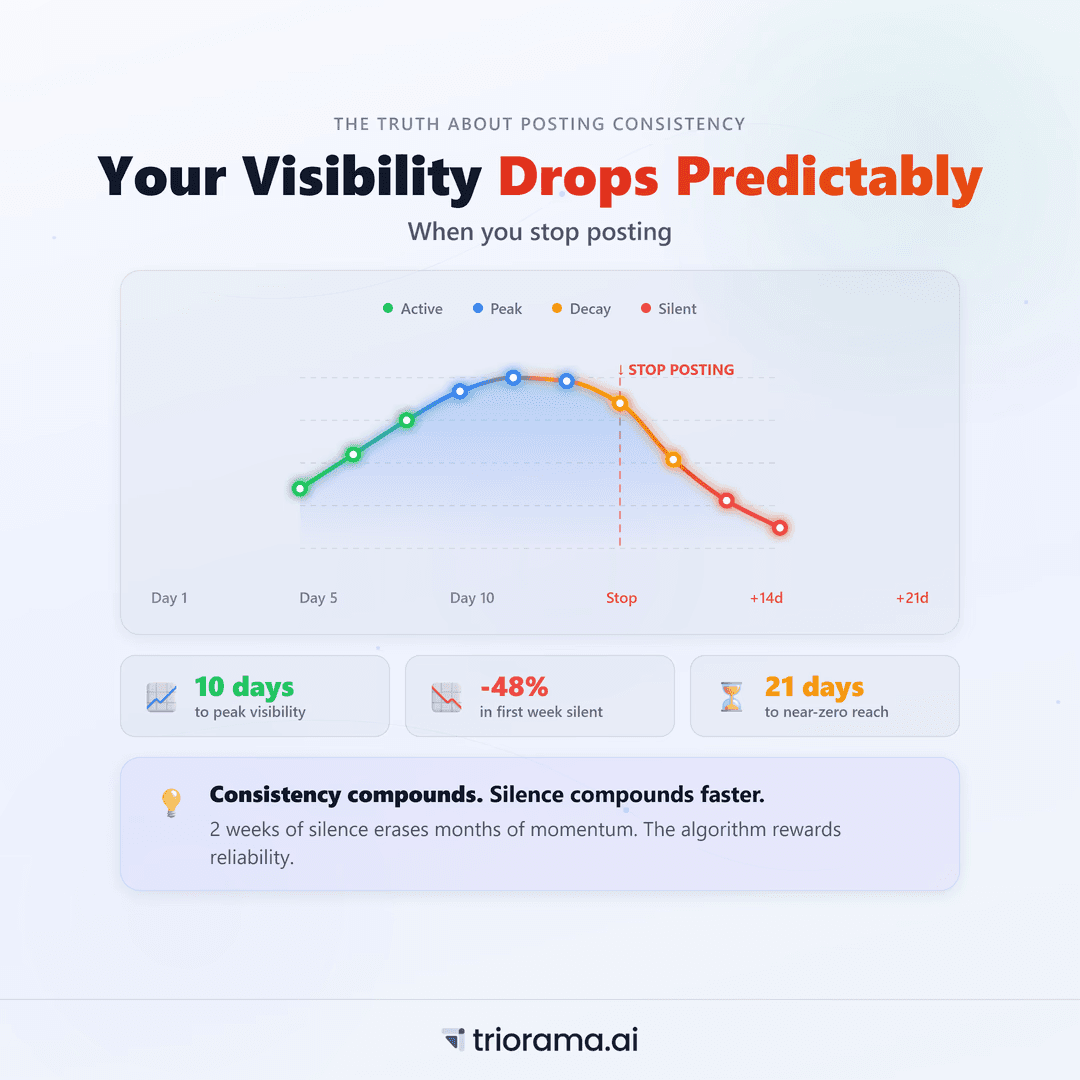
It's called visibility decay:
| Time Silent | Estimated Reach |
|---|---|
| 1 week | 100% (baseline) |
| 2 week | ~75% |
| 3 week | ~45% |
| 4+ week | ~15% (starting over) |
Even two weeks of silence erases months of momentum. Three decent posts per week will outperform one "perfect" post per month every single time.
That's why creators prefer to schedule posts early, not for convenience, but for LinkedIn signal stability. Tools like Supergrow help maintain consistent publishing across platforms without daily effort.
The Wrong Network Limits Reach
This is actually the number #1 killer of your LinkedIn engagement, and almost nobody talks about it.
LinkedIn initially pushes your new post to a small initial audience (roughly 8-15% of your connections). If those people don't engage, your post dies there. Game over.
The problem is that LinkedIn heavily weights relationship signals — especially first-degree connections and people you frequently interact with. LinkedIn predicts whether a given member will engage with a specific post based on their interaction history.
-
Do they usually comment or just scroll?
-
Do they engage with posts like this topic?
-
Do they prefer video, documents, or text?
-
Do they interact with this author?
If someone engages with your posts, messages you or views your profile, LinkedIn learns there's a relationship and is more likely to surface your content to each other.
But, when they don't, LinkedIn reads that as a signal: this content isn't relevant. So even if your post is valuable, insightful, or well-written… it stalls. This is one reason "random follower counts" don't matter in 2026.
Vanity Metrics Mislead Your Strategy
Likes, impressions, and follower counts, often referred to as "vanity metrics", create an illusion of popularity. But here's a truth that no one admits: vanity metrics don't build businesses.
A viral post? Cool. But did it lead to actual customers?
-
10,000 new followers? Great. But do they trust you?
-
A surge in engagement? Nice. But will they remember your name in a month?
The real signals that measure whether your personal brand is on track are:
-
Comments: LinkedIn looks at who comments and how relevant they are to the topic. Twenty low-quality comments aren't meaningful engagement. One thoughtful comment from the right person can outperform all of them.
-
Profile views: If you consider your LinkedIn profile as a landing page, the profile view and followers from a post provide a strong impact on your lead gen and business revenue.
-
Saves: People save content that feels actionable and useful for their day-to-day life. On average, 1 save carries more weight than multiple likes. Creators whose content is saved consistently grow followers materially faster over time.
Now, you see how a post with over 100+ likes changes nothing, but a post with 10 relevant comments and 5 profile views creates a deeper impact in the long run.
Optimising simply for likes is broad and generic; having unique insights and signature formats is what turns your content from good to unforgettable. You can annoy your way to attention. You cannot annoy your way to authority.
And authority is what actually compounds.
The Algorithm Punishes Inconsistency
LinkedIn doesn't blast your post to your entire network the moment you hit publish. Your post is first shown to a small, highly relevant slice of your audience, people who have interacted with you before.
This is your quality filter. When you post irregularly, you weaken that initial test group.
-
Your audience forgets you
-
Your past engagers stop interacting
-
The algorithm loses confidence in your content pattern
So when you finally post again, your "test audience" is colder and less responsive.
Earlier, impressions, likes or low-quality comments could carry a post, but the LinkedIn algorithm prioritizes behavioral signals like:
-
Dwell time (how long someone stays on your post)
-
Scroll speed (do they pause or swipe past instantly?)
-
Depth of interaction (comment depth > likes)
-
Lasting reference value (save for later and private shares indicates content is valuable)
This explains why some posts from three days ago are going viral, but your recent posts aren't getting the reach. LinkedIn prioritizes relevance over recency, allowing valuable content to stay active as long as it continues to generate authentic discussions.
No System Means No Growth
Most people write a post, publish it, check likes and move on. When they don't see the result, they blame the content: "Maybe the writing isn't compelling enough," or "The topic must not be resonating."
But the real issue is simpler: Your distribution muscle could be weak. The real bottleneck is the absence of a system that connects everything they're doing.
-
Content is created without a clear structure: Most professionals use the "Island Method." They post about a trend on Monday, a "how-to" on Wednesday, and a personal win on Friday. The winners in 2026 use the pillar content strategy, in which each post is part of a pillar and a larger content cluster.
-
Distribution is treated as an afterthought instead of an active process: If you're not actively engaging, replying to comments quickly, starting conversations in other people's posts, bringing attention back to your content, your post never gets the early signals it needs to travel further.
This combination is the sole reason your posts are shown to a limited audience, contributing to lower engagement.
- Performance is not used to inform future posts: Most people treat posting like a one-time event. They publish, check likes, and move on. But every post is data.
For instance, different formats reach different segments of your audience, so if you don't know which format works for your audience, you'll never be able to scale or build influence, even when you are creating the best content.
That shift changes everything.
Winning on LinkedIn isn't about producing more. It's about creating a system that encourages good content creation, distributes it to the right people and helps you multiply what you are already good at.
The LinkedIn Engagement System That Drives Consistent Results
Building a highly engaged audience isn't just about going viral once. It's about applying a consistent framework to every post you publish.
This section shows that growing on LinkedIn is not a set of tactics but a proven, interconnected system designed to create consistency, clarity, and compounding growth.
Here's what you need to focus on:
1. Content Pillars (What to Post)
Most creators don't struggle with writing. They struggle with deciding what to write about consistently.
That's where content pillars come in. A good pillar is not defined by topic. It's defined by the problem it solves for your audience. Justin Welsh, a LinkedIn growth expert, said: "Pick one expensive pain point of your target audience and become their best solution".
Look at your audience and identify:
-
What are they actively struggling with?
-
What are they trying to achieve faster?
-
Where are they stuck or confused?
Then narrow it down to 3–4 repeatable problem areas you can consistently speak on. Your pillars should be broad enough to support a variety of content, but specific enough to keep your strategy focused.
After studying hundreds of LinkedIn posts from your favorite creators, we have analyzed the top content pillar structure that they follow.
Insight
People rely heavily on the first piece of information they receive when making a decision. Your unique differentiation comes from the unique insights you share in your content.
Many LinkedIn creators have achieved success through this because:
-
You interpret your audience's challenges
-
Connect patterns
-
Translate experience into perspective
That's what turns ordinary content into something memorable.
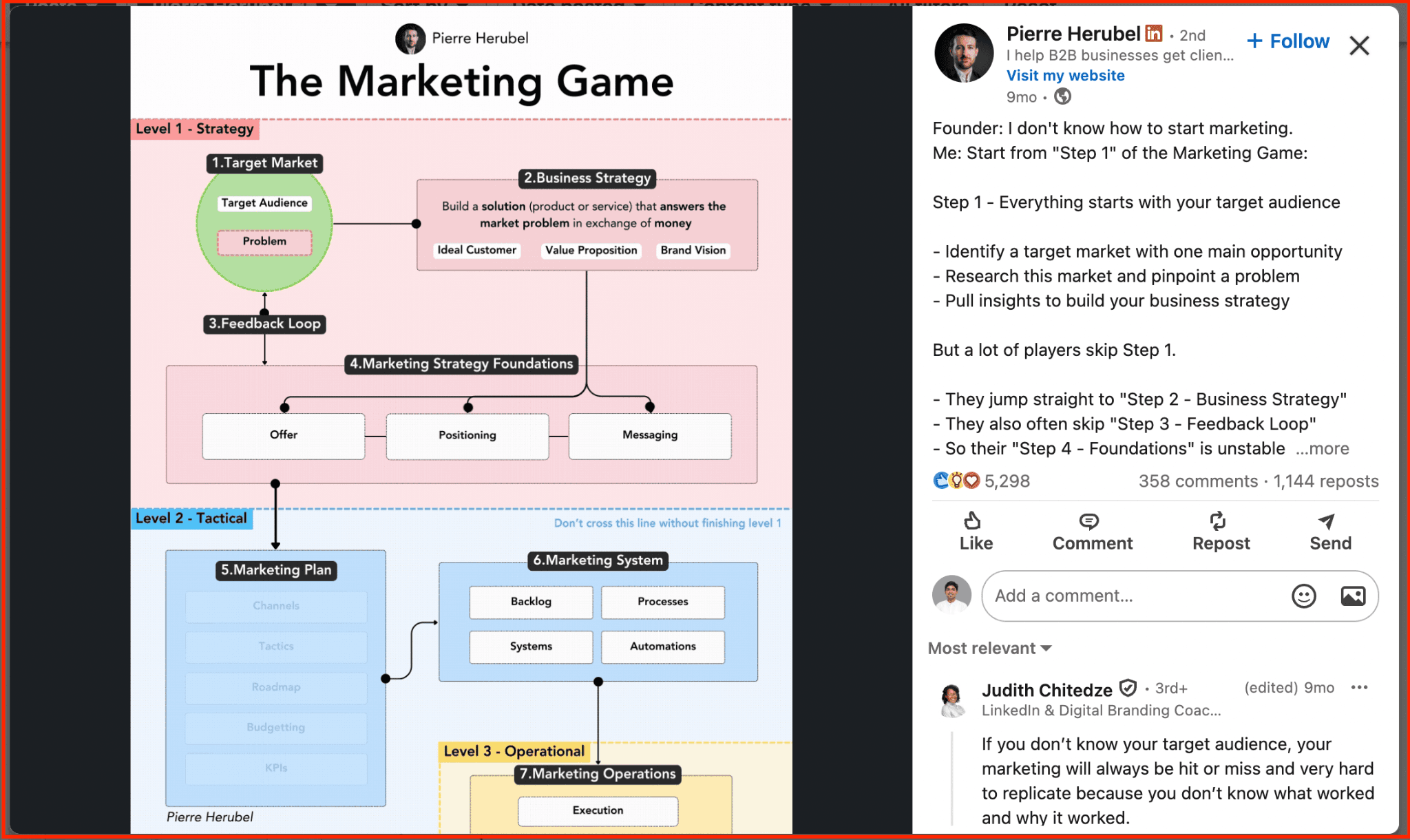
Pierre Herubel has created multiple frameworks for his audience and has reached 30 million views a year following the same pattern.
Perspective
This is where you build your voice and philosophy.
Such posts communicate what you stand for, what you challenge, and how you see the world. Lead with the "how you did something". Instead of "I did something, look at me."
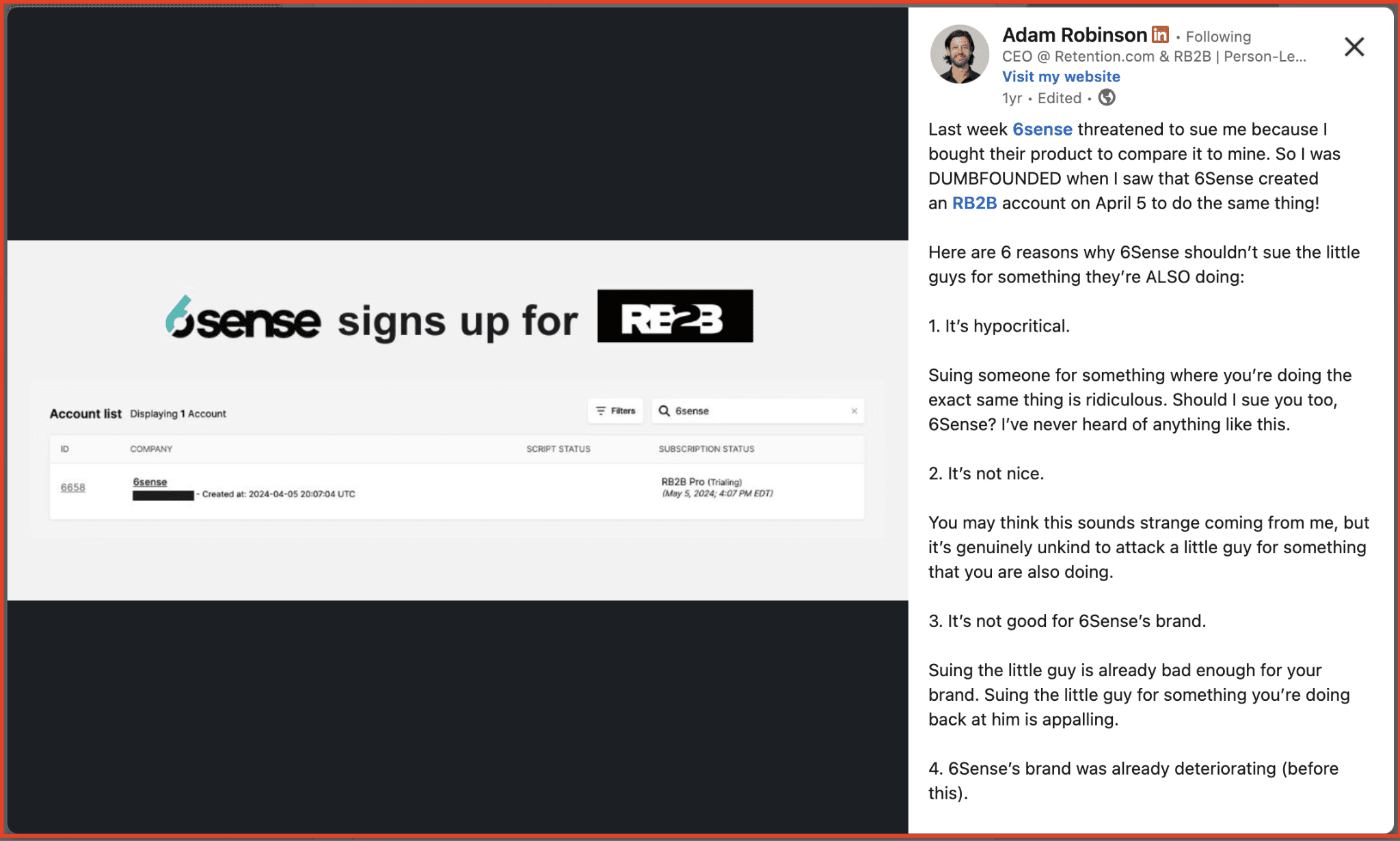
For instance, Adam Robinson, CEO of Retention.com, wasn't afraid to challenge bigger players or call out ideas he believed were fundamentally flawed. For instance, the 6Sense beef with Adam fueled his initial growth.
Proof
We all love content that talks numbers.
Proof content shows that you don't just talk numbers, you solve them. These posts include client wins, before/ after results, experiments or personal results.
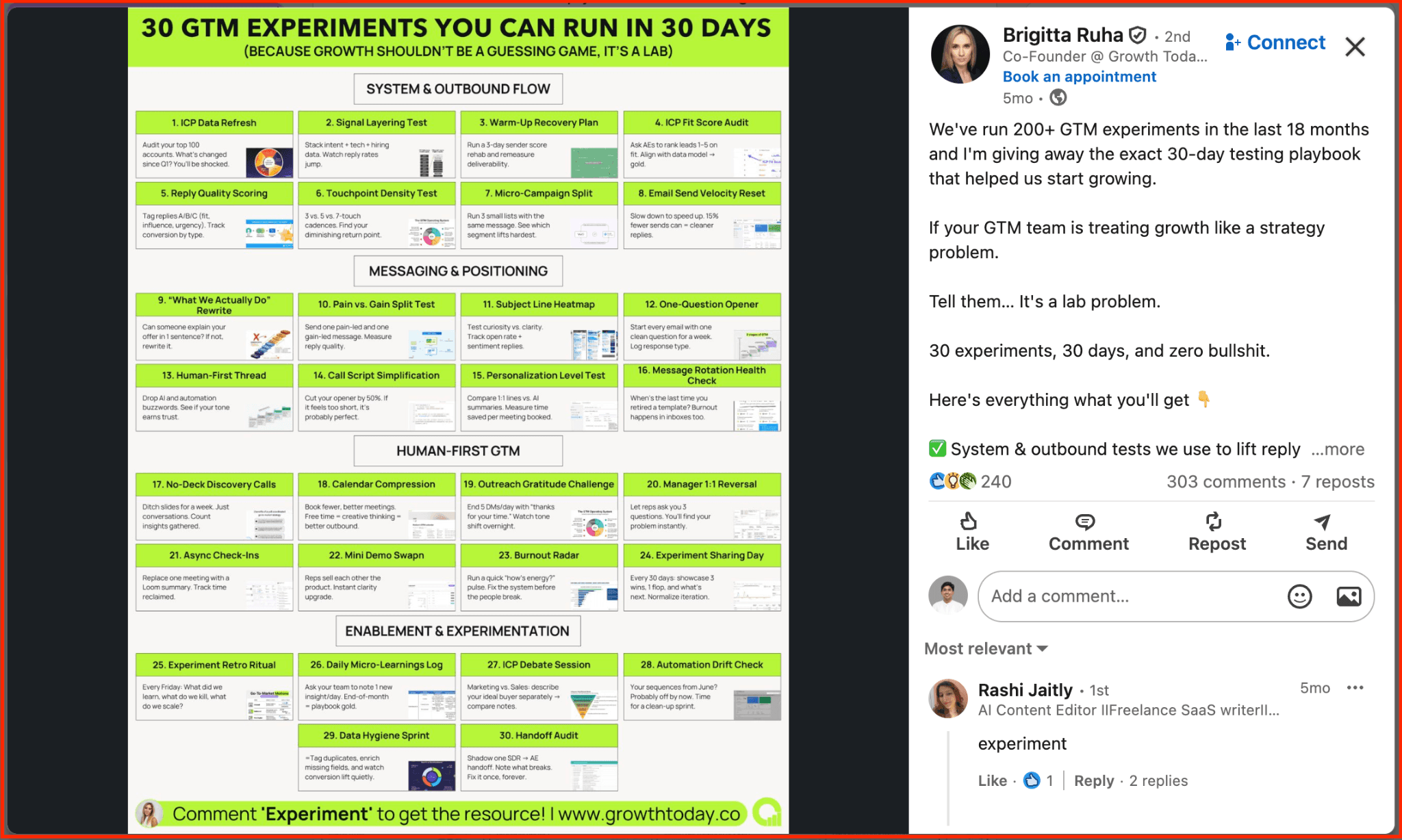
This post by Brigitta Ruha focuses on the experiments she ran for GTM growth and how readers can achieve similar success with their GTM strategy.
Opinion
The best posts on LinkedIn have one thing in common: they're all based on experience, not theory. It takes the starting point from "what should I post today?" to "what can I naturally talk about?"
For example:
-
A sales rep might talk about buyer conversations and objections
-
A designer might share the creative process or inspiration
-
A manager might reflect on leadership lessons
-
A junior employee might document their learning journey
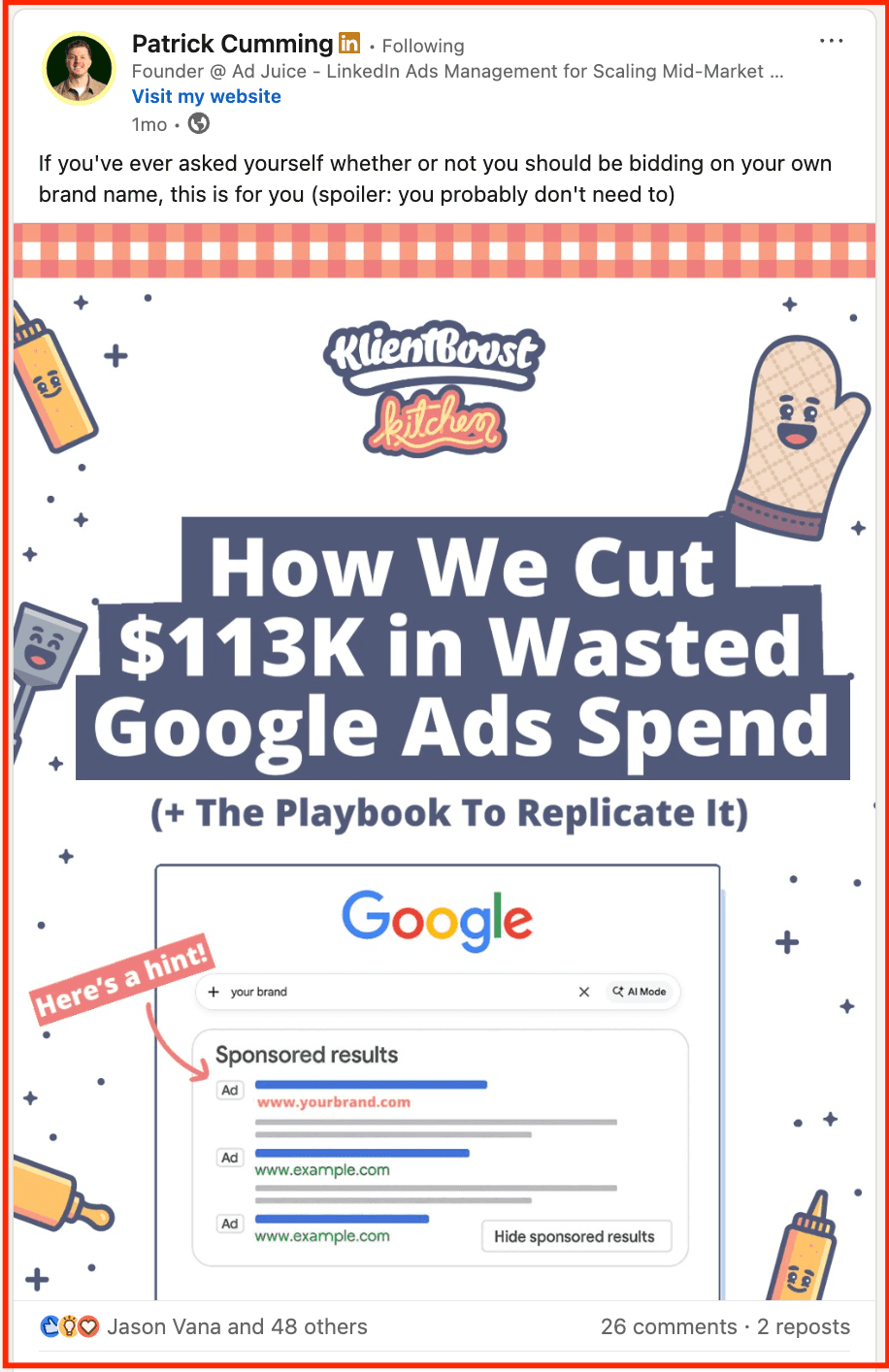
For instance, Patrick Cumming, marketing leader, regularly pulls back the curtain on real client work, sharing screenshots, charts, and concise narratives.
Most people already have an abundance of ideas; what they lack is a predictable way to create them.
Supergrow's content DNA feature lets you build a profile that captures your tone, opinions, vocabulary, and topics you care about. You can then join guided conversations with our AI interviewer and talk about industry topics, deals you've closed, and lessons learned.
The AI asks smart follow-up questions to draw out the insights worth sharing.
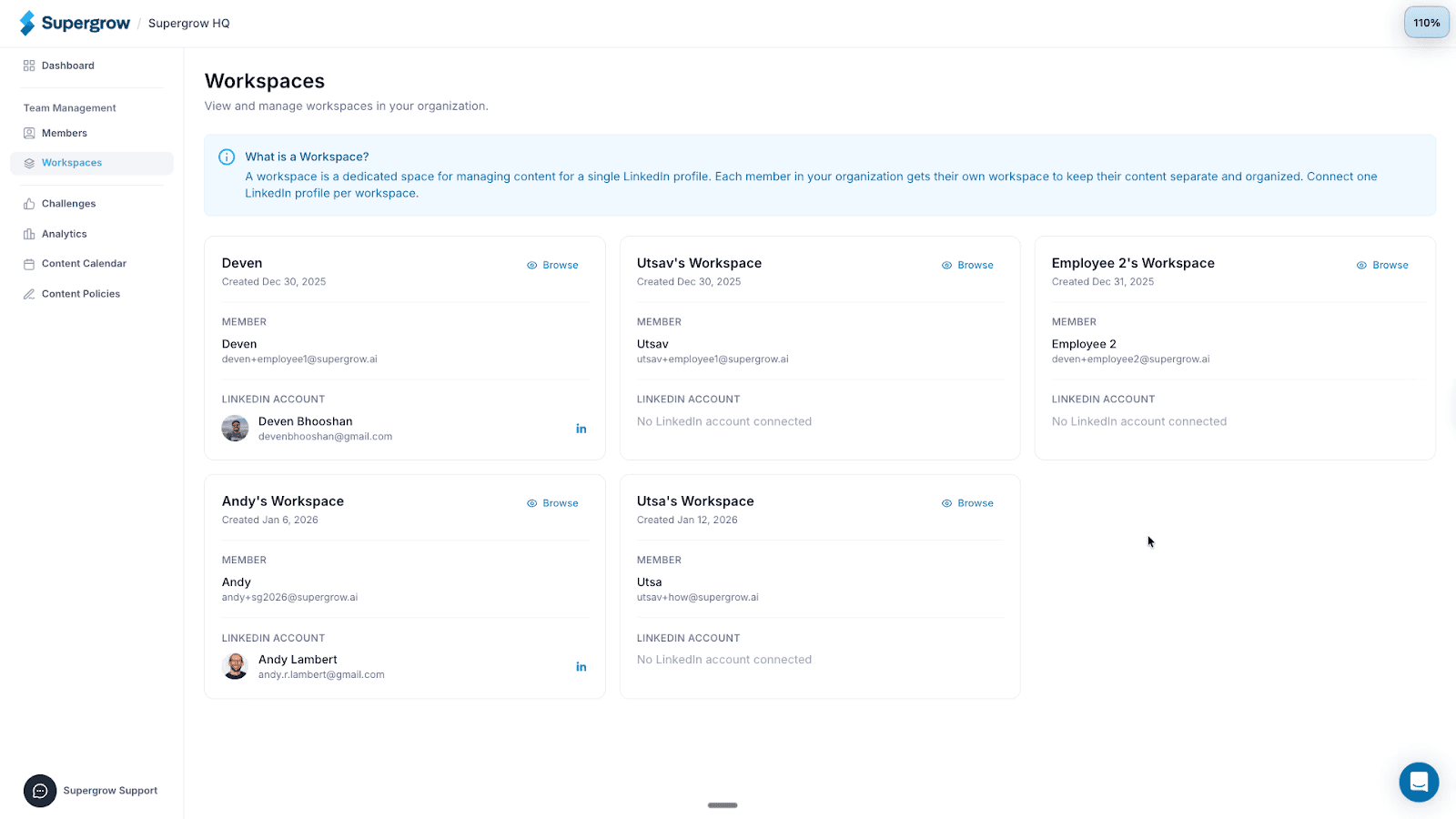
You can further repurpose those ideas into carousels, videos, and visuals, so you don't have to build them from scratch. This way, you maximize reach across LinkedIn with far less effort.
2. Content Formats (How to Package It)
Format selection is one of the most controllable levers of organic reach in 2026. The LinkedIn algorithm favors formats that increase dwell time, and the performance gaps between content formats have widened compared to previous years.
Understanding these differences lets you make strategic format choices rather than defaulting to whatever is easiest to produce.
Document Posts (PDF Carousels)
Benchmark: 6.60% average engagement, the highest of any LinkedIn format.
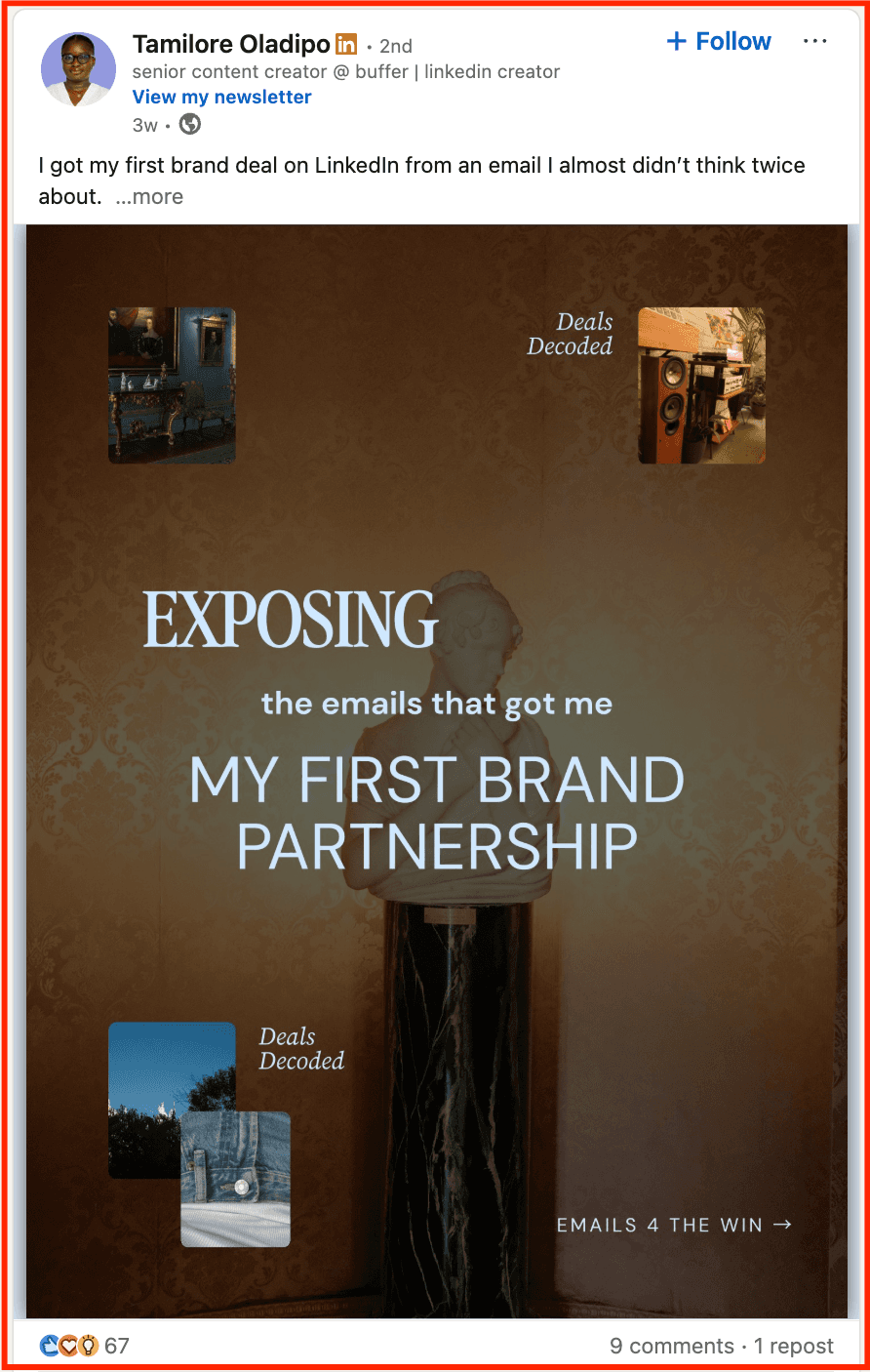
Since LinkedIn removed native carousel uploads, multi-page PDFs became the workaround. They're now the dominant format for engagement across industries:
-
278% more engagement than video
-
303% more than single images
-
596% more than text-only posts
Top-performing topics across industries:
-
Step-by-step frameworks and processes
-
Before/after transformations (career, sales, projects)
-
Data visualizations and industry benchmarks
-
Career lessons and professional insights
If you want to create easy-to-consume, thumb-stopping, high-engagement content, carousels are a favorable format for reaching your audience.
Native video (30-90 seconds)
Benchmark: 5.60% engagement
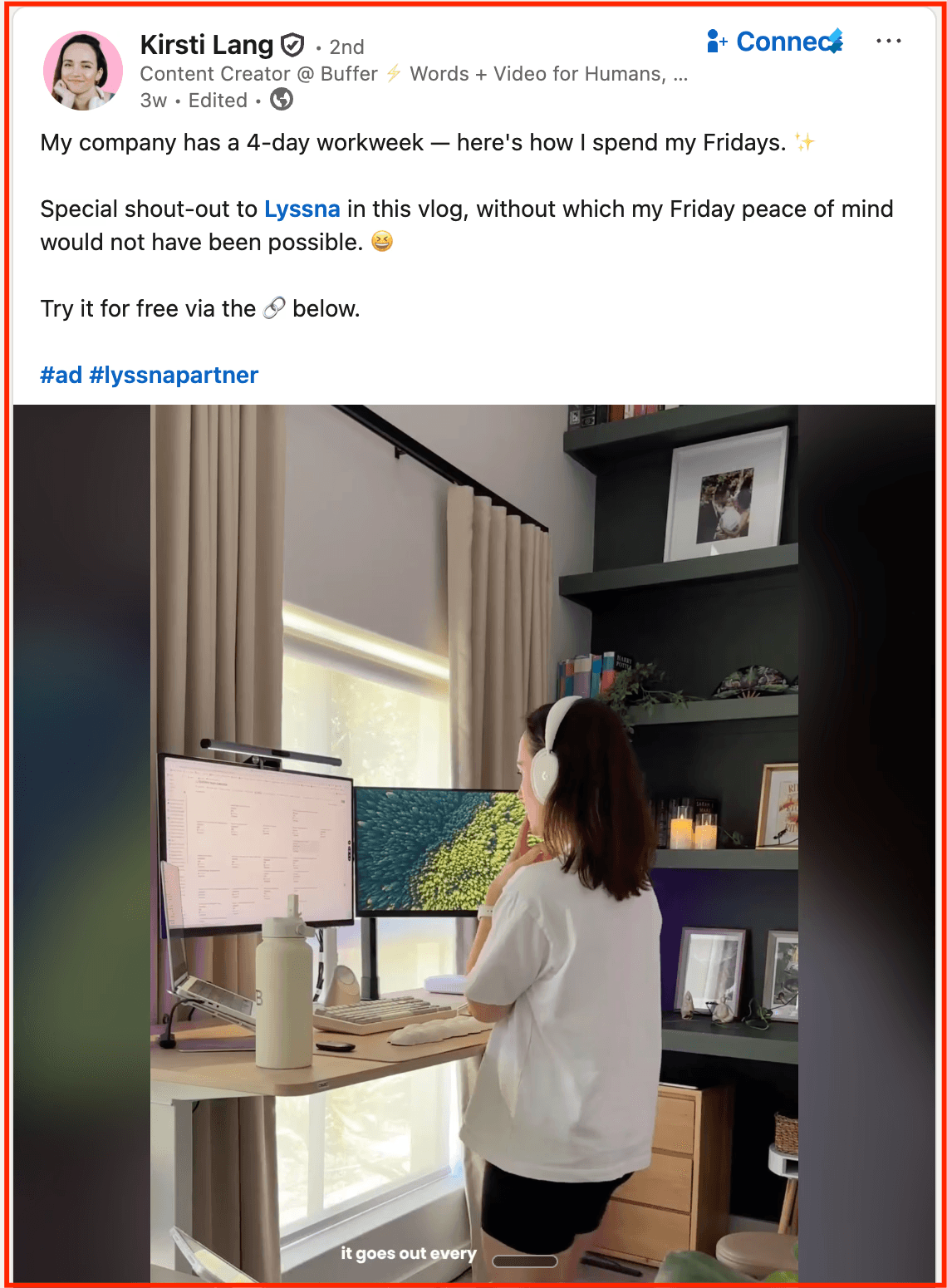
Video views on LinkedIn grew 36% year-over-year, and video content creation is growing 2x faster than other formats. The platform is clearly prioritizing video with new features like "Videos For You," personalized feeds, and full-screen mobile mode.
Top-performing topics across industries:
-
Quick reactions or takes on industry news (30–60 seconds)
-
Behind-the-scenes moments — real, over-polished
-
Product or service demos with clear, specific use cases
-
Personal insights drawn from experience
-
Short, actionable tips or advice (60-second format)
Strategic Text Posts
Benchmark: 2-4% engagement.
Text posts still work when they deliver genuine value. The key is an easy-to-skim structure and immediate relevance.
Top-performing topics across industries:
-
Contrarian takes on common industry practices
-
Personal career lessons
-
Specific problems you've faced and how you solved them
-
Data-backed observations from your own experience
-
Behind-the-scenes insights from your day-to-day work
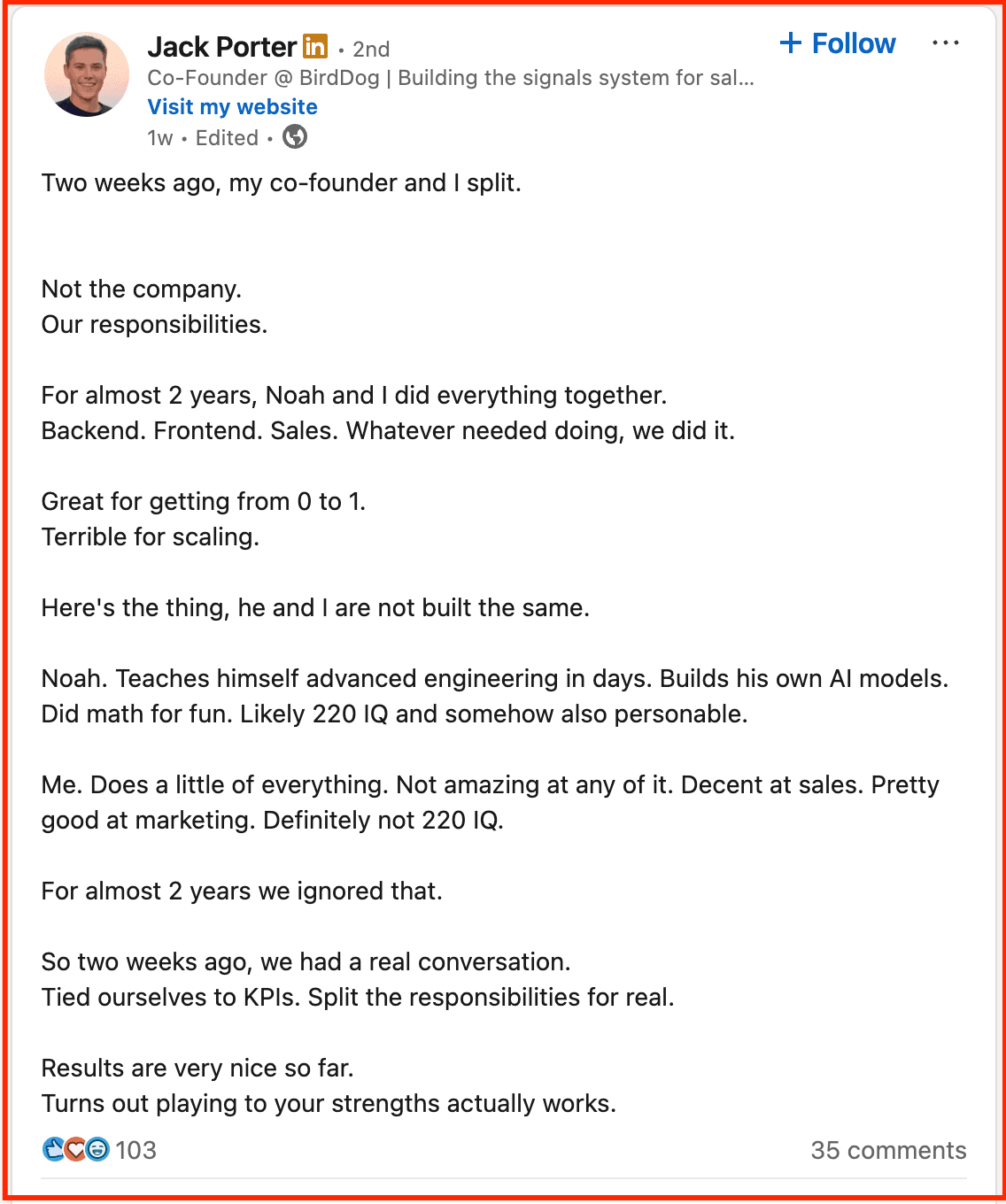
Different formats reach different segments of your audience and signal content diversity to the algorithm. Some people love reading long posts. Others prefer quick visual content.
Aim for this mix over 10 posts:
-
4-5 text posts
-
2-3 carousels or image posts
-
1-2 videos
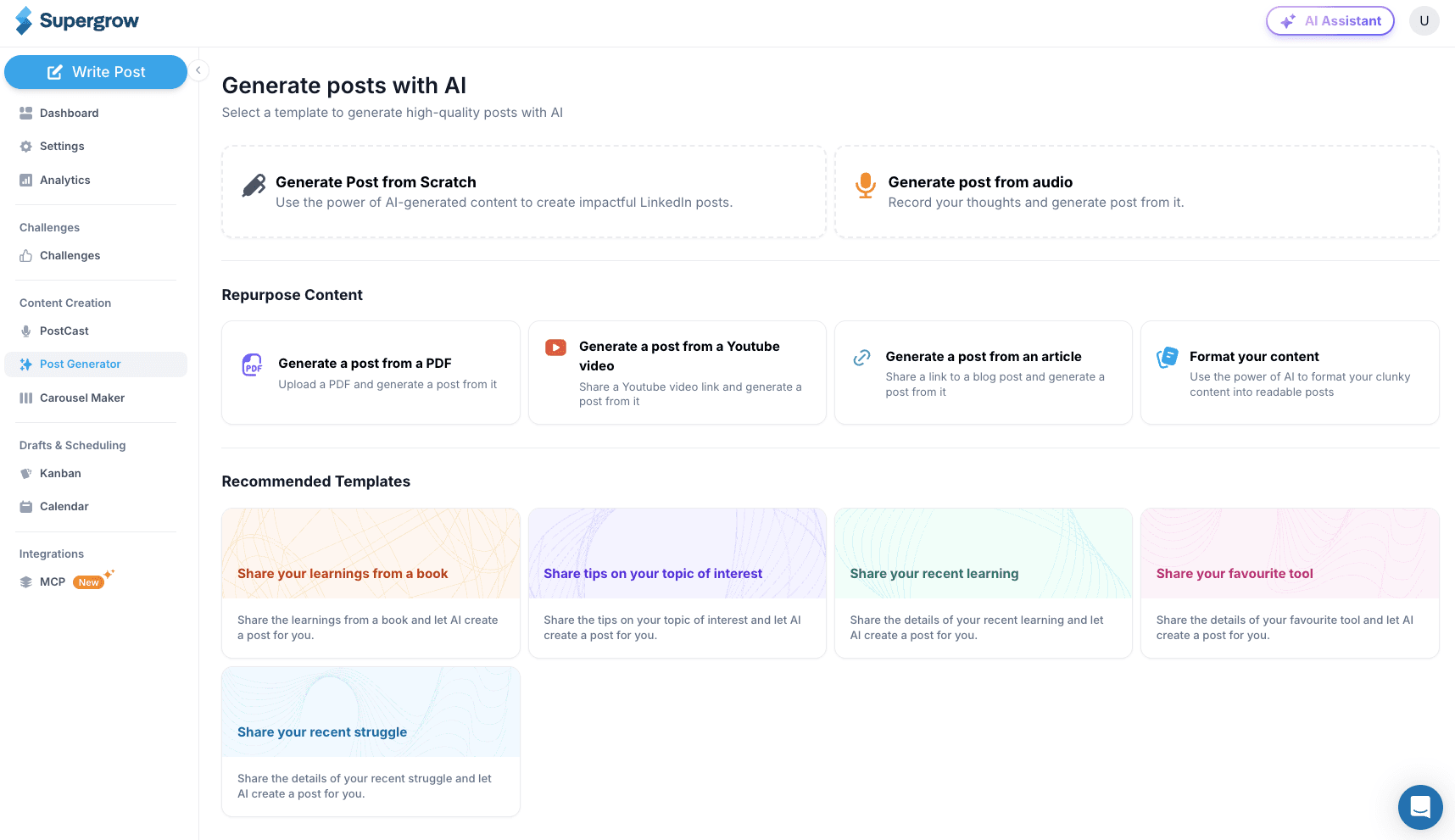
If you want to skip the hassle of choosing the right format, then Supergrow post generation templates will help you get started.
It enables you to repurpose content from YouTube, Blog, and PDF across 50+ post formats to make LinkedIn posts visually appealing, or simply talk to our AI to create LinkedIn posts from scratch.
3. Posting Rhythm (When and How Often)
Posting frequency and consistency play a crucial role in determining if your post will gain engagement on LinkedIn.
Conventional wisdom is that posting more often should be better. Still, it's not enough according to the latest LinkedIn algorithm, because posting every day doesn't help if you're confusing the system. The algorithm rewards predictability of value, not volume.
Two strong posts a week on the same theme beats five scattered ones every time.
Posting 2 to 5 times per week on LinkedIn is the sweet spot for improving reach and engagement without overwhelming your schedule.
The best day to post on LinkedIn shifts based on your specific audience, their roles, time zones, and how they consume content.
Your followers' workdays determine the peak activity times. Multiple time zones mean multiple posting opportunities.
You can also use Supergrow's post scheduling feature to plan posts and keep your calendar consistent without chasing reminders. It shows every scheduled post, the best time slots, and the gaps you need to fill.
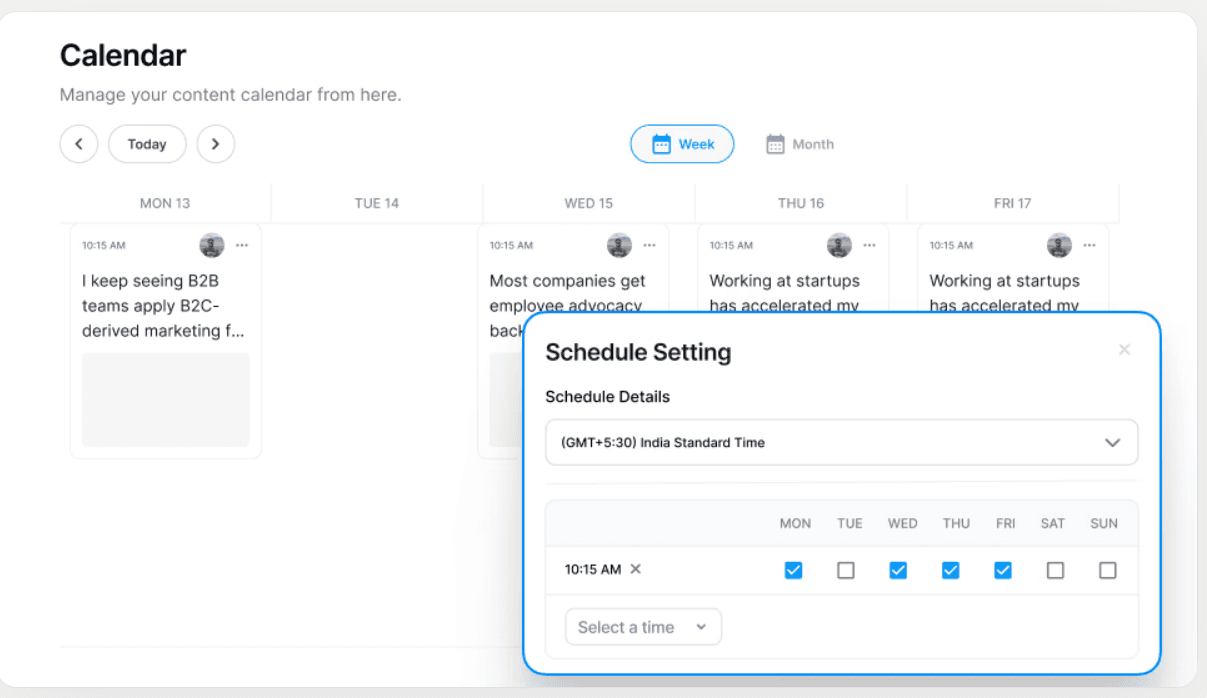
With the post scheduler, you can keep your posts running seamlessly for over 3 months in advance.
4. Engagement & Distribution System (Reach Engine)
The LinkedIn algorithm is not designed to reward creativity alone. It rewards relevance, clarity and sustained interaction patterns.
Creators who grow steadily usually send very clear signals on the type of people they can help, the content they enjoy or who will love their posts. This way, their content is easy to categorize, and their audience behaves predictably.
There's also the reciprocity effect- when you thoughtfully comment on others' content, they'll probably engage with yours.
Instead of posting into a void, try these tactical approaches to help maximize your visibility:
-
Look for creators, peers, or industry voices whose audience overlaps with yours. Then, spend 10–15 minutes commenting on 3 to 5 relevant posts in your niche.
-
The first 60 minutes after posting are critical for LinkedIn's algorithm. Respond to every comment within the first hour or ask follow-up questions to deepen the conversation.
-
Schedule posts when you have time to engage. A post published at 2 am while you sleep wastes the critical first hour.
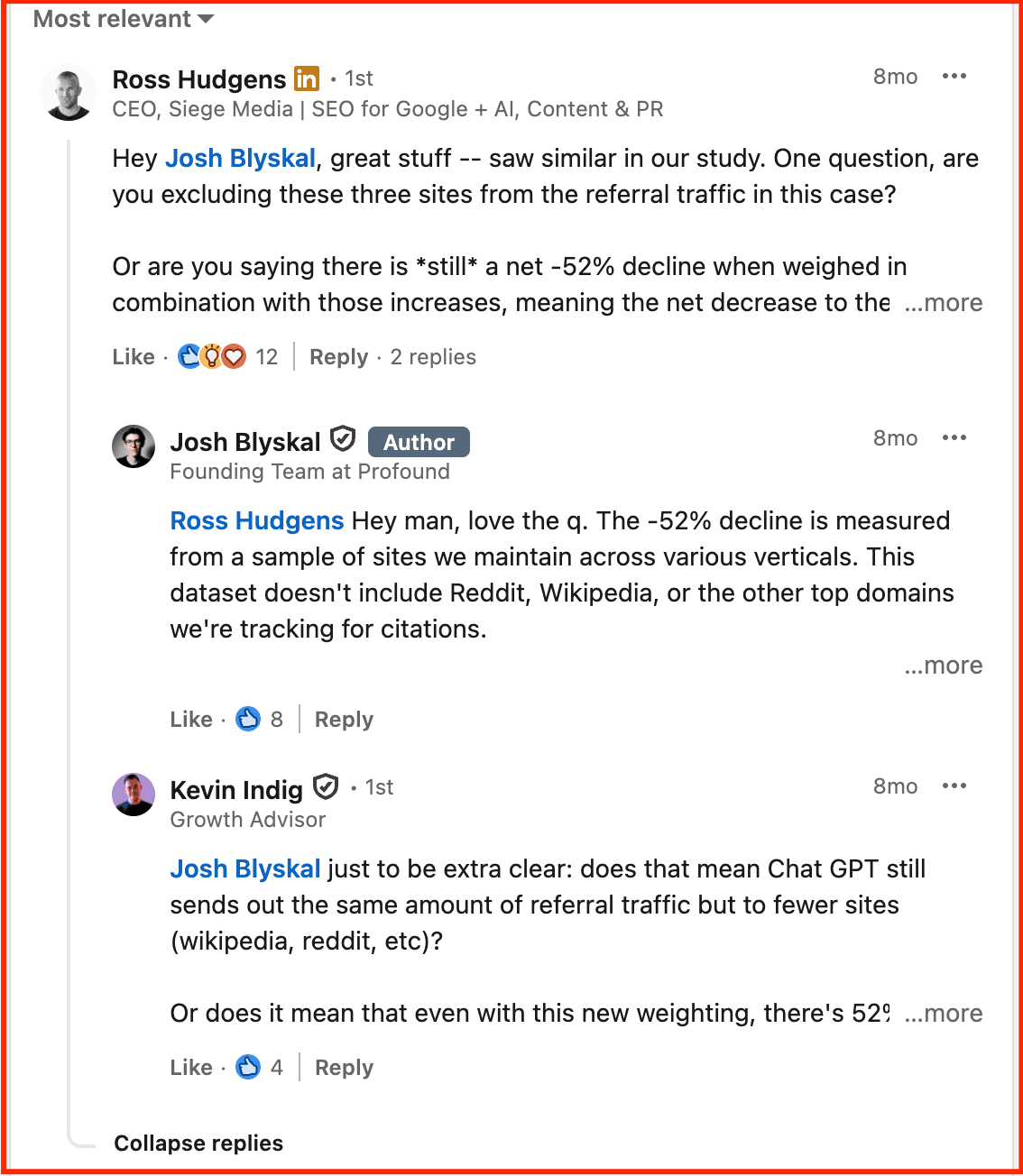
Remember, there's a difference between simply commenting and making an impact.
A lazy comment like "Good post" or "well put" won't cut the bar. On the other hand, a memorable comment adds perspective and makes you an expert.
5. Network Quality (Who Sees Your Content)
Previously, getting engagement on LinkedIn posts was a volume game. You post, people interact with it, and the post reaches a larger audience and the people you frequently interact with.
But the LinkedIn algorithm has flipped the switch. LinkedIn heavily weights relationship signals–especially first-degree connections. If you regularly engage with someone's posts, message them, or view each other's profiles, LinkedIn learns there's a relationship and is more likely to surface your content to each other.
So, when you add random connections, your network becomes noisy:
-
People you added randomly
-
People outside your industry
-
People who never interact
-
People who don't care about your content
So when you post, LinkedIn tests it on the wrong audience. Instead of taking your LinkedIn network as a number game, ask: "Who do I want to see my content every week?"
That shift changes everything.
-
Send connection requests to people in your niche
-
Engage with creators and peers in your space
-
Start conversations in DMs to turn passive connections into active relationships
But, keeping track of whom to engage with can quickly become overwhelming and require hours of manual work. The simplest fix: batch your engagement into two 20-minute blocks — one before you post, one after. Identify 20–30 high-priority people to comment on regularly and keep that list in a simple doc or note. Consistency here beats volume every time.
6. Post-Performance Compounding (Turning Data Into Growth)
For years, LinkedIn influencers have chased likes, shares and impressions– the kind of shiny numbers that look great in a report but don't necessarily translate into engagement.
A post can go "viral" and still leave you invisible when it matters.
Instead, track these analytics to see what's working and what's not. Let us break down what metrics you should track in 2026:
-
Repeat profile visitors: When the same people who engaged (or you engaged with) return to your profile, it means your content (or comment) created mental availability. They remember you enough to look you up again.
-
Strategic comments: One thoughtful comment from the right person can outperform low-quality comments. Posts with replies to comments (what the data calls indirect comments) consistently see 2x+ distribution compared to posts where all comments sit at the top level.
-
Saves: One of the strongest signals in the data isn't immediately apparent. Saved posts are significantly more likely to be shown again days later. Creators with a high number of saves grow followers materially faster over time.
Lastly, identify your winner formats to get the highest engagement. Something that works for another creator might not work for your profile.
Here's how professionals actually test this:
-
Week 1-2: Post 2 document carousels, 2 text posts, 1 video
-
Week 3-4: Double down on the winning format
-
Week 5-6: Test variations of your winning format
-
Track: Engagement rate, saves, profile visits for each format
Doing this manually might take a lot of time; instead, using Supergrow's advanced analytics dashboard shows you exactly which formats, topics, and posting patterns drive the highest impressions on LinkedIn.
Example dashboard view:
| Format | Posts | Avg Engagement | Saves | Profile Visits |
|---|---|---|---|---|
| Documents | 8 | 12.3% | 47 | 23 |
| Text | 12 | 3.1% | 8 | 4 |
| Video | 4 | 5.8% | 12 | 7 |
With this data, you'd know to focus on documents and understand exactly which topics within that format perform best.
Conclusion — Engagement Is Built, Not Discovered
In 2026, the LinkedIn algorithm isn't a mystery, but a system. It's optimised to reward content and profiles that encourage people to stay more on the platform.
The practical strategy is straightforward (even if execution is hard):
-
Stay native, stay human, stay consistent
-
Build authority in a narrow set of topics
-
Create posts that hold attention
-
Spark thoughtful conversation with the right audience
If you align with how distribution really works in 2026, your posts are much more likely to reach the people who actually matter—future clients, potential hires, partners, and collaborators.