
Posting random thoughts on LinkedIn is not a strategy.
Not in 2026, when the algorithm rewards relevance over volume, AI has flooded the feed with generic content, and your audience's attention is harder to earn than ever.
The creators who grow consistently are not more creative than you. They have a better system. A repeatable set of LinkedIn post ideas they return to, real examples they learn from, and a framework for turning LinkedIn content ideas into posts without the blank page killing their momentum.
That is exactly what this guide covers:
-
Post ideas you can use today — with real examples that prove they work
-
Frameworks for each idea type — so execution takes minutes, not hours
-
A system to never run out of content again
How I Picked These LinkedIn Post Ideas for 2026
I didn't simply take a shot in the dark. I looked at what actually performs. Which formats drive the most engagement, which post types build trust, and which ideas the 2026 algorithm actively rewards.
The data tells a clear story. According to Socialinsider's analysis of over 1.3 million LinkedIn posts, format alone has a significant impact on how far your content travels:
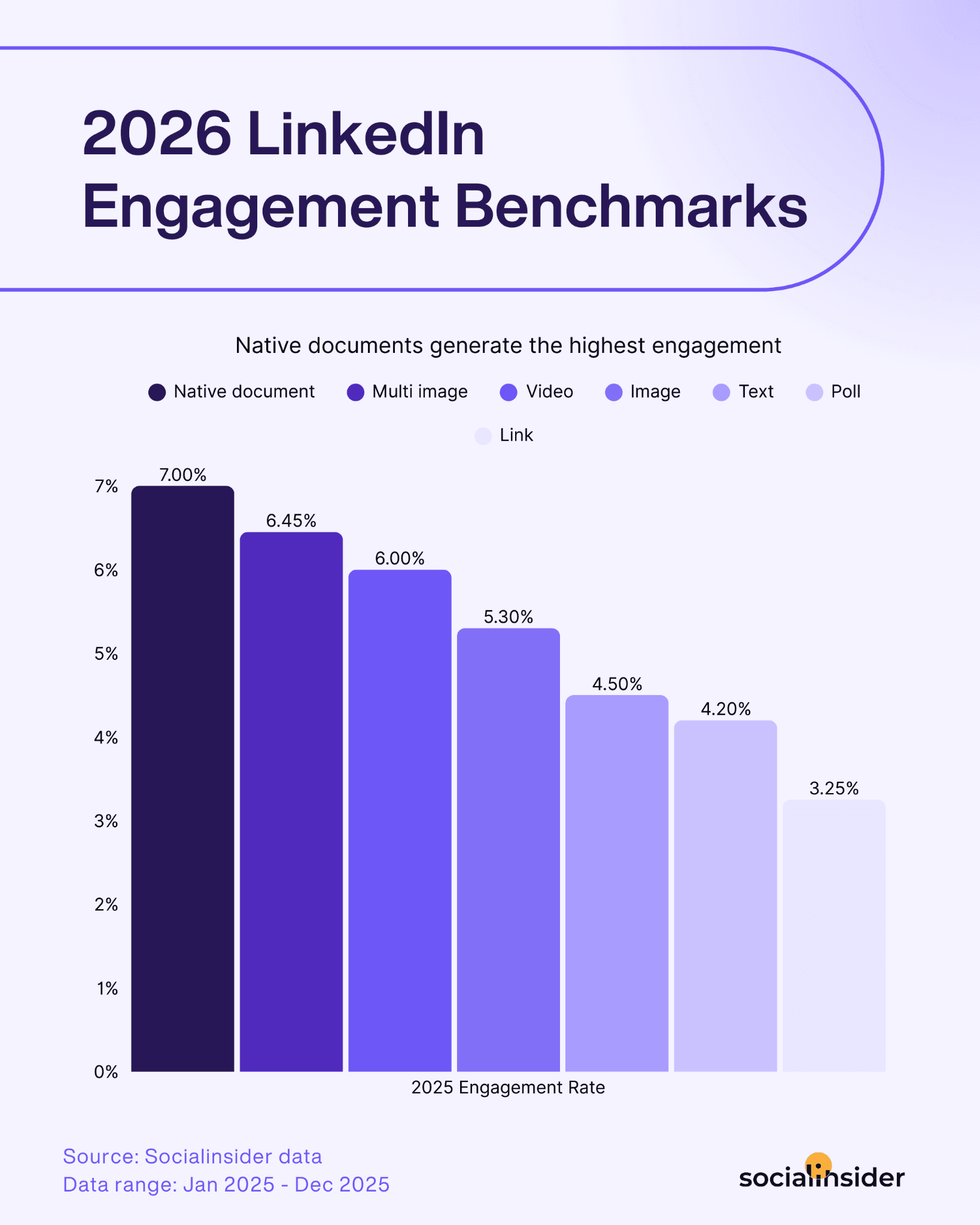
Format is not just a creative choice. It is a distribution decision.
Each of the 10 LinkedIn post ideas below maps to the format that best supports its performance. And every idea comes with a real example from a real creator. So you can see exactly what good execution looks like before you write a single word.
10 Best LinkedIn Post Ideas With Real-World Examples of 2026.
These are not generic templates. Each idea is backed by a real LinkedIn post, a why-it-works breakdown, and the format that gives it the best chance of performing.
Founder Stories & Origin Posts
Nothing connects like a story, especially when it’s yours. That’s because founder stories tap into that human element that builds trust, emotional resonance, and genuine engagement.
A few good examples?
-
Share what you were doing before
-
The spark that triggered your journey
-
Hurdles you overcame to grow your business
-
Why your mission matters today
Plus, founder stories offer a credible source for posts, but even more importantly, they add context that wins hearts and drives repeat engagement.
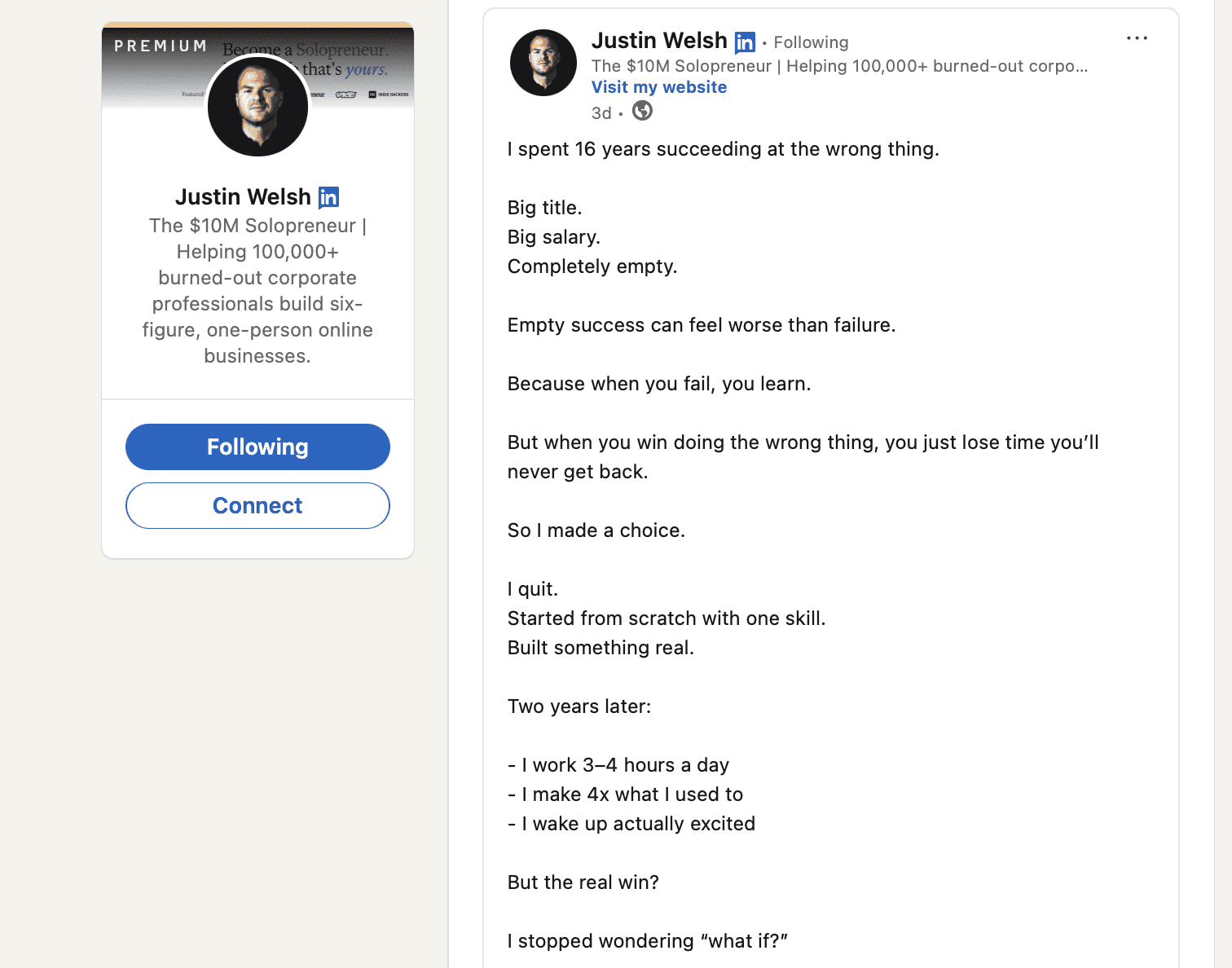
For example, Justin Welsh became a $10 million solopreneur by sharing tips that worked for him and his playbook for building more efficiently.
In his recent post, he opens with an emotional hook that draws readers in.
Why it works
-
He highlights a very relatable conflict — the feeling of professional misalignment, where he had 16 years of success, but was on the wrong path. This tension draws people in immediately.
-
He then shares a personal realization that led to a career reset, making his post aspirational yet authentic.
-
He shares short sentences with a very clear arc (before - discovery - shift).
-
It also acts as an engagement driver, since it opens the floor for sharing vulnerability and pivot stories from his community.
Behind-the-Scenes & Real Workflows
People love seeing the real process. We want to know what happens before the polished product or final result hits the stands. Behind-the-scenes content is a great storyteller here, as it humanizes your brand, builds trust, and gives your audience a reason to keep coming back.
The idea here isn’t to be super flashy. Instead, you can focus on these simple LinkedIn post ideas-
-
A day in the life of your team or yourself
-
Your creative process or decision-making steps
-
Tools, templates, or workflows you use daily
-
Your fails, restarts, and experiments
An example that immediately comes to mind is Brooklin Nash, a freelance B2B content marketer turned content agency owner. He often writes about freelancing and growing his agency.
Below is an example of him sharing the tools and processes he uses at his agency to scale systems.
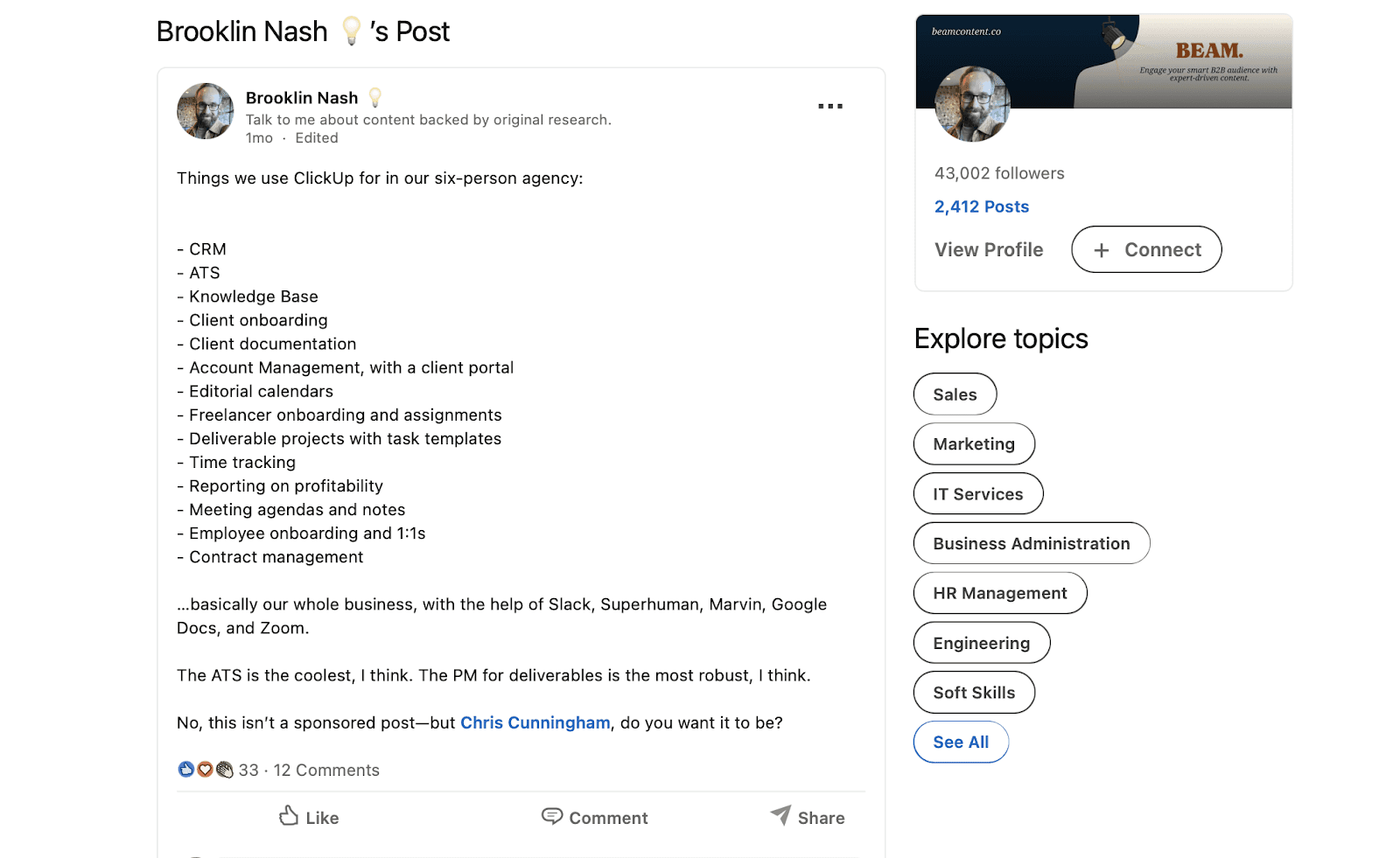
The beauty of this post lies in its simplicity. He opened with a pretty straightforward hook, shared how he uses ClickUp, and made a joke (or not) at the end to keep the post engaging.
Why it works
-
Offers a peek into the “how,” not just the “what”
-
Makes your expertise tangible and repeatable for your audience
-
Encourages conversation when readers share their own processes
Want to take it a step further?
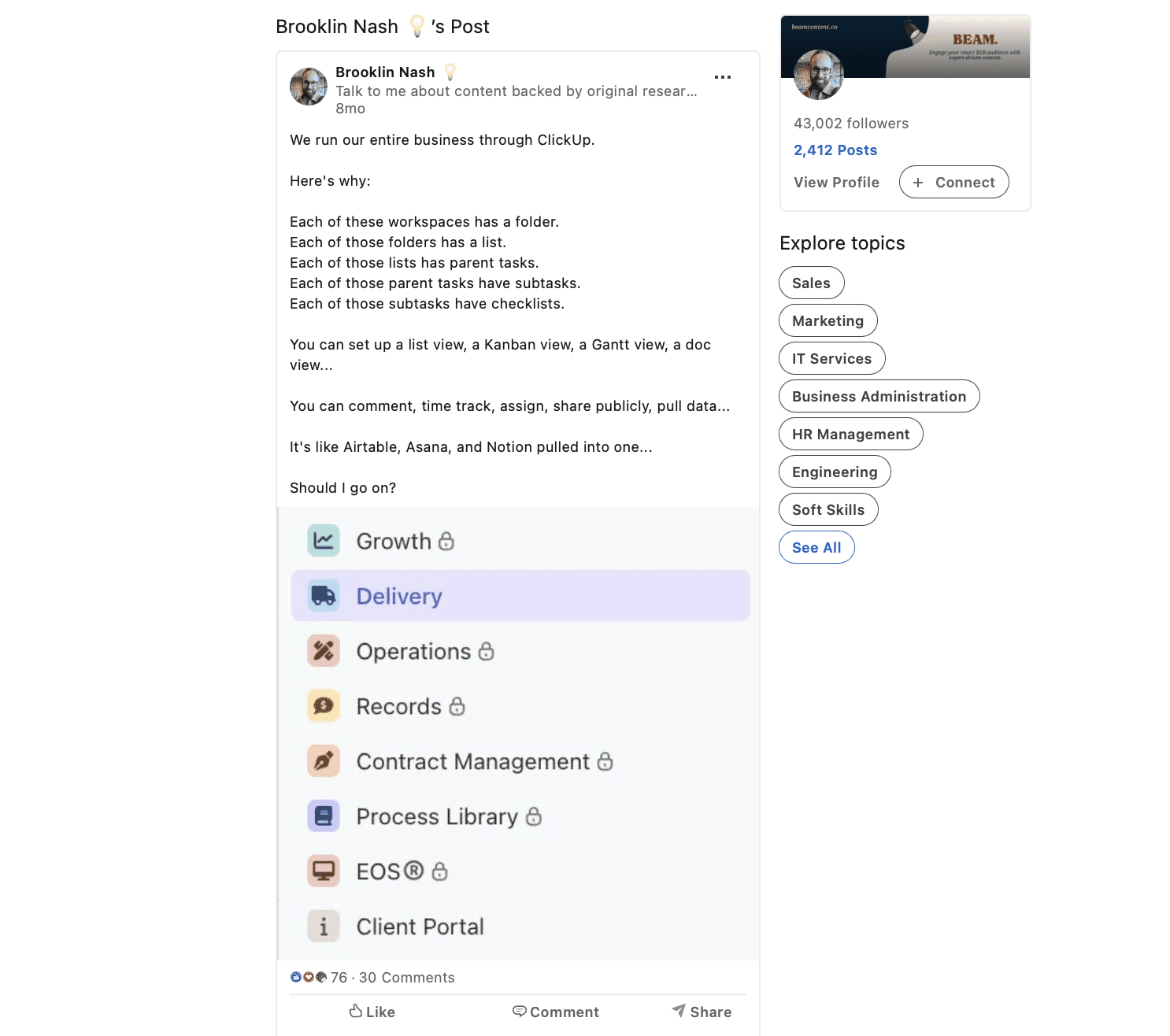
Add photos, short clips, or screenshots of your workspace or tools to make the experience feel more real (like below).
Educational & How-To Posts
To build serious niche authority and keep your audience coming back, educational posts are a must-have. These are the ‘teach something useful in 60 seconds’ kind of updates that deliver instant value.
Some winning approaches include:
-
Step-by-step breakdowns of your process
-
Short tutorials with actionable takeaways
-
Common mistakes in your field (and how readers can avoid them)
-
Myth-busting posts that challenge outdated thinking (think ‘SEO is dead’ posts)
And when you think of educational posts, you think of bestselling author Sahil Bloom.
Whether direct tidbits of information or breaking down a prominent figure’s theories, most of his posts are a value-add for readers that can be directly implemented.
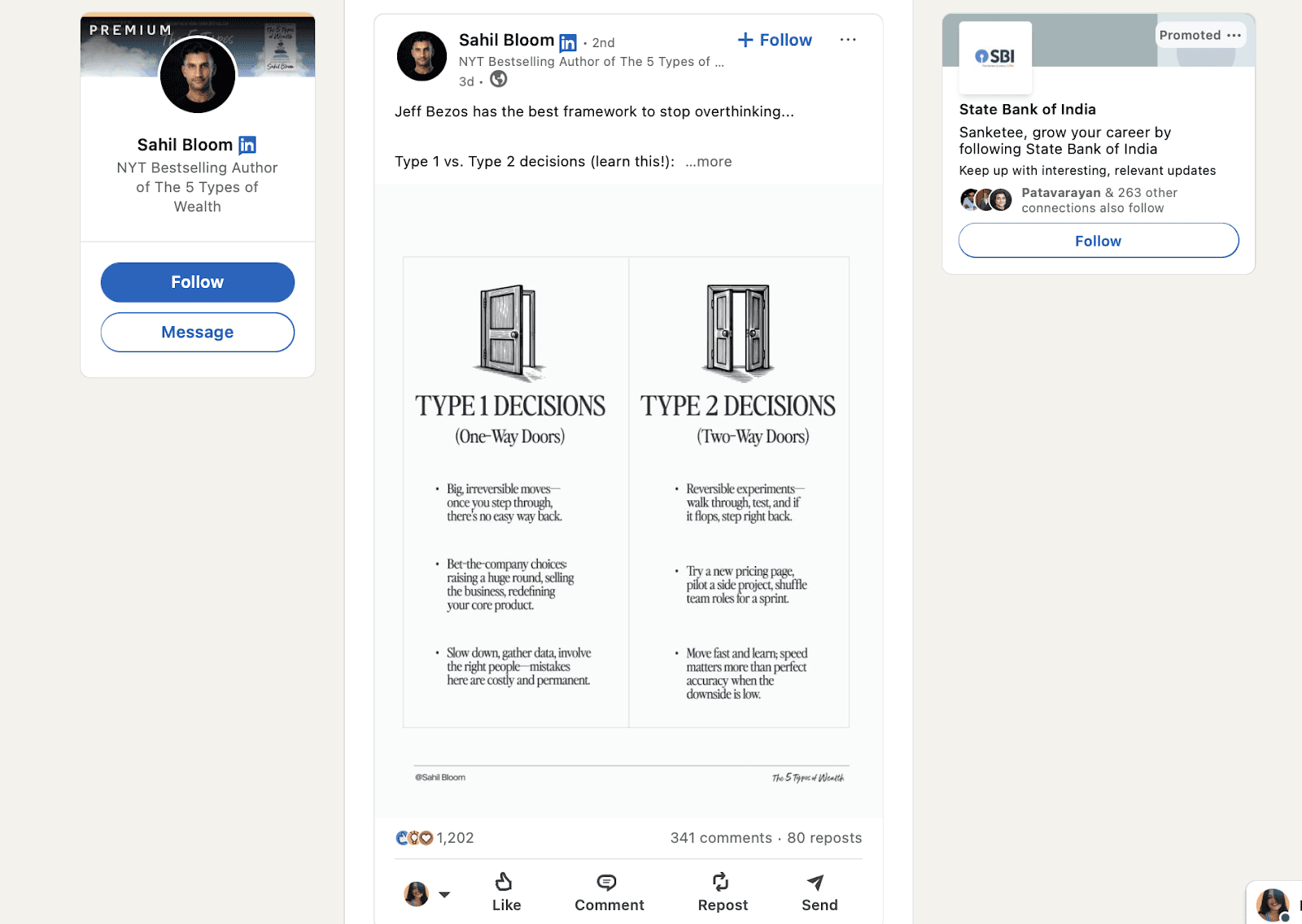
Why it works
-
Clear hook that focuses on insight over fluff
-
Referencing a notable person who adds authority by association
-
Thought-provoking insights that increase shareability
Hot Takes & Industry Opinions
If you’ve been in your industry long enough, you’re bound to have differing opinions. That’s why hot takes stand out. They challenge assumptions, spark conversation, and stop people from scrolling.
Curious people don’t consider them as rants; they’re informed opinions that show you have a clear point of view on your industry. Plus, they foster engagement. In fact, comments on posts can 15x your post reach.
Let’s take this post from Martin Polasek below as an example.
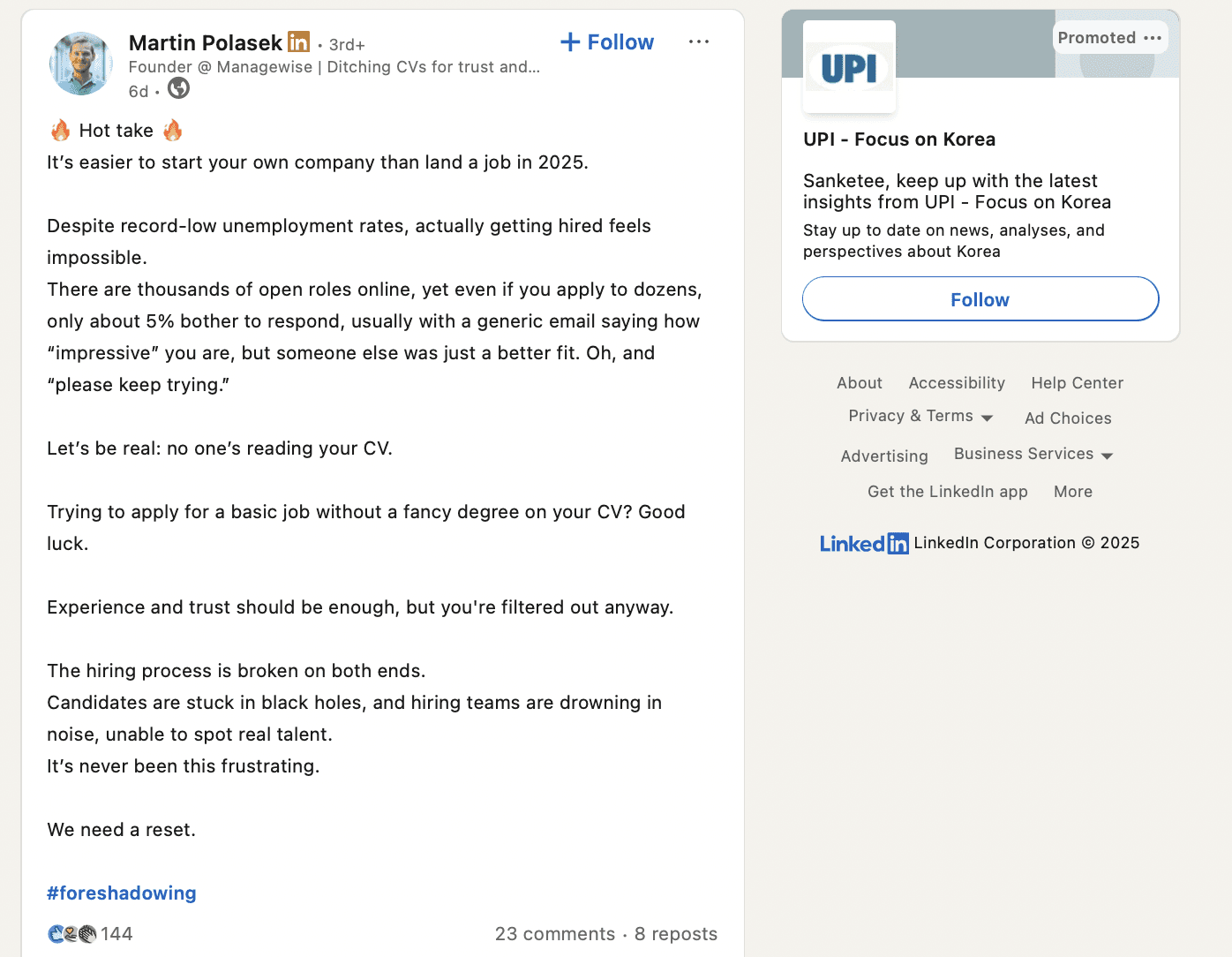
Martin’s post begins with- “It’s easier to start your own company than land a job in 2025.” Bold? Maybe. Scroll-stopping? Definitely.
He backs it up with data points, personal observations, and relatable frustration about broken hiring processes. The mix of directness, stats, and lived experience makes it both credible and shareable.
Why it works
-
A punchy headline draws readers in instantly
-
Shared frustration unites people and fuels engagement
-
Ending with “We need a reset” leaves space for discussion and solutions
Similarly, you can share hot takes and opinion pieces.
-
Challenge a common practice or belief in your field
-
Predict where your industry is headed
-
Call out inefficiencies or flaws in a current system
With hot takes, the challenge isn’t having an opinion. You must express it in a way that’s clear, impactful, and evidence-backed.
That’s where AI-generated LinkedIn post ideas from our LinkedIn post generator feature can help.
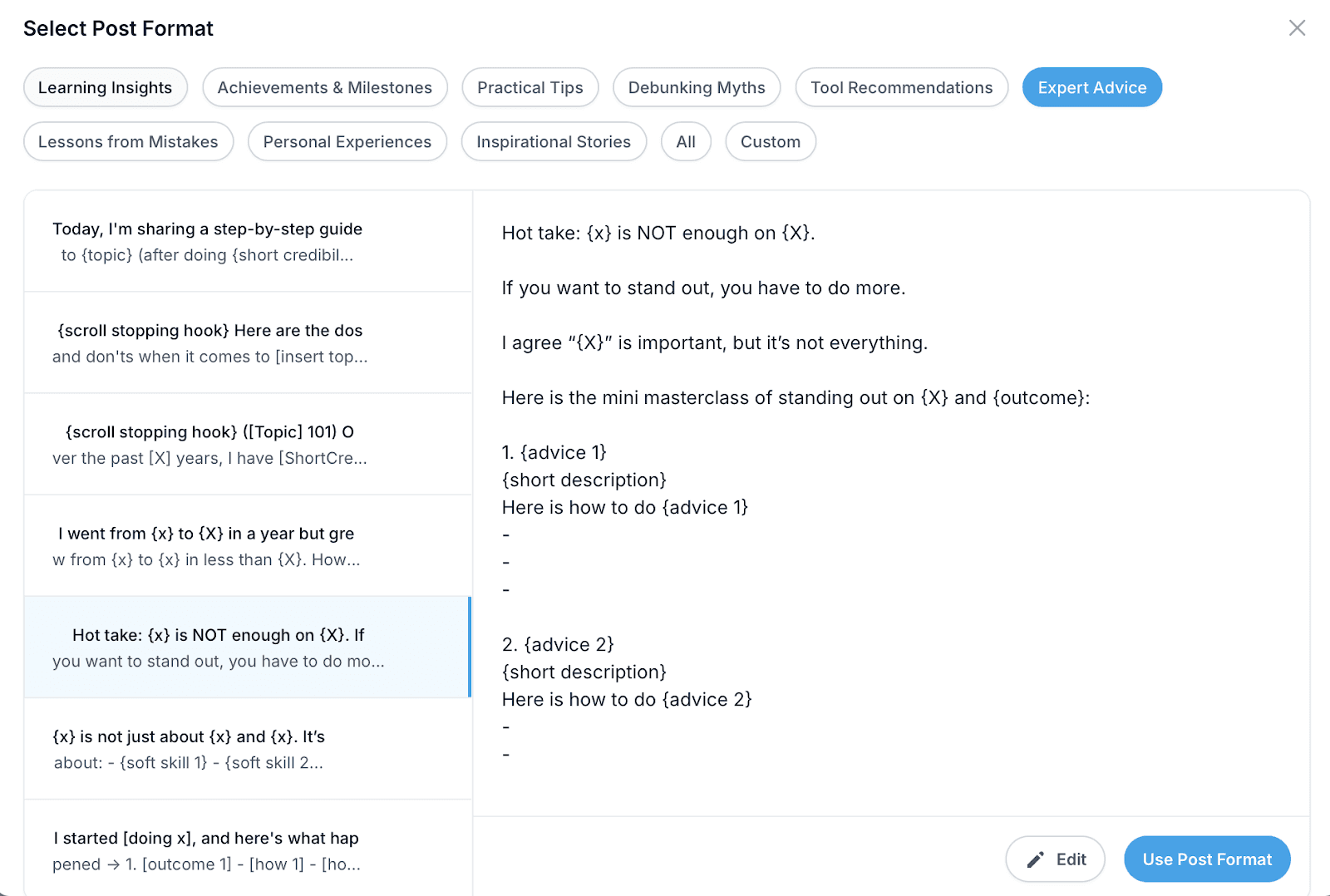
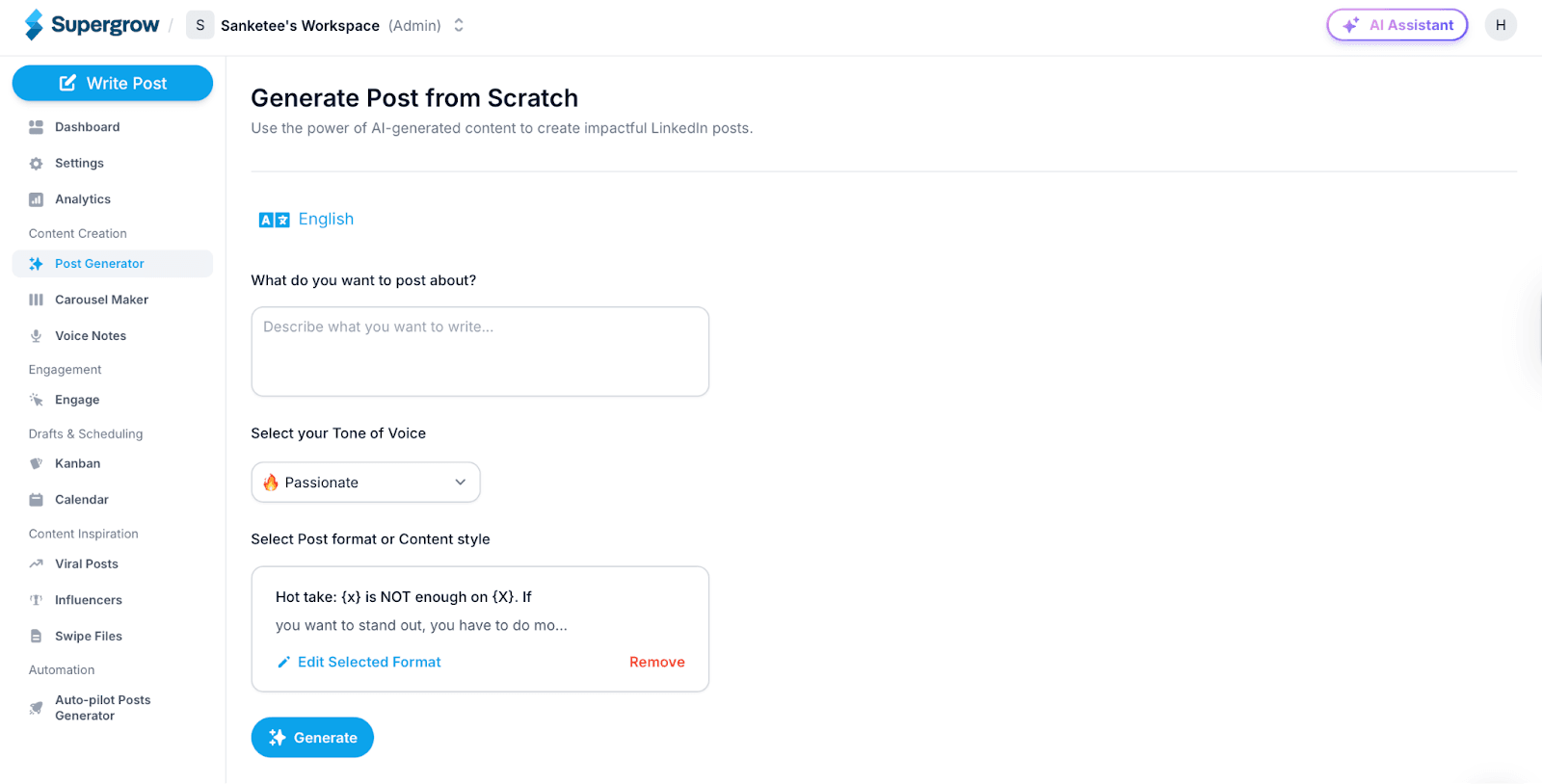
Instead of struggling to piece a post together, you can quickly turn your rough concept into a polished post that’s authentic to your style.
Proof of Work & Case Studies
If you want to build credibility fast, show earned results. Because proof-of-work posts combine data, storytelling, and tangible outcomes to demonstrate expertise, they don’t feel like a sales pitch.
You could experiment with these LinkedIn post ideas-
-
Before-and-after transformations
-
Campaign recaps with screenshots of key metrics
-
Client success stories (with permission)
-
Step-by-step breakdowns of how results were achieved
For instance, James’ post shared a high-performing campaign recap that highlighted link-building success, major media coverage, social traction, and measurable brand lift. The focus wasn’t just on the impressive numbers; it also broke down the channels and strategies that amplified results, which promotes inspiration and learning.
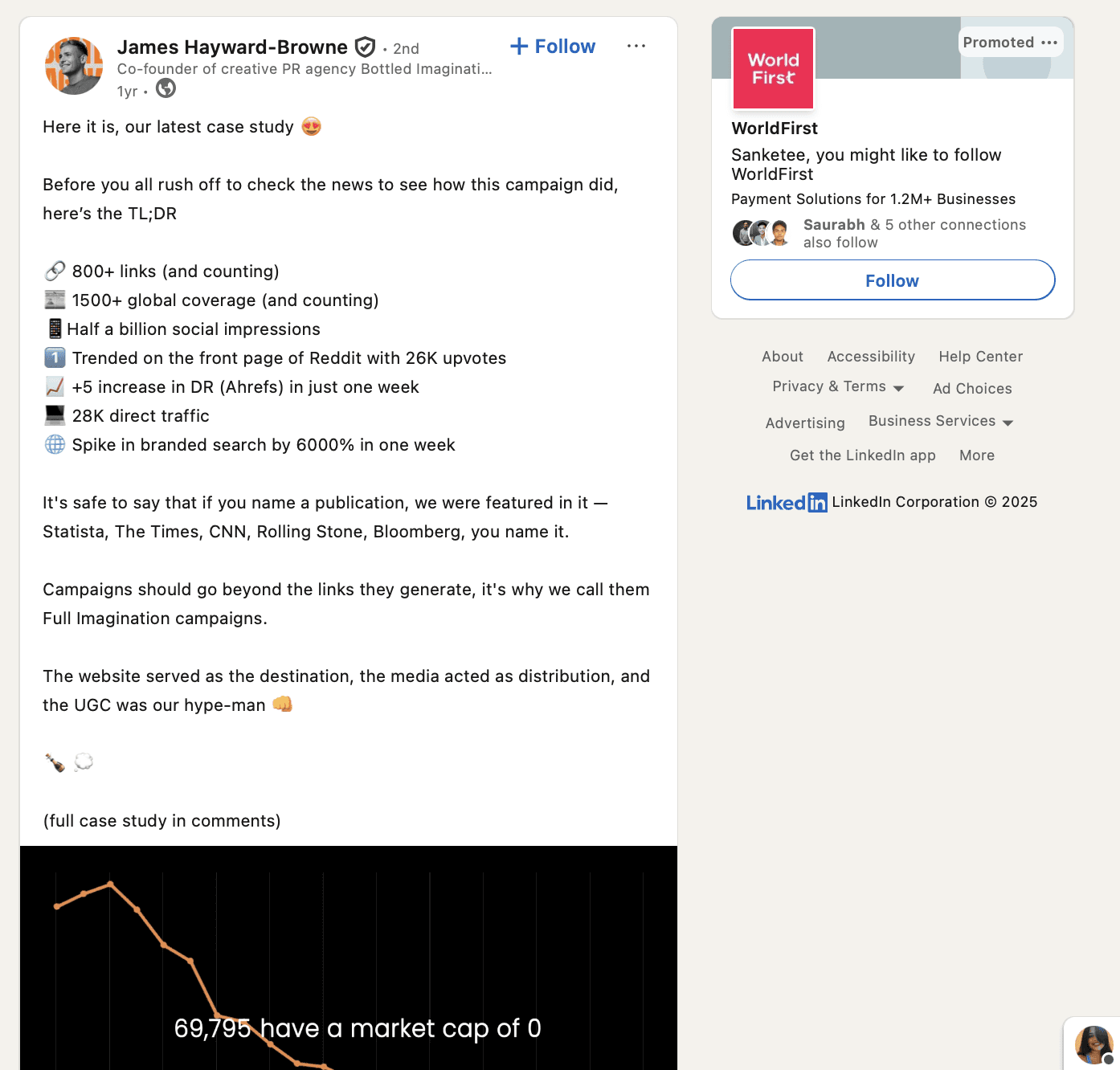
Why it works
-
Hard data builds instant trust and authority
-
Bite-sized formatting makes results easy to digest
-
The closing insight reframes it as a strategy, not just bragging
Most importantly, the post doesn’t overwhelm. James offers key insights and links to the full version in the comments for those interested in reading further.
Engagement & Conversation Starters
Sometimes the best LinkedIn post ideas aren’t about teaching or proving expertise; they’re about starting a dialogue. Engagement posts are designed to get people talking, sharing opinions, and connecting in the comments. They’re simple to create yet powerful for building community.
Some conversation starters you can try on for size-
-
Open-ended questions about industry trends
-
Light but relevant polls
-
“This or that” comparisons for quick interaction
-
Sharing a personal dilemma and asking for input
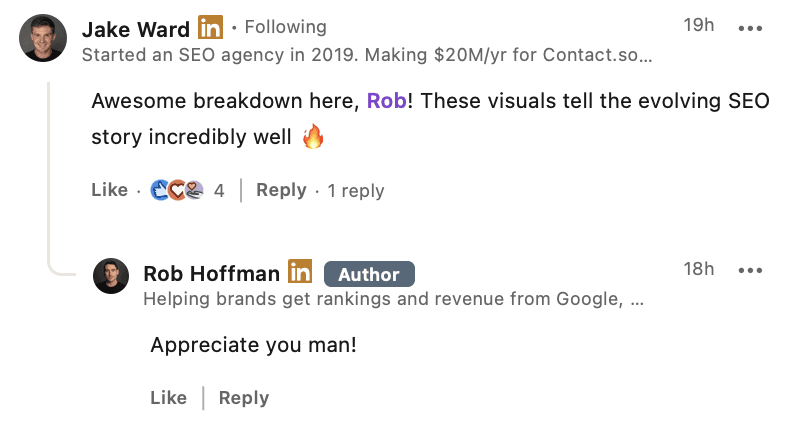
For example, in the post below, Rob Hoffman (who has amassed over 72,000 followers on LinkedIn) shared how SEO is evolving by comparing traditional and LLM SEO.
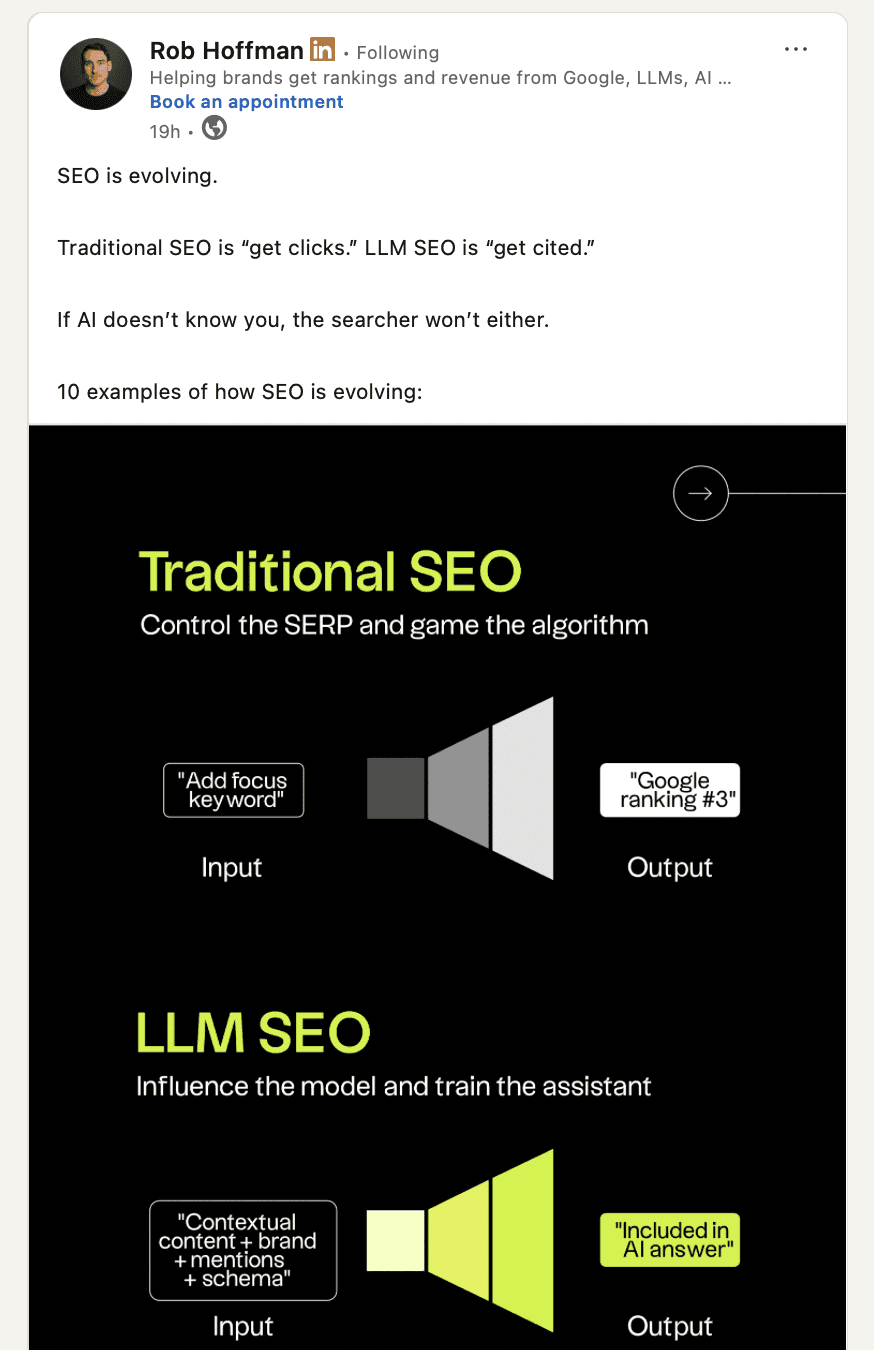
In under 24 hours, the post has 70+ comments and 18 reposts- one of them is Jake Ward, an online entrepreneur with 4 businesses and ~175,000 followers. This goes to show how posts designed for engagement can bring you the right kind of traction.
Why it works
-
Relatable topics make it easy for more people to engage
-
Increases post visibility since comments boost reach in LinkedIn’s algorithm
-
Builds community and recall value
Personal Growth & Mindset Posts
There aren’t more universal themes than overcoming challenges, learning from failure, or reframing how we see success. These posts tend to resonate widely because they’re rooted in shared human experiences rather than niche industry knowledge.
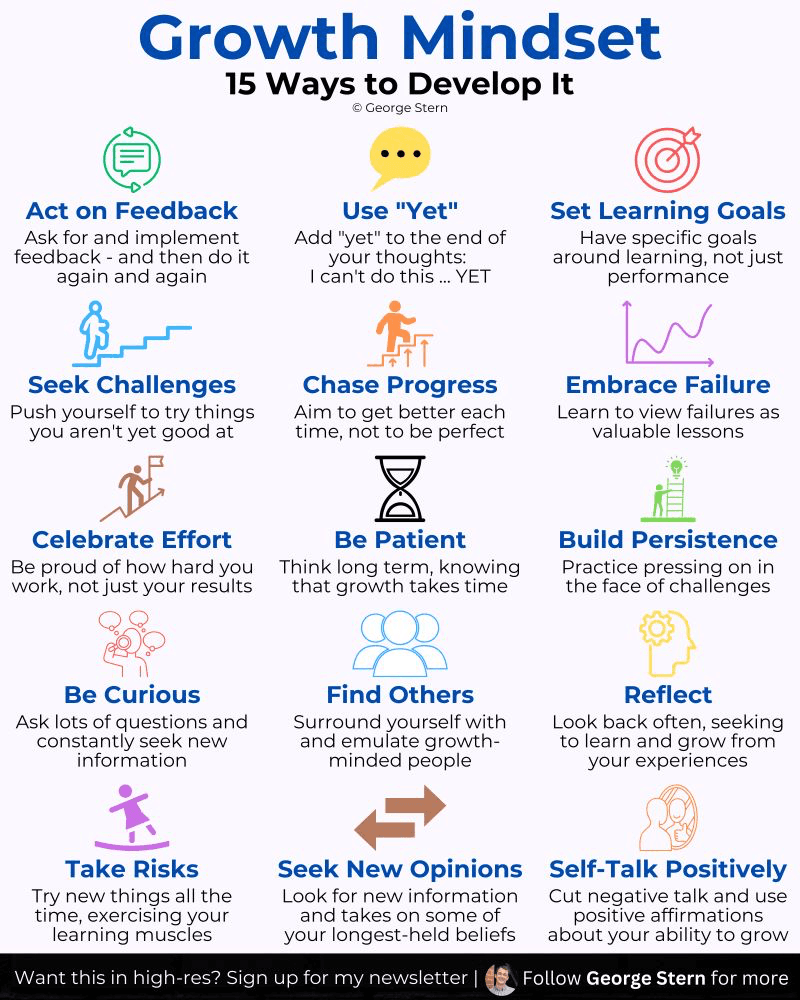
For example, entrepreneur and author George Stern spoke about how a growth mindset can make people unstoppable.
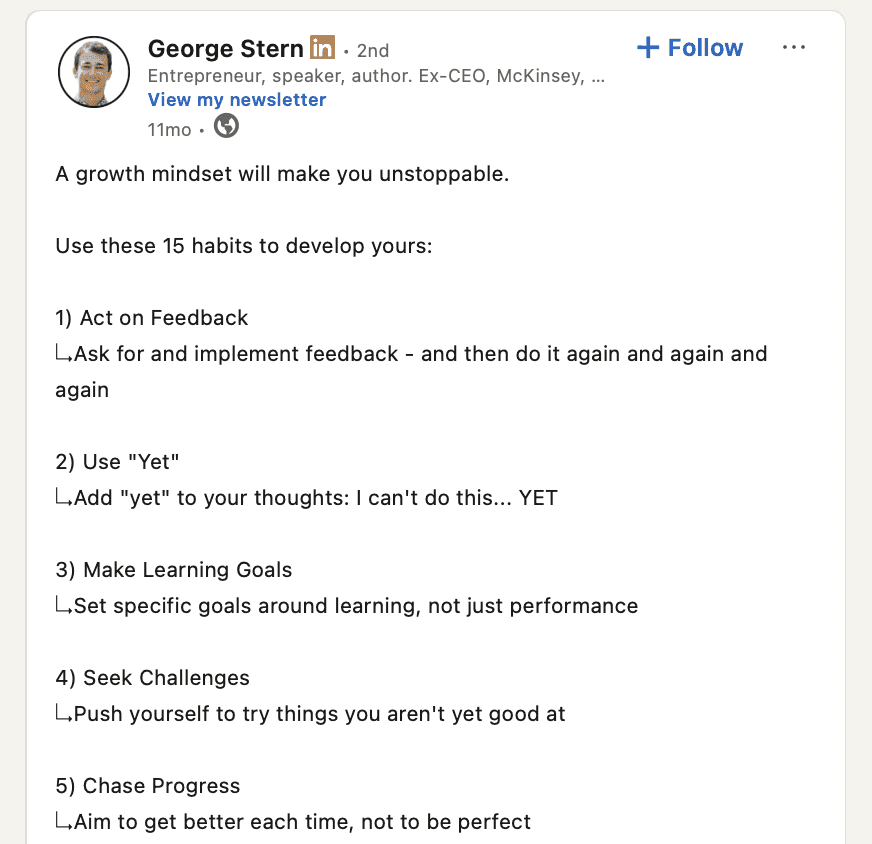
While he wrote a to-the-point, well-structured post, he created an image version of it for visual learners and to get in the LinkedIn algorithm’s good graces.
Not every topic can be summed up in the post, though. You may need to contribute LinkedIn articles for the more juicy opinion pieces. Take a cue from Erik, a senior director at Microsoft-
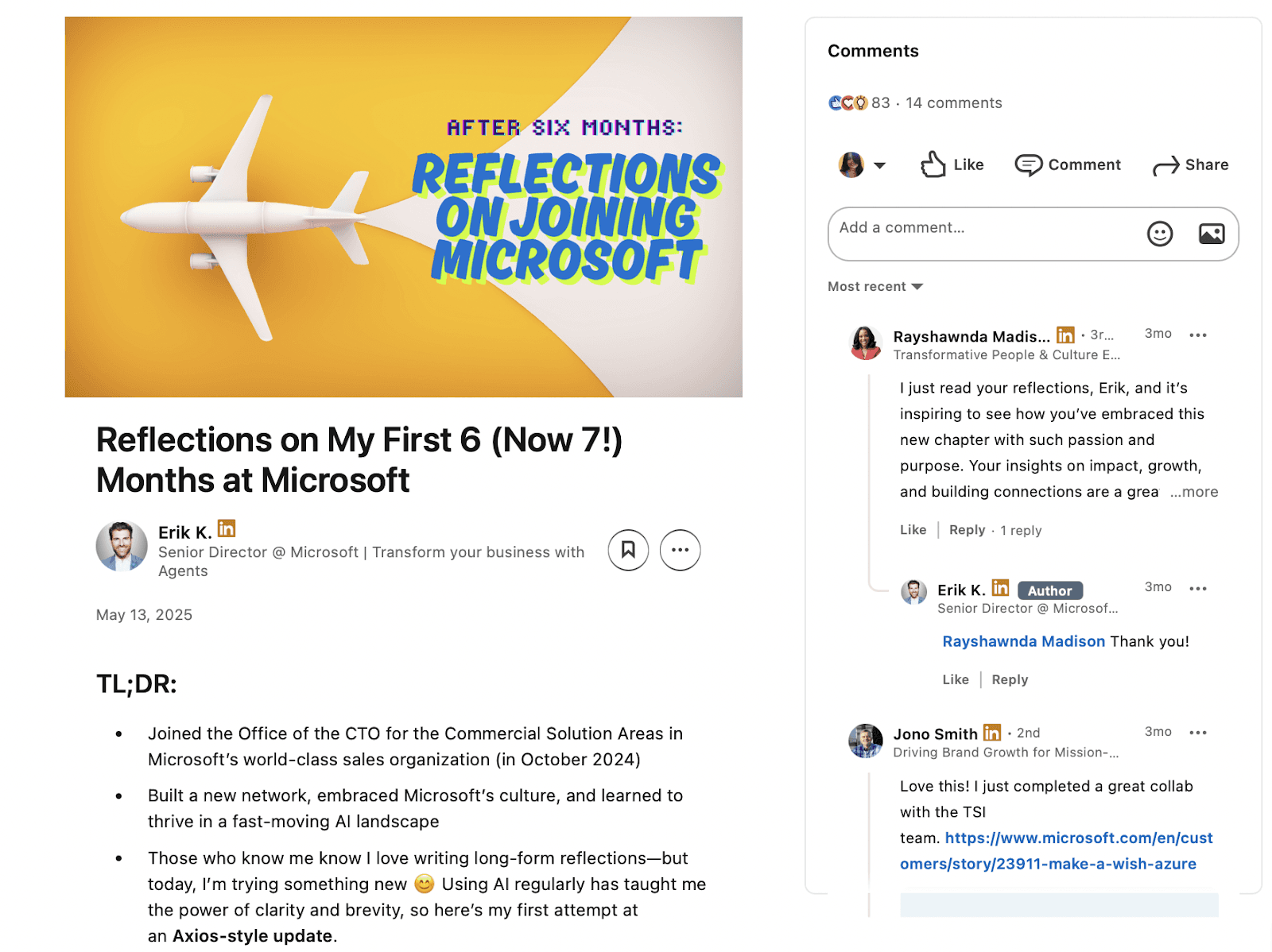
He breaks down point by point what he did during his first 6 months at the company and the takeaways for each section.
8. Employee Stories & Advocacy Posts
The post that builds trust is not the repost. It is the employee writing in their own voice about a real moment. A problem they solved, a lesson they learned, a company milestone they were part of.
LinkedIn posts written in employees' own words outperform pre-written shares by 9x. The difference is not the reach mechanic. It is credibility. An employee sharing their genuine experience is a person. An employee copying a brand message is a channel.
The most effective employee advocacy content follows one of four patterns:
-
The joining story — what surprised me in my first 90 days at [company]
-
The customer win — a problem we solved last week and what it taught me
-
The milestone moment — why this company achievement matters to me personally
-
The growth post — what this role has taught me about [skill or industry]
None of these require company secrets. None require approval of every word. They require one thing: a system that gives employees the topic direction and removes the blank page.
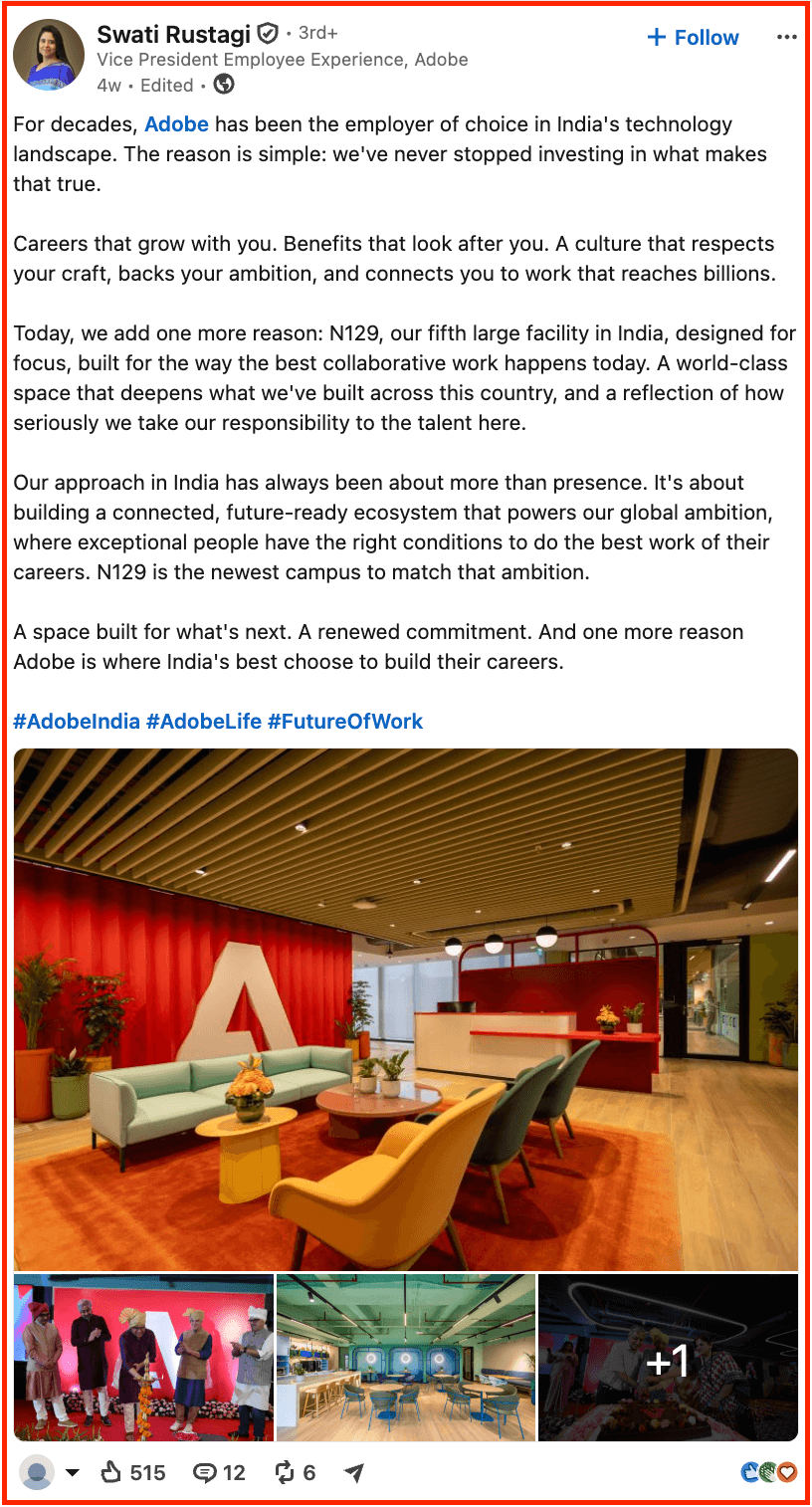
Take this post from Swati Rustagi, VP of Employee Experience at Adobe. She writes about Adobe's new N129 campus in India using #AdobeLife — not as a company press release, but as a personal reflection on what it means to build for talent in India. The post is in her voice. It carries the weight of someone who actually leads the people strategy behind the decision.
Why it works
-
She is not sharing a company announcement — she is sharing what the announcement means to her and the people she works with
-
#AdobeLife signals an active employee advocacy program — readers know this is one of thousands of authentic employee voices, not a one-off post
-
Every employee who posts extends the company's reach into a network the brand page cannot touch
That is the system.
Supergrow's Teams idea Library replicates it for any company. Admins push relevant topic prompts directly into each team member's draft queue. The post is theirs. The starting point is provided. Participation stays voluntary, and the content stays authentic.
9. Short-Form Video & Talking Head Posts
Video on LinkedIn is underused for one simple reason: most people think it needs to look polished. It does not. What cuts through the feed is a clear point of view, a face on camera, and something worth watching in the first five seconds.
The format is more forgiving than you think. Some ways to approach it:
-
Record a 60-second take on something you noticed this week
-
Walk through your screen — a dataset, a tool, a process — as you narrate
-
Share your live reaction to industry news before the moment passes
-
Pull a strong minute from a podcast or webinar and upload it natively
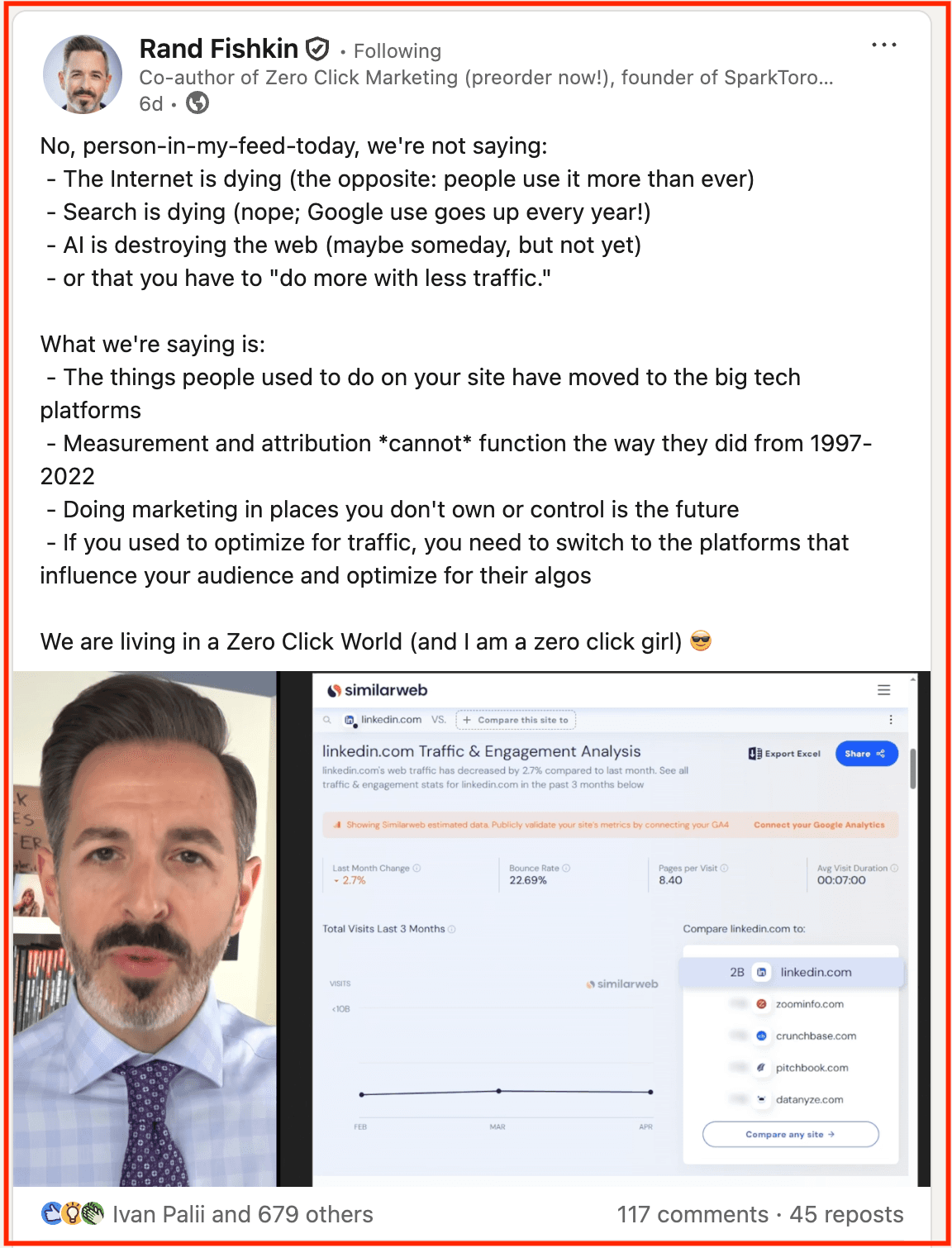
An example that immediately comes to mind is Rand Fishkin. He regularly posts talking head videos where he shares his screen and walks through live data in real time, making his argument visible rather than just telling you to trust it.
In this video post, he opens with a scroll-stopping hook, appears directly on camera, and shares his screen — pulling live traffic data from Ahrefs and Similarweb as he talks. No studio. No script. Just a practitioner showing evidence as he speaks.
Why it works
-
The hook in the post text earns the click before a single second of video plays
-
Screen-sharing adds visual proof — he is showing the data, not just claiming it
-
Talking to camera builds familiarity faster than any text format can
-
Uploading natively to LinkedIn gives it algorithmic priority over an external video link
Short-form video is still one of the most underused formats on LinkedIn. Most people scroll past the idea. That is your advantage.
10. Hiring Stories & Recruiter Posts
Hiring decisions are some of the most consequential moments in any company's story — and almost nobody talks about them honestly. The brief that took three iterations to get right. The unconventional candidate who turned out to be the best hire. The process you rebuilt after one bad experience.
These posts work because they offer a perspective most people never see. Some approaches worth trying:
-
The hiring decision that surprised you — and why it worked
-
The interview question you use that reveals more than any CV does
-
The thing you changed about your hiring process after a specific mistake
-
An unconventional approach to recruiting that most companies would never try
-
What you wish every candidate knew before applying
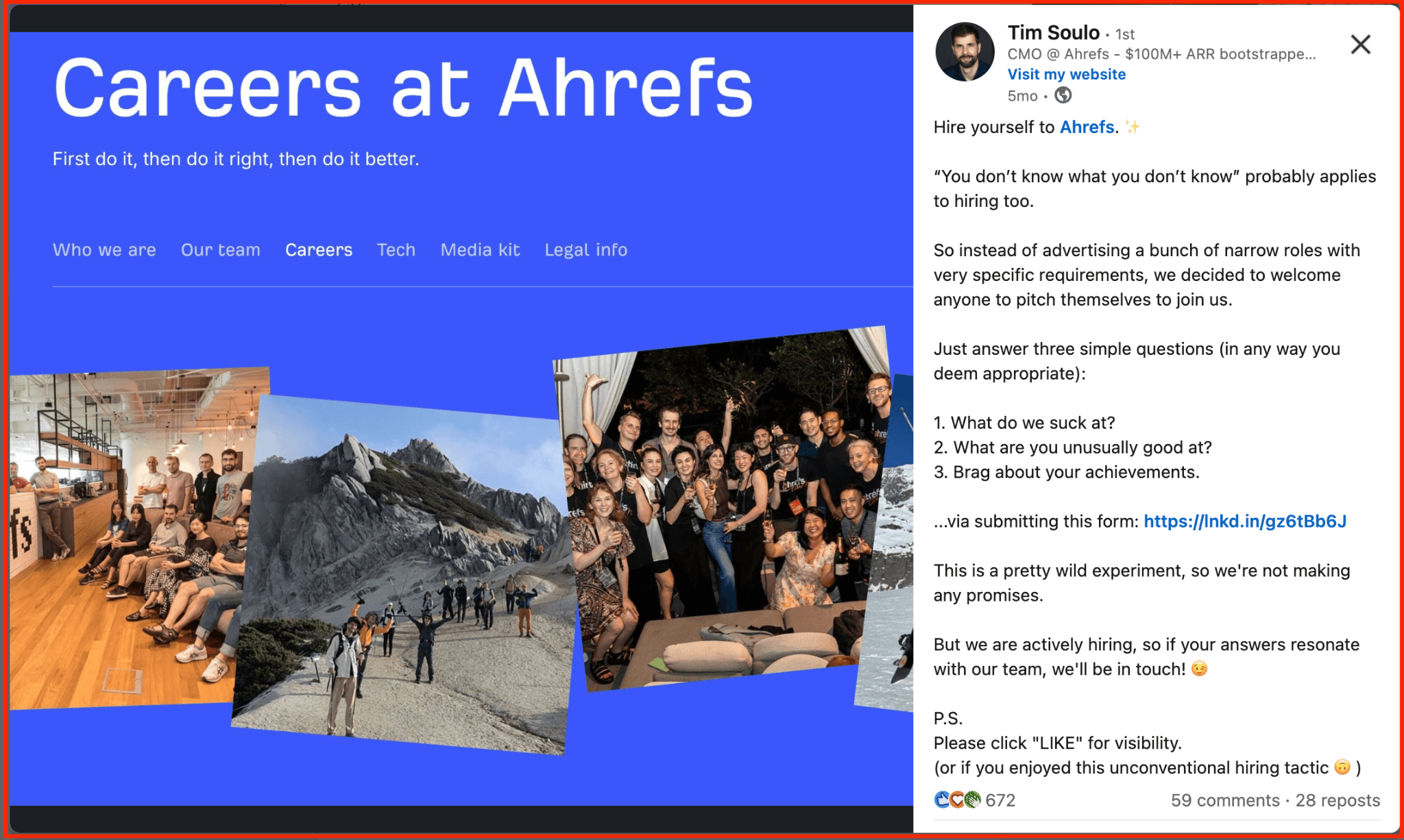
A strong example of this done right is Tim Soulo, CMO at Ahrefs — who joined as employee #16 and helped grow the company to over $100M in ARR. He regularly shares Ahrefs' unconventional approach to building a team, turning internal hiring decisions into content that reveals how the company actually thinks.
In this post, he shares Ahrefs' approach to hiring in a way that is specific, transparent, and completely unlike a standard job posting. It does not read like recruitment marketing. It reads like someone explaining exactly how they think.
Why it works
-
Specific and unconventional — immediately signals this is not a generic hiring post
-
Reveals how the company actually thinks, not how it wants to appear
-
Invites the right candidates to self-select in — and the wrong ones to opt out
-
Builds trust with the audience long before any application is submitted
Hiring stories position you as a thoughtful builder — whether you are a founder, a recruiter, or a team lead. They attract the right people passively.
Supergrow'sPost Generator helps you turn your hiring experiences into posts in your own voice — without starting from a blank page.
Quick Reference: 45 LinkedIn Content Ideas by Audience and Format
The 10 LinkedIn post ideas above come with full breakdowns and real examples.
These 45 are for the moments when you know what you want to say but need a starting point. Find your audience, pick your prompt, and write.
1. LinkedIn Post Ideas for Founders
What should a founder post on LinkedIn to build visibility and attract inbound?
-
The decision that almost killed the company — and the one thing that saved it
-
Month [X] update: revenue, headcount, and the lesson that surprised me most
-
The feature we nearly did not ship — and why the data said we were wrong
-
What I wish someone had told me before I started [company]
-
The customer conversation that rewrote our entire product roadmap
2. LinkedIn Post Ideas for B2B Marketers
What should a B2B marketer post on LinkedIn to generate leads organically?
-
The campaign that generated [X] pipeline — a full breakdown with the numbers
-
Three things we stopped doing in our content strategy and what replaced them
-
How we reduced cost per lead by [X]% using LinkedIn organic alone
-
The one content format that outperformed everything else this quarter
-
What our audience actually wants to read versus what we assumed they wanted
3. LinkedIn Post Ideas for Employees
What should employees post on LinkedIn for company advocacy?
-
A customer problem I solved last week — and what it taught me
-
Three months at [company] — the thing that surprised me most
-
The project I am most proud of this quarter and why it mattered to the team
-
What working here has taught me about [skill or industry] that I did not expect
-
Behind the scenes of how our team actually approaches [specific challenge]
Supergrow's Teams 2.0 Idea Library lets admins push ideas like these directly into each team member's draft queue — so employees always have a starting point. See how it works.
4. LinkedIn Post Ideas for Recruiters
What should a recruiter post on LinkedIn to attract candidates and build authority?
-
The green flag I look for in every first interview — that no job spec ever captures
-
Why [X] candidates declined our offer this quarter — and what we changed
-
The question I ask every hiring manager before I write a single job brief
-
What a strong application actually looks like right now — with a real example
-
The hiring mistake that changed how we write every role description since
5. LinkedIn Post Ideas for Consultants and Freelancers
What should a consultant or freelancer post on LinkedIn to attract clients?
-
The client brief that taught me more than any course I have ever taken
-
How I went from [X] to [Y] clients in [timeframe] — what actually changed
-
The scope creep conversation nobody teaches you to have — and how I handle it now
-
My exact onboarding process for new clients — step by step
-
The red flag I watch for before signing any new engagement
6. LinkedIn Post Ideas for Sales Professionals
What should a sales professional post on LinkedIn to build pipeline and credibility?
-
The opening message that booked a meeting with a [C-suite title] — word for word
-
Why I stopped leading with product features in every discovery call
-
The objection I used to dread — and the one reframe that changed everything
-
Three signals that tell me a prospect is ready to buy before they say a word
-
What [X] closed deals taught me about what buyers actually care about
7. LinkedIn Post Ideas for Coaches and Educators
What should a coach or educator post on LinkedIn to grow their audience and build authority?
-
The one shift that changed how my clients get results — explained in five slides
-
The question I get asked every week — and the honest answer most people skip
-
Three things I used to teach that I no longer believe are true
-
The framework I use with every new client in session one — broken down simply
-
What [X] years of coaching has taught me about why people actually get stuck
8. LinkedIn Post Ideas for Trainers and Speakers
What should a trainer or speaker post on LinkedIn to build their profile and attract bookings?
-
The moment in a room when I knew the training had actually landed
-
The question from the audience that made me rethink part of my keynote
-
What I always tell the organizer before any session — and why it matters
-
The topic I get booked for most — and the real reason it resonates right now
-
Three things that separate a forgettable workshop from one people talk about after
9. LinkedIn Post Ideas for Students and Fresh Graduates
What should a student or fresh graduate post on LinkedIn to stand out and attract opportunities?
-
The internship that taught me more than any lecture this semester — and the one lesson I keep coming back to
-
I am in my final year of [degree]. Here is what I wish I had started doing in year one
-
I applied to [X] jobs this month. Here is exactly what the process taught me about what companies actually look for
-
The project from my course that turned into a real brief — and how I approached it differently knowing someone would actually use it
-
Three things I learned from my first professional conversation that no textbook covers
How to Use These LinkedIn Post Ideas: Build a System
Having ideas is the easy part. Knowing which one to use, when, and why is the system that makes you consistent.
Here is how to turn this list into a posting rhythm that runs without you having to think about it every week.
Start with your content pillars
Before you pick an idea, define two or three topics you will be known for. Everything you post should connect to one of them. A founder in SaaS might own: company building, product decisions, and hiring.
A B2B marketer might own: demand generation, content strategy, and team leadership. Your pillars make every idea selection faster and every post more coherent over time.
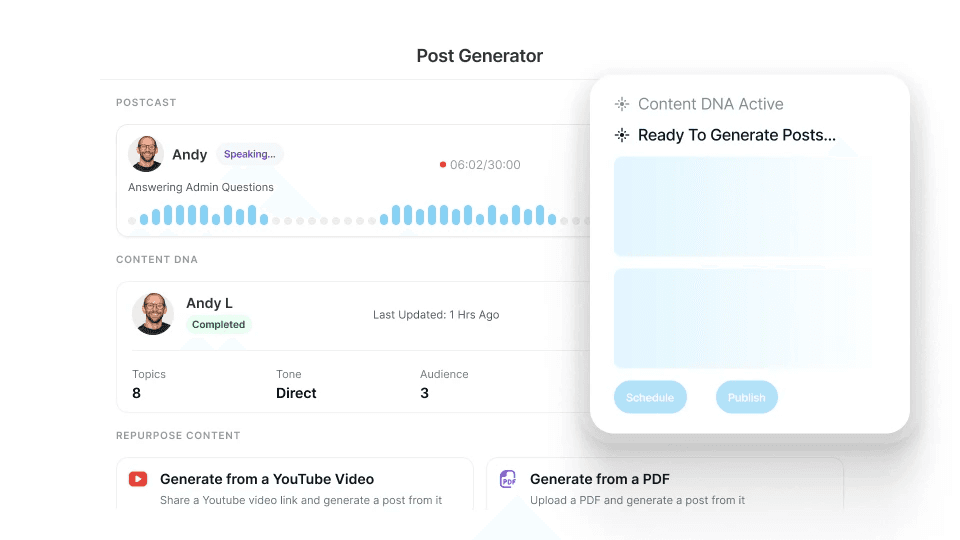
Supergrow's Content DNA builds this from your LinkedIn profile. It maps your identity, voice, and topic ownership so every post starts from a foundation that sounds like you.
Match your ideas to the right stage
Not every post should do the same job. A simple framework to keep your content balanced:
-
TOFU — reach new audiences: hot takes, polls, educational how-tos, industry commentary
-
MOFU — build trust with people who already follow you: case studies, proof of work, frameworks, lessons learned
-
BOFU — convert interested followers: client wins, product milestones, AMAs, direct problem-solution posts
Aim for roughly 40% educational, 30% personal stories, and 30% split between industry insights and proof of work across your week.
Post consistently, then repurpose
Posting 2 to 5 times per week delivers significantly more impressions per post than posting once a week. Consistency compounds. And one strong post can become several — pull the hook into a poll, extract a single lesson into a micro post, record the story as a 60-second video.
Supergrow's repurpose feature turns any PDF, article, or YouTube video into LinkedIn-ready posts so your existing content never goes to waste.
Schedule it once, stop thinking about it
The biggest reason creators fall out of their rhythm is the daily decision about what to post. Batch your ideas once a week, write in one sitting, and schedule everything in advance.
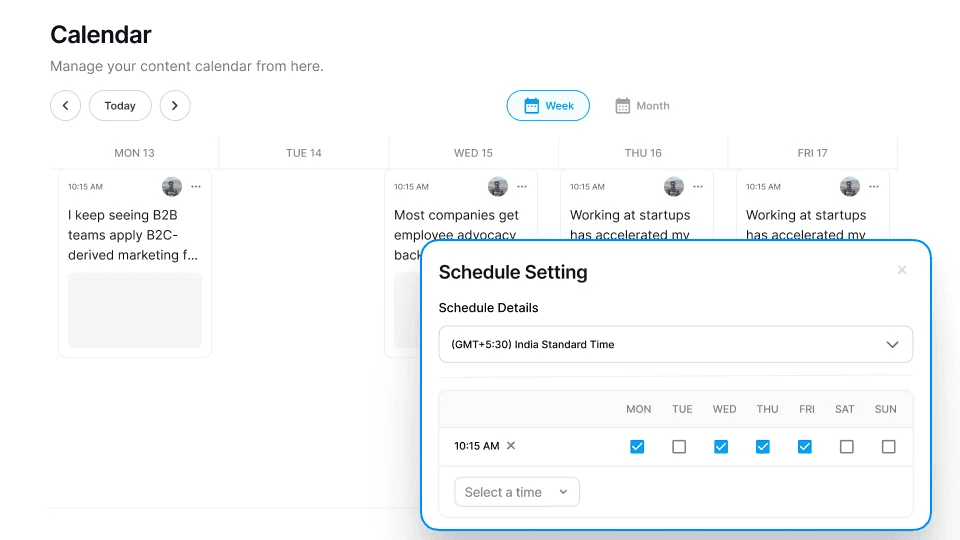
Supergrow's scheduling queue handles the rest — including your first comment, which goes live automatically the moment your post does.
Get Started With These Linkedin Post Ideas With The System
Consistency on LinkedIn is not about having more ideas. It is about having a system that makes showing up effortless.
The ten post types in this guide give you the depth. The forty quick-reference prompts give you the breadth. The framework provides the structure to bring both together without having to start from scratch every week.
What separates creators who compound on LinkedIn from those who plateau is not talent or time. It is the removal of friction at every step.
Supergrow is built for exactly that. Create content in your voice, schedule it consistently, automate the first-hour actions that drive distribution, and track what is working week over week — so every post builds on the one before it.
Ideas are where you start. A system is what keeps you going. Start your 7-day free trial.