
Most LinkedIn summaries don’t fail because they lack credentials; they fail because they go nowhere. You get profile views, maybe even repeat visits, but no conversations, no inbound opportunities, and no real trust built.
That’s because most summaries are still written like bios in 2026: backwards-looking, self-focused, and disconnected from how buyers actually make decisions.
Your LinkedIn summary isn't just your career story, but like a landing page. Your profile is what will compel visitors to either engage or bounce off.
Whether you’re growing a personal brand, chasing new roles, or sourcing leads, the LinkedIn About section can set you apart if you know how to use it.
This guide will reset your approach to writing a LinkedIn summary. It will guide you on writing a conversion-driven LinkedIn summary using clear frameworks and real examples from your favourite LinkedIn creators.
Why the LinkedIn Profile Summary Still Matters in 2026
Many people treat the summary as an extended version of their resume rather than as a story. Your About section is your chance to tell your story and show how you help others.
This section is designed to build trust and relationships, or at least spark curiosity that prompts them to check your content or connect with you.
Your About section should answer a few key questions for the reader:
-
Who do you help?: Clearly define your ideal audience so visitors instantly know whether this is for them.
-
What problem do you solve?: Use the Problem–Agitate–Solution framework that identifies the core challenge, highlights the real-world consequences of not solving it, then positions you as an expert.
-
Why are you the right person to help?: Articulate your unique value proposition—what sets you apart and why your perspective, experience, or results are different.
-
How do you do it?: Outline your approach or methodology. A clear process or proprietary framework builds trust and signals expertise.
-
What should they do next?: Give a specific CTA. Tell them exactly how to move forward, reach out, book a call, or visit your website.
Use your summary to share what drives you, what you’re good at, and the unique path that led you to the work you love. In the world of AI content, where it's extremely easy to write words, your personal story is what drives trust.
How to Write a LinkedIn Summary (Step-by-Step System)
A typical LinkedIn summary is about 3 paragraphs long or roughly 300 words, which is enough to showcase your story and personality without losing the reader’s interest.
The following 7 steps provide a basic outline for writing an effective “About” section on LinkedIn.
Step 1: Choose the ONE Primary Outcome Your Summary Must Drive
Your LinkedIn summary sets the tone for your profile. Are you a lead generation expert, have founded a CRM, hiring talents, or looking for better job opportunities? You can be one of these, but not all.
By the end, a reader should have an idea of why you’re on LinkedIn and what your goal is. A major reason why your LinkedIn summary fails when you try to impress everyone is:
-
You try to speak to multiple audiences at once — clients, recruiters, candidates, and peers—and each requires a different message.
-
Your profile doesn’t tell a cohesive, compelling story that holds together or inspires.
-
You lack a single outcome–the reader doesn’t know whether to follow, message, or hire.
These are 4 valid outcomes a LinkedIn summary should drive:
Authority (Thought Leadership)
Your summary positions you as a sharp point of view in your space. It’s designed to earn trust at scale by showing how you think, what you see others miss, and why your perspective is worth following.
The win here isn’t messages; it’s credibility, influence, and long-term pull.
Pipeline (Leads & Clients)
Your summary is a conversion asset. It attracts the right buyers, filters out the wrong ones, and moves qualified readers toward a conversation.
Every line reduces friction, clarifies fit, and answers the silent question: “Should I talk to this person?”
Hiring (Job Opportunities)
Your summary makes decision-makers see you as an obvious hire. It’s built to signal value, scope, and impact—fast.
The goal isn’t to list experience; it’s to help a recruiter or founder quickly understand where you fit and why you’d be a strong bet.
Recruiting (Attracting Candidates)
Your summary sells the mission. It attracts people who want to work with you by communicating standards, culture, and ambition.
The outcome is inbound interest from candidates who already align with your operating model.
Step 2: Use the Right Summary Framework for Your Goal
Each of these goals follows a unique writing structure.
For instance, if your goal is to get job opportunities, your summary must read like a hiring manager’s mental checklist: relevance, proof, trajectory. However, if your goal is inbound leads, it must behave like a conversion page: problem, insight, differentiation and next steps.
Let’s dive into different frameworks for writing your perfect LinkedIn summary according to your goal:
Authority-Driven Summary Framework
The Authority-Driven Summary Framework compresses years of thinking into a short path that makes the reader think, “This person sees something I don’t — and I trust where they’re pointing me.”
This framework includes:
-
POV: A strong POV that challenges a quiet but costly assumption.
-
Pattern: The Pattern is where you demonstrate that your POV isn’t accidental — it’s earned.
-
Proof: Strong proof answers why someone should trust your POV.
-
Position: When your POV, Pattern, and Proof align, positioning becomes almost unavoidable. People begin to associate you with a specific kind of clarity.
Such a framework is best for creators, consultants, educators, and founders building trust and followers.
Pipeline-Driven Summary Framework
The Pipeline-Driven Summary Framework turns attention into action by guiding readers through a clear, logical buying path without sounding salesy or desperate.
This framework includes:
-
Problem: This is not a generic pain point. It’s the specific friction your ideal buyer feels but hasn’t fully articulated.
-
Outcome: Translate your buyer’s frustration into a tangible result like speed, clarity, revenue, confidence, or scale. The reader should clearly see themselves after the problem is solved.
-
Method: This is where you differentiate. Not a list of services, but your approach: how you think, structure, diagnose, and execute.
-
CTA: The CTA removes ambiguity and tells the reader exactly how to move forward: DM, book a call, download, or apply.
This framework works best for freelancers, agencies, and B2B service providers who want their summary to function more like a conversion-focused landing page than a bio.
Hiring-Focused Summary Framework
The Hiring-Focused Summary Framework helps a hiring manager quickly answer the only question that matters — “Where does this person fit, and why should I care?”
This framework includes:
-
Role: This includes the kind of problems you’re repeatedly trusted with, and how you show up inside a team.
-
Strengths: This helps you understand which type of work you’re most passionate about and whether you're a good fit for the position you apply for.
-
Impact: It's not just about showing where you worked, but also how those positions fit into the narrative of your career.
-
Direction: This is a clear signal of intent. What type of role, environment, or challenge are you looking for next so the right opportunities can find you?
This framework is best suited for job seekers, operators, and individual contributors who want clarity, not charisma, to sell.
Recruiting-Focused Summary Framework
In a world where candidates have more options than ever, remember, you don’t choose talent, but the talent chooses you. The Recruiting-Focused Summary Framework connects the right people self-select into your company before you ever read a resume.
This framework includes:
-
Mission: Not a vision statement, but the problem you’re unwilling to ignore. The reason this company was worth building and the outcome you’re trying to bend the market toward.
-
Culture: Describe how decisions get made, how people are treated, and what’s rewarded. This is where candidates decide whether they’d thrive or burn out.
-
Opportunity: The kind of person who succeeds in this environment. What they’ll own, what they’ll learn, and why this role matters now, not someday.
-
Invite: A clear, human next step. Not “apply here,” but an invitation that signals openness, intent, and respect for the candidate’s time.
This framework is best for founders, team leads, and hiring managers who want to communicate their recruitment philosophy and why candidates should trust them with their future roles.
Step 3: Write a Mobile-First Opening That Earns the “See More”
LinkedIn shows only 2-3 lines of your summary (300 characters) before readers must click “see more” if they want to keep reading. And this is where many people fail with their summaries.
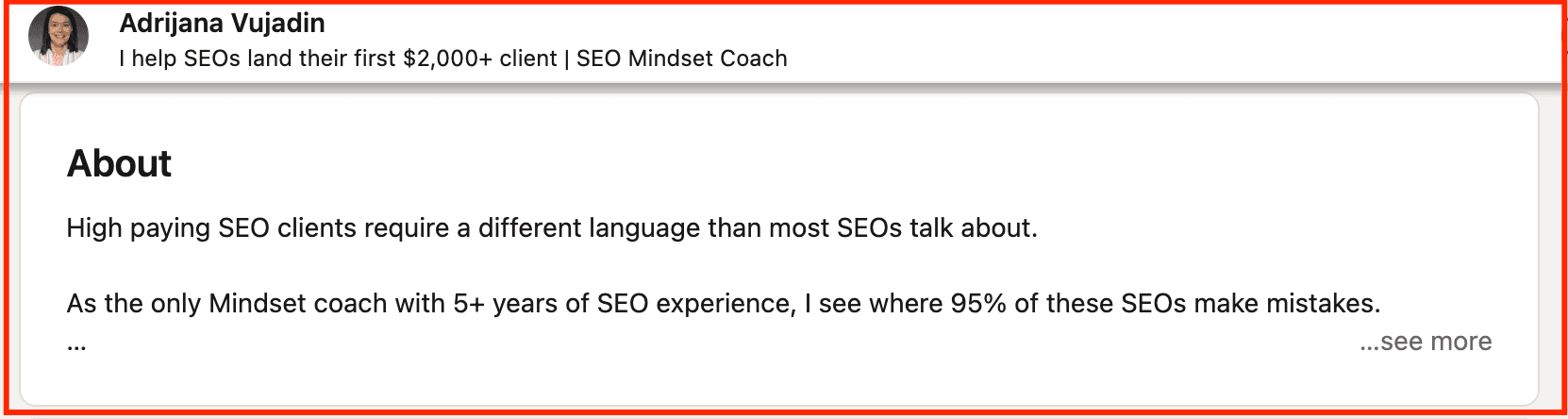
The message of your LinkedIn post can be spectacular, punchy, and powerful, but if you fail in those first three lines, no one's going to read the rest of the post. That’s why the opening lines of your framework are extremely important.
These are hooks that encourage readers to click the “see more” option. The opening lines for each of the above frameworks will be tailored to the target reader's relevance.
Hook example for each framework:
-
Authority → POV Hook: Most people think X is the reason Y works. After watching this pattern repeat across dozens of cases, I’ve learned it’s actually the opposite—and that insight changes how results are built.
-
Pipeline → Pain Hook: If your profile gets views but no replies, demos, or inbound conversations, the issue isn’t visibility—it’s that your message never gives the reader a reason to act.
-
Hiring → Role/Impact Hook: I help teams turn X problem into Y outcome by owning this specific role, where execution matters more than credentials.
-
Recruiting → Mission Hook: We’re building X because the old way of doing Y no longer works—and we’re looking for people who want to shape what replaces it.
At its core, the opening line of your LinkedIn summary has one job: pull the reader in and make them want to keep going, and these examples execute this flawlessly.
Step 4: Structure the Body to Reinforce Trust (Not Ramble)
While you do get 2000 character space for your LinkedIn summary, the last thing your audience needs is long, rambling paragraphs with no clear progression.
To make a real impact, focus on these few key elements: when applying these frameworks:
-
Keep your summary short and skimmable: people tend to scan, not read. Each element of your framework should become its own short, skimmable section.
-
Choose between bullets and short paragraphs strategically: Keep sentences concise or break longer paragraphs into bullet points.
-
What Not to Include (Even If It Feels “Authentic”): Every section should help the reader decide one thing: do I trust this, and do I want to keep reading? Avoid anything that doesn’t add up to this value, like life stories, buzzwords, or vague passion statements.
Your entire LinkedIn summary should read like a narrative, reflecting who you are. Aim to write a LinkedIn summary that tells a story rather than paragraphs that list your experience.
Step 5: Add Proof That Supports the Goal (Without Selling)
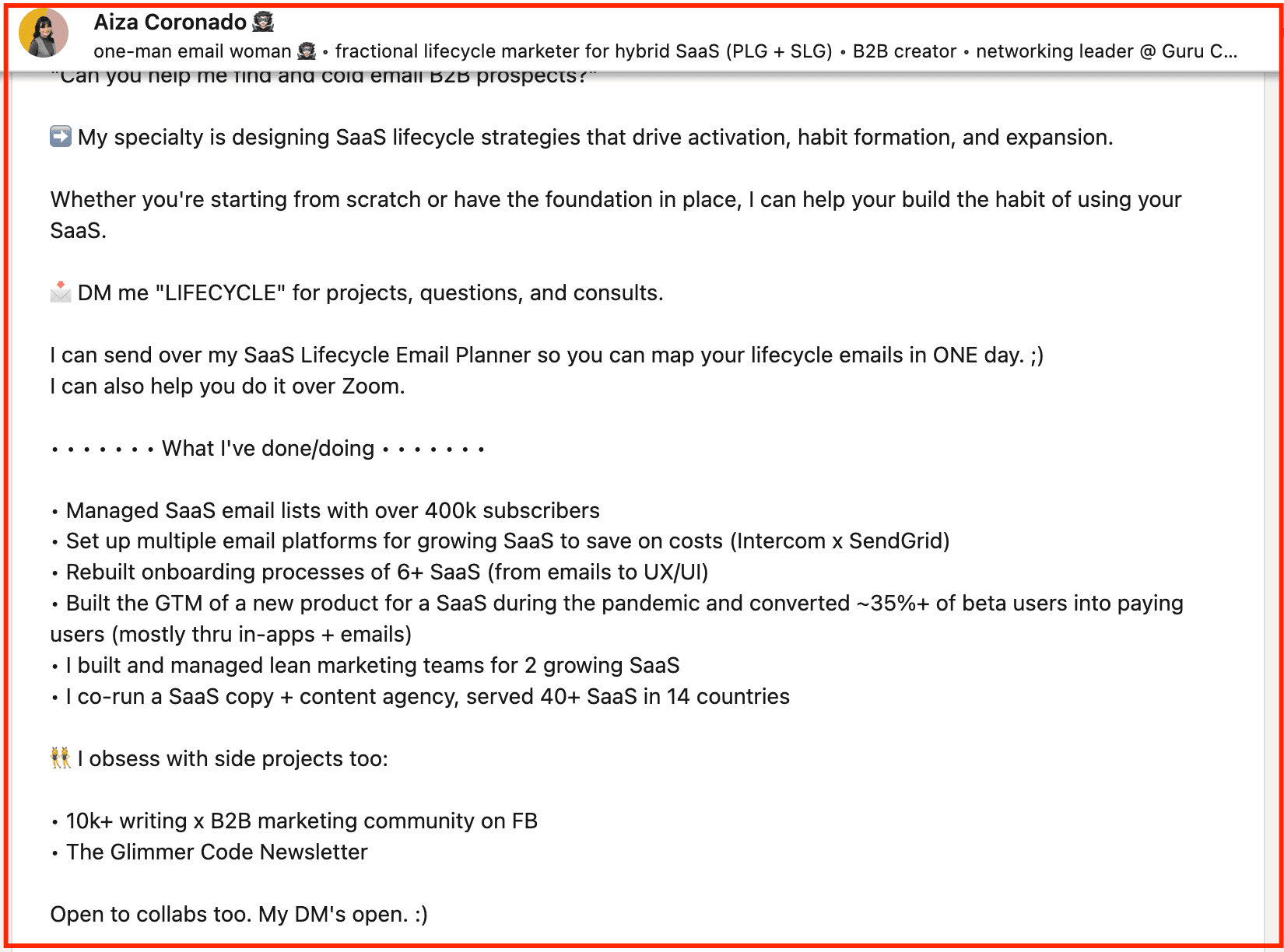
One way to build credibility for your claims is to include social proof. Numbers provide context for your success and show the real impact you’ve had.
Even if your role doesn’t involve easily quantifiable metrics, you can still find elements that matter: time saved, efficiency improved, or managing teams.
Instead of saying, "I helped a business increase sales," write:
-
I improved conversion rates from 2.1% to 3.4% in 90 days
-
I managed $30,000 in monthly ad spend with a 3.6x ROAS
This is an excellent way to demonstrate your capabilities and earn your reader’s trust. This is essential to helping you:
-
Impress recruiters as a job seeker
-
Proves the value you’ll bring to the table
-
Showcase your achievements and what clients can expect
The following is a great summary if you’re in a competitive industry and want to provide your worth as a recruiter, job seeker, or salesperson.
Step 6: End With a CTA That Matches the Framework
Don’t leave your readers hanging. Tell them what you want them to do next.
A clear CTA is an effective way to conclude your LinkedIn summary. You could encourage readers to reach out, mention that you’re exploring new roles, or include your email for collaborations and business conversations.
Each of the above-mentioned frameworks requires a different CTA, like:
-
Authority Framework: “I share weekly insights on X—follow to stay ahead.”
-
Pipeline Framework: “DM me ‘X’ if this sounds relevant.”
-
Hiring Framework: “If this matches what you’re building, let’s talk.”
-
Recruiting Framework: “We’re hiring for X—reach out if this excites you.”
Keep your tone friendly and approachable, not pushy or overly formal.
Step 7: Align Your Summary With Headline and Content
Now, you’re cooking– you have all kinds of valuable context, from the framework you’ll use to the final CTA, but there is one thing you need to check: alignment.
When your headline, summary, and body content point in different directions, readers feel the disconnect. That mismatch creates friction, and friction kills clarity, trust, and memorability.
A simple alignment check keeps everything tight:
-
Same audience: Are you speaking to the same person at every level?
-
Same topic lane: Do the headline, summary, and content all live in one clear area of expertise?
-
Same promise: Are you reinforcing the same outcome, belief, or value throughout?
When these three line up, your message feels intentional, coherent, and credible.
Outcomes-Based LinkedIn Summary Examples
Now that you know how to write an impactful LinkedIn summary, it's time you see it in action.
Don’t worry. We’ll help you with this by providing real-life examples you can follow.
Authority Summary (Founder / Operator / Marketer)
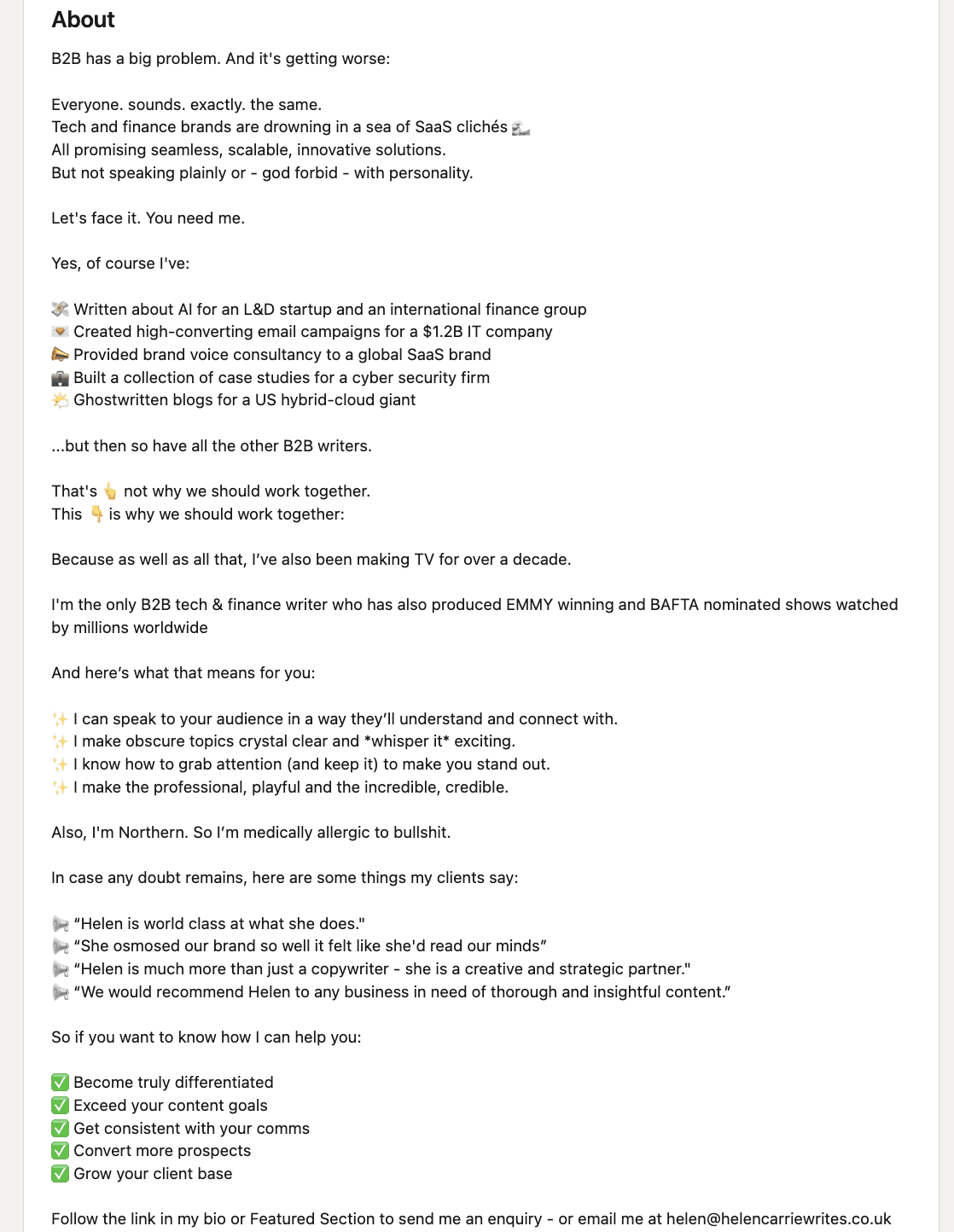
Helen Carrie speaks virtually to every aspect of this framework. She addresses a striking POV*, “B2B has a big problem. And it's getting worse”,* that makes people click on the “See more” button.
She highlights the recurring pattern her audience faces and explains how she can help them navigate it. Finally, ending it with a strong CTA that tells the reader exactly what to do next.
Pipeline Summary (Consultant / Agency / Freelancer)
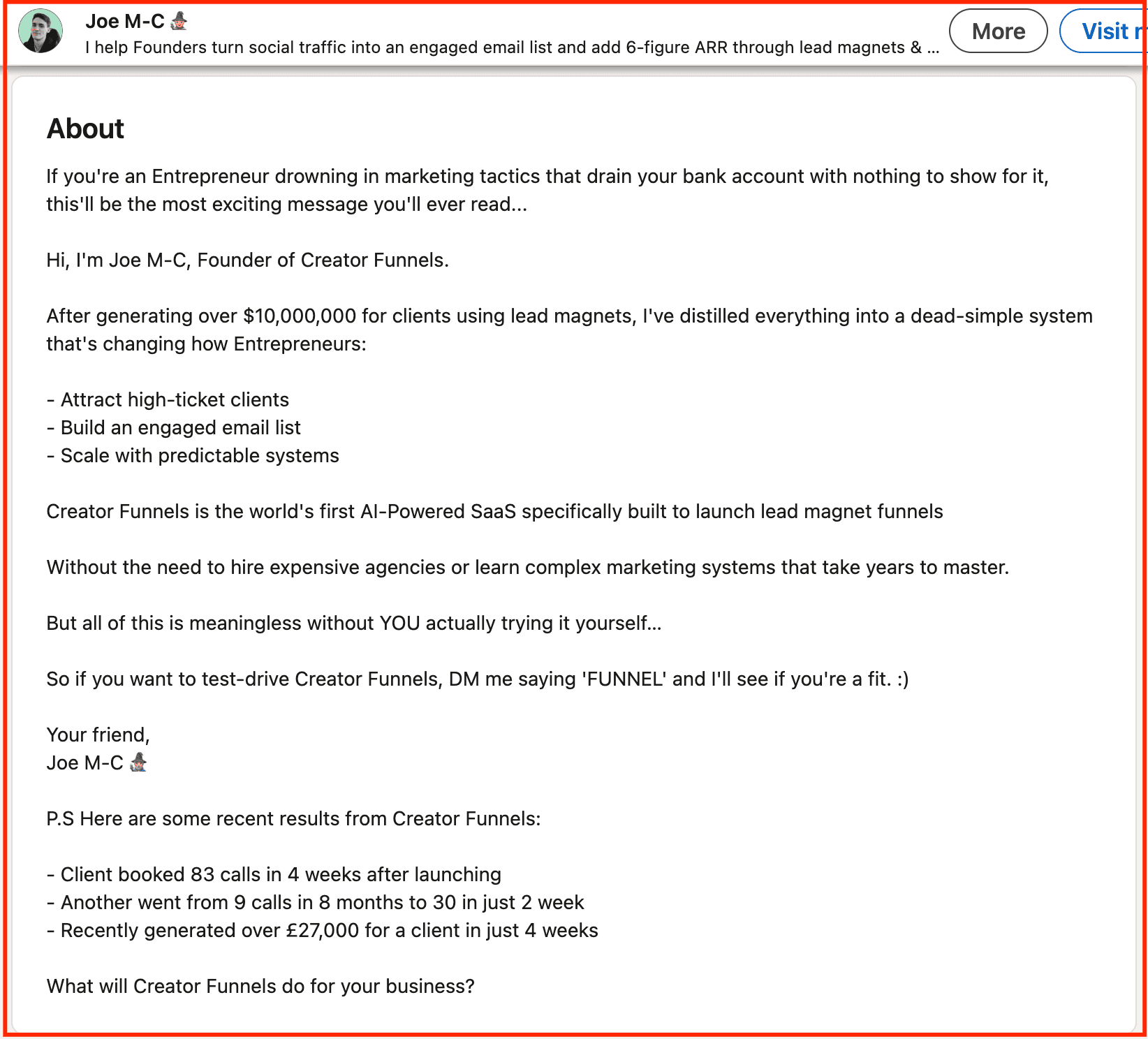
Joe M's strong opening not only captures attention but also defines the clients he’s targeting in this LinkedIn summary. With the first two sentences, Joe puts himself in the shoes of his prospects and then follows it with the outcome the reader would want.
By showing his results, he positions himself as someone who has effective solutions, which is exactly what his prospects are looking for.
Hiring Summary (Job Seeker / Career Switcher)
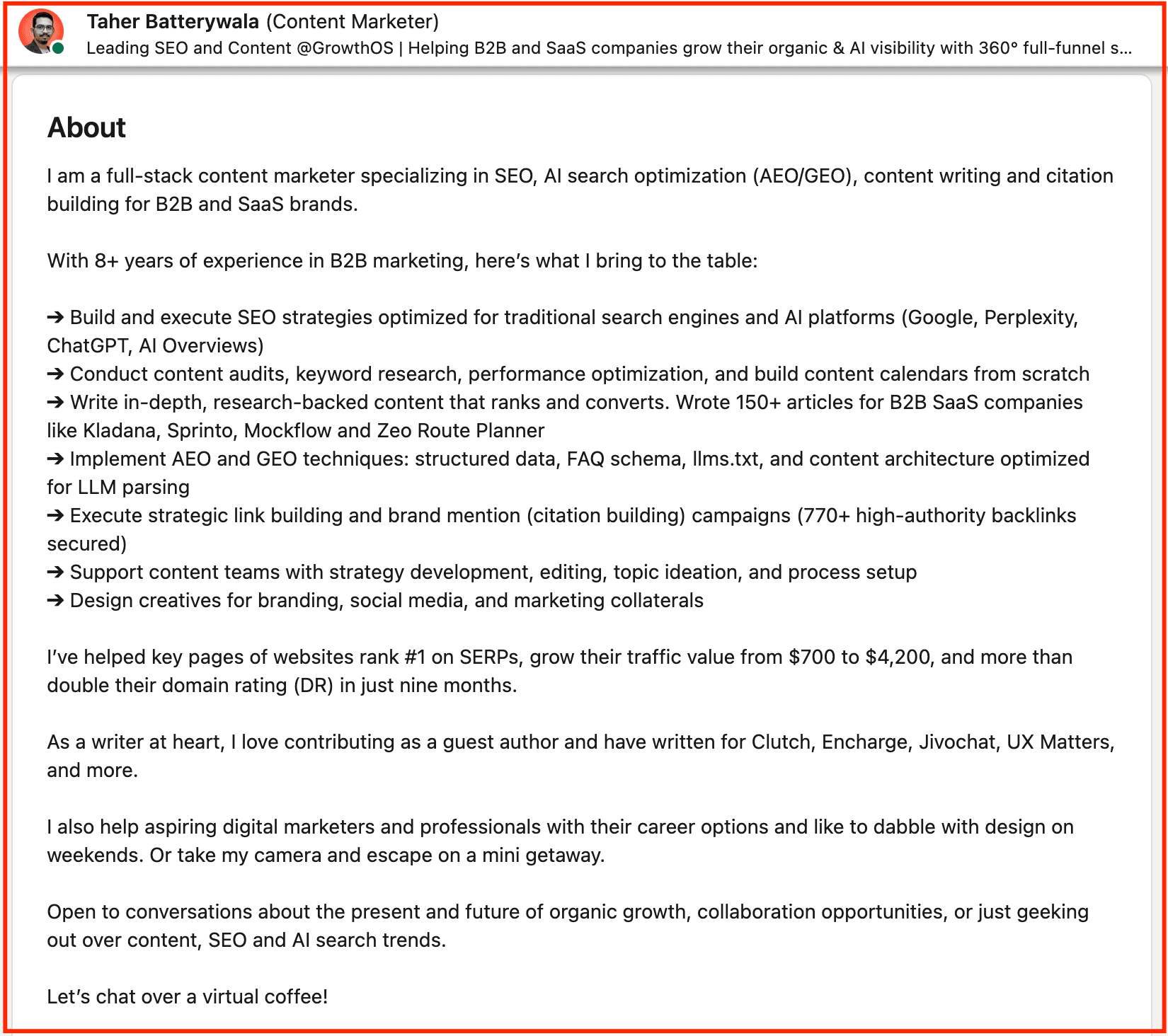
When looking for a new job, you should put your best foot forward. This is an excellent example of a summary that focuses on your skills and achievements. Taher Batterywala clearly explains who he is, what he does, and the value he brings. More importantly, it showcases his work experience.
To bolster his chances of being found by recruiters, he mentions top skills that hiring managers use when searching for candidates to fill roles like the one you wants to fill.
Recruiting-Focused Summary Framework
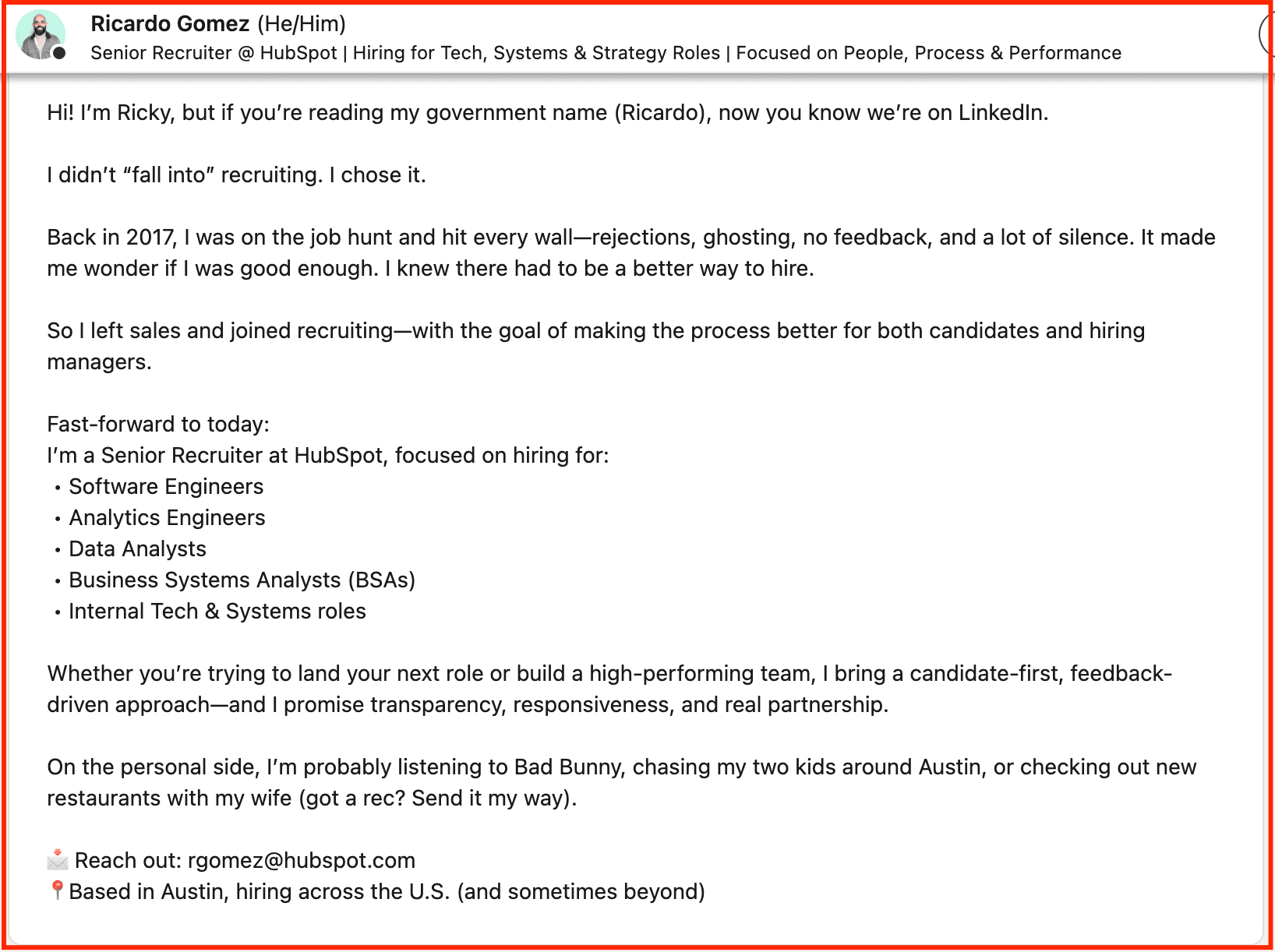
Ricardo Gomez keeps it real with a LinkedIn summary on how he attracts and retains top talent for his clients. Right from the start, we see her personal mission presented succinctly and effectively.
Also, you can feel the positive vibes in this LinkedIn summary! Letting your personality shine is another great LinkedIn hack for writing summaries. This gives a sneak peek into who you really are and makes it easier for the job seeker to start a conversation.
Use Supergrow AI LinkedIn Summary Generator
If you’re like most people, you might get a bit of writer’s block. Distilling your entire personality and career into a little text box, it’s supposed to be challenging.
If you’re looking for a swift kick to create a perfect LinkedIn summary that is both personalized and SEO-optimized, then our LinkedIn Summary Generator is the tool you need.
Just fill in a series of questions to better understand who you are and how to portray yourself, and the Supergrow LinkedIn Summary Generator, then generate the first draft of your LinkedIn Summary based on your input, skills, and experience.
Your LinkedIn journey shouldn’t feel scattered. With Supergrow, you can plan content, refine your summary, engage smarter, and grow—without switching tools or losing focus.
Start your free 7-day trial today and experience the power of Supergrow for LinkedIn success.