
Most companies are misrepresenting their employee advocacy programs.
-
They think it’s “working” because employees occasionally share a post
-
They call it a “win” when someone reposts the company blog
-
They keep renewing the advocacy tool because… it already exists
But when you actually look at the numbers
-
80% of “advocates” haven’t logged in for months
-
The same 3-5 people share everything, every time
-
The sales team isn’t using the advocacy at all
That’s not advocacy, that’s a marketing team desperately trying to keep the lights on.
If you want to launch an employee advocacy program built with purpose and that actually drives engagement, this guide is for you. Let’s dive in.
Why Employee Advocacy Matters For B2B Brands in 2026
Employee advocacy truly emphasizes the ‘social’ in social media by leveraging person-to-person connections. What began as a simple amplification tactic is becoming something more deliberate: a structured growth channel built on trust, confidence, and credibility.
In this section, we’ll look at why employee advocacy matters for B2B brands more than ever in 2026.
B2B Buyers Trust People More Than Brands
Employee advocacy works because it feels human.
Think about the difference between:
-
A company post announcing a “commitment to culture.”
-
An employee sharing their personal experience on what a supportive manager actually did during a busy day
The second example feels real because it is specific.
Research consistently shows that employees are among the most trusted sources of information about an organisation.
Not CEOs. Not marketing teams. Employees. Content shared by employees generates 8X more engagement than content shared by company accounts.
Simon Heaton shares that employee advocacy is their biggest driver of awareness at Buffer. In 2025, it has brought them over 17.5 million in reach.
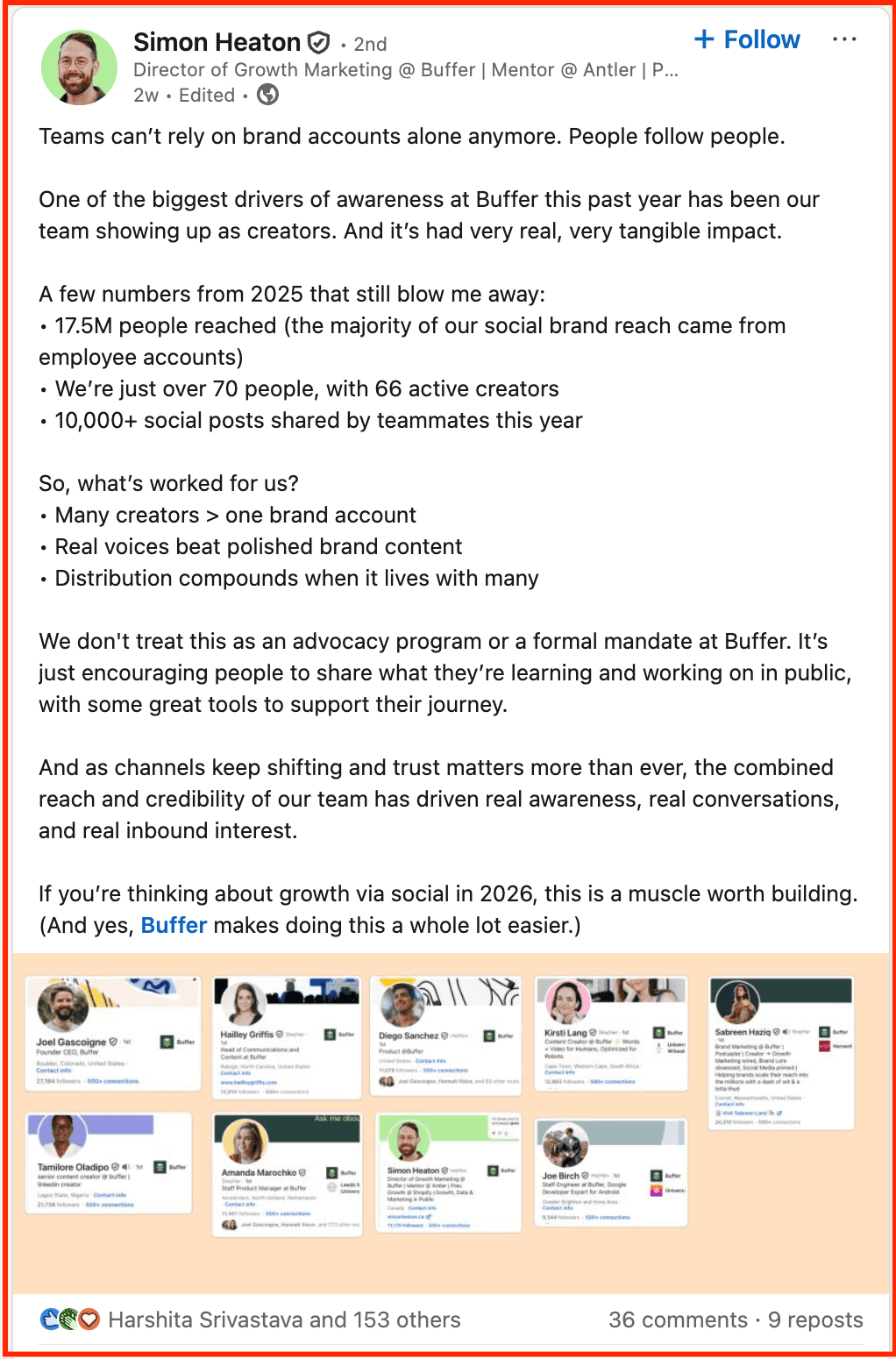
The exact numbers change year to year, but the pattern does not. Trust flows through people, not logos.
Content Volume Is Rising, Attention Is Falling
While AI has made it easier to create content, it's also made it harder to stand out. The result is more output, less impact, and growing pressure to show that attention actually leads to something meaningful.
This is where employee advocacy is changing shape.
People closest to the work carry more credibility than the work itself. Employees understand the product, the process, the internal contradictions and the day-to-day reality of what a brand actually is.
This isn't a traditional influence. It’s not reach-based. It’s relational. Employee’s content is built on lived experiences, knowledge, emotional truth, and a kind of honesty that doesn’t require polish to feel legitimate.
Advocacy Without Structure Is Unsustainable
59% of organizations consider employee advocacy extremely or very important, highlighting the strategic role these programs now play.
However, the challenges remain stagnant. Remarkably, 29% of employee advocates lack formal training or clear social media guidelines, and just half of organizations actively encourage authentic, employee-generated content.
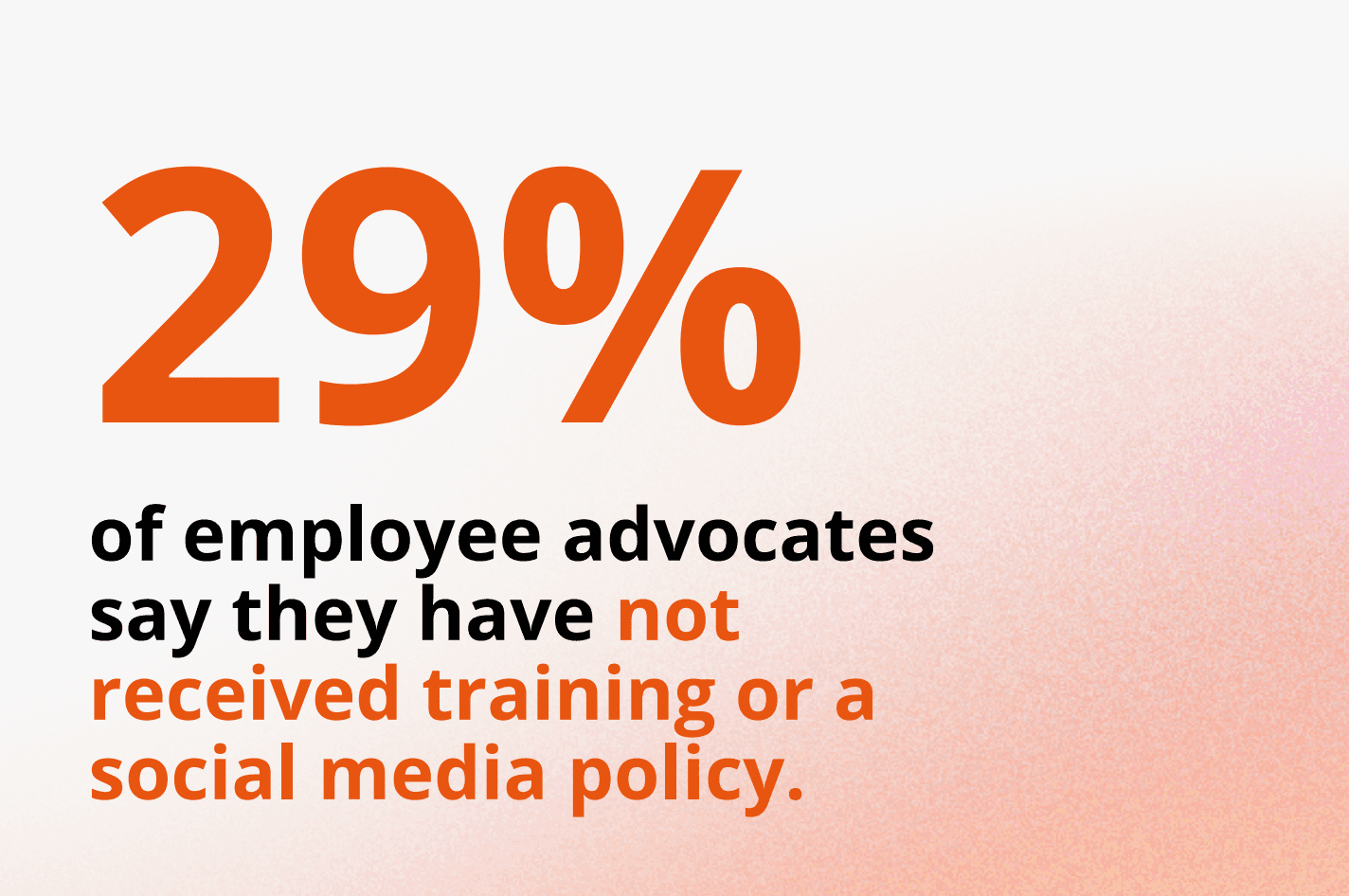
Instead, most provide ready‑to‑share images and text (75% and 74%, respectively) without any strategy or structure.
This creates a huge gap between creating content for authenticity and simply ad hoc. People don’t share authentically in cultures that punish honesty.
What Breaks When Employee Advocacy Has No System
Most employee advocacy programmes fail for predictable reasons. Not because employees lack interest, but because the environment doesn’t support it. Employee advocacy struggles when employees lack clarity, confidence, and time.
Successful programs start with understanding employee motivation. Not everyone wants to post publicly, and participation should never be mandatory. The aim of your employee advocacy should be a confident contribution, not compliance.
If you want advocacy that actually works, here’s the reality check:
-
Stop making it complicated: A confusing system kills advocacy. Make it easier for advocates to create and share content.
-
Leaders need to step up: Leadership involvement and support are the best ways to increase employee advocacy. If your C-level isn’t engaging, why would employees? Walk the talk.
-
Ditch the corporate scripts: A dozen disconnected voices weaken credibility. Nothing screams "fake" like a templated post. Let employees share authentically.
-
Momentum fades fast: Initial excitement is easy. Sustained participation requires ongoing enablement, not a one-time launch and silence. Recognition, bonuses, and even small shout-outs fuel participation.
-
Enable, don’t chase: When marketing has to constantly nudge employees to share, the system is broken. Advocacy should feel supported and effortless, not forced.
Authentic employee voice does not require heavy management. It requires trust, support, and a system that makes advocacy easier.
How To Launch an Employee Advocacy Program That Scales in 2026
The modern employee advocacy programs require a framework where employees' voices are treated as part of an editorial strategy – not a loose social experiment.
Step 1: Define the Role of Employee Advocacy in Your GTM Strategy
Before you ask employees to post, share, or “build their personal brand,” you need clarity on why advocacy exists inside your GTM motion, and what business outcome it is meant to support.
Just like your LinkedIn presence, advocacy should be shaped by your product, positioning, and buyer journey.
Ask yourself: what role should employee voices play in our GTM strategy?
-
Trust-building in complex or high-consideration deals
-
Expanding reach into niche buyer communities?
-
Building credibility in a crowded or noisy category?
-
Signaling expertise and maturity to customers, partners, or future hires
The answers to these questions determine how you position advocacy, who should participate, and what content will resonate with your audience.
Advocacy works best when employee content reinforces GTM narratives from a human angle, real use cases, buyer pain points, market insights, and lessons from the field, not marketing slogans or mass reposts.
Step 2: Choose the Right Employees to Start the Program
Once you’ve identified your advocacy goals in place, you’ll want to identify which employee groups, departments, and functions within your company can help you achieve these goals.
But here’s the thing that marketers should keep in mind: not every advocate will make an ideal advocate.
Some of your team members might not use social media, and others might not be building a personal brand. Too often, companies don’t understand this and blast emails to everyone, getting minimal responses.
The best advocacy champions usually share these key traits:
-
Active: They’re talking about the company, their work and creating genuine connections
-
Believe in the mission: They genuinely care about the company’s story, products, and the impact it creates.
-
Credible in their space: Peers, customers, and colleagues trust their perspective
-
Willing to speak up: They may not post every day, but they’re comfortable sharing their voice when it matters
Based on our experience, the sweet spot for an initial employee advocacy programme is around 15 employees. This is large enough to attract a diverse mix of voices while remaining small enough to maintain high engagement and foster a strong sense of community.
So, how do you find the perfect participants?
While CEOs and senior leaders achieve the same level of engagement as a company page, even with 98% fewer followers, it’s far more important to choose those who are genuinely motivated, willing to participate, and have the time.
You can use the Pyramid of Employee Influence to help guide you when planning who to invite:
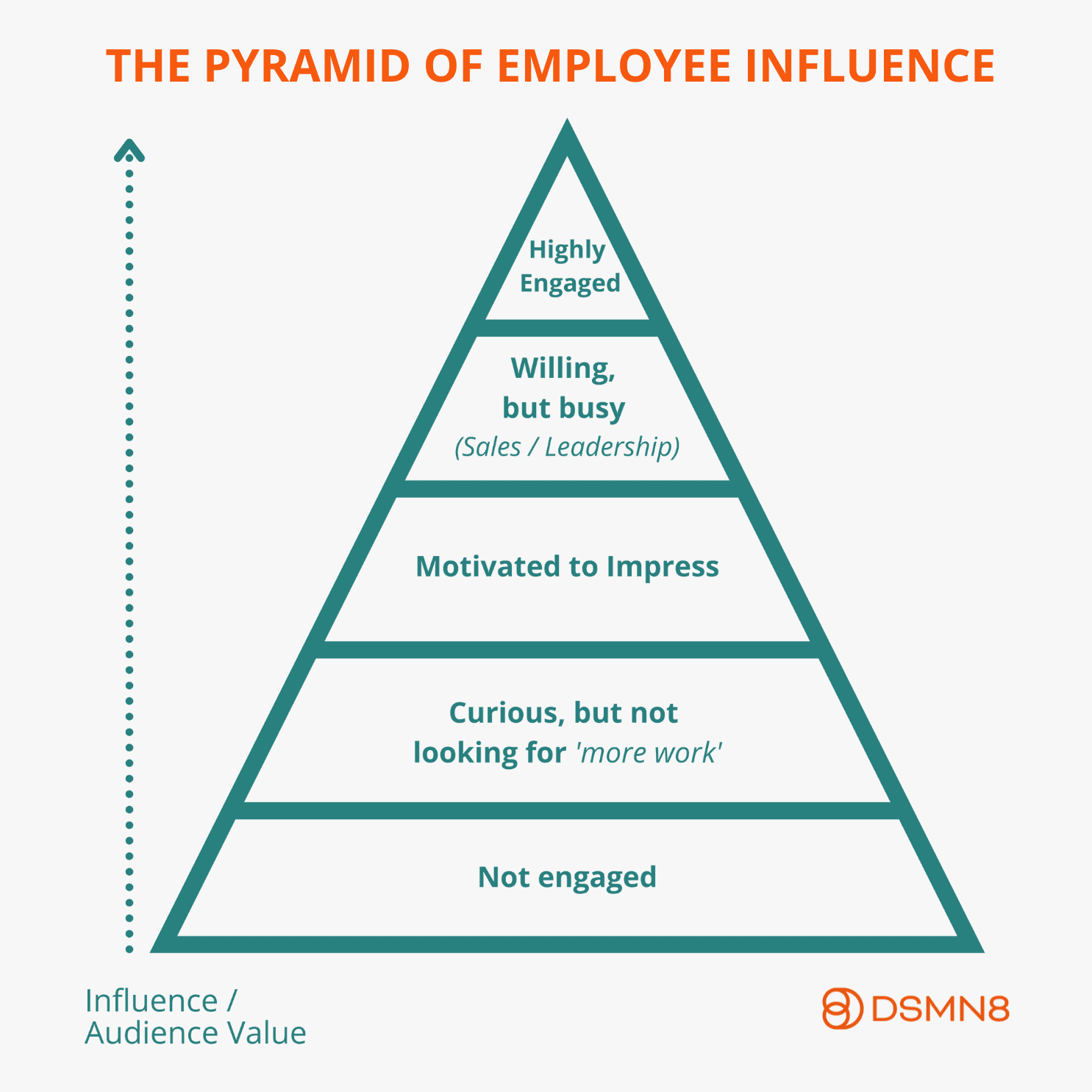
Personal accounts with a smaller, more focused network tend to have a significantly higher engagement than those with a large following but post occasionally.
Step 3: Choose the Right Platforms for Employee Advocacy
The rise of social media has made advocacy more scalable, more organized, and more impactful. Naturally, there are many social media platforms available for employee advocacy programs.
But which one should you choose?
-
LinkedIn: For B2B brands, LinkedIn is where thought leadership is established, buyer trust is earned, and deals are often influenced even before conversations begin.
-
X (Twitter): X works well for leaders and subject-matter experts who share sharp opinions, quick insights, and commentary that positions them as plugged into what’s happening right now.
-
Facebook: Facebook is more effective for employer branding, culture stories, and human moments than for influencing buying decisions. It shouldn’t be the primary channel for establishing credibility or influencing demand.
-
Niche Platforms (Reddit, Slack): These platforms prioritize depth over scale. Advocacy here looks like participation, not posting.
While employee advocacy can occur across multiple platforms, 70%+ of advocacy activities occur on LinkedIn. In addition to LinkedIn, you can select 1-2 complementary platforms to maximize reach.
Step 4: Design Strategic Content Themes (Not Post Prompts)
Now, you need a thoughtful approach to launching your employee advocacy content.
You can segment your content in 4 ways: Role/team, Seniority, Region and Language.
Here’s a quick step-by-step guide:
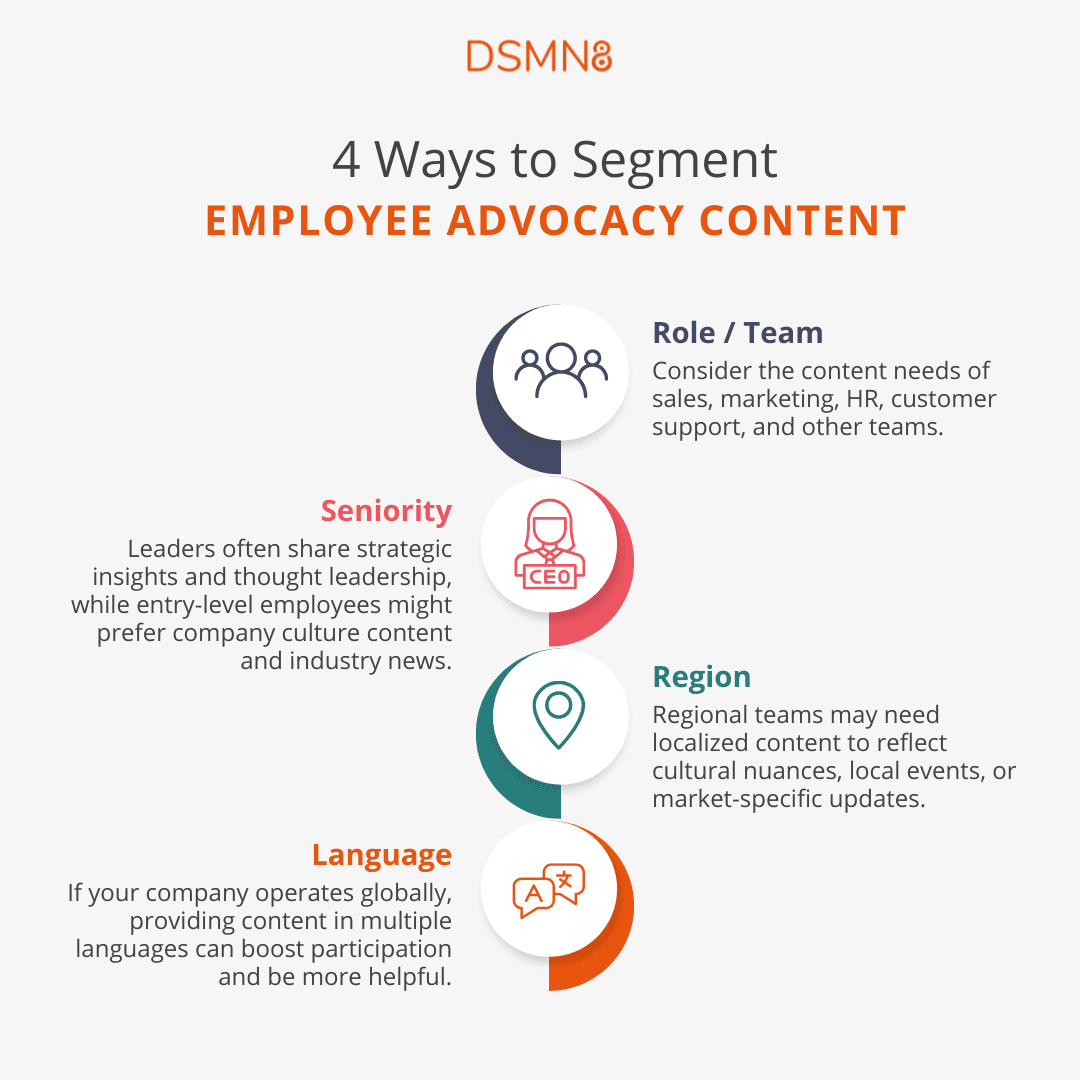
Once you've identified your segments, the next step is to craft an employee advocacy content strategy that meets their needs.
For example:
-
Sales Teams: Focus on customer stories, industry insights, and product updates that help spark relevant conversations with prospects.
-
HR Teams: Prioritize content showcasing your company culture, recruitment initiatives, and employee spotlights.
-
Marketing Teams: Share thought leadership pieces, creative campaigns, and brand-building content.
Based on roles, you can enable advocates with different themes that answer one of the most crucial questions: “What should I post today?” Instead of controlling their voice with scripts, templates, and forced prompts, simply provide them with references to the content they can post.
Here are a few employee-advocacy content your team can experiment with:
-
Work anniversaries and milestones: One of the most popular types of employee advocacy content, attracting top talent and strengthening the company’s credibility.
-
A day-in-the-life: People are naturally curious about what a person actually does day-to-day, beyond just a job title. Gives potential hires a glimpse of what their day might look like.
-
Expert advice: Educational, opinionated content gets more shares and engagement, increasing the likelihood of reaching decision-makers and industry peers.
-
Behind-the-scenes: People love to get a sneak peek into how their favorite companies collaborate, get work done, launch products, or share fun, raw, unscripted moments.
-
Employee recognition: A simple shoutout can make a huge difference in how team members are valued. It boosts employee morale and builds a company culture where appreciation is the norm.
Step 5: Train Employees to Think Like Creators, Not Marketers
Most employee advocacy programs fail at this step. Not because employees don’t want to post, but because they’re subconsciously trying to “market” rather than share how they think and work.
When you market something, it comes off as salesly (or brand-centered), but being a creator is a foundational mindset–not a job title. This is probably the one skill every founder, operator, creative, and even CFO needs more of!
Employee-generated content comes from real people, not the suits in the C-suite. People feel comfortable engaging with employees in conversations.
Your carefully written blog won’t have that kind of interaction, unless an employee shares it, adding their two cents. As a content marker, you’re paid to write those posts. Your engineer isn’t.
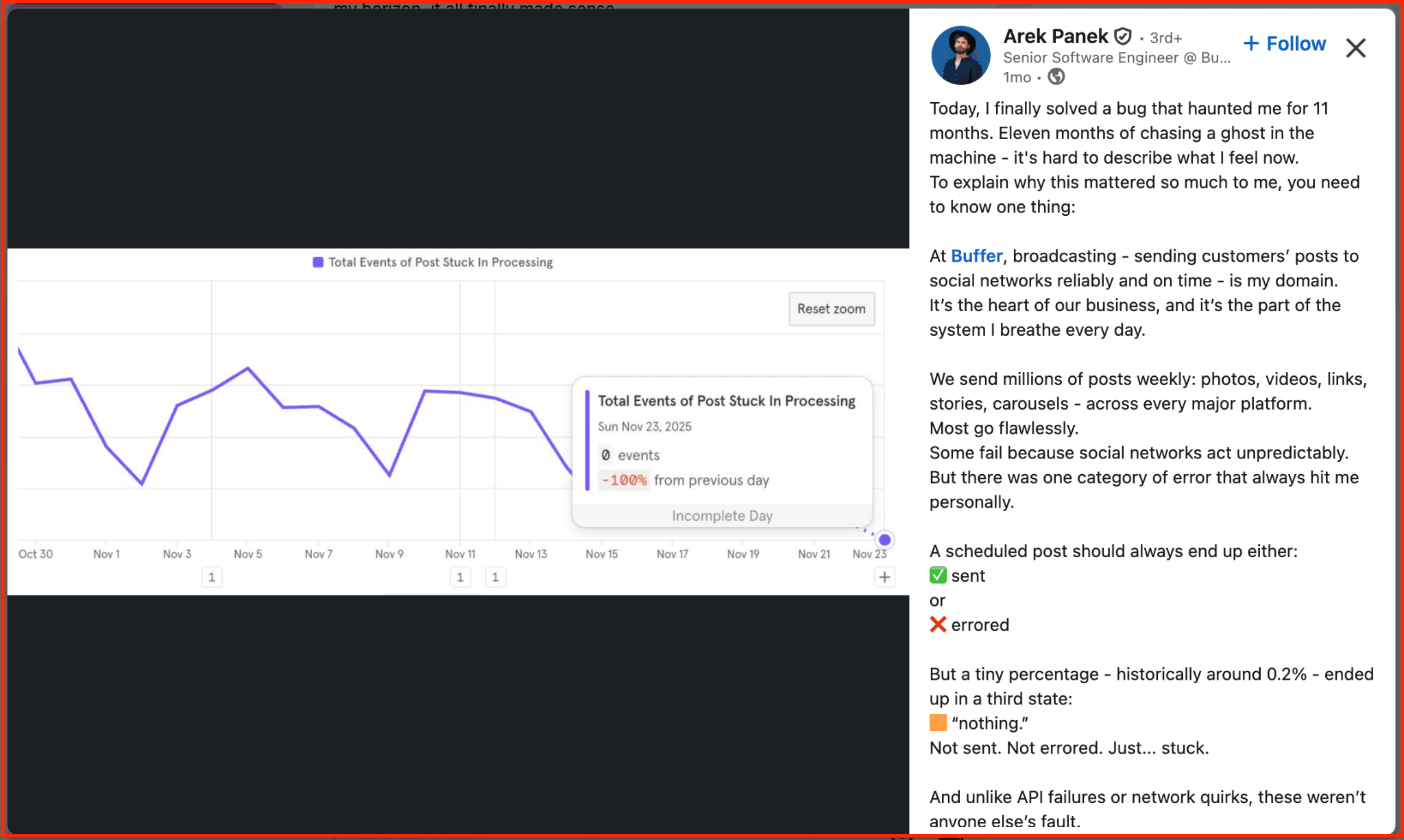
When Arek, Software Engineer at Buffer, posts something their team created, people listen because;
-
He’s sharing his experience, not a marketing copy
-
He doesn’t get paid for creating social media posts.
Step 6: Establish Clear Content Guidelines and Review Rules
While you want employees to be genuine, providing them with a content guideline ensures consistency and protects the company’s reputation.
Evidence from communication and compliance research consistently shows that rigid, overly restrictive policies reduce participation, whereas clear, principle-based guidance leads to stronger engagement and better outcomes.
These are best addressed through:
-
Clear, plain-language guidelines
-
Training focused on confidence, not compliance
-
Examples rather than rules
-
Give them the time and tools they need
-
Details about your brand’s target audience
-
Do’s and don’ts for best representing your brand
You can also set up a brand library of assets that contains photos and graphics, links to recent content pieces, sample captions or talking points to jumpstart their own posts and recent company news and milestones.
If you want to set your employees up for success, an internal resource like this provides clear expectations, practical guidance, and ongoing support.
Step 7: Set Goals That Reflect Program Maturity
Every successful employee advocacy program begins with clarity. The primary goal of the programs is brand awareness and visibility.
But advocacy is not a campaign. It’s a capability that matures over time, and your goals must evolve with it. One of the fastest ways to kill an advocacy program is to apply end-stage performance metrics to early-stage behavior change.
Early-Stage Goals: Build the Muscle, Not the Scorecard
At the beginning, success has nothing to do with virality or reach. The real work is psychological and behavioral.
Focus on:
-
Participation consistency: Are the same people showing up month after month? Consistency matters more than volume.
-
Confidence and comfort: Do employees feel safer expressing opinions, sharing learnings, or posting imperfect thoughts?
-
Learning loops: Are people experimenting, observing what resonates, and improving over time?
This stage focuses on creating a low-pressure environment where employees learn to show up publicly without fear of judgment or failure.
Growth-Stage Goals: Shape Direction Without Killing Voice
Once participation is stable, confidence is visible, and content flows naturally, you can begin introducing directional metrics.
Focus on:
-
Message alignment: Are employee narratives reinforcing your positioning and core beliefs, even when expressed in different voices?
-
Reach quality (not raw reach): Are the right audiences engaging—customers, peers, candidates, partners, not just vanity impressions?
-
Inbound signals: Are conversations, DMs, referrals, hiring interest, or sales touchpoints being influenced by employee content?
This stage is about signal quality, not scale obsession.
Make sure your goals for the program are aligned with business goals - this is how you prove ROI and secure investment in the program (budget, time and stakeholder engagement).
Step 8: Measure What Matters (and Ignore Vanity Metrics)
Measuring employee advocacy success means assessing how your program supports your business. You can break this down by business goals, marketing outcomes, and people outcomes.
Marketing outcomes include:
-
Monitor social media engagement
-
Track website traffic and conversions
-
Equivalent earned media value or cost-per-click
-
Inbound/employee-referred leads
People outcomes include:
-
Participation
-
Posting rhythm
-
Topic resonance
-
Morale and culture
-
Retention
Vanity metrics like likes and impressions are easy to track and easy to misinterpret. High impressions don’t equal high impact. A single meaningful conversation often matters more than a thousand passive views. The real measurement happens when the metric contributes to your goals.
Lastly, building a personal brand on social media platforms is challenging and requires time and effort. It's important to recognise your employees' success, whether that’s sharing something insightful, growing their following, speaking on a podcast, or simply being consistent.
Recognising these efforts helps team members feel seen and appreciated, and it encourages the rest of the team to get started as well.
How Supergrow Supports Employee Advocacy for B2B Teams
Scaling your employee advocacy is straightforward with Supergrow.
Supergrow helps B2B teams manage an employee advocacy program at scale—without chasing employees, scripting posts, or relying on one-off campaigns.
Instead of posting randomly, Supergrow equips you with the structure, tools, and inspiration needed to consistently publish high-performing content, deepen audience relationships, and run a predictable, scalable employee advocacy program.
**What You Get With Supergrow: **
-
Content DNA: Builds a unique voice profile based on how you actually communicate, your tone, opinions, vocabulary, and the topics you care about, so every post sounds like you wrote it yourself.
-
PostCast (AI Interviews): Have a conversation with Alex, our AI interviewer, who asks thoughtful questions about your expertise, adapting in real-time to go deeper. Each 10 to 15 minute session generates multiple LinkedIn post drafts that sound like you.
-
AI Post Generator: Write posts from scratch or repurpose YouTube videos, blogs, PDFs, or swipe files, trained on your voice, tone, and writing style.
-
Content Calendar & Scheduling: Plan, schedule, and manage your post pipeline with clean calendar views. Schedule posts plus first comments, and manage campaigns across multiple accounts from one dashboard.
-
Feedback & Approval Workflows: Route posts through manager review before they go live. No more rogue publishing. Marketing stays in control without becoming a bottleneck.
-
Organisation Management: Manage all voices from one dashboard with role-based permissions, team-level drafts, and workspace separation.
-
Challenges & Leaderboard: Keep participation consistent with posting challenges and leaderboards that drive adoption and maintain momentum beyond the launch week.
-
Team Analytics & Weekly Reports: Track performance insights per team member, with visibility, engagement, and pipeline impact reporting.
-
MCP Integration (New): Use Claude or ChatGPT to run your LinkedIn workflow directly through Supergrow.
Supergrow is designed for creating employee-led content, not generic social media sharing. Simply invite your team to Supergrow to scale your employee advocacy.
Conclusion — Employee Advocacy Scales When the System Does
Advocacy programs and employee-generated content humanize brands, build trust and create cost‑effective organic reach.
Many studies have shown that employee recommendations are trusted more than corporate messages and can drive substantial revenue growth. Sustained advocacy also creates a strong community. It helps employees feel heard, helps leaders see measurable ROI, and helps your brand story spread organically through the networks that matter most.
Want to build an employee advocacy program that scales and brings ROI? Sign up on Supergrow now!