
The social media landscape in 2026 isn’t just competitive, it’s fundamentally different.
Algorithms remain volatile. Paid costs haven’t come back down. Audiences are more selective about who they trust.
But the only constant is trust in people. This is where employee advocacy is changing shape.
What began as a simple amplification tactic is becoming something more deliberate: a structured growth channel built on trust, confidence, and credibility.
Employees are posting more. Leaders are showing up more visibly. Original voices are outperforming polished brand content. Whether you intend it or not, your employees already represent your brand on LinkedIn.
Still on the fence about how employee advocacy benefits your business and employees? Then this guide is for you.
6 Key Benefits of Employee Advocacy for Companies
Many of the companies generating buzz on social media right now have something in common; it's not just the brand account posting great content, but their employees, too.
Businesses that implement employee advocacy programs see a 27% increase in online engagement and a 19% rise in sales within the first year. Personal profiles outperform company profiles every day of the week.
That’s not it. Let’s dive into some more benefits of employee advocacy for companies:
1. Stronger Brand Trust at Scale
96% of people don’t trust ads. If that’s any indication, your buyers don't trust ads, either. Employee advocacy works because it feels human.
When employees talk about their work, it carries a different weight in corporate communication. This is especially true for regulated industries, where audiences actively seek reassurance and credibility.
Research consistently proves that employees are among the most trusted sources of information about an organisation. Not executives. Not marketing teams. Employees.
Long-term workplace and trust research consistently shows that:
-
Employees are viewed as more credible than senior leaders when it comes to describing everyday culture
-
Messages from “people like me” are perceived as more authentic and truthful
-
Trust grows when communication feels personal and human, rather than formal or corporate
With 31% of U.S. adults saying they’re “almost always” online, you can’t neglect the importance of people-to-people marketing.
2. Sustainable Organic Reach at Scale
Hinge Research published a new study on employee advocacy, finding that 31% of high-growth companies surveyed have implemented an employee advocacy program, suggesting a strong correlation between employee advocacy and rapid company growth.
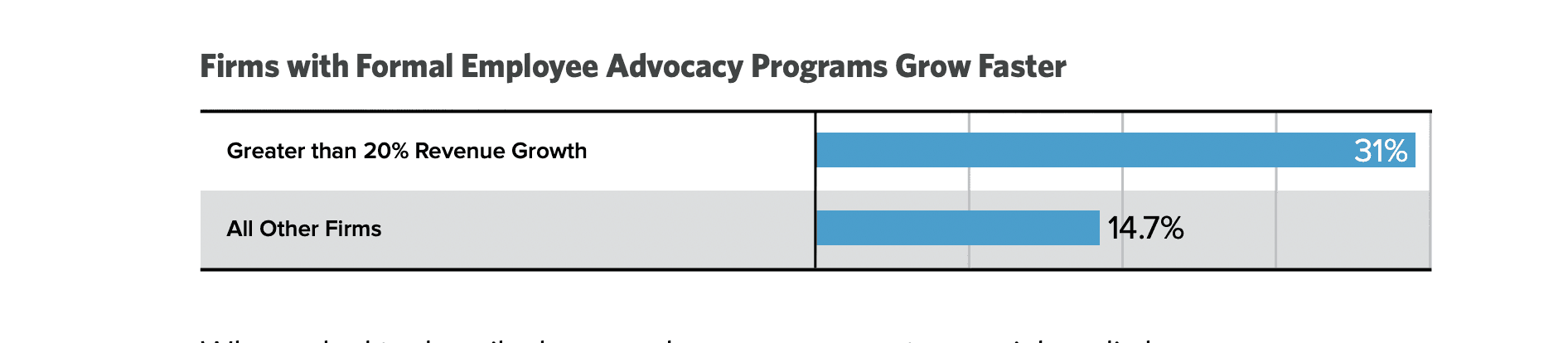
Not just that, 96% of businesses benefited from employee engagement, and 27% of high-growth companies reported a shorter sales cycle, more than double the rate seen among slower-growing companies.
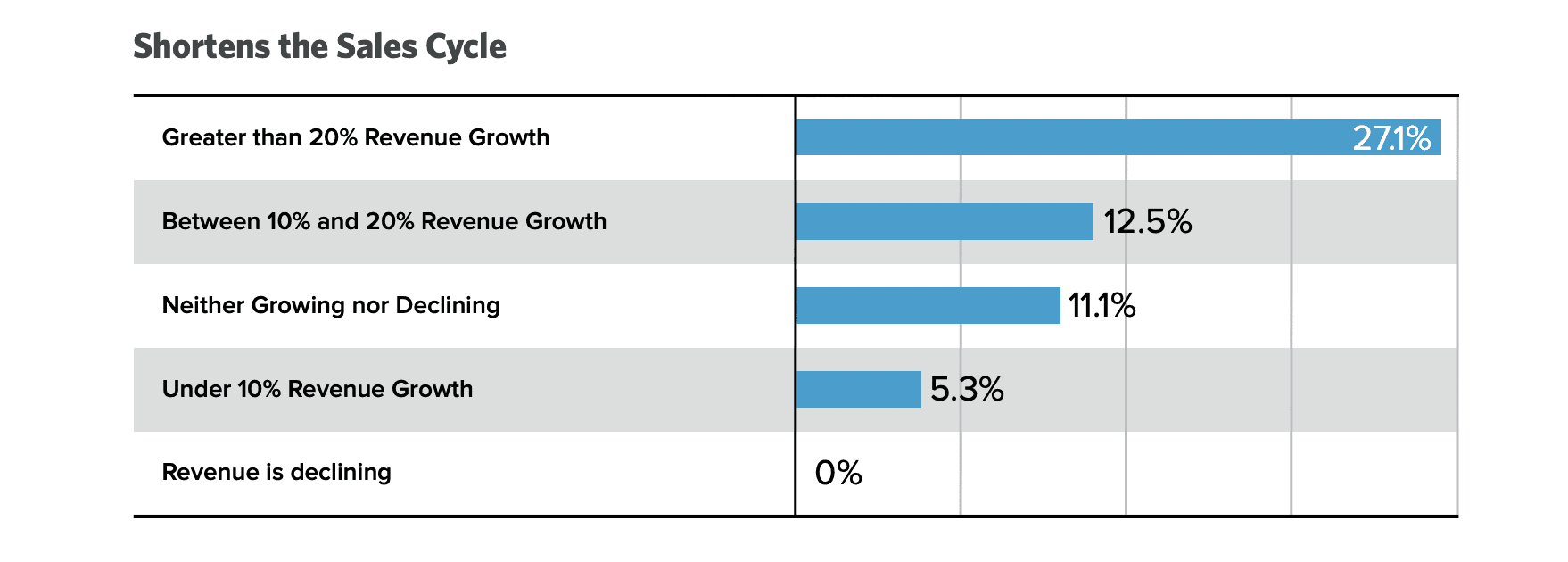
This percentage was twice that of their slower-growing counterparts. Firms whose revenue is declining, and do not see this as a benefit at all.
Simon Heaton confirms that LinkedIn employee advocacy is their biggest driver of awareness at Buffer. In 2025, it has brought them over 17.5 million in reach.
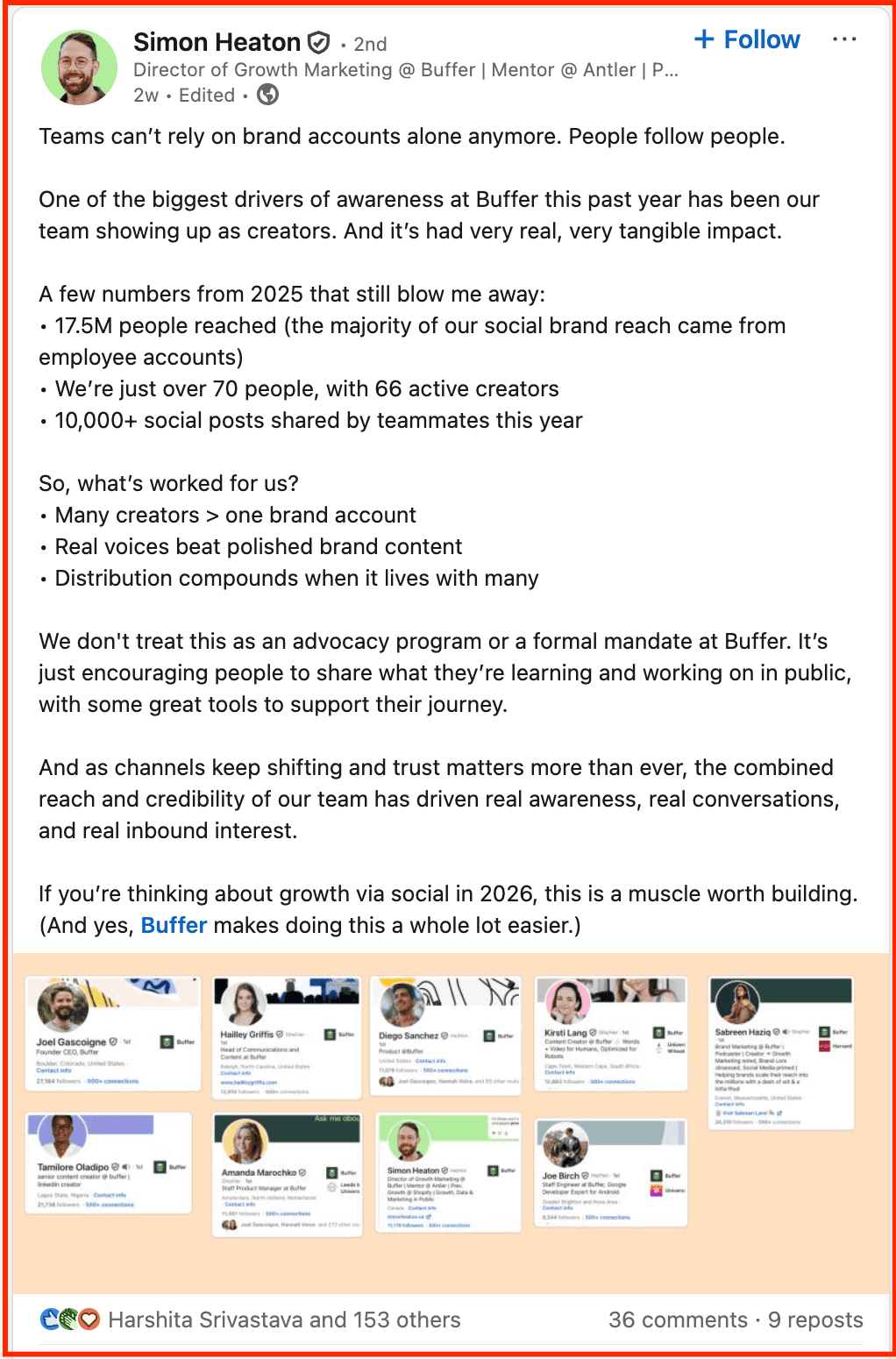
This is because personal accounts enjoy more engagement than company pages. Not only do they have a larger audience, but they also have higher engagement. Your brand logo is just a drawing. However, your employees are real people with families, pets, likes, and dislikes.
With employee advocacy, your brand stops being a logo and becomes a group of people with shared values. That’s why any lead you acquire through your employees' social media is 7x more likely to convert than leads you find anywhere else.
3. Helps You Attract Better Talents
Companies that invest in employee branding are three times more likely to hire quality talent than those that don’t.
When employees are advocates for your company, they’re always happy to speak highly of you. So what better way to amplify your talent brand message than through your own employees?
When your employees share not just the latest vacancies but also what it's like to work for your company, it helps attract top candidates through their networks.
That’s why you see so many employees sharing about new job openings on their LinkedIn accounts.
Here’s how AiSensy employees are promoting their new hiring position by highlighting the company's culture and their experience working with the company.
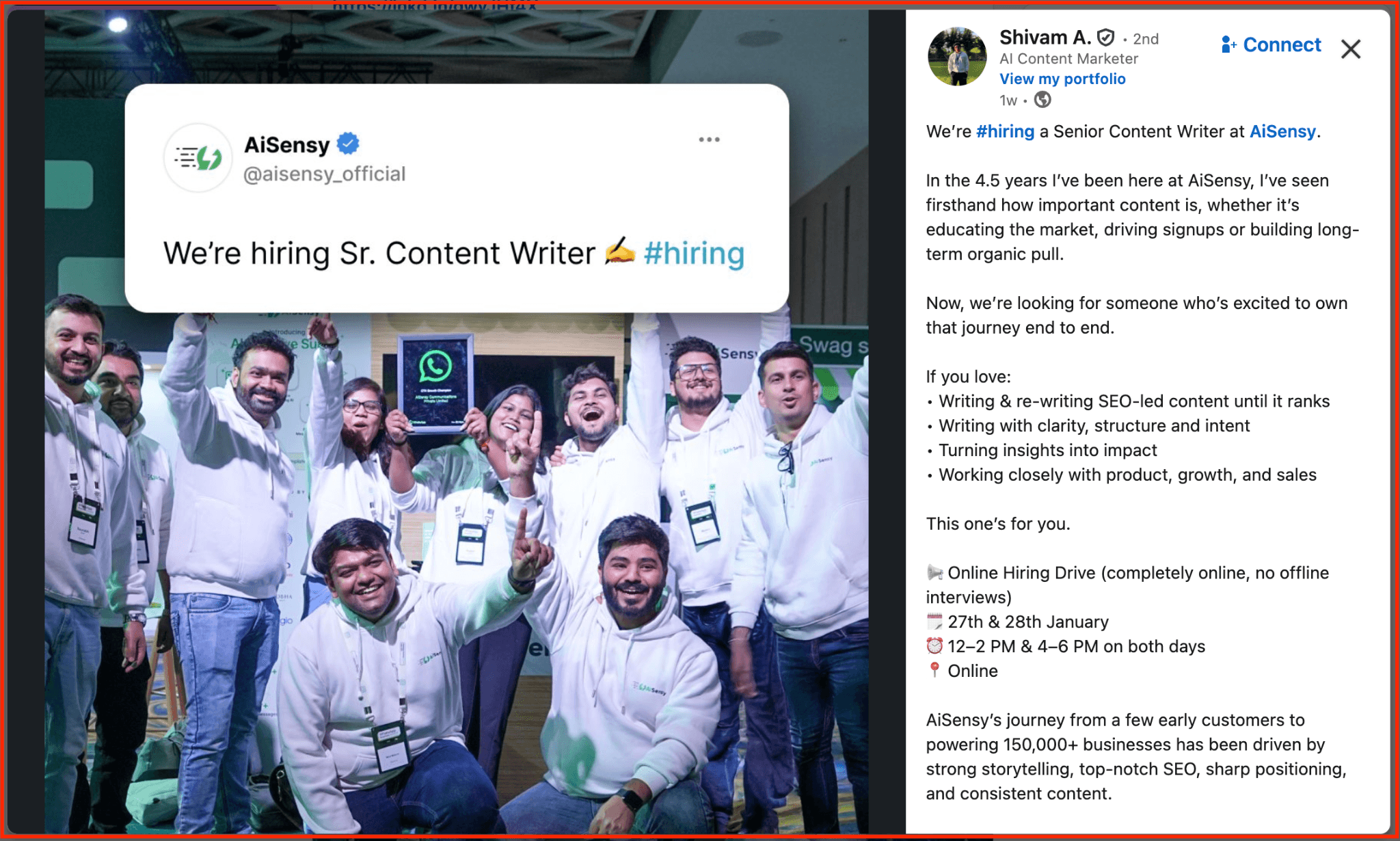
Employees are seen as 2X more trustworthy than a company CEO, so thoughts about what it’s really like to work at your company carry far more credibility when they come from them. This not only builds trust with potential hires but also makes the role more appealing.
This automatically reduces your time and cost to hire. Employee advocacy helps businesses hire better talent with less money.
4. Faster Market Feedback Loops
Employees, especially in sales, customer success, recruiting, and product, interact daily with prospects, customers, candidates, and partners.
When they share content, comment on industry discussions, or engage in 1:1 conversations, they naturally surface early signals: shifting buyer priorities, emerging objections, pricing sensitivity, competitive mentions, and unmet needs.
-
DMs expose real buying intent, concerns, and use cases
-
Comments reveal what resonates or confuses
-
Silent signals (views without comments, saves, profile visits) suggest latent interest even when prospects aren’t ready to engage publicly
-
Repeated questions highlight gaps in content, enablement, or product clarity
When captured systematically, these insights inform messaging, content strategy, sales enablement, and even roadmap decisions.
5. More Consistent Brand Presence Without Burnout
Brands spend 10-20% of their marketing budget on brand awareness, yet very few have a recognisable name in the industry. In B2B organizations, it can account for ~16% of the total marketing budget, often the largest single area of spend.
It's because 58% of Google searches end with zero clicks, as audiences find answers directly in search results, AI Overviews, or tools like ChatGPT and Perplexity.
Inbound marketing isn’t dead; it's just that the linear funnel it relied on is no longer fit for the purpose. That’s where employee advocacy comes into existence.
Michel Lieben, founder of Cold IQ, revealed that turning its employees into LinkedIn creators generated 27+ new clients and over $153,000 in MRR in just 90 days. Prospects kept telling the sales team, “We see you guys everywhere.”
You can read the detailed breakdown here.
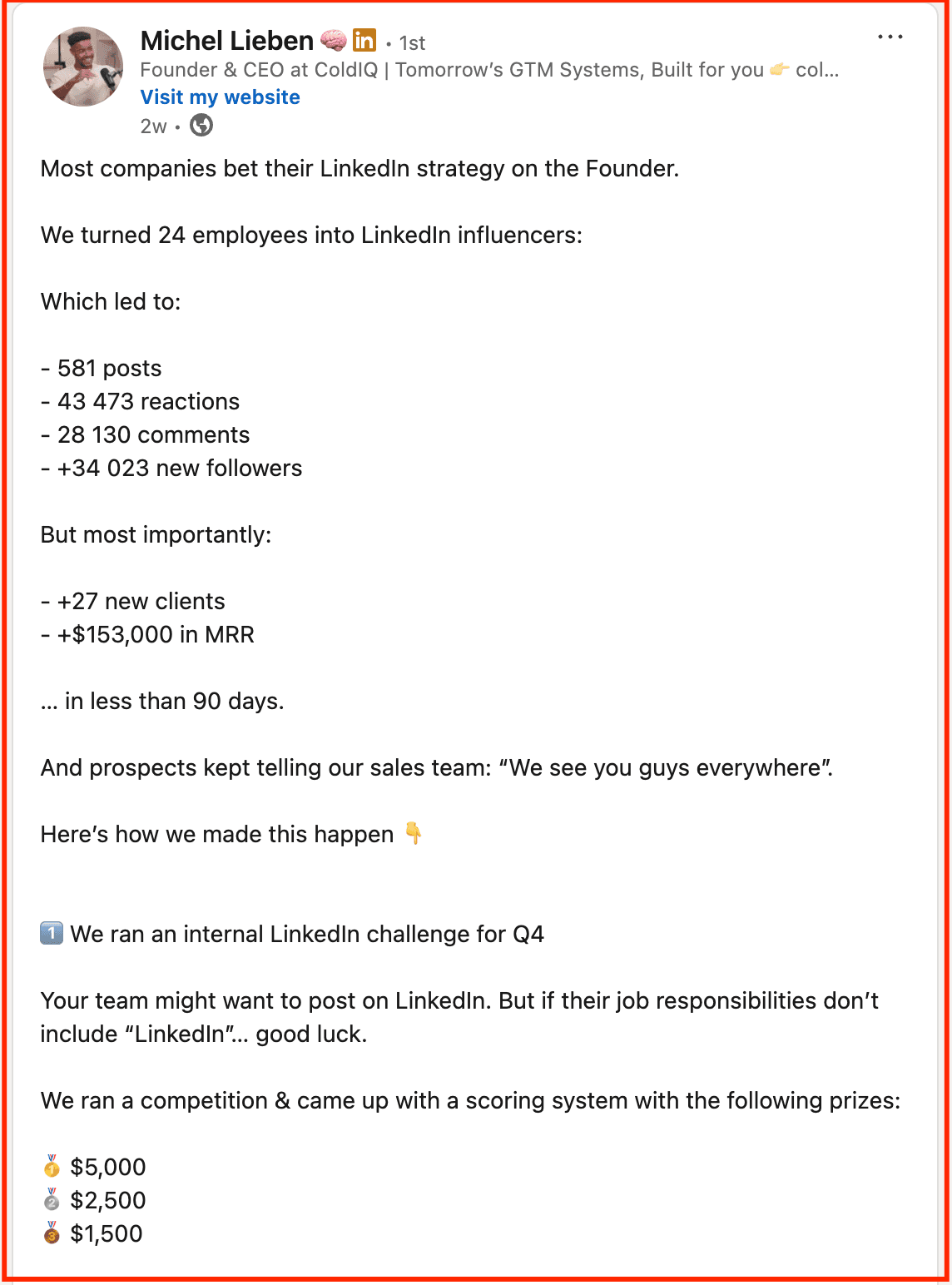
That’s called the advocacy loop.
Every post shared, every comment replied to, and every relationship built by employees adds to the momentum, helping brands reach long-term brand equity.
Every time an employee shares, comments, or engages, your circle of trust grows.
-
Over weeks, that activity increases visibility
-
Over months, it builds a reputation
-
Over the years, it creates brand gravity—the kind of recognition no algorithm change can’t erase
When your people express your brand values, discuss the nuances of their industries, and evolve through real-world feedback, they help brands build a presence that marketing teams take years to achieve.
6. Lead Generation That Compounds Over Time
Most B2B buying happens before a prospect ever contacts you.
Bain & Company found in early 2025 that around 60% of searches end without a click, as people find answers directly in search results and AI tools. By the time someone fills out a form, they've already made up their mind.
That's where employee advocacy earns pipeline. When your people share how they solve real problems, they put your company inside that private research phase:
-
Buyers meet a familiar voice, not an ad they scroll past
-
Trust is built before the first sales call
-
Every post keeps surfacing long after it goes live
Leads sourced this way convert faster because the credibility already exists. Nobody needs convincing your team knows the work.
6 Key Benefits of Employee Advocacy for Employees
Employee advocacy programs don’t just benefit firms; they help the advocates, too.
As mentioned above, the key benefits are often most associated with the employer, but employees are often unaware of the benefits of employee advocacy. The benefits of participating in the advocate programmes might not be immediate, but participating colleagues will see real perks.
Let’s outline the key reason why an employee would want to share content on social media.
1. Increased Professional Visibility
Sharing and engaging can quickly establish employees as thought leaders, which can do wondrous for them as professionals.
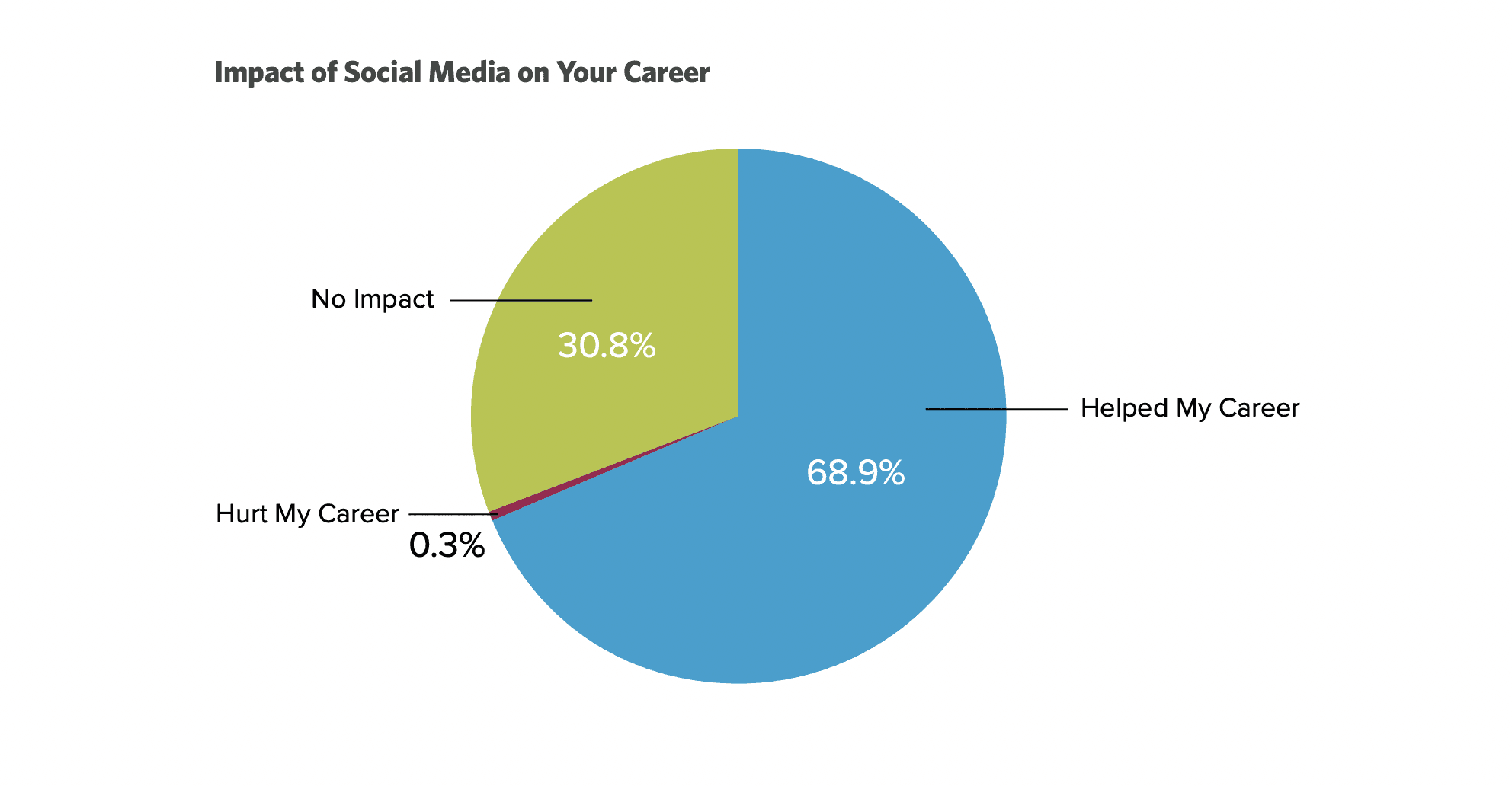
68.9% of employees at companies that have implemented an employee advocacy program report a positive impact on their careers. At the same time, almost none said social media has hurt their career.
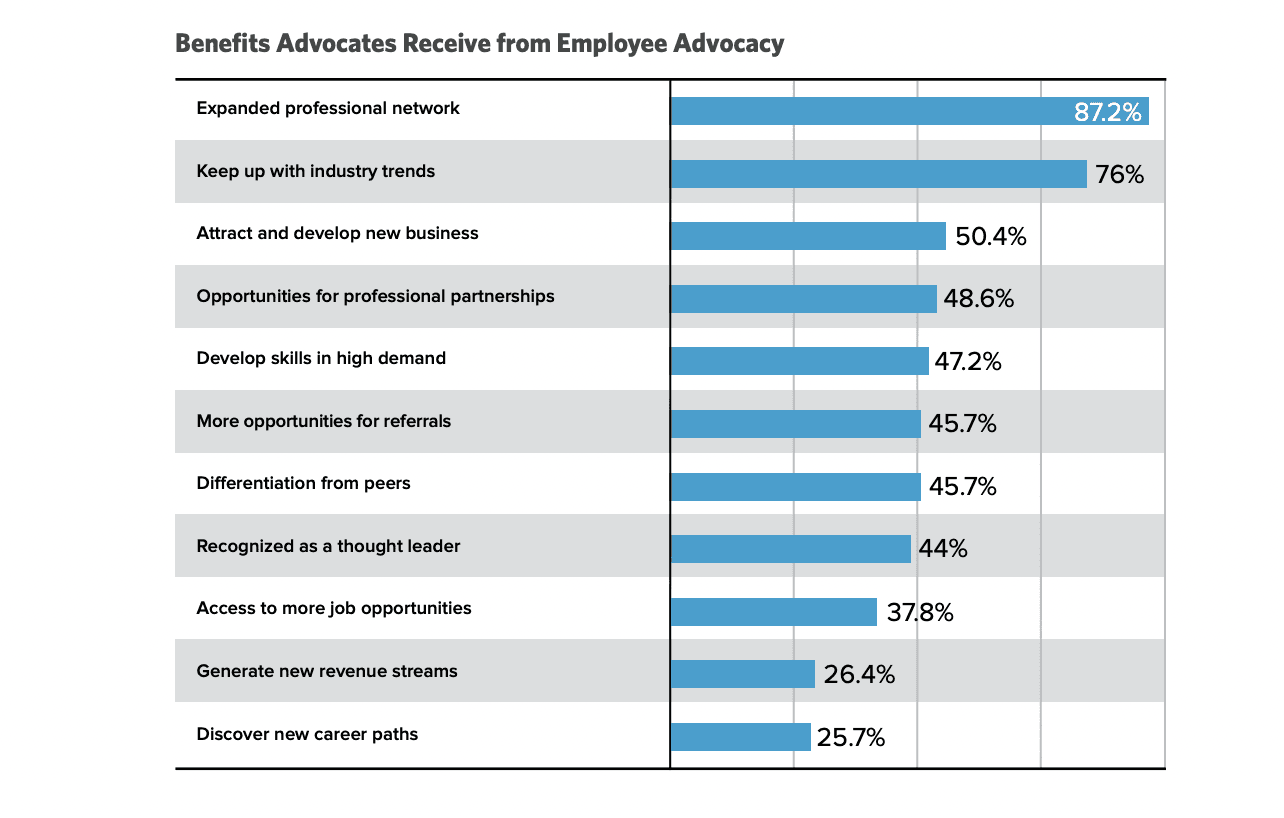
Expanding professional networks (87.2%) and keeping up with industry trends (76%) are the two most common benefits of employee involvement in social media for employees beside:
-
Attract and develop new business (50.4%)
-
Opportunities for professional partnerships (48.6%)
-
Develop skills in high demand (47.2%)
-
More opportunities for referrals (45.7%)
-
Differentiation from peers (45.7%)
-
Recognized as a thought leader (44%)
-
Access to more job opportunities (37.8%)
-
Generate new revenue streams (26.4%)
-
Discover new career paths (25.7%)
You can become a thought leader and an employee influencer, side by side. Your personal brand provides an online space to share your story and achievements, and helps you reach your career goals.
2. Stronger Personal Brand & Credibility
Ever noticed how some people on LinkedIn “own” the space so clearly that your brain creates a shortcut?
When you think of marketing hot takes, you might think of Patrick Cumming.
When you think of SEO, you might think of Kevin Indig
When you think of UX, you might think of Casey Hill
When you think of growth, you might think of Roxana Irimia
Not because they have thousands of followers or they work with big brands, but because they’ve built their credibility through content.
Platforms like LinkedIn consistently prioritize:
-
Executive insights over brand talking points
-
Unique employee perspectives over generic company promotions
-
Human explanations over templated tone
Why? Because real, authentic voices signal accountability and authenticity.
Employees who consistently show up by commenting on trends, breaking down complex topics, or sharing firsthand experiences build a visible body of work that demonstrates competence and judgment.
This turns everyday work into public proof of expertise and credibility.
3. Expanded Professional Network
Employee advocacy doesn’t just amplify the company brand; it compounds your personal brand, too.
When your insights, opinions, and expertise are shared and discussed in rooms you’re not physically part of, it builds credibility at scale.
At its core, advocacy is relationship-building in public:
-
Sales teams use it to create trust before the first call
-
Marketers use it to ensure the right ideas reach the right audiences organically
-
HR teams use it to bring company culture and values to life through real voices
-
Recruiters use it to attract top talent by showing what working at the company truly looks like.
Over time, this consistent visibility creates social capital, a career asset that opens doors to new peers, partnerships, speaking opportunities, and roles. People begin to recognize your name, associate you with expertise, and proactively seek you out.
That visibility often influences who gets trusted with bigger responsibilities, leadership opportunities, and promotions.
4. Creative Ownership & Autonomy
Most employee advocacy programs fail for predictable reasons. Not because the employees lack interest, but the environment doesn’t support them.
While organizations worry about losing control, the bigger threat is silence or messages that lack authenticity. Authentic employee voice does not require heavy management.
When businesses focus on enabling rather than controlling, employees naturally become stronger advocates, resulting in stronger engagement, greater trust, and a reputation that reflects reality rather than aspiration.
In practice, strong employee advocacy looks like:
-
Content that teaches, reflects, or explains – rather than promotes
-
Employees posting occasionally, not constantly
-
Profiles that are clear and current
-
Managers who support participation rather than police it
When such conditions are present, your employees automatically represent your culture, not a separate entity.
5. Career Growth Beyond the Job Title
Traditional success metrics emphasize climbing the ladder, increasing workload, and chasing the next title. However, in today’s chaotic and uncertain environment, many professionals have limited control over their work.
The key insight? Success is not solely dependent on the role itself but also on how individuals showcase their work.
This is where advocacy becomes a powerful skill-builder. Sharing insights, lessons learned, and real experiences sharpens communication, strengthens positioning, and forces clarity of thought.
As a result, employees are no longer invisible contributors. They become recognizable industry voices, trusted for their expertise rather than their designation.
In an uncertain job market, advocacy-led growth increases mobility. Professionals are not confined to their current role or employer; their reputation travels with them. The outcome isn’t just career progression, it’s career resilience.
6. Staying Sharp and Current in Your Industry
Advocacy is usually framed as output, employees creating content for the company. The overlooked benefit runs the other way. To post intelligently about your field, you have to keep up with it.
Employees who share regularly build a habit of paying attention:
-
They read closer and spot shifts earlier
-
Writing a post forces real understanding, not passive scrolling
-
Sharper content pulls sharper conversations into their comments and DMs
That's why keeping up with industry trends consistently ranks among the top benefits advocates report, second only to expanding their networks. The loop compounds. Engaging with your field to create content makes you more informed, and being more informed makes the next post better. Creators end up sharper than peers who passively consume the same feeds.
Unlock the power of employee voices
Employees are the most effective way for businesses to connect with their audiences and build trust, but employees need to establish their own names and have a voice beyond their job titles.
Scaling employee advocacy is straightforward with Supergrow’s employee advocacy platform. It empowers companies to amplify their brand through their people, while helping employees build visibility, credibility, and influence in their industry.
With Supergrow, scaling employee advocacy becomes simple and structured:
-
Enable employees to share relevant, on-brand content effortlessly
-
Encourage authentic thought leadership, not forced corporate posts.
-
Maintain brand consistency without limiting individual expression
-
Track participation, reach, and impact across teams
Supergrow turns employee voices into a powerful, scalable growth channel for both businesses and the people behind them.
Want to build an employee advocacy program that scales and brings ROI? Sign up on Supergrow now!