
Most B2B teams that use AI to create social media content are struggling.
Scroll through LinkedIn, and you’ll see it everywhere. Polished, professional-looking AI content that somehow feels… empty, generic, or disconnected from real expertise.
AI makes it easy to publish. It also makes it easy to sound the same.
The issue is not AI itself; it's using AI without a framework, which results in content that sounds like everyone else's. AI can analyze data in milliseconds, but it can’t understand your brand or your audience unless you train it.
You need:
-
A system that learns your voice
-
Tools that generate ideas from your past content
-
AI that writes like you, not a robot
Because AI isn't a writer with original thoughts, it operates on structure, patterns, and inputs. It can extract your voice, systemize your ideas, and let your content sound exactly like you – consistently, and at scale.
So, here are 10 different ways you can use AI to create content for your social media without losing your voice.
Why Most AI-Generated Social Content Feels Generic
The biggest mistake B2B brands make isn't using AI–it's using it without any strategic guardrails. Most marketing teams approach AI content creation with a "set it and forget it" mentality that inevitably produces generic results.
AI Is Used Without Context
The complaints about AI are always the same: it's just fine. You can't point to an error, but the response doesn't feel written for you.
And, the reason AI output feels generically fine is that it was optimized to be generically fine. That's not a side effect. That's the training objective.
Every time you use AI without context, you're getting a response optimized for someone who doesn't exist– the median user, a composite of everyone's preferences and nobody's in particular. Most people type "write me a post about X." Then wonder why it sounds like everyone else.
It's like hiring an intern who has a PHD. Brilliant, fast, can research all night. But, if you don't give them the right prompts or weave in context, they'll crank out work that looks slick on the surface and misses the point underneath.
-
Wrong voice
-
Wrong audience
-
Wrong priorities
-
No alignment with platform intent (LinkedIn ≠ , Instagram ≠ , X)
-
Looks fine, but doesn't sound like us at all
That’s how AI content works. It doesn’t create brilliance. It amplifies what you feed it. If you feed it vagueness, you get polished vagueness. If you feed it clarity, you get clarity at scale.
AI Replaces Thinking Instead of Supporting It
If AI is replacing thinking instead of supporting it, a natural question follows: how would it ever know when to think in the first place?
For a writing assistant, this isn't trivial.
-
How would it know when an idea is underdeveloped and needs structuring instead of polishing?
-
How would it know when an opinion is too safe and needs sharpening?
-
How would it know whether adding a personal example creates clarity or just fills space?
AI can only brainstorm through the lenses you give it. Your brain can surface ideas AI simply can't, because you won't think to tell it where to look.
Not because the tool failed. But because the tool doesn't know your story, your tone, your customers, or your edge. That's why AI-generated content often looks polished but predictable, leading to lower engagement and sounding like every other post on that topic.
There Is No System Behind AI Usage
AI isn't slowing you down, but most people are still treating it like it's stuck in 2022.
They open a chat.
They type a one-off prompt. Ask for captions, ideas or posts.
They copy-paste the output and upload it to their social media.
That's fine for generic posts. But it's not how you build consistent, high-quality content at scale. Every time you open AI, you're starting from scratch.
There's no link between what you create, where it goes, or how it performs. The best creators today aren't just prompting, they're building workflows, testing, and engineering content that actually works.
A system turns content creation from a chaotic, draining task into a predictable, repeatable process. It frees up your time and mental energy to focus on what truly matters: adding context, sharpening your point of view, and turning raw ideas into POVs that only you can provide.
10 Ways to Use AI in Social Media Without Losing Your Voice
Here's the reality:
-
You plug in a prompt, get a shiny result, and at first, you're impressed.
-
Then you read it back and think… "This could be any company, in any industry."
-
It's not bad. It's just not you.
And that's why most AI-generated copies feel generic. So how do you stop AI from sounding like everyone else and start making it work for your brand?
Here's the framework we give leaders:
1. Use AI to Generate Ideas, Not Final Posts
Instead of asking AI to generate ideas from scratch, you need to teach it to become your research assistant: one that could surface ideas worth your attention, while maintaining complete control over what actually deserves your time.
Firstly, train your AI on everything:
-
Your voice and tone
-
Your positioning
-
The problems you solve
-
Your beliefs and values
-
Your content pillars
This will help you keep your content coherent over months.
Instead delegating to "write me a LinkedIn post about automation," have back-and-forth strategy sessions:
-
Based on my last 30 posts, what patterns do you see in engagement?
-
Which topics consistently get saves vs. likes vs. comments, and why?
-
What adjacent topics am I not talking about but should be?
-
What assumptions am I making about my audience that might be wrong?
-
Which of my past ideas are worth revisiting from a different angle?
-
What contrarian takes could I explore based on my positioning?
Now filter the ideas based on your expertise, audience relevance and platform context.
For instance, a detailed text-post about a topic might work really well on LinkedIn, but tank on Instagram, since it's about storytelling angles and visuals. In contrast, X is all about writing, a sharp, distilled take that lands better.
2. Define Your Voice Before Using AI
The biggest threat to AI-generated content is sameness.
Your protection is you—your thoughts, experiences, opinions, mission, vision. It's the things that AI can't copy, and the way they bleed into your words.
You can build this by training your own personalized GPT model using all the information available about you, your brand, and your processes. You can lay this out in four foundational "modules":
-
Your stance layer. This is where you define how you show up in your content, not just what you say, but how you say it and what you stand for.
-
Your tone. You decide the emotional texture of your writing, whether you sound sharp and opinionated, calm and educational, or conversational and relatable.
-
Your perspective. You choose the lens you speak from: an operator sharing real-world lessons, an educator breaking things down, or a storyteller creating narrative-driven insights.
-
Your boundaries. You define what you stand for, and just as importantly, what you push against. This includes ideas you disagree with, trends you won't follow, and lines you won't cross.
Each document should contain as much detail as possible, so your AI can easily retrieve it when needed.
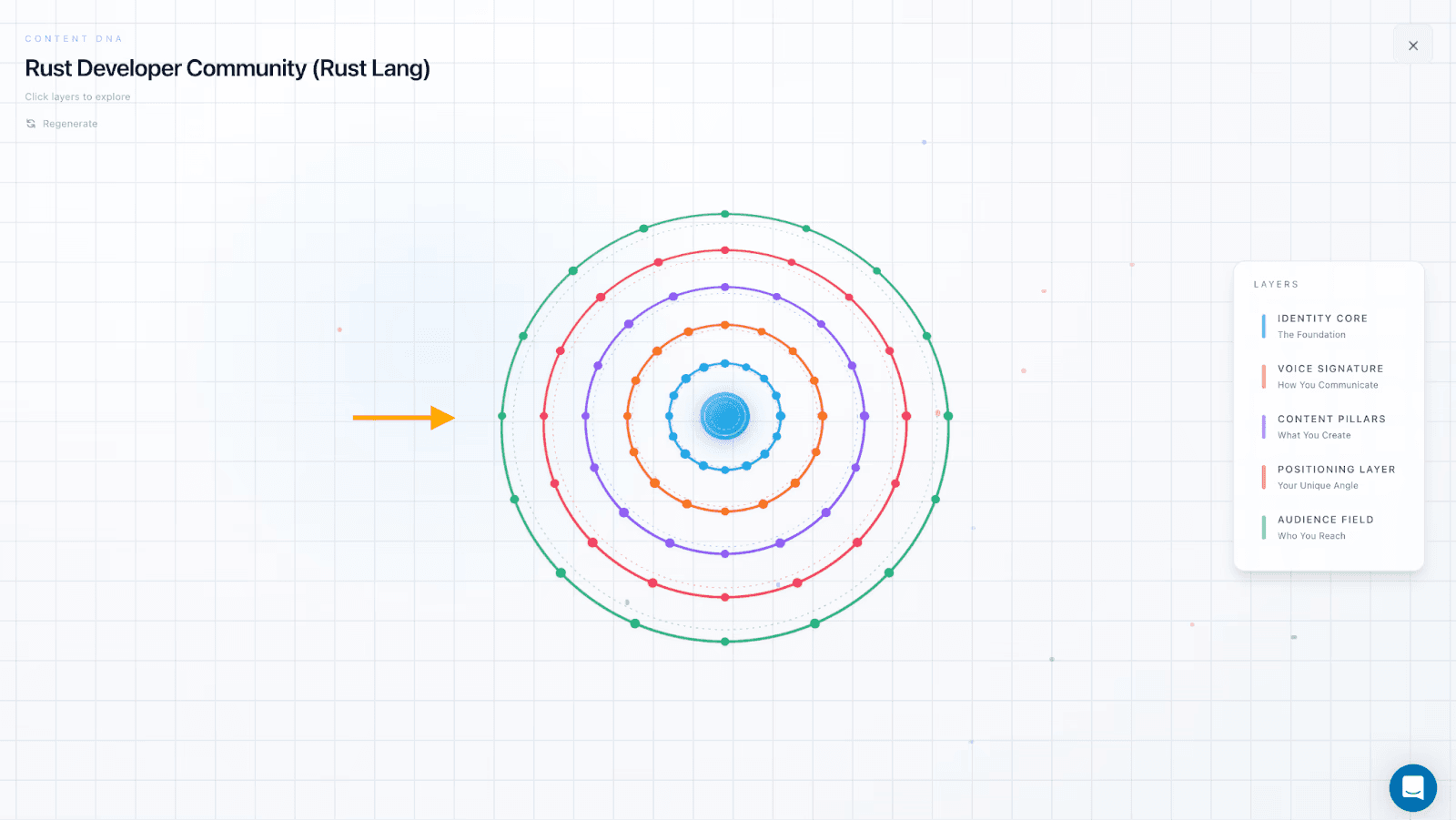
If you want to skip the hassle of building your personal voice, Supergrow DNA does it for you. It's a comprehensive framework that lets you build a profile that captures your tone, opinions, vocabulary, and topics you care about.
-
Identity Core — The Foundation (Who You Are)
-
Voice Signature — How You Communicate
-
Content Pillars — What You Create
-
Positioning Layer — Your Unique Angle
-
Audience Field — Who You Reach
Think of it as your professional identity map; each layer builds on the previous one to create a complete picture of your LinkedIn brand.
3. Turn AI Outputs Into Personal Insights
Because of AI, anyone can spin up "10 tips" in seconds. That's not impressive anymore; what stands out is when you share the things only you can.
For instance,
-
Personal experience: Moments you've actually lived through, what worked, what failed, and what changed your thinking.
-
Client examples: Bring in patterns and proof from your actual work. This shows that your ideas aren't just opinions; they've been tested successfully.
-
Real-world observations: Layer in what you're noticing in the market, audience behavior, or platform trends. This keeps your content relevant and sharp.
The easiest way to stand out is to document the things only you can answer. The trick is to capture it in a way AI can reuse later.
If you want to influence and inspire, add receipts of your claim. You don't want to sound like this. Anyone in any industry could write this Post (or idea).
Based on persuasion best practices, here are three essential ways to support and back up your claims:
-
Data: Numbers, statistics, and research are foundational. It provides context for why your post matters.
-
Testimonies: Third-party validation is incredibly powerful. A glowing endorsement from a satisfied client or an insight from a respected industry expert builds credibility.
-
Stories & Anecdotes: Humans are hardwired for narrative. Use cases, specific examples, and demos breathe life into your claims and support your core message while making it more memorable.
Once captured, upload that doc into your AI Project. Now, when we ask the AI to draft a LinkedIn post, carousel, or newsletter, it's not guessing. It already has the client's receipts and stories in context.
4. Use AI for Structure, Not Substance
AI amplification is fundamentally about thinking better about the work you are doing, not so much about having it do the work for you.
It's bloody brilliant at sharpening how your ideas come together, rearranging your thoughts so they move naturally, and then there are hooks and transitions—the parts most people struggle with.
But, it's not better than human thoughts.
Your content doesn't grow because of your posting frequency, your hooks, or how polished your content looks. It comes from unique insights that humans bring to the table: the way they interpret reality, connect patterns, and translate experience into perspective. That's what turns ordinary content into something memorable.
The real leverage comes from combining the two, using AI to sharpen the packaging, while you own the perspective.
-
On YouTube, it means better concepts driven by your opinions.
-
On LinkedIn, it means sharper insights, clearer structure, rooted in your personal experience.
-
On Instagram, a swipe-worthy carousel built from a real-world perspective and storytelling
The leaders who get this right don't sound like they're chasing AI hype. They sound like themselves, sharper and more consistent than their competitors.
5. Match AI Output to Platform Format
It's not surprising most creators are copy-pasting the same Post across 10 platforms and calling it a "strategy"… then wondering why it disappears without a trace.
Each social media platform has its unique rules of engagement. Instagram loves images. LinkedIn echoes boardroom talk mixed with water cooler banter, aka thought leadership. X breathes rapid-fire takes.
Algorithms reward platform-specific content, not duplicated assets pushed everywhere. When you have to be on multiple channels and want to tailor your posts to all of them, AI is the tool for the job.
Here's the secret. You don't need to reinvent the wheel every time. Start with one pillar asset like a case study, report, webinar, or campaign. Then ask AI to tailor it:
-
LinkedIn: Turn it into a carousel, breaking down key insights, frameworks, and takeaways people can apply.
-
Instagram: Pull out one compelling stat or moment and design it into a story or carousel that's easy to consume and swipe through.
-
X: Distill the core message into sharp, bold statements, thread it or turn it into a meme that travels fast.
-
YouTube: Expand the idea into a narrative; context, breakdown, examples, and your personal story layered in.
The content is the same at its core, but the format respects each platform and the people who spend time there.
When an idea moves between platforms without structural adaptation, it carries the assumptions of the environment it came from. It speaks the accent of its original platform. That is why resized content feels generic. It is not wrong; it is misaligned.
6. Use AI to Maintain Consistency Across Platforms
Most B2B teams share one personal branding challenge. They dread the content calendar.
AI, combined with a good process, eliminates most of the friction. It ensures that AI produces high-quality drafts that require minimal revision while maintaining the consistency and coherence that define your personal brand.
But, before you touch the tools, lock in the essentials:
-
What do we value?
-
How do we want to sound?
-
What words, phrases, or tones do we never want to use?
Write it down. Keep it short, clear, and brutally honest. This becomes the DNA for your AI copy and brand messaging.
Now, open your AI tool and prompt it for a bulk list of content ideas.
You can try this prompt:
"You're creating content for [Company Name]. Write in a [voice characteristics] voice for [target audience], keeping their needs and context in mind. Use these top-performing examples as style references: [insert examples].
Focus on [pillar 1], [pillar 2], and [pillar 3]. Generate 40 content ideas (10 per pillar) for [platform] in [month/year]. Each idea must have a specific angle or hook—no generic topics."
This should give you a full idea bank in seconds. Go through the list and mark the ones that feel right for your brand. You don't need all 40, you only need the best 20–25.
Now you can begin writing the content. Batch the content by pillar. Take all your ideas and prompt the AI to draft them together.
You can also use Supergrow's post scheduling feature to plan posts and keep your calendar consistent without chasing reminders. It shows every scheduled Post, the best time slots, and gaps you need to fill.
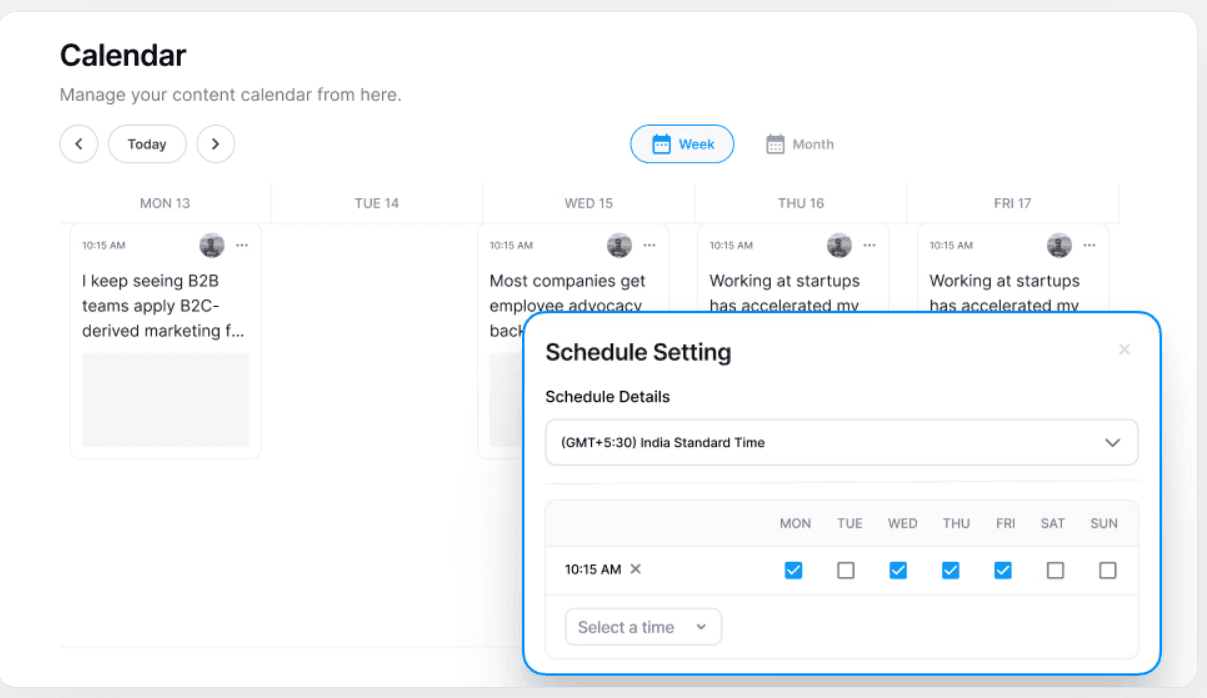
With the post scheduler, you can keep your posts running seamlessly for over 3 months in advance.
7. Use AI to Repurpose What Already Works
Most of what organizations call "repurposing" is simply distribution. An AI tool generates a shorter version of an existing asset and publishes it somewhere else.
True repurposing starts earlier. It begins with an idea and asks how that idea should exist on each platform.
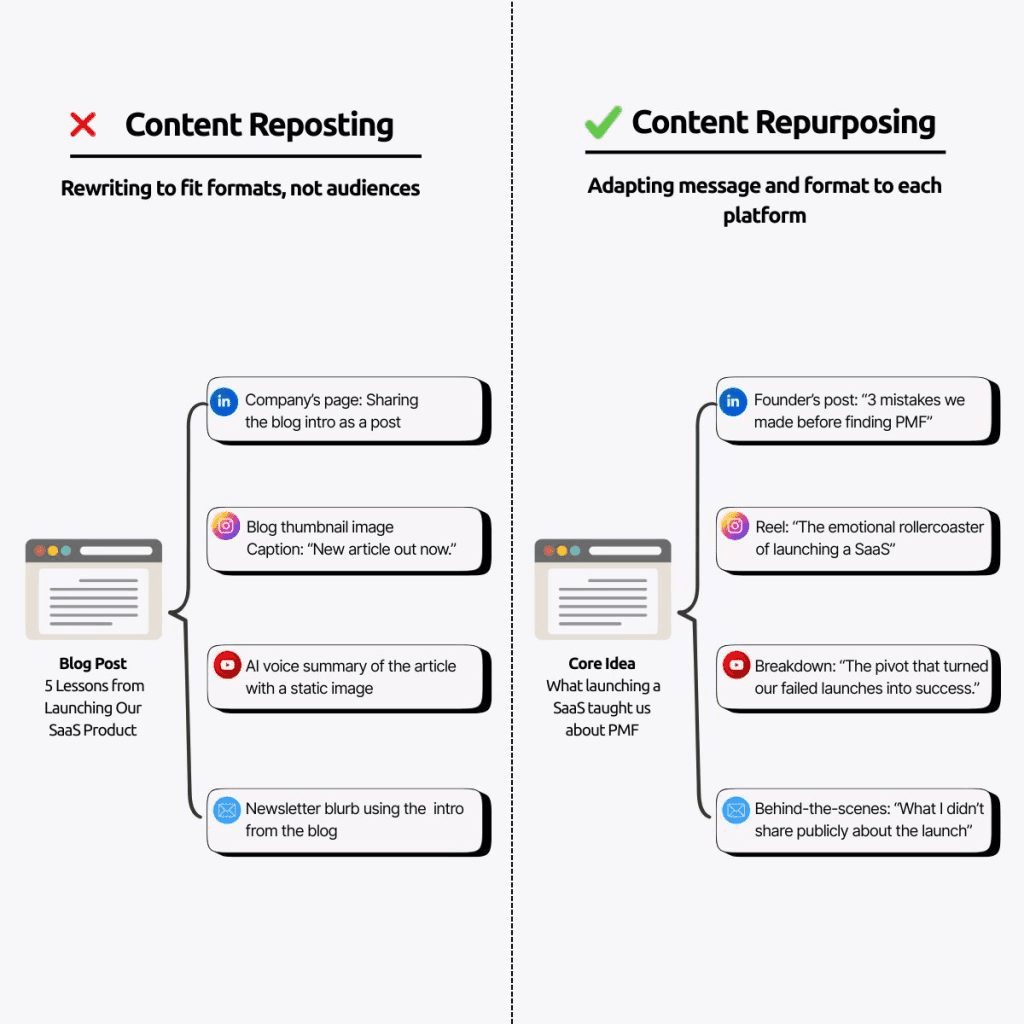
Content repurposing starts with an ideation system from validated ideas: winning LinkedIn posts, high-performing threads, strong newsletter sections, and videos that already contain proven insights.
Instead of inventing new topics, extract and refine the ideas that already performed well (impressions, saves, engagement, leads).
You can define your repurposing routes to remove 100% of the guesswork and blank-page syndrome from content creation.
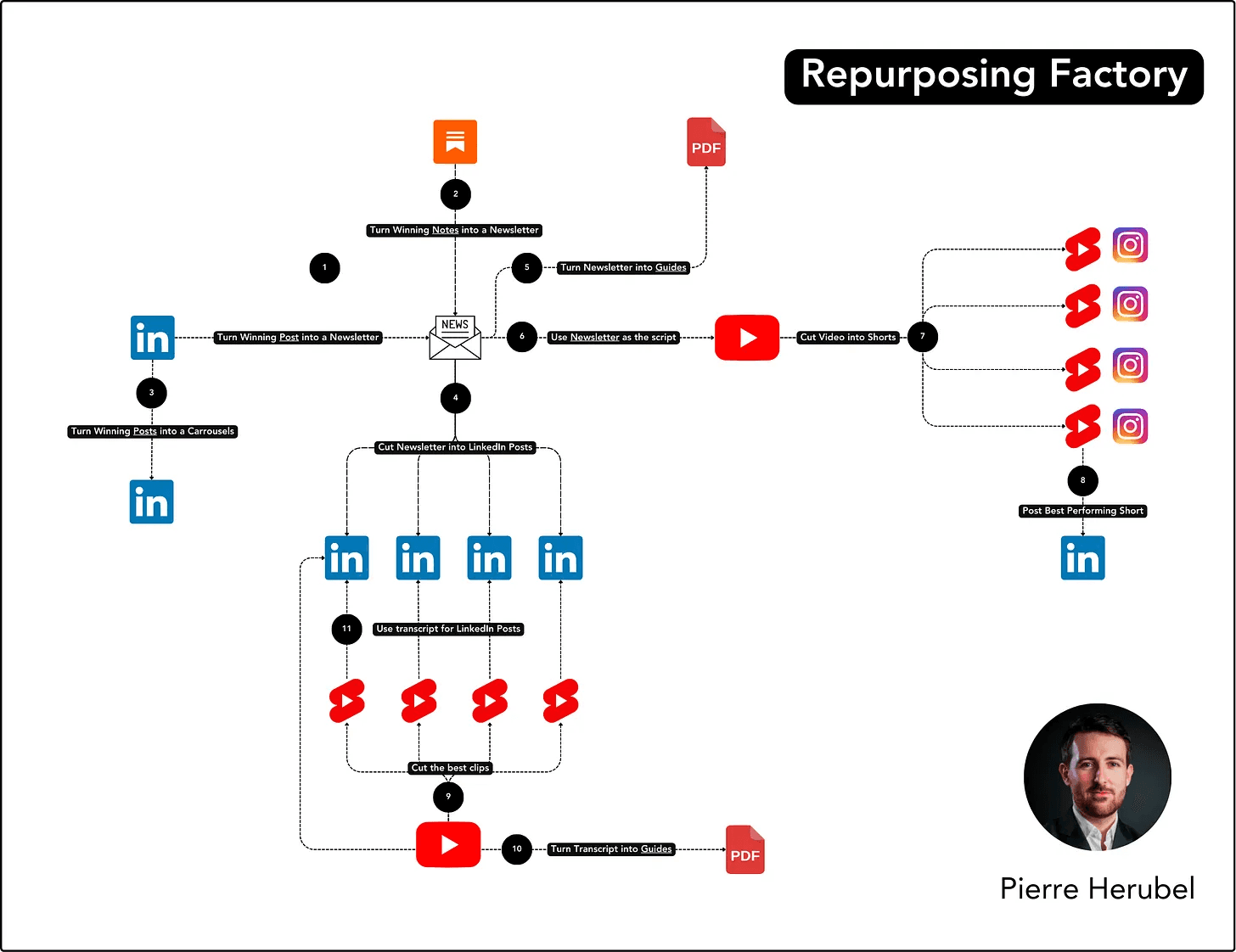
What this includes:
Route 1: LinkedIn Post → Carousel → Newsletter: Start with a high-performing post. Turn it into a structured carousel (framework, steps, or story). Expand on the same idea in a more in-depth newsletter with examples and context.
Route 2: X Thread → LinkedIn Post → YouTube Script: Test ideas as threads. Convert winning threads into sharper LinkedIn posts. Scale the best ones into long-form YouTube scripts with storytelling and depth.
Route 3: Instagram Carousel → X Threads → LinkedIn Posts: Use carousels to package ideas visually. Break each slide into multiple X threads (one idea per thread). Refine top-performing threads into high-signal LinkedIn posts.
Route 4: YouTube Script → LinkedIn Posts → Instagram Carousels → X Threads: Start with a long-form script (core idea + depth). Extract 15–20 insights into LinkedIn posts. Turn key frameworks into carousels. Distribute bite-sized ideas as X threads.
If you want to skip the hassle of choosing the right format, then Supergrow Post generation templates will help you get started.
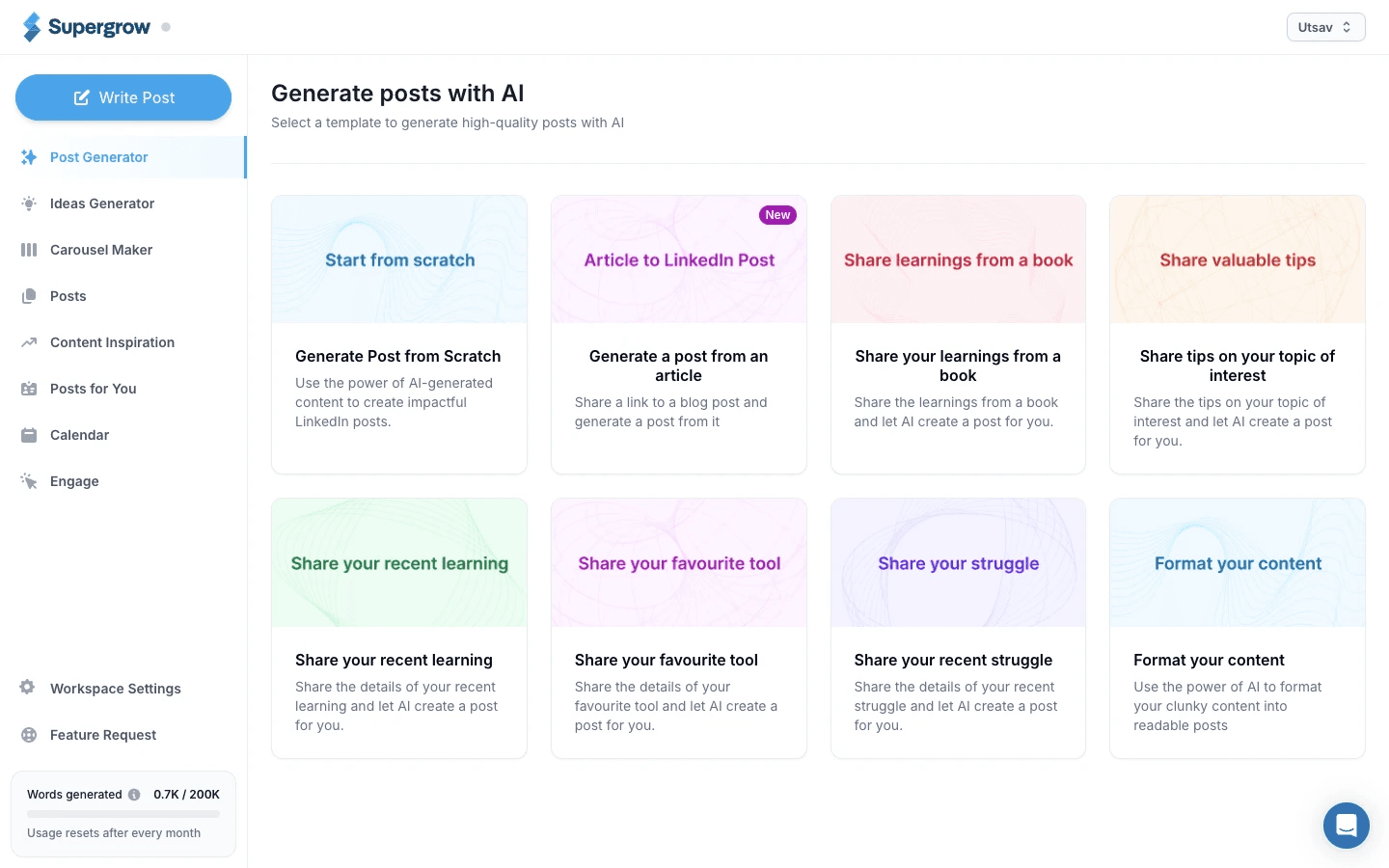
It enables you to repurpose content from YouTube, Blog, and PDF across 50+ post formats to make LinkedIn posts visually appealing, or simply talk to our AI to create LinkedIn posts from scratch.
8. Use AI to Improve Hooks and Clarity
If you've watched any of Alex Hormozi's videos, you've probably noticed one thing: he gets straight to the point.
So, why does Hormozi put so much effort into the hook?
Because attention is the real currency, in today's world, attention is everything, whether it's a LinkedIn post, X threads, or a YouTube ad if your first 5 seconds don't stop the scroll, game over.
Here's the truth: AI makes it easier to create hooks faster. It has access to millions of high-performing content across platforms and can definitely identify patterns in hooks that generate engagement.
A high-performing hook built with AI typically follows a three-part structure:
-
First Lines: The reader feels concerned: "oh this is for me."
-
Headlines: Concrete details (numbers, timeframes, or constraints) that make the promise credible.
-
Transitions: A seamless transition into the value proposition of your message.
Never settle for the first AI output. Request 10-20 variations across different hook types like questions, statistics/ numbers, contrarian opinion, personal story and timeframe achievement.
Don't treat hooks as one-size-fits-all; each platform rewards a different kind of attention trigger. For instance, LinkedIn favors clear, insight-driven hooks, X rewards sharp and punchy first lines, and successful YouTube videos have a compelling title paired with an engaging intro.
Create a hook performance spreadsheet tracking with hook test and type, impressions, engagement rate and comments quality. After 20-30 posts, patterns emerge showing which AI-generated hook types perform best for your specific audience.
9. Use AI to Learn From Performance
If you're posting without looking at your numbers, you're flying blind. You would need KPIs that are flexible to this dual function of creating content (experimentation and performance).
Produce lots of content with content formats, pillars and hooks. At the end of every week, evaluate:
-
What topics worked?
-
What was the most fun to work on?
-
What feels like it's got legs and/or did well considering the amount of time it took to create?
-
Was the 'hook' of the videos really engaging, but the follow-through less effective?
-
Were there standout posts with identifiable patterns?
From there, define:
-
What activity to pause
-
What worked well / could be evolved
-
What you're curious to experiment with further
Think about the engagements that matter to you. This will vary by platform. For YouTube, you'll likely want more detailed metrics like impressions, click-through rate (CTR), and retention after the opening hook.
On LinkedIn, it's about the number of saves or profile views your posts get; they have a strong impact on your audience.
10. Use AI Within a System, Not in Isolation
AI becomes powerful only when it stops being a "content shortcut" and starts functioning as part of a closed loop, where every output informs the next input.
The difference between a half-baked insight and a fully formed original post is the system it survived. AI can remove friction endlessly, on demand, about any topic.
Every earlier step—hooks, clarity, optimization, performance learning —only creates leverage when it is embedded in this single, continuous system rather than treated as a separate AI experiment.
So overall, the key is to combine 4 core aspects:
-
Unique ideas based on your expertise, audience relevance and platform context
-
Visual content like infographics and carousels to compete in the feed
-
Repurposing ideas that have already performed well
-
Measuring which content worked well and what tanked
When these components are disconnected, AI usage becomes inconsistent and reactive.
The real advantage comes from making this cycle repeatable. Each iteration improves the next, ideas become sharper, execution becomes faster, and distribution becomes more strategic.
Conclusion — AI Should Amplify Your Voice, Not Replace It
It's not that AI is bad. In fact, it's the smartest tool most leaders have ever touched. But smart doesn't equal aligned. Without direction, AI outputs blur into the same "corporate robot" voice that every other company is using.
Instead of seeing AI as a tool you use and discard, view it as a space you cultivate over time. The real magic of AI being used in a coherent system is that they grow more valuable with each interaction, creating a compounding effect that transforms not just what you produce, but how you think.
This cognitive upgrade is worth the initial investment many times over.
Remember: you are still in charge. AI is not a replacement for your thinking — it is a thinking partner that helps you move past the blank slate, sparking ideas, challenging assumptions, and enabling the kind of dialogue that leads to better decisions and breakthrough solutions.