
Gamify your Employee Advocacy with Challenges & Leaderboards
Challenges, leaderboards, and rewards turn passive participation into a competitive habit. Based on Supergrow customer data, teams see posting frequency double within 30 days.
Start a challenge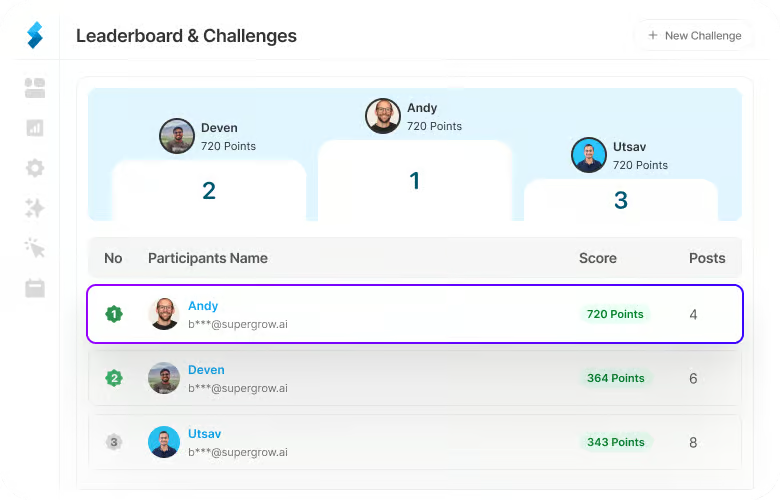
The problem
Why employee advocacy programs lose momentum (and how to fix it)
Most employees want to post. But without structure, motivation fades by week two.
Without challenges
With challenges active
↑ Consistent activity throughout
What is employee advocacy gamification?
Turn passive participation into a weekly habit. Challenges, leaderboards, and rewards replace vague encouragement with visible progress and real stakes.
How It Works
How LinkedIn posting challenges work in Supergrow
Create a challenge
Define the goal: post frequency, engagement, or topic coverage. Set a timeframe, assign a reward, invite your team.
Team members compete
Everyone sees the live leaderboard. Points update in real time. Notifications fire when someone overtakes you.
Reward and recognise the winners
Public recognition on the leaderboard. Announce results to the team. The next challenge fills faster every time.
Gamification Challenges
Run LinkedIn posting challenges your team will actually compete in.
Define the rules, assign a reward, invite your team. Running in minutes.
30-Day Posting Sprint
Post at least 3 times per week for 30 days. Most consistent team member wins.
Reaction Race
Earn the most total reactions across all your posts this month. Quality beats quantity.
90-Day Streak Club
Post every single week for 90 days without breaking the chain. Earn elite status in your org.
Live Leaderboard
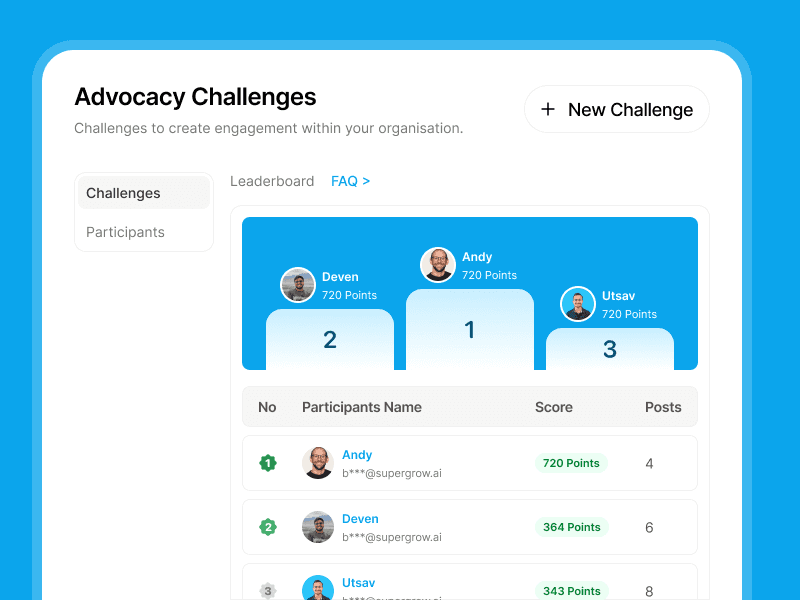
A live leaderboard that tracks every team member's LinkedIn activity
Real-time rankings across the team. Filter by challenge, timeframe, or department.
What team managers say about gamification
Real teams. Real results.
“Once we launched challenges with leaderboards, everything changed. Now over 40 team members are posting regularly and actually competing for streaks.”
FAQ
Frequently asked questions about employee advocacy gamification
Gamification turns LinkedIn posting into a structured competition with visible stakes. Admins create a challenge by setting a clear goal — post frequency, engagement rate, topic coverage, or streak consistency — along with a timeframe and a reward. Team members earn points automatically as they post, track their live ranking on a leaderboard that updates in real time, and compete to finish at the top when the challenge closes. The mechanism works because it replaces vague encouragement with something more powerful: visible progress relative to peers. Most employees already want to post on LinkedIn, but without structure, motivation fades by week two. A live leaderboard removes that ambiguity. Team members can see exactly where they stand, what they need to do to move up, and what they stand to gain. Supergrow handles the tracking automatically — no spreadsheets, no manual counting, no chasing people for updates.
You can run posting frequency challenges — where team members earn points for hitting a target like three posts per week — engagement challenges where the goal is earning the most reactions or comments across all posts in a set period, streak challenges where the prize goes to whoever posts consistently without missing a week, and topic-based challenges tied to a product launch, event, or campaign you want amplified. Each challenge type serves a different programme goal: frequency challenges build a posting habit, engagement challenges push quality, streak challenges sustain long-term momentum, and topic challenges coordinate messaging without a top-down mandate. Challenges can be team-wide or scoped to specific departments or regions. You set the goal, the timeframe, and the reward, and Supergrow tracks everything automatically. Running two or three different challenge types in sequence keeps the programme fresh and maintains participation momentum across the quarter.
Tangible, cash-equivalent rewards convert best. Amazon vouchers, cash prizes, and restaurant vouchers consistently outperform company swag because they feel like a real win, not a participation trophy. The amount does not need to be large — between $50 and $200 is enough to drive genuine competition in most teams. Public recognition compounds the effect: announcing winners in a Slack channel or an all-hands meeting signals to the rest of the organisation that LinkedIn activity is noticed and valued, which raises participation in the next challenge. Supergrow does not handle reward fulfilment — you choose the prize and deliver it through your normal recognition channel. The platform handles everything else: tracking points, displaying the live leaderboard, notifying team members when they are overtaken, and surfacing the final rankings when the challenge closes. The whole process is entirely self-serve.
Most teams see posting frequency increase within the first week of launching a challenge. The leaderboard goes live as soon as you start the challenge and updates in real time as team members post, which creates immediate visibility into who is participating and who is not. A 30-day challenge is typically enough to observe a measurable shift in participation rates and consistent posting activity across the team. The habit effect compounds: teams that run two or three sequential challenges typically see higher baseline posting between challenges than before gamification was introduced, because the leaderboard has made LinkedIn activity a normal part of how the team operates. Results depend on the reward, the communication around the launch, and whether leadership participates — when senior team members compete, participation across the wider team rises significantly. The effect strengthens with each subsequent challenge.
Challenges and leaderboards are available on the Teams plan. You can set up your first challenge, configure the leaderboard, and have everything live in under five minutes — there is no separate module to activate or integrate. The challenge builder is in the same dashboard where you manage approvals, content, and analytics, so there is no context-switching between tools. You can run as many challenges as you like simultaneously or sequentially. There is no limit on the number of team members who can participate, and every member on your workspace is automatically eligible to compete as soon as they have connected their LinkedIn account. If you are on a free trial, you can explore the challenge builder and see the leaderboard interface before upgrading. The Teams plan includes a 7-day free trial.
Start your gamification program
Your team is waiting for a reason to compete.
Cancel any time. Included in Teams plan.