
EveryoneSocial is built for enterprise employee advocacy programs, with one quote-based plan for rollouts that start around 500 registered users. It combines approved content, personal-voice AI, integrations, governance, and revenue reporting.
That setup fits large programs. Teams compare EveryoneSocial alternatives when they need a smaller LinkedIn-first workflow, published pricing, advocacy inside a wider social platform, or internal communications alongside advocacy. This guide compares nine options, including how they work, what they cost, and where each one fits.
The Best EveryoneSocial Alternatives at a Glance
The right alternative depends on what you want to change. Supergrow suits LinkedIn-first teams creating original employee posts. Oktopost connects advocacy with B2B social management and CRM reporting. GaggleAMP and DSMN8 support centrally managed sharing, while Haiilo and Poppulo cover broader communications workflows.
- Supergrow: Best for LinkedIn-first teams where employees and executives publish original posts from their own expertise.
- Oktopost: Best for B2B marketing teams that need advocacy, social management, and CRM reporting in one platform.
- GaggleAMP: Best for broad participation through Slack and Microsoft Teams with pricing based on company size.
- DSMN8: Best for centrally managed advocacy campaigns with personalized content feeds and AI-assisted sharing.
- ClearView Social: Best for professional-services teams that want published prices and straightforward sharing queues.
- Haiilo: Best for organizations buying employee advocacy alongside an intranet and internal communications.
- Poppulo Experience Platform: Best for advocacy run within a wider employee-experience and frontline communications suite.
- Ambassify: Best for community-led programs built around campaigns, recognition, rewards, and employee contributions.
- PostBeyond: Best for curated content sharing and social selling with marketing integrations.
Before comparing them, it helps to understand where EveryoneSocial fits today.
EveryoneSocial Review: About, Pricing, Pros and Cons
EveryoneSocial is an enterprise employee advocacy platform where administrators curate company content into feeds for employees to share. It also supports AI drafting, brand and personal voice settings, approvals, enterprise permissions, and integrations for communications, CRM, and compliance workflows.
How EveryoneSocial Works
Employees receive approved content and AI suggestions through EveryoneSocial, Slack, or Microsoft Teams. They can share, schedule, engage with, and approve posts from those connected tools. Salesforce, HubSpot, Microsoft Dynamics, Smarsh, Global Relay, and Bloomberg Vault integrations support marketing attribution and regulated workflows.
The platform works across several publishing channels and supports programs ranging from 500-person pilots to global rollouts of more than 50,000 people.
EveryoneSocial Pricing
EveryoneSocial has one plan priced by the number of registered users. Contracts run annually, with multi-year discounts available. The company provides a custom quote and does not list a self-serve trial.
EveryoneSocial Pros and Cons
Pros
- Enterprise permissions, SSO, SCIM, implementation, and customer support are included in one plan.
- CRM and compliance integrations support revenue reporting, supervision, and record-retention workflows.
- Brand and personal voice AI support both approved company content and employee-specific copy.
Cons
- The platform is designed for large enterprise rollouts, starting around 500 registered users.
- Pricing is available only through a quote and requires an annual agreement.
- Smaller LinkedIn-only teams can end up paying for broader governance, integrations, and rollout support.
For Whom EveryoneSocial Is Ideal
EveryoneSocial fits enterprises that need social governance, several publishing channels, and CRM-connected reporting in one program. A focused alternative makes more sense when your program serves a smaller group, starts with employee expertise, or needs a different pricing model.
How We Compared the Alternatives
We compared every tool on the same six criteria:
- Who creates the posts: Employees share company content, adapt it with AI, or write original posts.
- LinkedIn focus: The tool is built for LinkedIn or supports several networks and communications channels.
- Approval workflow: Marketing, communications, legal, or the employee can review content before publication.
- Reporting: The platform tracks participation, engagement, traffic, pipeline, revenue, or estimated earned media value.
- Pricing and contracts: Prices are listed or quote-based, and contracts run monthly, annually, or for several years.
- Team fit: The platform fits a small pilot, a focused team, or an enterprise-wide rollout.
Supergrow publishes this comparison. It appears first, includes real limitations, and uses the same fields as every other platform.
EveryoneSocial Alternatives Compared
| Tool | Best For | Content Workflow | Reporting Focus | Pricing |
|---|---|---|---|---|
| Supergrow | Original employee content on LinkedIn | Interviews, individual voice profiles, and approvals | Reach, engagement, participation, and earned media value | Teams costs $199/month for five accounts or $189/month billed annually |
| Oktopost | B2B social programs needing CRM reporting | Pre-approved advocacy board with employee suggestions | Social analytics and CRM-connected attribution | Custom annual quote |
| GaggleAMP | Broad participation through Slack and Teams | Admin-assigned activities with AI copy variations | Reach, earned media value, and UTM-based attribution | Custom quote based on company size |
| DSMN8 | Centrally managed advocacy campaigns | Personalized content feeds and AI-assisted sharing | Engagement, earned media value, and integration-based reporting | Custom annual quote |
| ClearView Social | Professional-services teams wanting published prices | Curated sharing queues | Reach, referrals, campaigns, and earned media value | $425/month for 50 employees or $675/month for 100, billed annually |
| Haiilo | Advocacy alongside internal communications | Content channels and employee sharing | Sharing analytics, with attribution features by tier | From $15 per seat per month, with a minimum |
| Poppulo Experience Platform | Advocacy inside an employee-experience suite | Company content distributed through a broader communications platform | Content, engagement, and participation reporting | Custom quote |
| Ambassify | Community-led programs with rewards | Campaigns plus employee-created Personal Posts on Premium and above | Participation, attribution, and ROI reporting | Custom quote |
| PostBeyond | Curated advocacy with marketing integrations | Content library and employee recommendations | Engagement, earned media value, and lead attribution | Custom quote |
Supergrow focuses on LinkedIn. The other platforms support broader social, communications, or employee-experience workflows. Their available networks can differ between company-page publishing and employee-profile sharing.
The 9 Best EveryoneSocial Alternatives
Each entry covers what the tool is, who it suits, how it differs from EveryoneSocial, what it costs, and its main pros and cons.
1. Supergrow
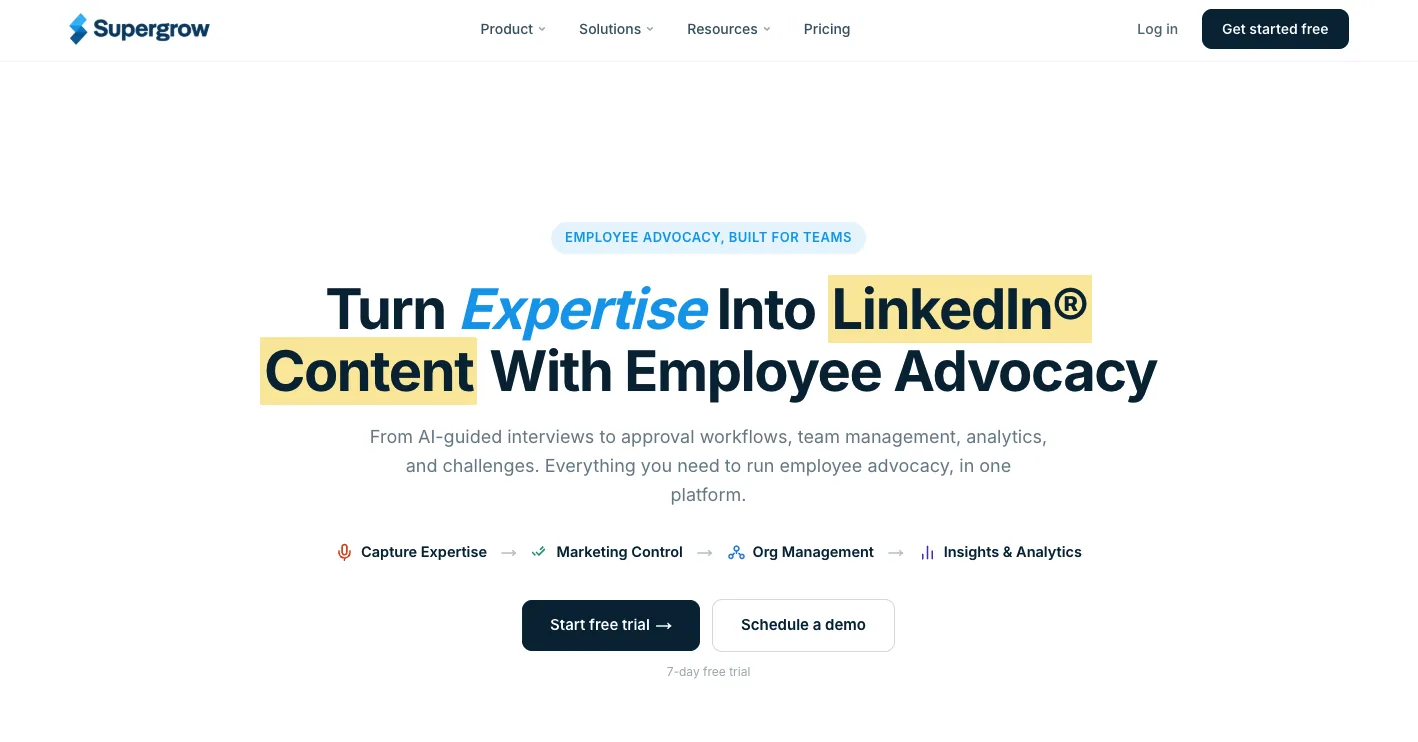
Supergrow gives each employee or executive a separate workspace inside one LinkedIn employee advocacy platform. A contributor can bring in an idea, source document, voice note, or interview, then review the resulting draft before anything is scheduled. Comments, approval status, publishing dates, and performance stay attached to the post instead of moving across email and spreadsheets. The workflow keeps the author involved in the final message while giving the program owner a clear view of what is being created, reviewed, approved, and published.
Best for: B2B teams that want employees and executives to publish original LinkedIn content instead of mainly sharing company posts.
How it differs from EveryoneSocial: EveryoneSocial combines enterprise-wide sharing, personal-voice AI, governance, and integrations. Supergrow starts with each person's expertise. Content Interviews built on PostCast capture ideas, Content DNA keeps each person's voice and positioning, and the Content Board routes drafts through review and approval. Team analytics, weekly reports, Challenges, and leaderboards track participation.
Pricing: Teams costs $199/month for five LinkedIn accounts or $189/month billed annually. Pro costs $39/month for one account. Enterprise pricing is custom, and a seven-day free trial is available.
Pros
- Employees and executives create original posts from their own experience and ideas.
- Content capture, approvals, scheduling, and team reporting are in one LinkedIn-focused workflow.
Cons
- Supergrow supports LinkedIn only.
- It does not replace an intranet, multi-network advocacy suite, compliance archive, or CRM-based revenue-attribution platform.
2. Oktopost
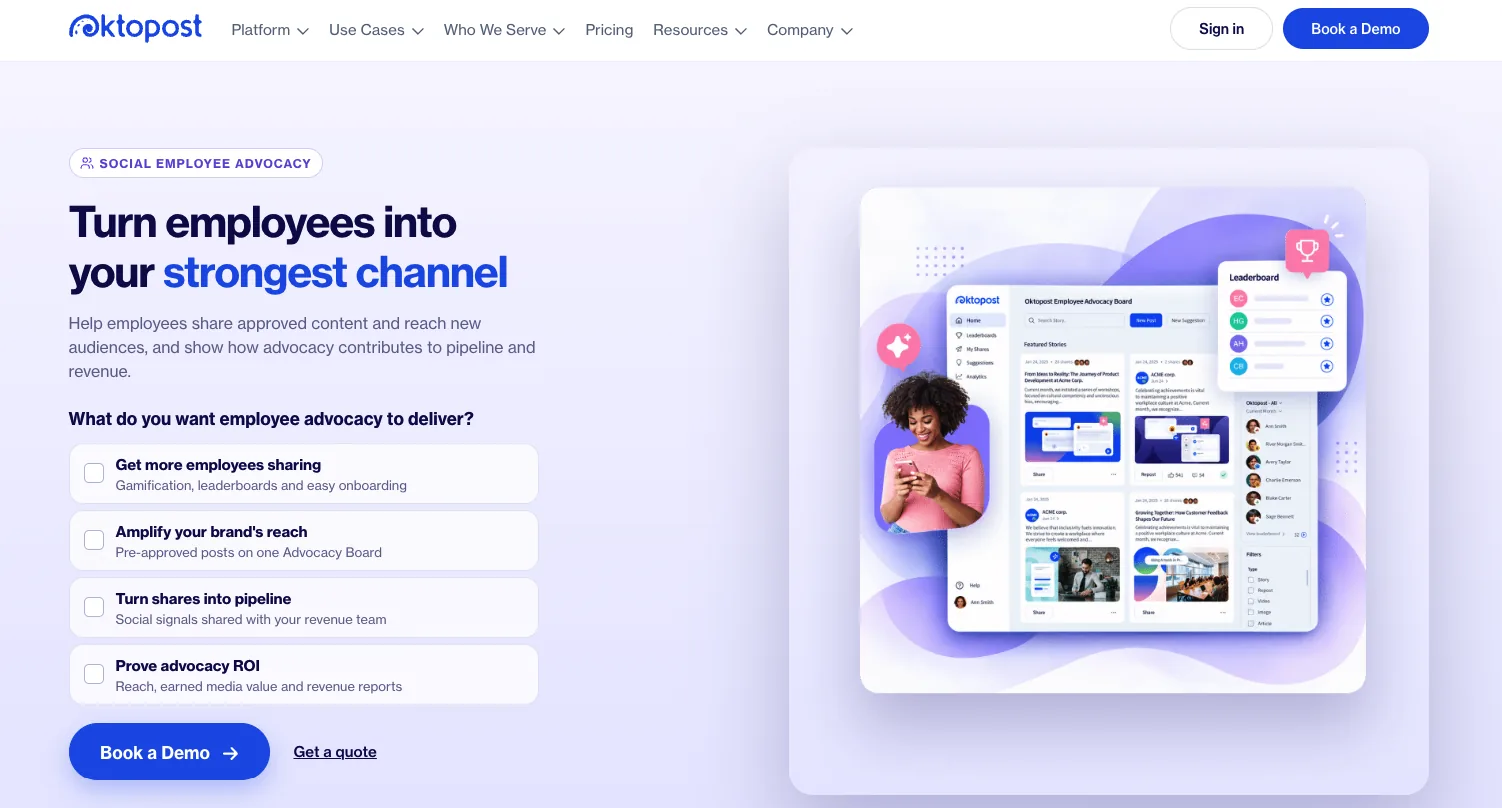
Oktopost brings company-channel management and employee advocacy into the same B2B social workspace. Marketing teams can plan brand posts, route them through approval, monitor conversations, tag campaigns, and analyze performance without moving between separate products. At the same time, employees use the Advocacy Board to browse approved material, filter it by relevance, recommend new items, and share through their own profiles. Because both sides use common campaigns and reporting, program managers can see how corporate publishing and employee distribution contribute to the same marketing activity.
Best for: B2B marketing teams that want advocacy connected to social management and CRM reporting.
How it differs from EveryoneSocial: Both platforms support advocacy and marketing attribution. Oktopost places advocacy inside a wider B2B social management system, so campaigns, brand publishing, lead tracking, and CRM integrations share the same workflow. Its Advanced plan adds approvals, compliance controls, SSO, provisioning, and API access.
Pricing: Professional and Advanced are annual plans with custom quotes based on team size and add-ons.
Pros
- Brand publishing, listening, analytics, and advocacy share one platform.
- Salesforce, HubSpot, and Marketo integrations connect social activity with leads and pipeline.
Cons
- Advanced approvals and compliance controls require the Advanced plan.
- Teams that only need employee advocacy also buy into a broader social management platform.
3. GaggleAMP
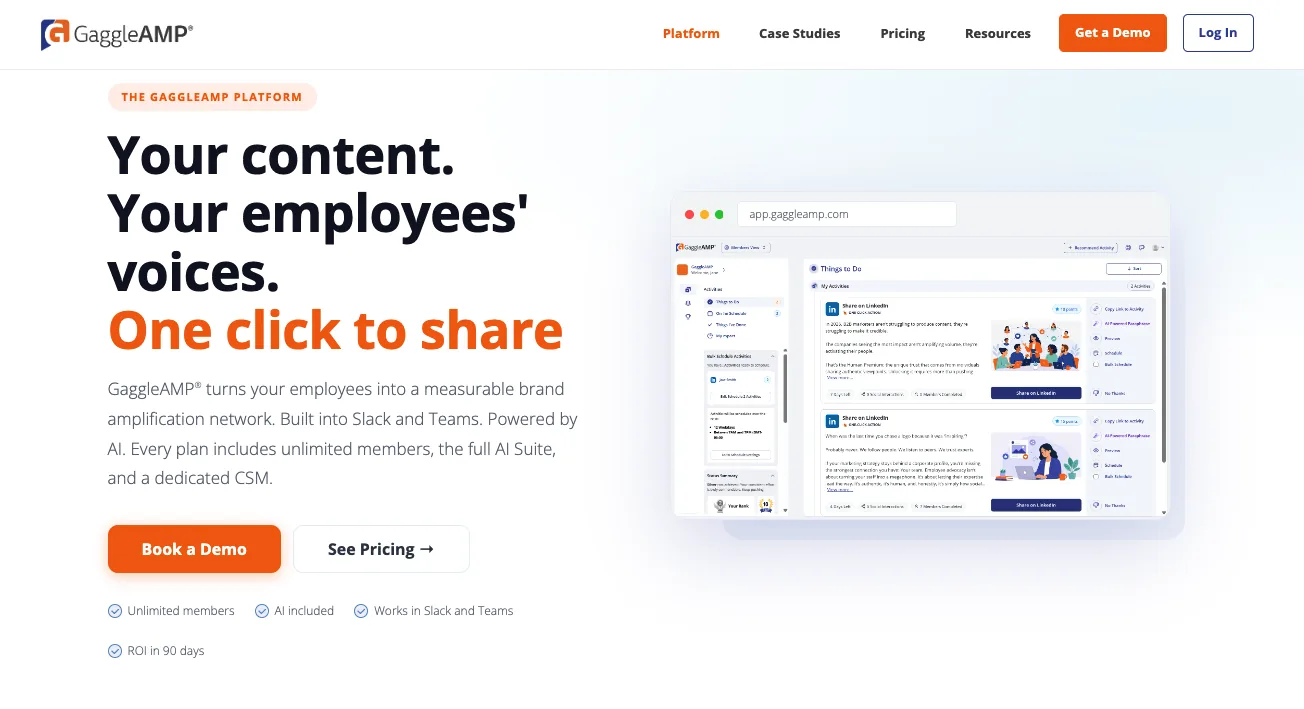
GaggleAMP treats employee advocacy as a stream of specific activities rather than a general content library. A program manager can ask selected groups to share a post, comment on company content, follow an account, watch a video, or complete another social action. Employees receive a personal queue and choose which activities to complete, while managers control timing, audience segments, reminders, and campaign cadence. The administrative view shows participation by activity and group, helping teams see which requests attract action and where the program is losing momentum.
Best for: Companies that want broad employee participation through Slack and Microsoft Teams.
How it differs from EveryoneSocial: Both platforms support large programs and connected workplace tools. GaggleAMP prices by total company size and includes unlimited members. Its AI creates a different version of approved copy for each employee, while UTM tags connect shared links with traffic and conversions. The full breakdown of GaggleAMP alternatives covers the contract model in more detail.
Pricing: Pricing is based on company size and provided through a custom proposal. Contracts are billed annually. A two-year term sets the base rate, one year costs 10% more, and three years costs 5% less. One program workspace is included.
Pros
- Unlimited members let the company invite employees without adding per-seat costs.
- Employees can participate through Slack or Microsoft Teams.
Cons
- The price for a small pilot is still based on the company's total employee count.
- Content starts with program managers rather than each employee's original ideas.
4. DSMN8
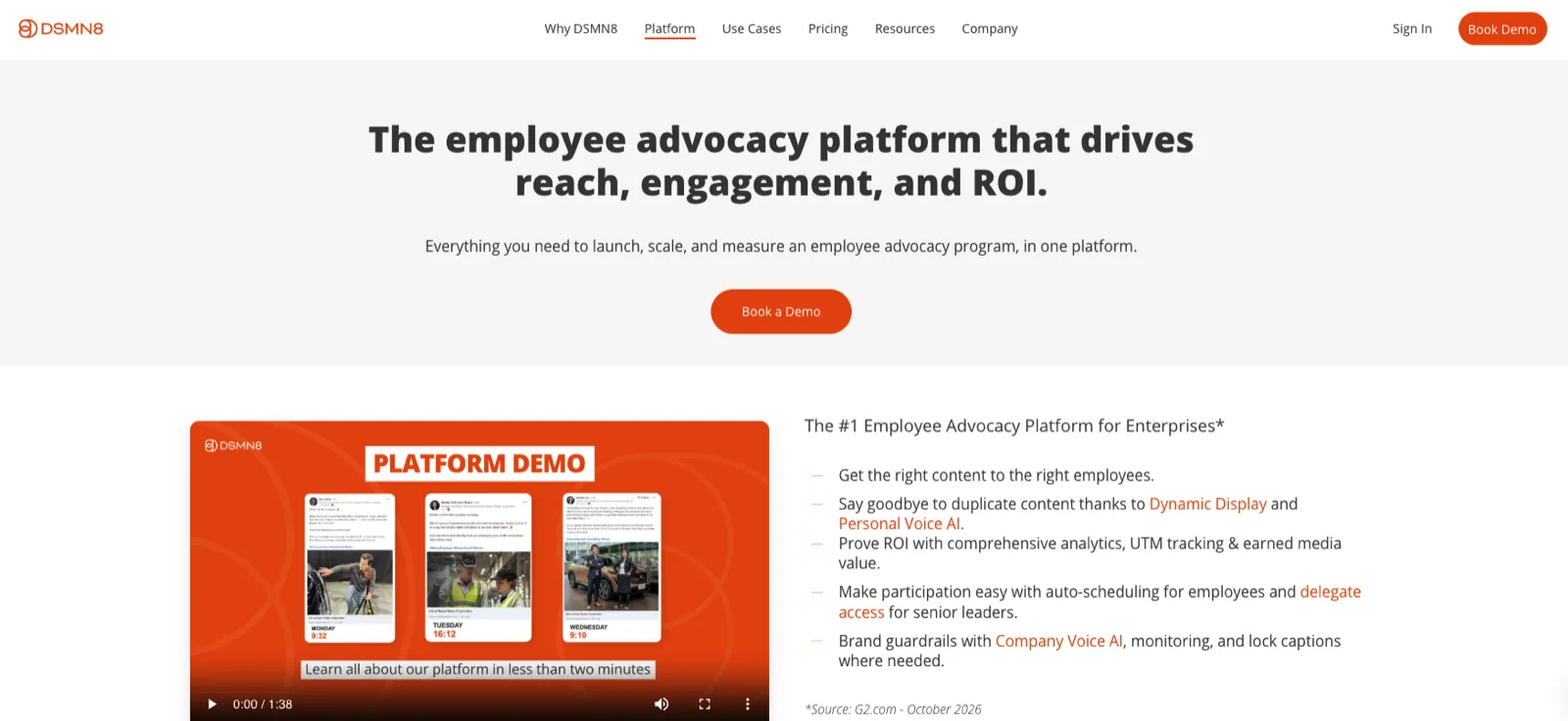
DSMN8 builds employee feeds from material the company already publishes across its website, blog, careers pages, and social accounts. Administrators review that material, prepare captions, and decide which employees should see each item based on factors such as role, region, language, or interests. Employees open a feed tailored to them, adjust the suggested text, and choose when to publish. The platform also gives program owners newsletters, notifications, leaderboards, and campaign controls, so content distribution and participation management happen within the same operating process.
Best for: Teams running centrally managed employee advocacy campaigns.
How it differs from EveryoneSocial: Both platforms support enterprise programs, AI-assisted personalization, and centrally managed content. DSMN8 stands out through its campaign workflow, Personal Voice AI, and separate modules for advocacy, executive influence, Boost Post, and newsletters. Teams comparing DSMN8 alternatives should assess the employee drafting experience alongside the administrator dashboard.
Pricing: DSMN8 provides custom annual quotes based on employee count, selected modules, integrations, onboarding, and support. Pricing typically starts at a few dollars per employee per month, and every package includes unlimited administrator seats.
Pros
- Personal Voice AI adapts approved company content to each employee's writing style.
- Unlimited administrator seats support programs managed across marketing and communications teams.
Cons
- The complete workflow can require separate modules.
- Posts still begin as company content, even when AI rewrites the copy.
5. ClearView Social
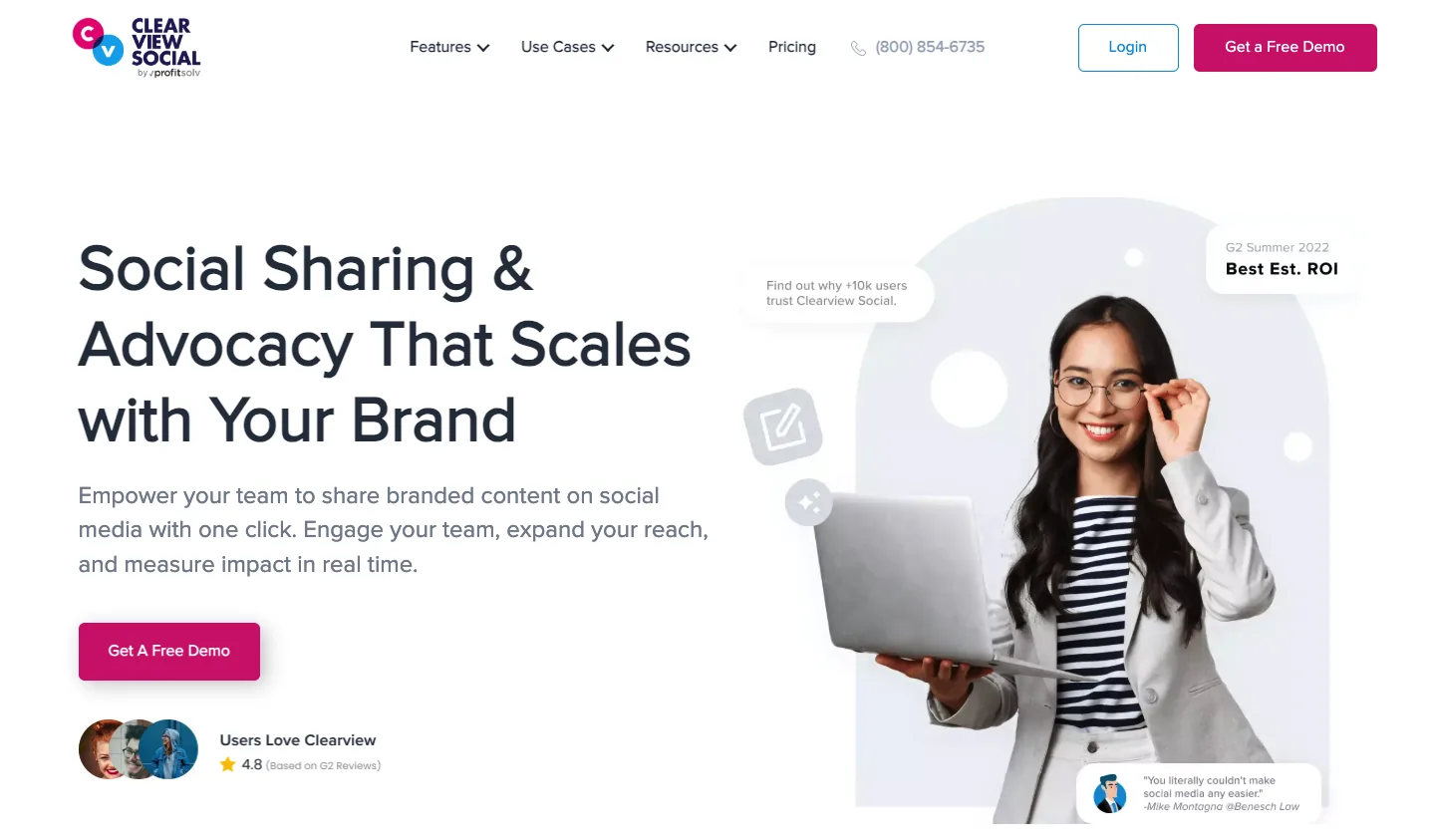
ClearView Social centers the employee experience on a prepared queue rather than an open-ended writing screen. Administrators add articles, company updates, or third-party material, then invite employees to share through email prompts and scheduled queues. Employees can review the suggested post, make changes, and let the platform choose a publishing time through its PeakTime scheduling feature. The same account can also handle company-page posts, content discovery, leaderboards, and participation reporting. This creates a defined process for firms that want regular employee sharing without asking every participant to manage a content calendar.
Best for: Professional-services firms that want published prices and straightforward content sharing.
How it differs from EveryoneSocial: ClearView Social is designed for smaller programs and provides a clearer starting budget. The Business plan adds approval workflows, tagging, referral and campaign tracking, and branded emails. Its reporting covers reach, referrals, campaigns, and earned media value.
Pricing: Team costs $425/month for up to 50 employees. Business costs $675/month for up to 100 employees. Both plans are billed annually, and larger teams receive custom Enterprise pricing.
Pros
- Published pricing makes the starting commitment clear before a sales call.
- Email, Slack, and Microsoft Teams queues reduce the effort required to share approved content.
Cons
- Approval workflows are not included on the lower-priced Team plan.
- The workflow centers on queued company content rather than employee-created posts.
6. Haiilo
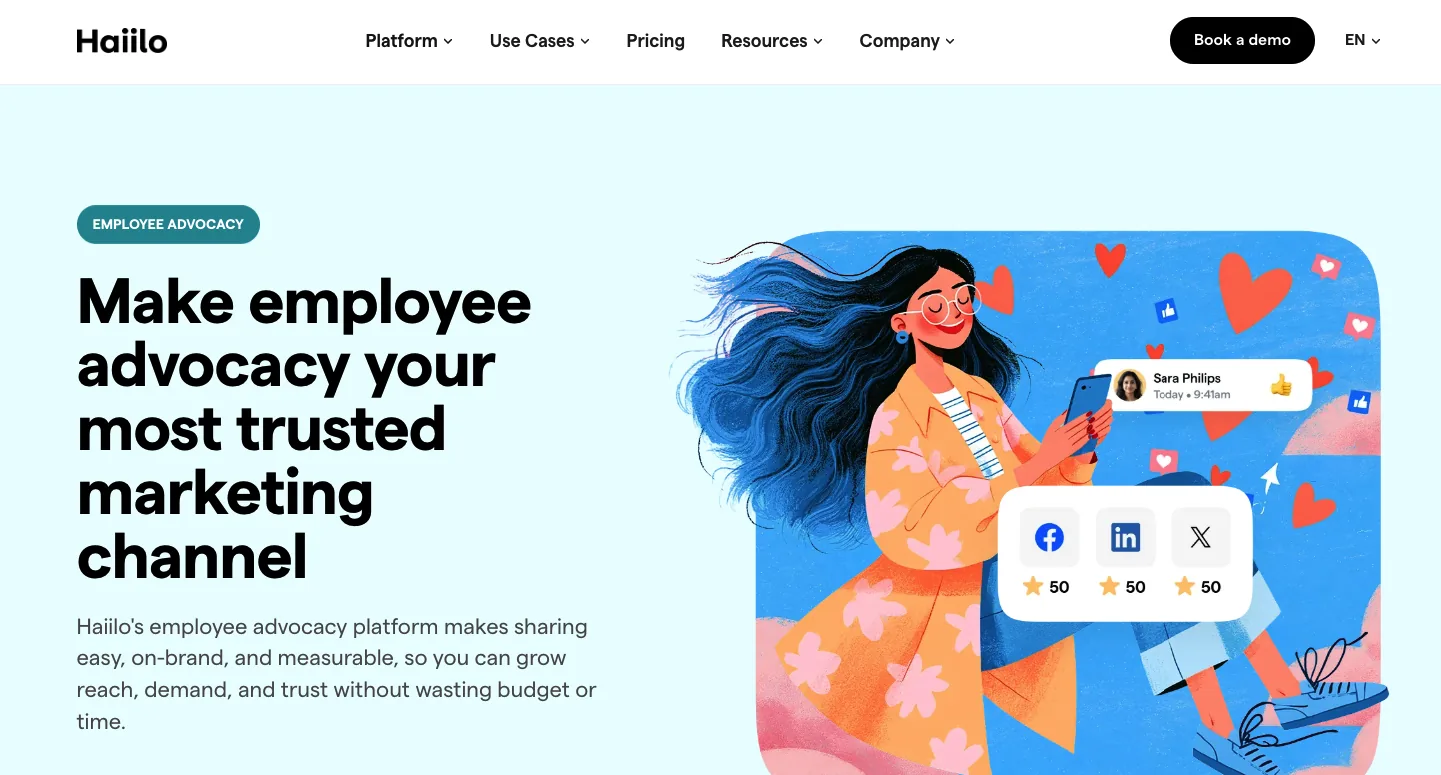
Haiilo approaches advocacy as one part of a wider employee communication environment. Program owners create content channels, organize material for different audiences, and distribute updates through web and mobile experiences. Employees can consume internal information first, then share selected items externally through their social profiles when advocacy is enabled. Administrators manage access, campaign content, notifications, and reporting from the same vendor used for broader workplace communication. That structure lets communications teams connect internal awareness with external sharing instead of running an advocacy program as an isolated marketing channel.
Best for: Organizations buying employee advocacy alongside internal communications.
How it differs from EveryoneSocial: EveryoneSocial focuses on enterprise advocacy, governance, and attribution. Haiilo combines advocacy with a broader digital workplace. Its Starter tier covers sharing and analytics. Scaling adds automated UTM tagging, attribution, and LinkedIn impressions analytics. Enterprise adds AI, SSO, rewards, more integrations, and executive ghostwriting.
Pricing: Advocacy starts at $15 per seat per month. Haiilo lists a 100-seat minimum in the plan table and a 150-user minimum in its FAQ. Scaling, Enterprise, and the intranet use custom pricing.
Pros
- Organizations can buy an intranet and employee advocacy from one vendor.
- The advocacy page provides a published starting price.
Cons
- The minimum commitment is too large for a small pilot.
- UTM tagging, attribution, and LinkedIn impressions analytics start above the Starter tier.
7. Poppulo Experience Platform, Formerly Sociabble
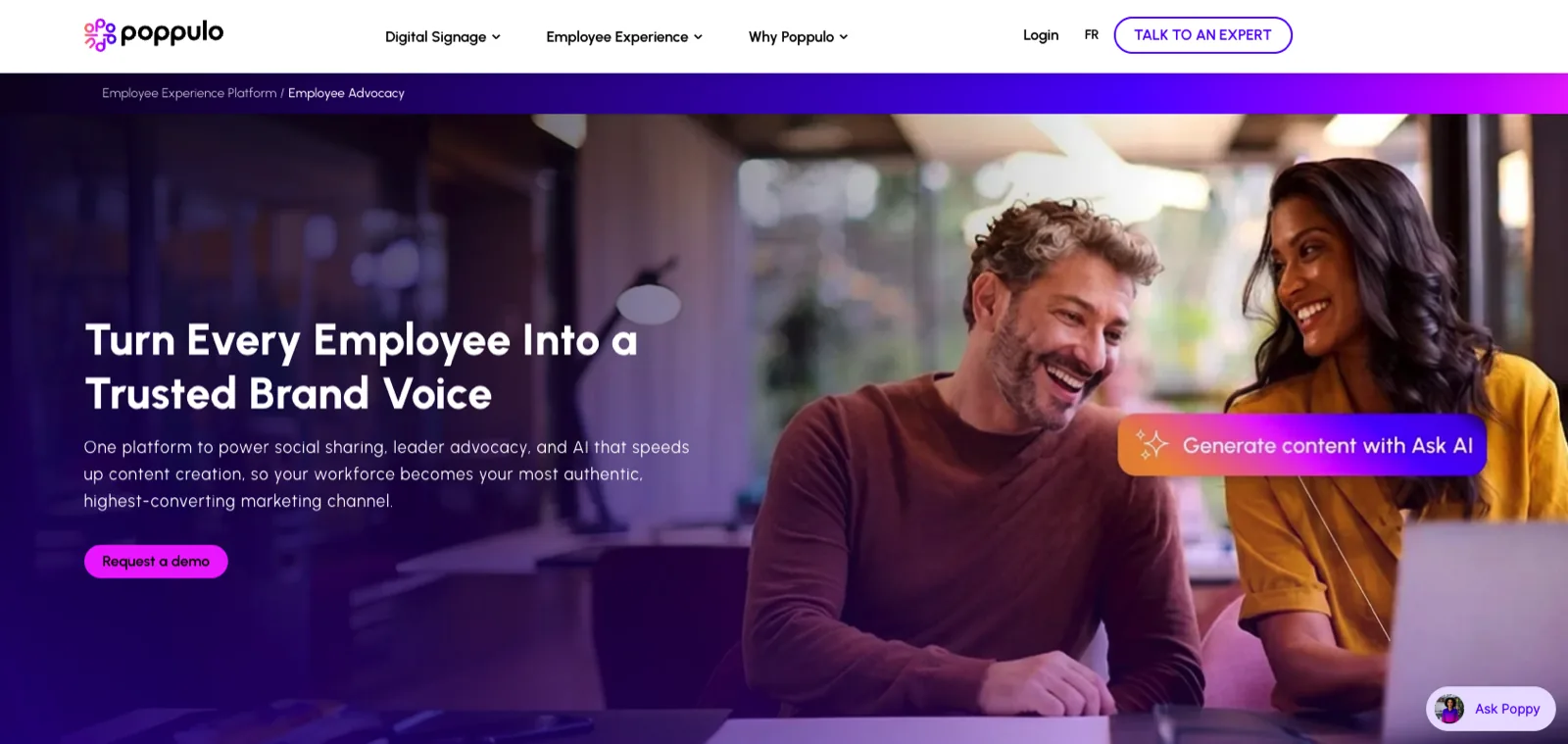
The Poppulo Experience Platform, which now includes Sociabble, connects employee advocacy with a larger communications system. Teams can publish updates through an intranet, email, newsletters, Microsoft Teams, a mobile app, and digital signage, then make selected stories available for external sharing. A central editorial process helps communications teams decide which audience receives each message and through which channel. Recognition and engagement tools sit beside that distribution layer, allowing the organization to manage internal reach, frontline access, employee participation, and social advocacy as related parts of one employee experience.
Best for: Organizations connecting employee advocacy with intranet and frontline communications.
How it differs from EveryoneSocial: EveryoneSocial focuses on advocacy, enterprise integrations, and connected reporting. Poppulo places advocacy inside a wider employee-experience suite. Communications teams can distribute updates across internal channels and invite employees to share approved content externally. Existing Sociabble logins, data, roadmaps, and support remain in place. The wider list of Sociabble alternatives compares focused advocacy tools with full suites.
Pricing: Poppulo provides pricing after a demo and does not list a fixed price for the Experience Platform.
Pros
- Intranet, frontline communications, email, digital signage, recognition, and advocacy share one platform.
- The mobile-first workflow reaches employees who do not use a corporate email address.
Cons
- Marketing-led LinkedIn teams use only a small part of the wider platform.
- Advocacy receives less focus than it does in a dedicated employee advocacy product.
8. Ambassify
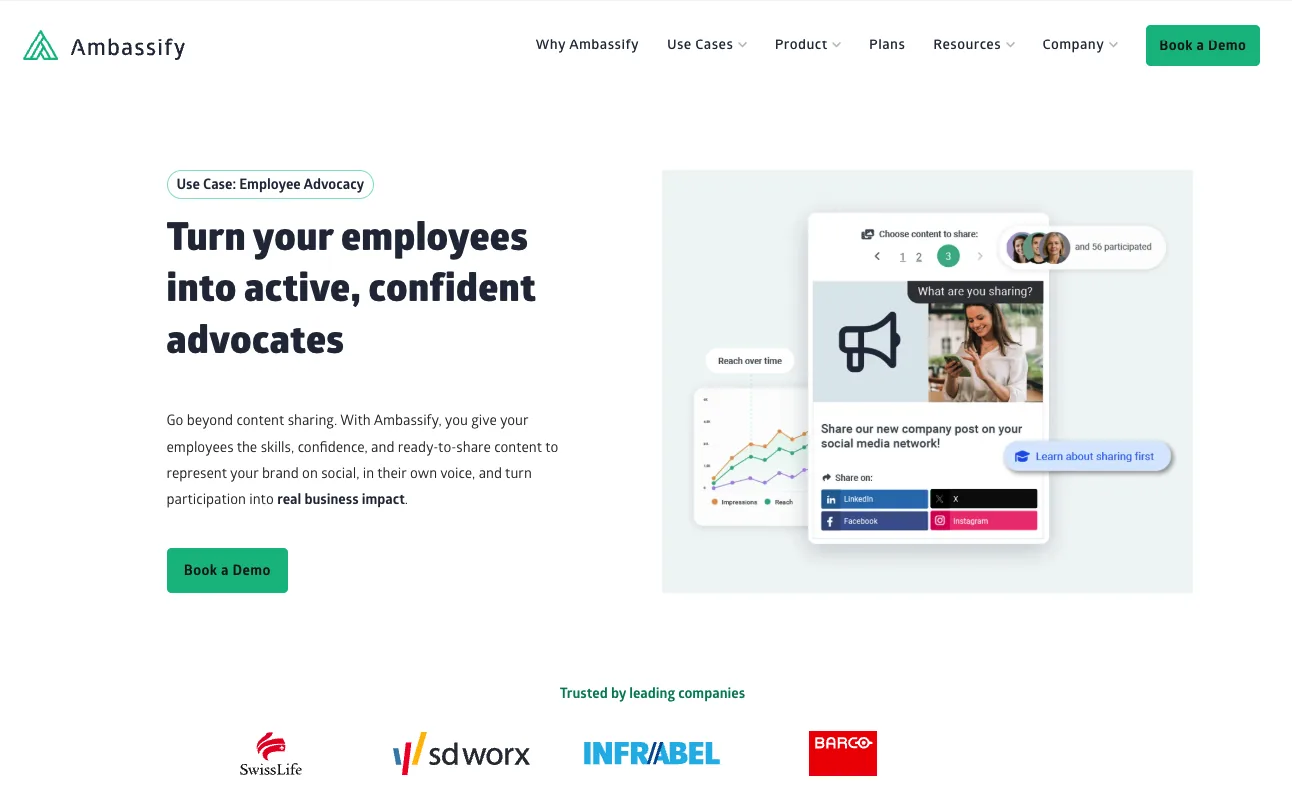
Ambassify runs advocacy through a branded employee community built around campaigns. A campaign can ask members to share content, react to a post, answer a question, complete a learning activity, or contribute material of their own. Program owners can segment campaigns, monitor participation, recognize contributions, and attach points or rewards to selected actions. Employees see a structured list of ways to participate instead of receiving only share links. The platform therefore treats advocacy as an ongoing community program in which learning, feedback, recognition, and external distribution reinforce one another.
Best for: Teams that want employee advocacy to operate as a community program.
How it differs from EveryoneSocial: Ambassify organizes the program around structured campaigns that can ask employees to share, comment, or react. Essential covers companies with up to 200 employees. Premium adds Personal Posts, advanced segmentation, rewards, and multilingual campaigns. Enterprise adds broader collaboration and security controls. The platform lists ISO 27001 certification and GDPR-compliant data processing.
Pricing: Essential, Premium, and Enterprise use custom quotes. Essential covers up to 200 employees, Premium covers 200 to 500, and Enterprise serves organizations with more than 500 employees.
Pros
- Plans align with company headcount, starting with organizations of up to 200 employees.
- Campaigns combine sharing, employee actions, learning, recognition, and rewards.
Cons
- Employee-created Personal Posts and rewards require Premium or Enterprise.
- Advanced collaboration and security controls require Enterprise.
9. PostBeyond
PostBeyond organizes advocacy around a searchable library of approved company and industry content. Administrators can group material by topic, feature priority items, set expiration dates, and send newsletters that direct employees back to the most relevant posts. Each employee receives recommendations and a personalized feed, then chooses what to share from desktop or mobile. Bookmarks and content categories make it easier to return to useful material, while the program team maintains control over what enters the library. The same structure also supports social-selling teams that need a dependable flow of approved resources.
Best for: Teams that want curated content sharing with marketing and social-selling integrations.
How it differs from EveryoneSocial: Both products support curated advocacy and marketing attribution. PostBeyond centers the daily workflow on a searchable content library with personalized feeds, topics, featured posts, bookmarks, newsletters, and content expiration. HubSpot and Marketo integrations connect shared content with lead reporting.
Pricing: PostBeyond provides pricing after a demo and does not list fixed plans.
Pros
- A structured content library helps employees find relevant approved posts.
- HubSpot and Marketo integrations support lead attribution for social-selling programs.
Cons
- Marketing supplies the content, so employees mainly share approved company posts.
- Pricing is available only through a sales conversation.
How to Choose the Right EveryoneSocial Alternative
Start with the job the replacement needs to do:
- Original employee posts on LinkedIn: Supergrow
- Advocacy alongside B2B social management and CRM reporting: Oktopost
- Broad employee sharing through Slack and Microsoft Teams: GaggleAMP
- Centrally managed campaigns with AI-assisted personalization: DSMN8
- Published prices for teams of up to 100 employees: ClearView Social
- Internal communications alongside advocacy: Haiilo or Poppulo
- Community participation and rewards: Ambassify
- Curated content with marketing integrations: PostBeyond
- Enterprise governance, archive integrations, and large global rollouts: Consider staying with EveryoneSocial
Then ask every vendor the same five questions:
- Who creates the posts, and how much can employees change before publishing?
- How do approvals work for employees, executives, and regulated teams?
- Which employee-profile actions and social networks does the platform support?
- Is pricing based on seats, registered users, company size, or modules, and how long is the contract?
- Which results are measured directly, and which depend on estimates or another system?
The final question prevents misleading comparisons. Participation, engagement, traffic, pipeline, revenue, and earned media value measure different outcomes. The employee advocacy metrics you choose should match the program's actual goal.
Run a small pilot with real employees before committing to a larger rollout. Use a real topic, reviewer, and publishing deadline. Also check notice periods, content exports, and access to historical reports before leaving an existing platform.
Picking the Right EveryoneSocial Alternative
EveryoneSocial works well for large enterprises that need governance, several publishing channels, enterprise integrations, and revenue reporting in one program. The alternatives solve different problems. Oktopost adds advocacy to B2B social management, GaggleAMP and DSMN8 focus on centrally managed sharing, Haiilo and Poppulo pair advocacy with internal communications, and Supergrow helps employees and executives publish their own ideas on LinkedIn.
Book a demo to see how expertise capture, approvals, scheduling, and reporting work for your LinkedIn employee advocacy program.