
"If you can not measure it, you cannot improve it."
While you might see your employees post content, share company achievements or follow your employee advocacy plan, how do you know it's actually working for what you started it for?
Whether it's for brand awareness, authority building, or simply hiring the best talent, you need numbers to back your claims. This is where most advocacy programs fall short.
If you want to measure your employees' impact as advocates, you need to focus on specific metrics that align with your targets. This guide focuses on nine measurable indicators that directly link employee advocacy to business results.
Why Employee Advocacy Tracking Matters
You probably already know that employee advocacy is great for brands. So, if you'd think of a world-class example of employee advocacy, you could look to IBM. After all, it was one of the companies that amplified employee advocacy.
But, what if we tell you that even with 6000 employees participating in employee advocacy, driving more than 25,000 clicks to shared content, some people provoked little to no response. That's because IBM treated employee advocacy as a distribution channel rather than analysing its qualitative benefits.
That's what happens when you get bedazzled by likes, comments and reshares: you tend to lose focus on the real ROI of employee advocacy programs.
Employee advocacy metrics are the foundation of employee advocacy. You need to know what you consider success and how you're gonna measure it.
Here are some other reasons why metrics are important:
-
Allow you to track your employee advocacy progress quantifiably over time.
-
Benchmark with similar organizations in your industry or company size to see how you compare.
-
Enable continuous optimization by identifying which content themes, formats, and posting times drive the strongest results.
-
Demonstrate program ROI by directly linking brand visibility and engagement to lead generation and pipeline impact.
-
Help employees see their impact, strengthening motivation and participation.
-
Align marketing and HR outcomes, from strengthening employer brands and accelerating sales opportunities to attracting top talent and future hires.
Tracking the right metrics allows you to gauge your program’s effectiveness, refine your approach, and ensure the program delivers value.
Types of Employee Advocacy Tracking (The 3-Layer Framework)
To understand the effectiveness of your employee advocacy program, you'll want to start with the right metrics.
These indicators show how well your content is performing, how broad its reach is, and the impact it has on your brand's overall organic visibility on social media.
We categorise employee advocacy in three broad layers:
Activity metrics
The first set of metrics focuses on the ongoing success of your employee advocacy program.
Look at how many users in your company share regularly. Then see how much content they are sharing and how much engagement each share generates.
Its purpose is not to prove success, but to confirm that the program has enough momentum and behavioral consistency to generate downstream effects. And, with that information in hand, you're well equipped to reward your top performers and give support to those who have fallen out of the habit.
Influence metrics
The next step in metrics involves how the content your employees share resonates with your target audience.
Activity metrics include likes, shares, and comments on employee posts. As with reach and impressions, you can track this manually by monitoring employee posts. But as your program scales, it will consume more resources. That's why adopting advocacy programs like Supergrow will make your life easier.
With Supergrow, you can monitor followers, connections, and profile-view trends. You can see reactions, comments, and response rates for every post. It also helps you understand which content works the best for your employee advocacy program.
Impact metrics
For impact, what you measure depends upon the goal of your employee advocacy program.
If your goal is to drive leads, see how your content engagement is creating opportunities for sales and bringing decision-makers into your employees' networks.
Look at website clicks from your employee's social media posts, calculate the click-through rates and conversions attributed to employee-shared content.
These metrics demonstrate the effectiveness of your employee advocacy program in driving tangible results for your company. Your primary goal here isn't just to increase reach and visibility on social media; it's to generate more leads and conversions.
9 Key Metrics for Employee Advocacy Tracking to Drive Real Business Impact
You've got the three-layer framework to measure your employee advocacy.
Now, it's time to highlight metrics that actually matter.
Whether you're just getting started or scaling your employee advocacy program, these are the nine employee advocacy metrics that every program manager should be tracking.
They'll help you understand what's working, where to improve, and how to prove ROI across departments.
Let's break them down one by one.
Layer 1: Activity Metrics (Participation & Consistency)
We've already briefly covered this, but it's integral to your program's success. These metrics demonstrate employees' enthusiasm for your program.
Active advocate rate
Active advocate rate measures how many enrolled employees are actually participating in your advocacy program, not just signed up, but posting consistently. If your adoption is high, your employees understand the value of advocacy and are keen to use it.
You can calculate your program's active advocacy rate by:
| Active Advocate Rate (%)= (Number of employees who posted at least once in a month/ Total number of enrolled employees) X 100 |
|---|
The average percentage of employees sharing content in companies with less than 1,000 employees was 7.52%, ranking highest overall.
The average across all company sizes was 6.54%.
In contrast, organizations with over 10,000 employees had an average content-sharing rate of just 3.86%.
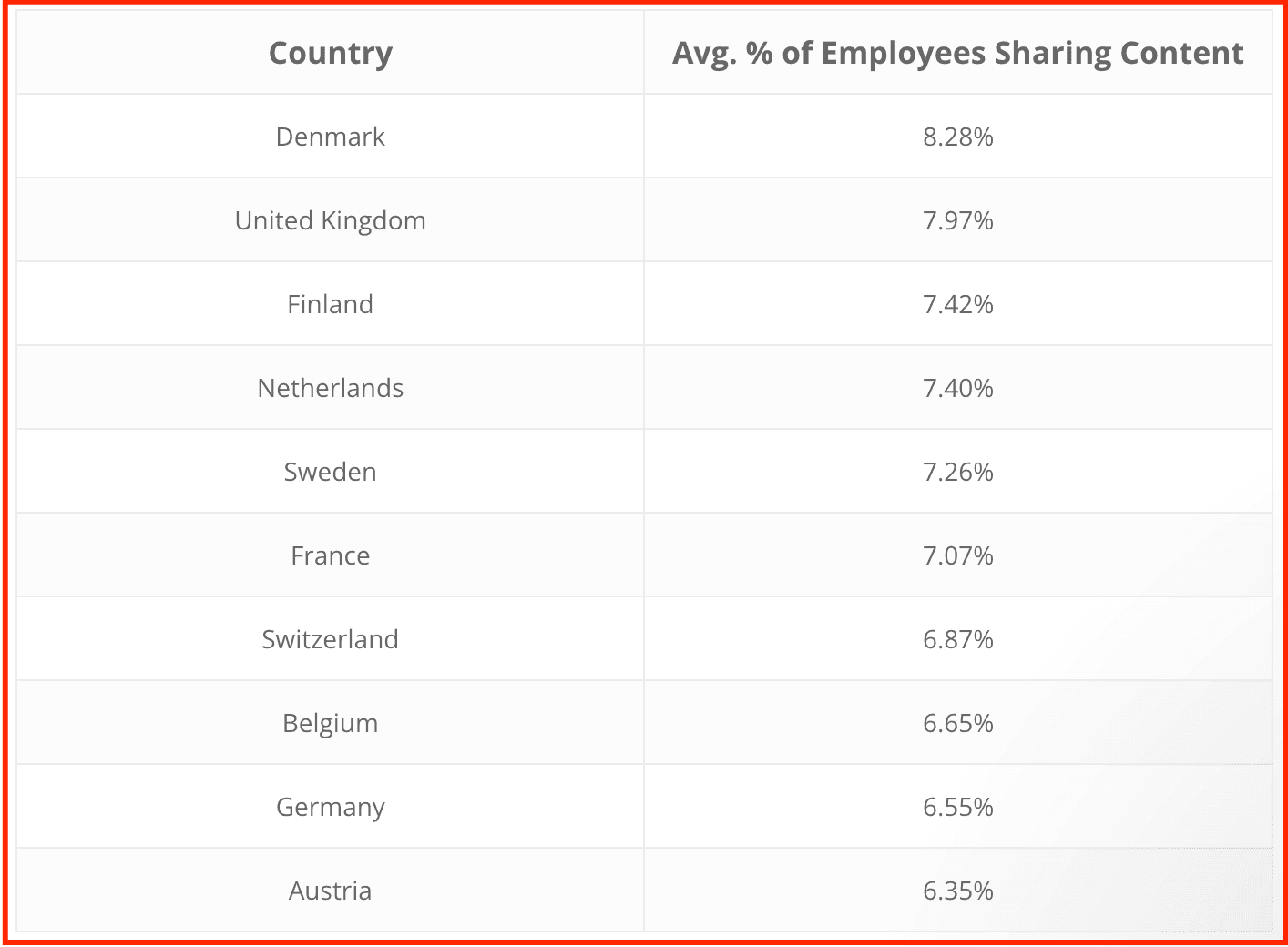
Smaller organisations feel that building brand awareness is everyone's responsibility, particularly when the marketing team is small. However, as businesses reach the 9,000-9,999 mark, these companies are already in the growth stage, and data suggests your employees might be holding back.
This isn't because they don't care, but because the culture and infrastructure around advocacy haven't been established. The companies successful at scale tend to have two things in common: a dedicated internal champion and visible executive participation.
Posting Consistency Index
For your employee advocacy to work, your advocates need to reach and engage more with your target audience to drive results ultimately.
Even if 3% of your employees are actively posting content, it is responsible for driving 30% in the total engagement a company sees.
And, posting consistency is one of the clearest signals of whether an employee advocacy program brings engagement.
Rather than counting how many posts employees publish in a given month, the Posting Consistency Index measures how reliably they show up over time.
Because a program where 70% of advocates post once a month consistently will outperform one where 15% post heavily and everyone else drops off. For early-stage, growing employee advocacy programs, you can aim for 2–4 posts per active employee per month.
Content Contribution Mix
A major reason IBM employee advocacy struggled was the inconsistency in content, despite all employees receiving the same material. People who shared identical content provoked little or no response.
So, if your employee advocacy is just about resharing branded content, then it would be challenging to see results.
For the employee advocacy program's content strategy, follow the 4-1-1 rule: for every 6 pieces of content you share with employees, 4 should be personal/authority-based, 1 should be owned/company-related, and 1 should be promotional.
Even when your employees share content that is not directly related to your company, your employer brand benefits, that's because when your employees are seen as thought leaders in their space, your company is seen as a leader by association.
Layer 2: Influence Metrics (Trust & Audience Signals)
People sharing company content, commenting and amplifying is valuable but only as a foundation. Reach without credibility over it generates noise, and it is the thing most advocacy accidentally optimizes for.
These metrics help you evaluate the credibility of advocates among their audience, where one person's knowledge becomes a multi-channel growth engine.
Non-Follower Engagement Rate
Social media follower counts aren't that important anymore, and you might need to change how you work out your engagement rates as a result.
On social media, people no longer have to follow you to see your content. Algorithms are designed to surface content they predict people will find interesting, not just posts from accounts they follow. As a result, on most platforms, roughly 50–80% of total views come from non-followers, depending on the app.
While a growing follower count can be a useful signal of popularity and helpful for demonstrating progress to stakeholders, engagement is ultimately far more important. Creating content that resonates and drives interaction has a much greater impact than simply increasing follower numbers.
But given that a huge chunk of engagements are from non-followers, therefore work out your engagement rate with reach instead of followers = (Likes + Comments + Saves + Shares) ÷ Reach ×100.
Conversation depth ratio
This is the most underutilised layer in almost every organisation, and the one with the greatest untapped potential.
A strong comments-to-reactions ratio shows that content is doing more than being passively consumed; it's prompting people to pause, think, and respond.
Most employee advocates show these signals, which translate into how their ideas influence others to think and act.
-
Comments that continue the idea: Thoughtful responses that add depth, challenge your point and or explain how someone applied it. This shows your content is shaping perspective, not just earning agreement.
-
People tagging others in your posts: When readers invite others into the discussion, your post becomes a go-to reference point. It signals relevance and authority within a specific audience.
-
Your name being mentioned when the topic comes up: When others reference your perspective elsewhere, inside comments or in their own posts, you start getting associated with the idea itself, not just the content.
For new readers, these signals act as trust shortcuts. They answer the unspoken question: "Is this person worth paying attention to?"
Profile Visit & Follower Growth Attribution
This metric is a measurable data point that shows you exactly how your profile and content are performing on the platform.
You've got three main categories of metrics to pay attention to:
- Profile views:
Profile views show you how many people have looked at your profile over a specific time period. When someone views your profile, they're showing genuine interest in you and what you do.
A sudden spike in profile views after advocate posts indicates that people liked your content and were searching for you on the search bar.
For most professionals, getting 50-100 profile views per week is solid. If you're actively posting content and engaging regularly, you should aim for 100-300 views per week.
- Search appearances
Search appearances tell you how often your profile shows up in LinkedIn search results.
When someone searches for terms related to your advocates' industry, roles and expertise, you want them to appear. Search appearances closely align with profile views and connection requests, making this a leading indicator of your LinkedIn growth potential.
If they're not appearing in searches, you're missing out on organic discovery opportunities.
- Follower growth rate
Your follower growth rate measures how quickly your LinkedIn network is expanding over time.
If you're posting regularly and engaging authentically, aim for 5-10% monthly growth.
Most casual LinkedIn users see <2% monthly growth, but active creators can achieve up to 15–20% growth when posting 3–5 times/week.
Layer 3: Impact Metrics (Business-Level Outcomes)
To evaluate the impact of employee advocacy on business outcomes, you'll want to dive into conversion and lead generation metrics, including:
Advocacy-Sourced Inbound Signals
Now, this is the juiciest part. Without visibility into results, measuring the effectiveness of employee advocacy is challenging. These signals sit right between engagement and pipeline.
They're early indicators that advocacy is translating into real commercial conversations.
-
DMs Referencing Posts: When prospects reach out directly citing a specific post, insight or comment, it's one of the clearest, highest-signal indicators that employee advocacy is creating real demand.
-
Discovery Calls Mentioning Employee Content: When leads reference something they saw from an employee during a discovery or intro call, it signals that trust and context were built before the sales conversation even began.
-
Warm Introductions via Social Activity: Multiple times, prospects engage with an employee's posts, so when the employee reaches them, they already know who they are and what they do.
When you track these little metrics, you understand how your employee advocacy program is impacting the buyer's journey.
Pipeline Influence Attribution
A formal employee advocacy program helps shorten the sales cycle.
Nearly 64% of advocates in a formal program credit employee advocacy with attracting and developing new business, and nearly 45% attribute new revenue streams to it.
Plus, leads developed through employee social marketing convert more frequently than others. So, it's important to measure deals influenced by employee advocacy.
It could be a post they shared, a comment, or an insight that built trust, or a reshared customer story that validated a buying decision.
Talent & Employer Brand Signals
Companies that invest in employee branding are three times more likely to hire quality talent than those that don't.
Because it solves the number one obstacle for candidates in the application process is not knowing what it's like to work at an organization.
Look for these metrics to track talent driven by your employee advocacy program:
-
Employee referrals
-
Analyse job portal traffic as your advocates promote hiring roles
-
Assess the time-to-hire. A short time-to-hire reflects that your employee advocacy program is working.
For every piece of content an employee shares on LinkedIn, 27% more likely to feel optimistic about their company's future and 15% more likely to feel connected to co-workers beyond their core teams.
If recruiting is a top priority for your advocacy program, employee advocacy can be a game-changer.
Measure What Moves the Business
There are many metrics mentioned to measure the success of your employee advocacy program, but you don't have to track them all.
Instead, align your employee advocacy metrics with internal stakeholders to determine which will make the biggest impact on your brand.
Tracking employee advocacy only matters if it leads to clarity and growth.
Supergrow gives you visibility into content creation, participation, and performance — so you can scale advocacy with confidence.
Start building a measurable advocacy system with Supergrow!