
What’s the one trait most of the fastest-growing companies share right now?
Their people are visible.
Not hidden behind brand pages or corporate messaging, but actively showing up on LinkedIn—sharing ideas, explaining how they think, and engaging directly with the market. Growth today isn’t just driven by marketing campaigns or ads. It’s increasingly people-powered.
Look at companies like Gong, Ramp, Gamma, or Lovable. Their leaders, operators, and subject-matter experts consistently publish insights that help their audience think better, work smarter, or solve real problems. Over time, those voices compound into reach, credibility, and trust for the entire company.
This isn’t accidental. It’s a system.
In this guide, we break down the Personality-Led Growth Engine—a practical framework that helps companies turn executive expertise and employee insights into a consistent LinkedIn presence that compounds visibility, engagement, and pipeline over time.
7 Steps to Turn Executive Expertise into a Compounding LinkedIn Growth Machine
These steps form a system, with each one fueling the next. It compounds over time. Instead of one company voice reaching a small audience, you create a network of authentic voices, each with its own positioning, expertise, and audience.
Your favourite brands use this exact playbook to turn people associated with their brand into a revenue engine on LinkedIn.
Step 1 — Select the Right Voices
Many companies start employee advocacy by asking senior executives or leadership teams to post on LinkedIn. While leadership visibility can be valuable, seniority does not automatically translate into influence.
People want to hear from people. Real ones, with opinions, track records, and something at stake. LinkedIn's own research says 59% of creator content on the platform is more trustworthy than other marketing materials.
That's why choosing the right voice is extremely important. You don't need many people, or even your entire team, to post on LinkedIn. You just need 3-5 people who are willing, well-positioned and have something valuable to say.
Look for people who meet these criteria:
-
Subject matter expertise: They know their domain deeply and can teach others. Could be your VP of Product, Head of Engineering, or lead strategist. They go deep on technical topics your audience cares about.
-
Willingness to be visible: Not everyone wants to post publicly, and participation should never be mandatory. You aim to make a confident contribution, not compliance.
-
Client-facing roles: Head of Sales, Head of Growth, or a senior AE interact with your ICPs daily. They understand the problems your audience faces.
These don't have to have thousands of followers, but someone with 2000 followers has a head start over someone with 200. Secondly, they don't have to be an expert in writing or content creation, but they should have the clarity to articulate ideas. Your content team can handle the production.
Step 2 — Extract Executive Expertise
Once you've chosen your team and assigned positioning, you need to map out what each person will actually talk about.
And here is where executive thought leadership programs get strangled. But, after hearing from multiple leaders and subject matter experts, the challenge is rarely ideological but operational.
-
They've got no time to post. Writing feels like an extra task on an already full calendar.
-
They don't know what to say. Actually, people have a lot to say, but they struggle to articulate their thoughts for a particular post.
-
They're hesitant. Often, people perceive LinkedIn as a playground for the marketing team and are reluctant to determine if it's relevant for them.
In almost every case, it's a friction problem. Remove the friction, and you'll see your personality-led growth program flourish. The solution to this is Supergrow's AI-guided interviews.
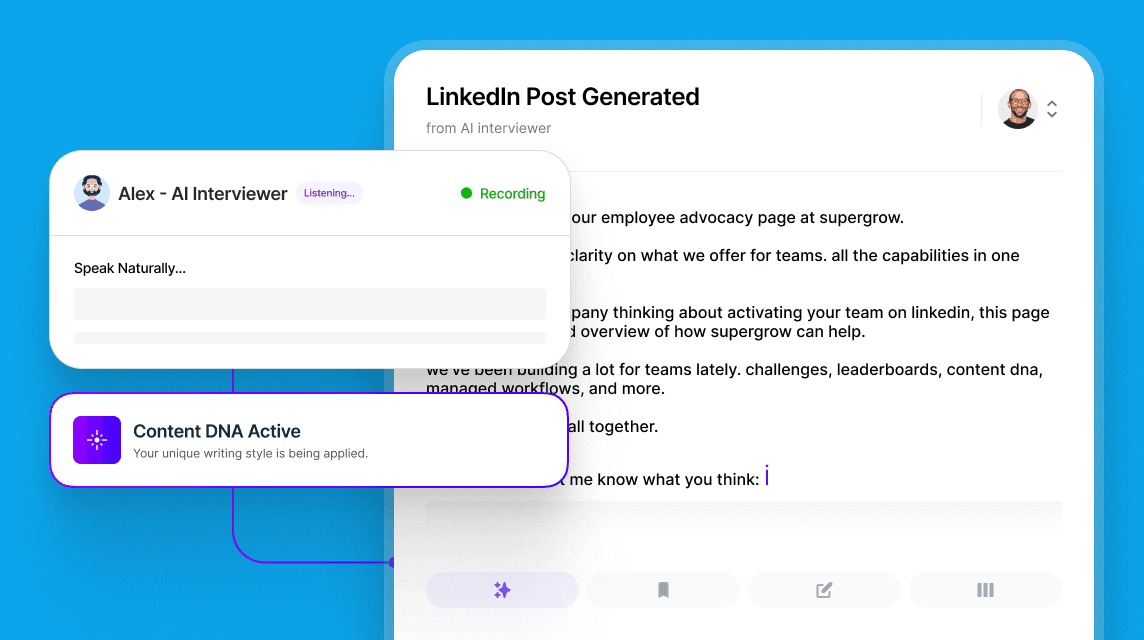
Team members will join a guided conversation with our AI interviewer and talk through their thinking on industry topics, deals they've closed, and lessons learned. So instead of executives putting in hours writing and thinking for a post, the AI will do it for them.
Here's how an AI interviewer never runs out of ideas, and how your content stays strategically aligned:
-
Each interview produces a rich pool of raw material. The AI interviewer spreads into 3-4 core themes per person. These are the broad categories their content falls into.
-
Do further interviews to break each theme into 5-10 subtopics. These are more specific angles within each theme.
-
The Supergrow AI LinkedIn Post Generator into 3-5 actual posts.
Example topical map for a Head of Growth:
| Core Theme | Substopics | Content Angles |
|---|---|---|
| Demand Gen | Content strategy, SEO vs. social, paid amplification | "Why your blog isn't generating leads" / "The content ecosystem framework" |
| Linkedin Growth | Algorithm, formats, engagement tactics | "How I grew to 50K followers" / "The 3 formats that work in 2026" |
| Pipeline Building | Warm outbound, intent signals, lead scoring | "Cold outbound is dead. Here's what replaced it" / "5 intent signals to watch" |
The goal is to have at least 60 ideas mapped out before you start publishing.
This gives you roughly 3 months of content at 5 posts per week and removes the "what should I post about?" friction completely.
Step 3 — Create & Approve Strategically
In 2026, LinkedIn feeds are more crowded than ever. Attention is fragmented, algorithms prioritize engagement signals, and a large share of posts follow the same playbooks and formats. The only reliable way to stand out is through original insights rooted in real experience.
Supergrow AI eliminates the anxiety of creating content from scratch. You can feed your AI-led interviews and instantly generate multiple LinkedIn-ready posts. And, it's not just one type of content, but different voices and levels, including:
-
Strategic content speaks to C-levels, VPs, and investors by sharing high-level insights, industry trends, vision, and point of view.
-
Tactical content includes frameworks, playbooks, step-by-step strategies, and decision frameworks that resonate with managers and senior ICs.
-
Operational content serves the teams doing the work every day through tutorials, templates, workflows, tool walkthroughs, and checklists.
But this AI-created content should be reviewed by a skilled editor. They ensure each piece ladders up to the company's broader narrative and current go-to-market priorities.
Think of the AI as producing a strong first draft at speed; the human brings taste, judgment, and strategic context.
To make the approval process, you can use Supergrow's Content Board to track your posts from draft to published. You can see all scheduled posts across team members in a single view, do one-click actions like approve, request changes, or publish without leaving the app.
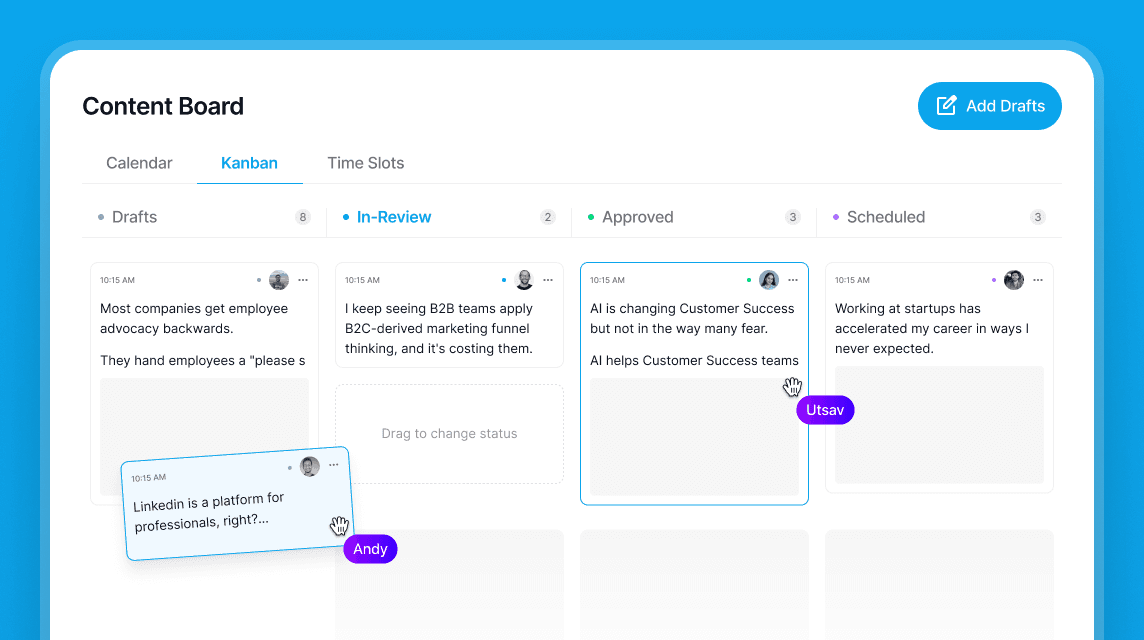
The result? Total coherence across teams and brands that are trying to be consistent on LinkedIn without it becoming another burdensome task.
Step 4 — Publish & Engage Consistently
Most teams skip the calendar and just "post when they feel like it". That's the fastest way to be inconsistent. Your team's contact calendar doesn't need to be complicated, but it should answer three questions for every post:
-
Who is publishing
-
what format
-
and when
We recommend 2 posts per week per person, as this is enough to stay visible without burning out. Stagger post timings across team members so you're covering different parts of the week.
Example: CEO posts Mon/Wed, Product Lead posts Tue/Thu, Growth Lead posts Wed/Fri.
You can also use Supergrow's post scheduling feature to plan posts and keep your calendar consistent without chasing reminders.
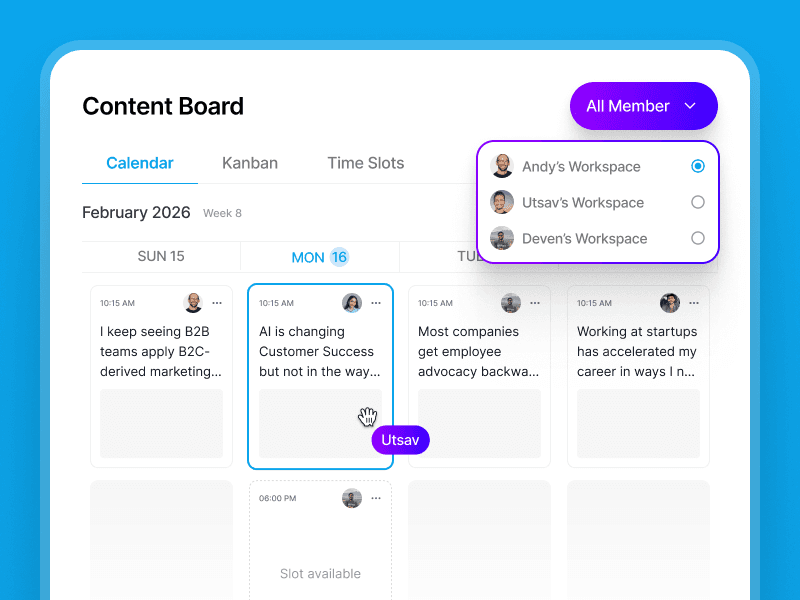
But that's not where you stop. Posting is only half the job. Each executive needs to spend 30 minutes per week engaging in comments on their own posts and publishing three comments on posts from respected leaders in the space.
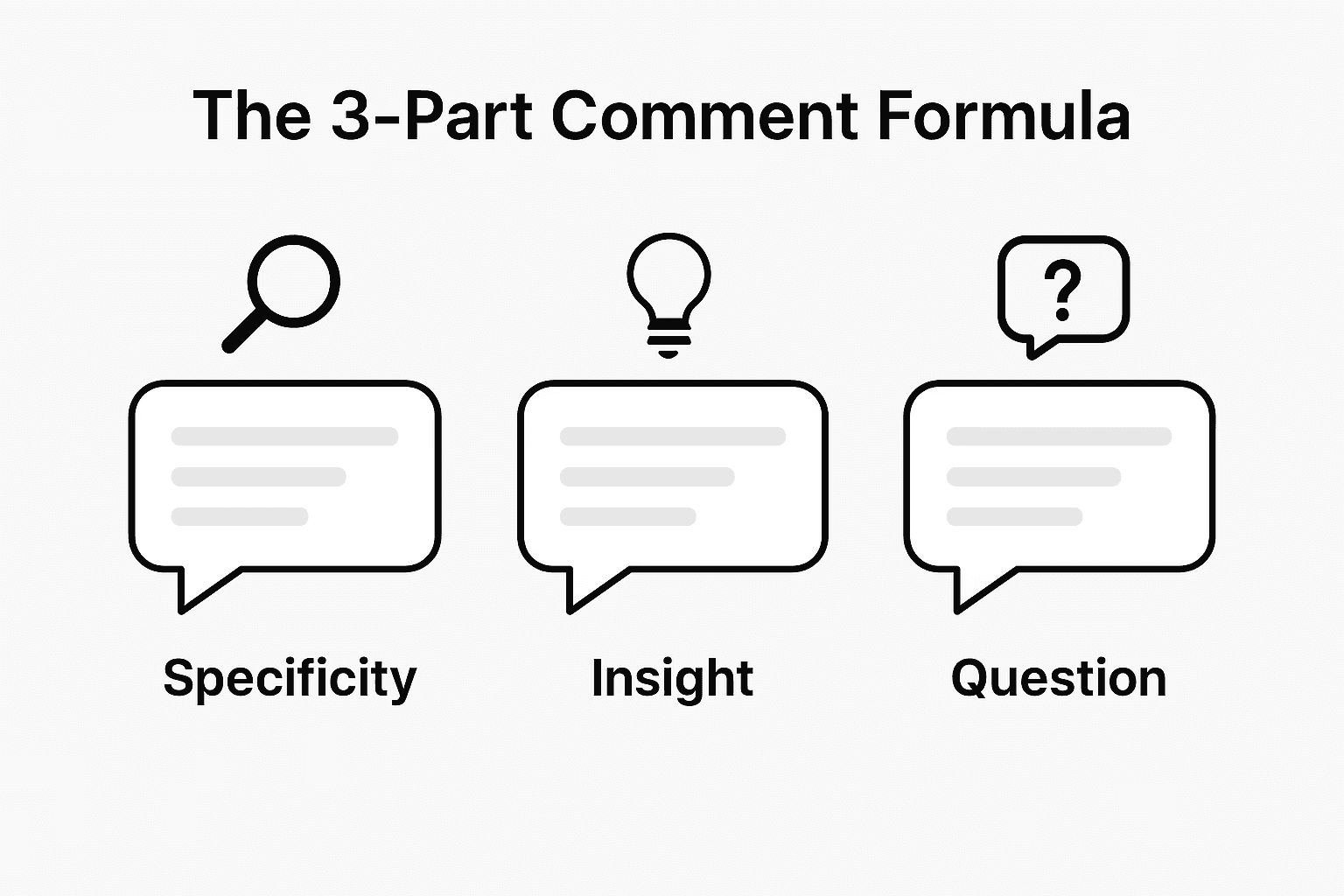
You can use our three-part LinkedIn comment formula to write engaging comments:
-
Open with specificity
-
Add your insight
-
End with a question or call to action to keep the conversation going
The key is focusing your comments on the right people. Identify 20–30 creators, prospects, or peers whose audiences overlap with yours and comment on their posts before you publish your own. This primes early visibility and builds the algorithm signal that your content is worth distributing.
Step 5 — Amplify What's Already Working
Not every piece of content needs to be amplified, but if posts are getting high engagement, they should definitely capitalize on it.
At this stage, it becomes important to track what’s actually working across your team. Supergrow’s analytics dashboard helps you see which posts, formats, and themes consistently drive engagement, follower growth, and meaningful conversations among executives and subject-matter experts.
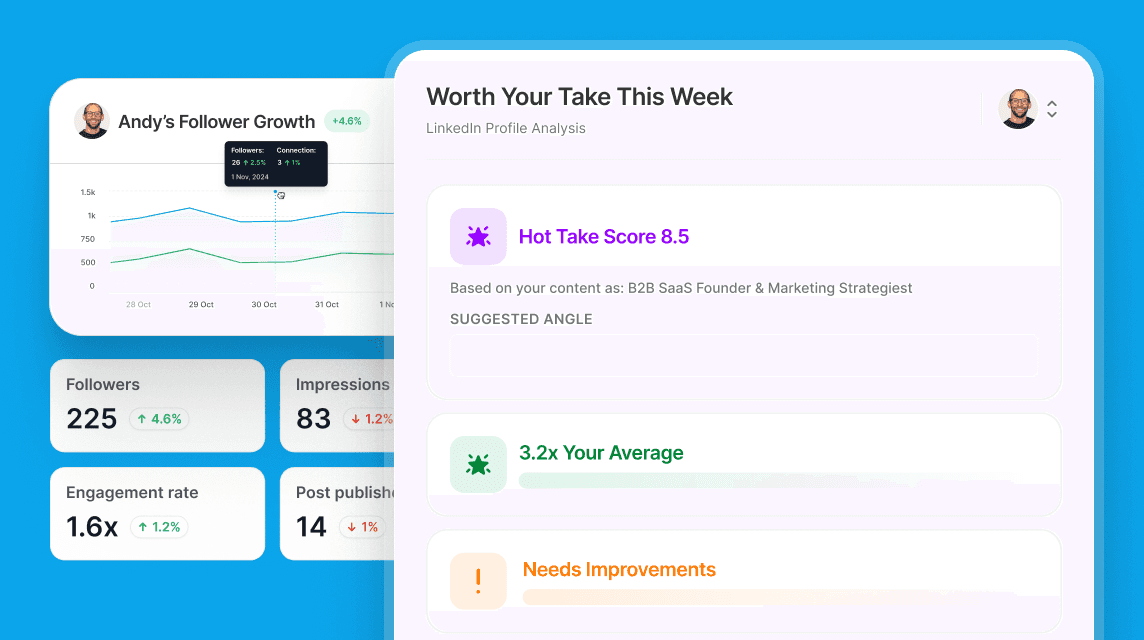
Instead of guessing which posts deserve amplification, you can identify clear patterns. Which voices resonate most, what topics generate discussion, and which formats consistently perform. This allows teams to double down on winning ideas and turn isolated content wins into repeatable growth.
Once you know what’s working, amplification becomes much more intentional. One of the most effective ways to scale the reach of high-performing posts is through LinkedIn Thought Leadership Ads.
These are sponsored posts from individual profiles that appear in the feed like regular content, with a small “promoted by” label.
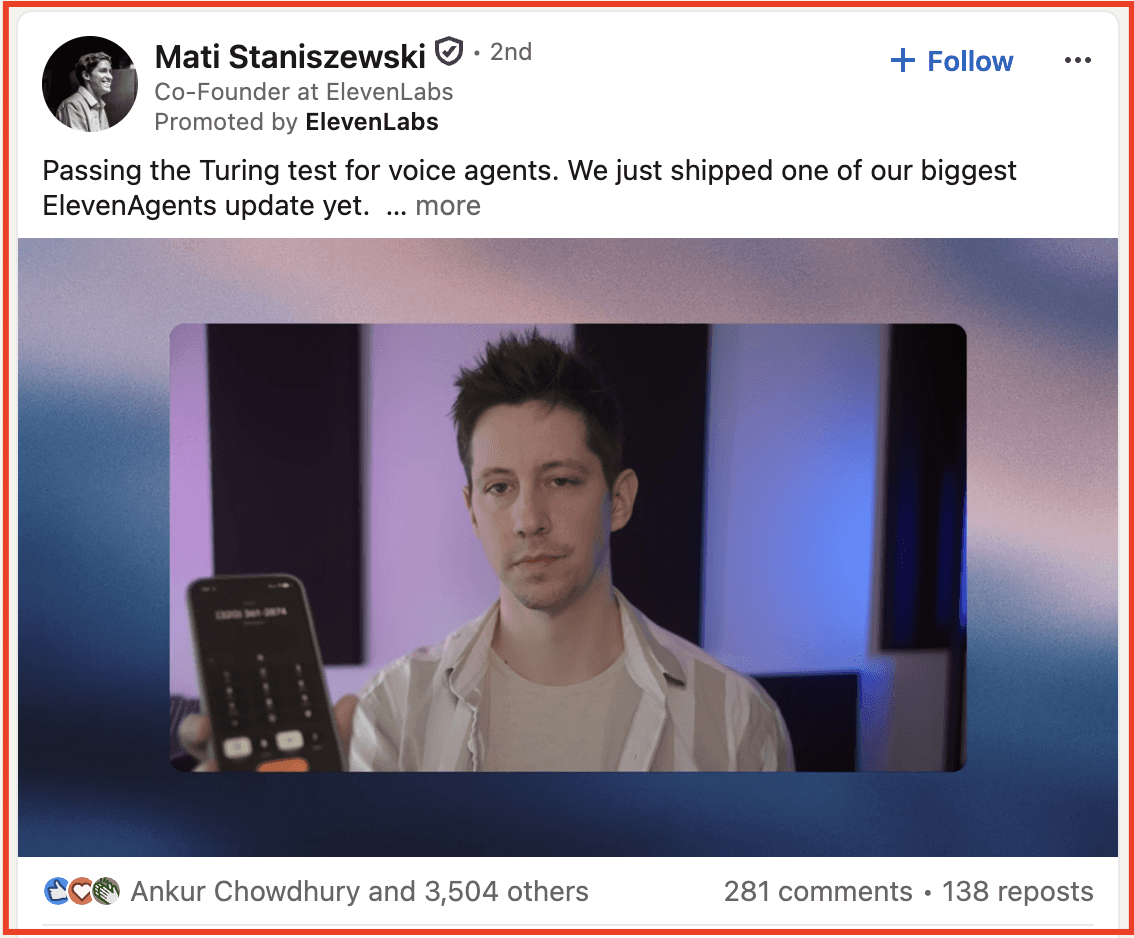
Compared to branded ad campaigns, thought leadership ads perform much better.
Research from Tribal Impact shows that thought leadership ads received a whopping 240% higher CTR than the company-sponsored post from Campaign A. And a 25% higher engagement rate.
Here's the data from these two ads compared in a table format:
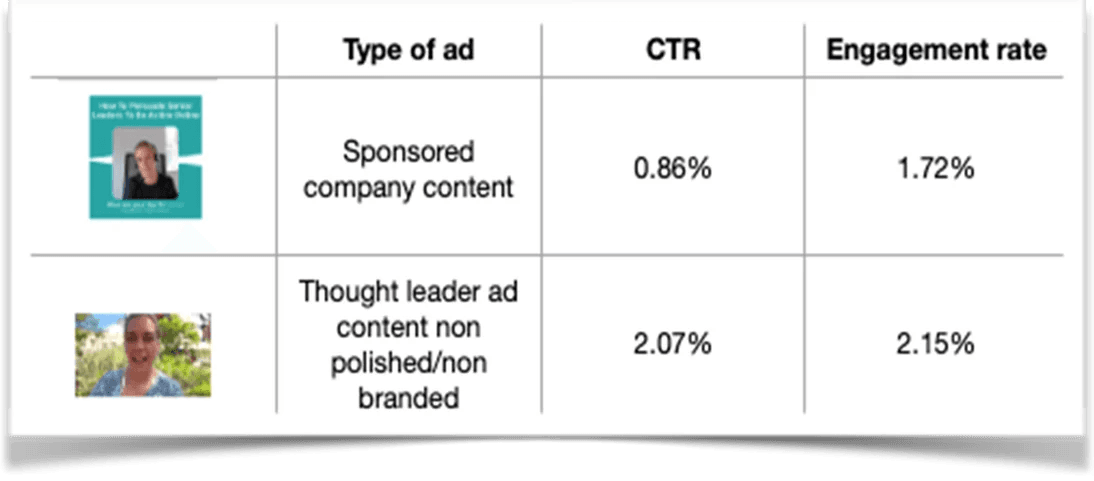
The big thing that stands out? Social proof!
When you amplify posts that already got engagement when they were initially posted, it gives the new audience a strong indication that the content could be valuable to them, too.
Since they're non-intrusive and blend seamlessly into people's feeds, it looks less like a salesy ad. You can use this feature to your advantage by promoting case studies and customer success stories, unique POVs, educational material and FAQs.
Step 6 — Capture & Qualify Engagement Signals
Not every LinkedIn like or comment means someone's ready to buy.
But when you see a pattern across multiple actions by multiple people within a company, it signals real intent. These patterns signal active interest in your brand or product.
Here are some of the most common public LinkedIn intent signals:
Following your team
If someone at a target account starts following your marketing leads, your founder or your head of product, pay attention. Especially if:
-
They work at a company in your ICP
-
They follow multiple team members
-
Their job title matches your target persona
This often happens early in the journey. Before demo requests. Before even visiting your site.
Liking or commenting on company posts
If a potential buyer is engaging with your company's posts, especially more than once, it's a clear sign they know who you are. Even more so if those posts are about specific features, problems or use cases.
Engagement on product-related posts is more valuable than on generic culture posts.
Engaging with employee content
When someone from a potential buyer account starts interacting with use cases, product insights, hiring, or thought leadership, it's a solid signal.
This is often more valuable than engagement on company posts. It shows they care enough to follow people, not just your brand.
Comments on competitor posts
If someone is engaging with your competitor's posts—especially asking questions or raising complaints—it's a valuable signal.
It shows they're interested in the category and may already be evaluating solutions. Comments like these often reveal strong research intent, indicating the prospect is actively looking for information and potential alternatives.
Job changes and role shifts
When someone steps into a new role, say a VP of Marketing at a company in your ICP, or a Product Manager becoming Head of Product, it often triggers change. New responsibilities usually come with fresh budgets, new priorities, and the opportunity to bring in new tools.
Step 7 — Warm Follow-Up That Feels Human
Once your team is consistently publishing and engaging on LinkedIn, something important starts to happen: conversations begin naturally.
People follow your team members, comment on posts, react to ideas, or start interacting across multiple pieces of content. These are signals of curiosity and early interest. But this is where many teams make a mistake. They either ignore these signals entirely or jump straight into a sales pitch.
The purpose of a warm follow-up is different. It’s not about forcing a meeting or pushing a product. It’s about continuing a conversation that already started in public. When done well, it feels like a natural extension of the interaction rather than a sudden shift into selling.
Here are a few simple ways to do it well.
Reference Something You Came Across
A simple way to restart a conversation is to share something relevant and connect it to them. So, instead of asking for time or a response, you're offering something interesting.
Example: "Read this piece on how sales teams are cutting onboarding time. Thought of your comment about speeding up training."
Acknowledge Their Perspective
People appreciate when their thinking is recognised. It's one of the best ways to initiate conversation and invite their opinion.
Example: "You're always sharp about spotting market shifts. Curious what you make of this piece on the rise of AI SDRs."
Bring Back a Past Conversation
One of the strongest ways to follow up is to reference something they mentioned earlier.
Example: "Last time we spoke, you mentioned you were looking for a Director of Business Development. I may
At a psychological level, these follow-ups change the dynamic of the interaction. It doesn't feel like an agenda, instead an effort to build genuine connections.
The Compounding Effect
A LinkedIn content strategy for employee advocacy is not the same as running a paid ad campaign and hoping to see immediate results based on the amount you are willing to spend.
Building trust through content takes time and must become an integral part of your team's daily routine, rather than an additional task picked up and dropped based on the day's workload.
This isn't a linear process but a flywheel. Each cycle through these seven steps compounds the results of the previous one.
-
More followers → more reach.
-
More reach → better signal data.
-
Better data → sharper content.
-
Sharper content → higher engagement.
-
Higher engagement → warmer leads.
-
Warmer leads → easier conversions.
-
Conversions → new advocates.
Most B2B teams see meaningful traction within the first month and compounding results by month three. The key is consistency across all seven steps, not perfection at any one of them.
Where Supergrow Fits
Supergrow powers the core of this engine by removing friction in content creation.
That shift changes the conversation. The subject matter expert becomes known in their field. The executive builds a durable personal reputation. The organisation earns trust it couldn't buy.
Supergrow helps you turn your most valuable team into your most powerful growth channel with:
-
AI-guided interviews talk through their thinking on industry topics, deals they've closed, and lessons learned.
-
Unique voice profiles to capture each team member's voice uniquely based on their vocabulary, tone, opinions, and the topics they're known for.
-
Content generation that interprets those interview transcripts into LinkedIn posts.
-
Centralised workflow to get a single view of all content in draft, reviewed or up for posting.
-
Performance analytics that make the whole system possible without burning out your marketing team or your executives.
Beyond content creation, Supergrow handles team management, approval workflows, and publishing so you can run a complete employee advocacy program from one platform.
Simply invite your team to Supergrow to scale your employee advocacy.
Conclusion — Build the Engine, Not Just Posts
So, that's it—nothing groundbreaking, but a sensible, easy-to-remember framework that, when applied correctly, always delivers results.
In a world where buyers are turning to AI before they even look at your website, where institutional trust is dying faster than ever, and LinkedIn content is being cited as a signal of credibility, a personality-led growth engine matters more than ever.
Want to build an employee advocacy program that scales and brings ROI? Sign up on Supergrow now!