
The best SaaS marketing tools in 2026 are the ones that own a distinct job, connect cleanly to the rest of your stack, and earn their cost in pipeline.
The default stack I would build for a growth-stage B2B SaaS company runs 15 tools deep, led by HubSpot for CRM and automation, Ahrefs for organic acquisition, and Mixpanel for product analytics.
From there, it adds Supergrow for LinkedIn employee advocacy, Profound for AI search visibility, and HockeyStack for attribution, then fills in messaging, AI content, outbound, email, creative, and automation.
What follows is that stack in order, with what each tool does, who it fits, where it falls short, and what it costs.
TL;DR: The 15 SaaS Marketing Tools At A Glance
Here is the full SaaS marketing stack in one view, ranked by how foundational each tool is to a growing SaaS marketing team.
| # | Tool | Function | Best for | Starting price |
|---|---|---|---|---|
| 1 | HubSpot | CRM + marketing automation | Teams that want their funnel on one data model | Free CRM; Marketing Hub from $9/seat/mo |
| 2 | Ahrefs | Organic acquisition / SEO | Content and SEO teams driving organic pipeline | From $29/mo |
| 3 | Mixpanel | Product analytics | Tying campaigns to in-product activation | Free to 1M events/mo; Growth from $0.28/1K events |
| 4 | Supergrow | LinkedIn employee advocacy | B2B teams turning employees into creators | Teams from $139/mo; individual from $19/mo |
| 5 | Profound | AI search / GEO visibility | Tracking brand presence in AI answers | From $99/mo |
| 6 | HockeyStack | Attribution/revenue analytics | Connecting spend to pipeline in long cycles | Reported from ~$1,399/mo |
| 7 | Intercom | Conversational / PLG messaging | In-product activation and AI support | From $29/seat/mo (annual) + Fin usage |
| 8 | Jasper | AI content generation | On-brand content at team scale | From $59/mo (annual) |
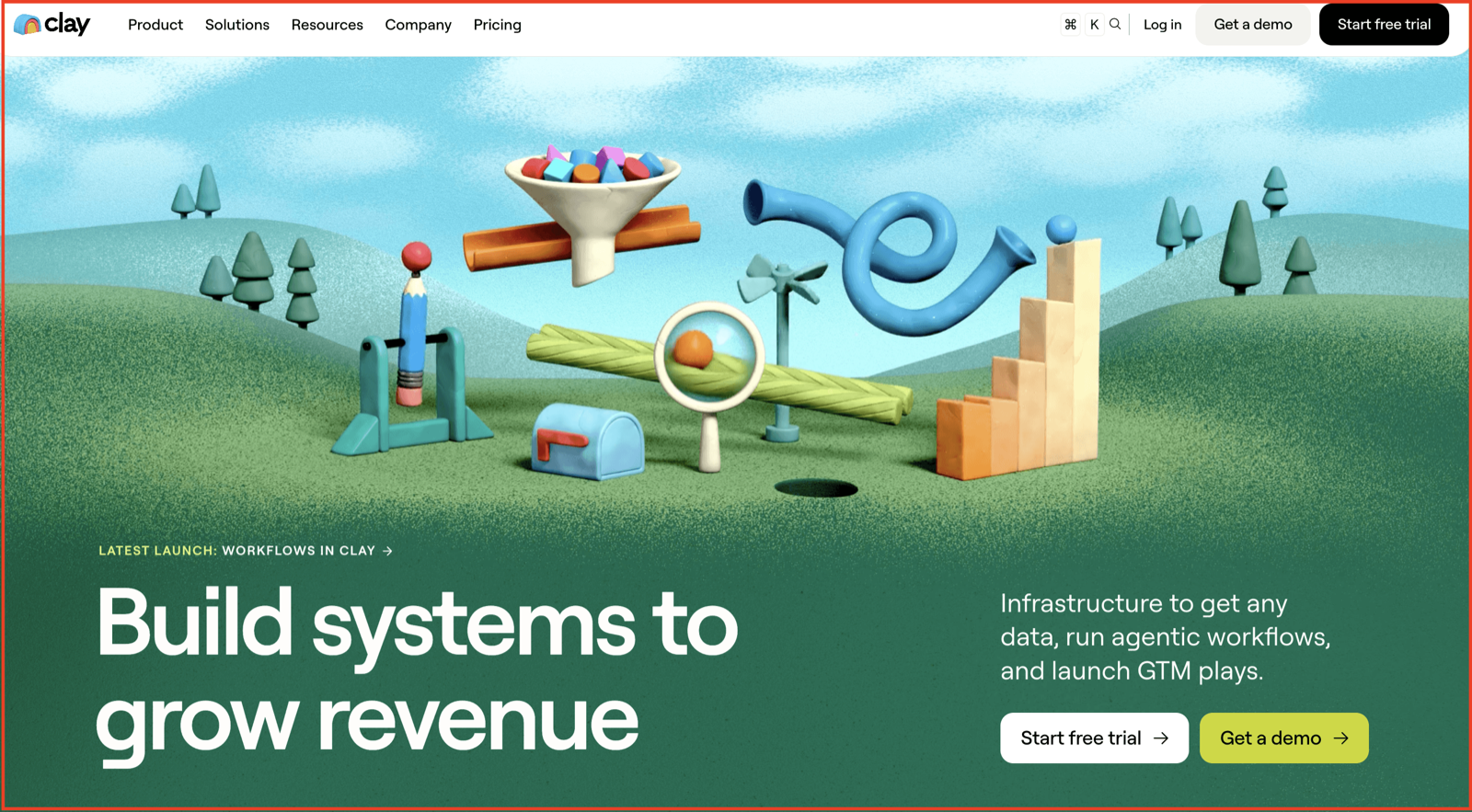
| 9 | Clay | GTM data/enrichment | Building and enriching targeted lists | Free; Launch from $185/mo |
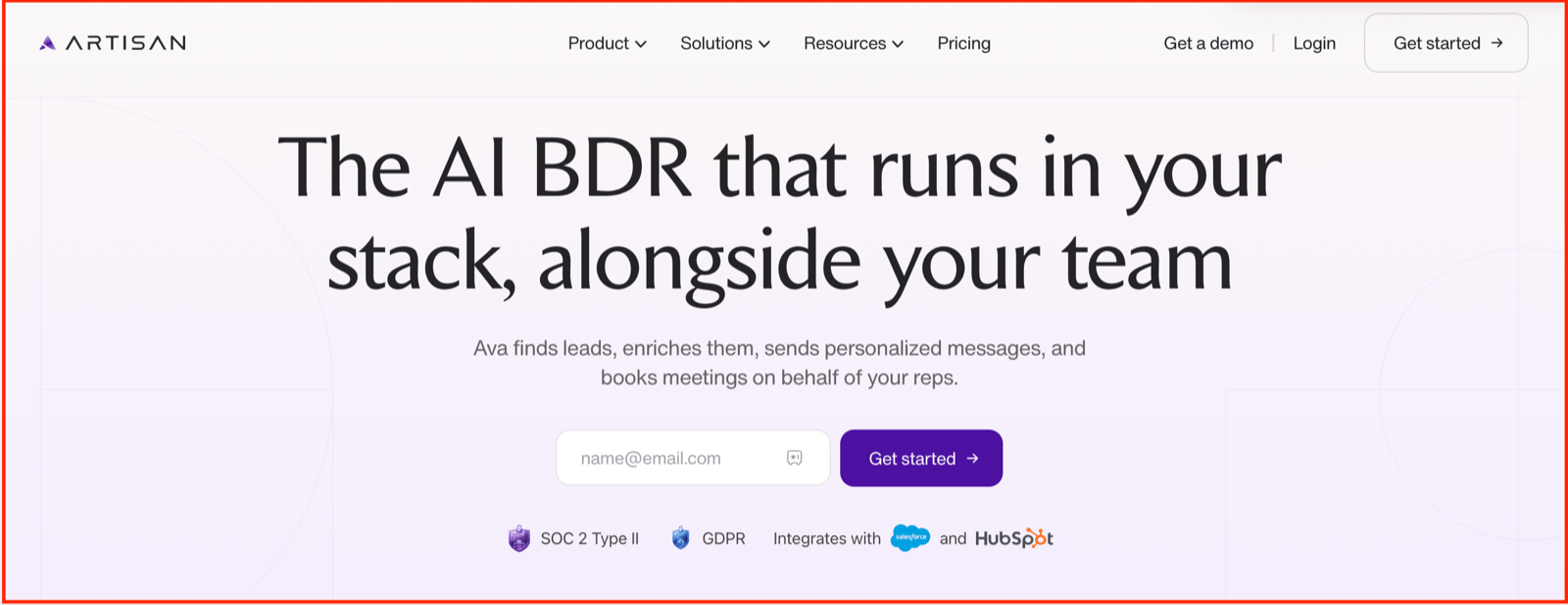
| 10 | Artisan | AI SDR / outbound | Automating the outbound motion | Self-serve from ~$250/mo |
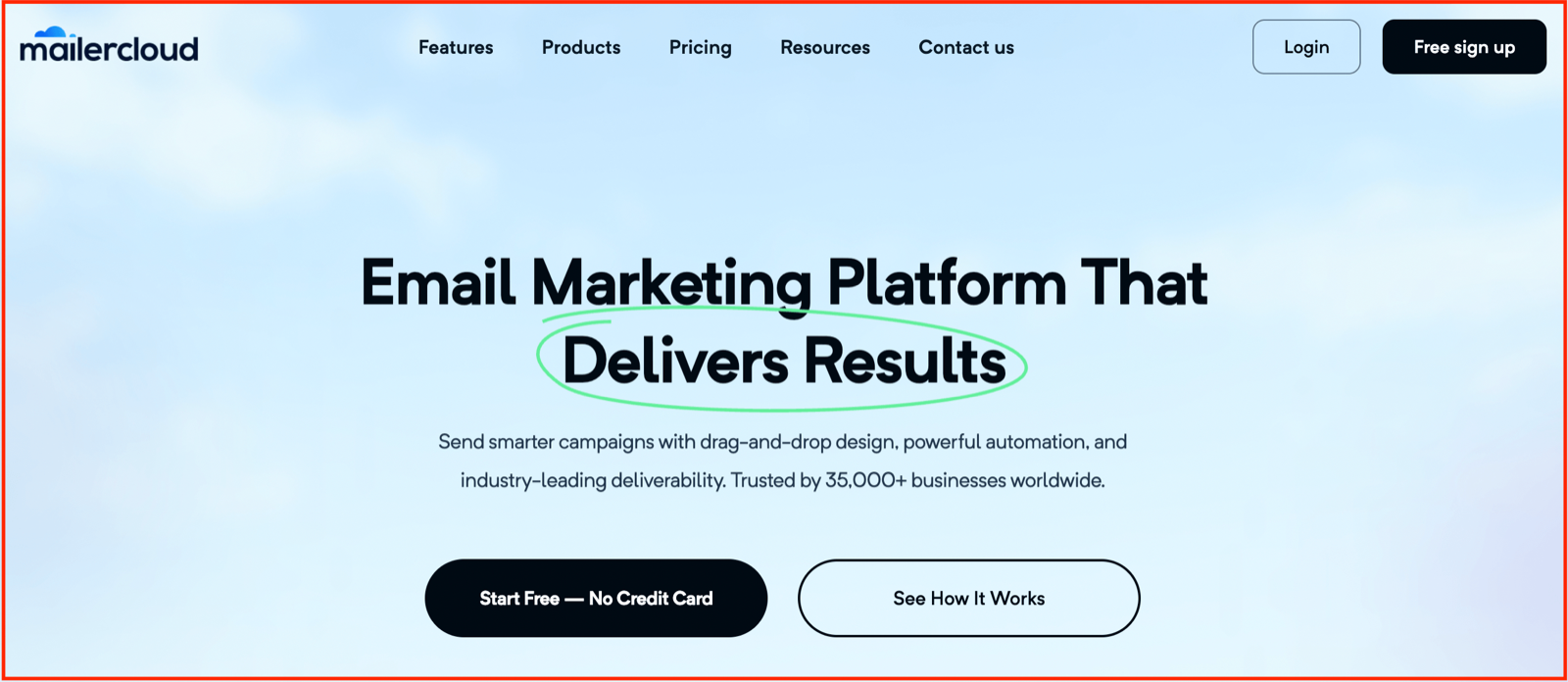
| 11 | Mailercloud | Email marketing/campaigns | Low-cost broadcast and lifecycle email | Free; paid from $10/mo |
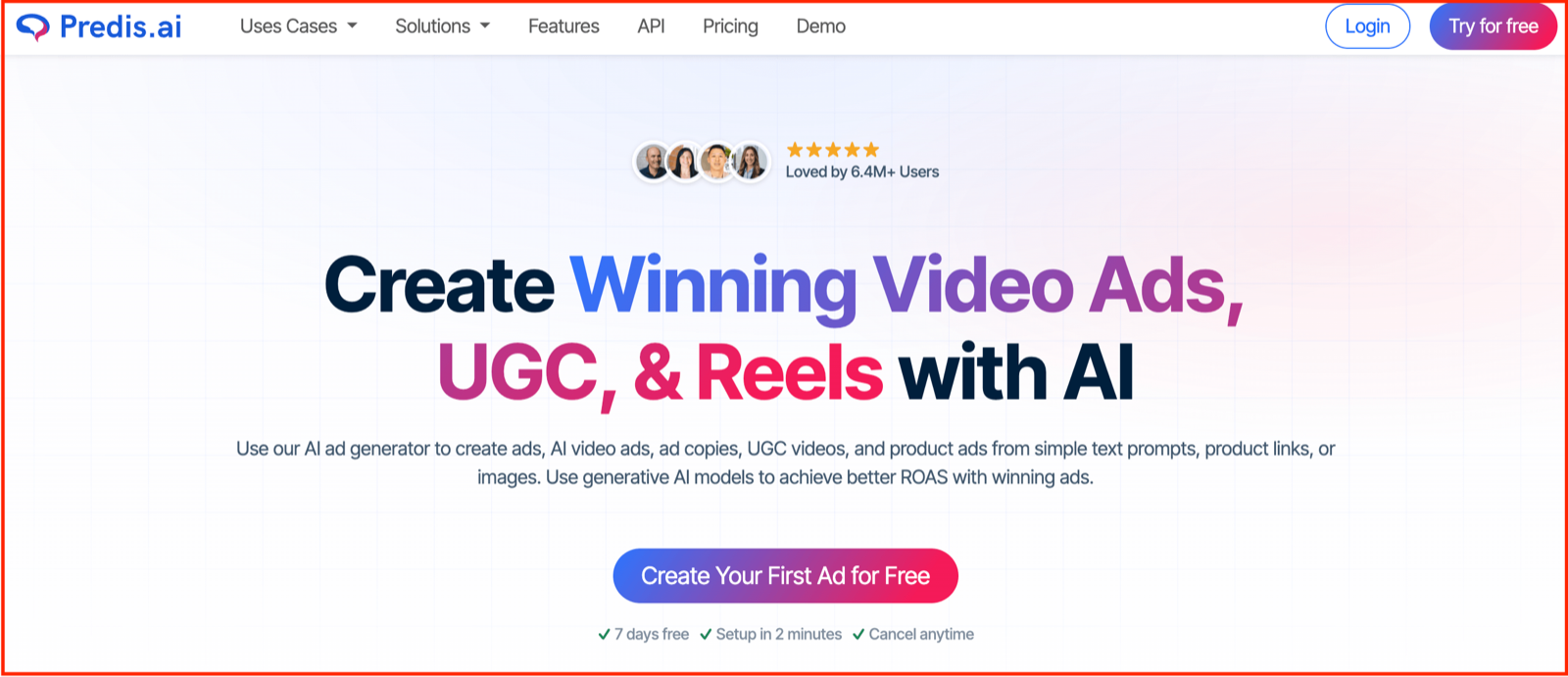
| 12 | Predis.ai | AI social video / creative | High-volume multi-platform social content | Free; Lite from $32/mo |
| 13 | Venngage | Design / visual assets | Infographics and data visualization | Free; Premium from $19/user/mo |
| 14 | Storydoc | Proposal automation | Generating and automating trackable proposals | From $19.80/mo |
| 15 | Zapier | Automation glue | Connecting tools without engineering | Free; Professional from $19.99/mo (annual) |
How I Picked These B2B SaaS Marketing Tools
I evaluated every tool against four tests, and a tool had to pass all four to make the list.
- Does it own a distinct job, so your stack is 15 specialists, not overlapping spend?
- Does it fit a growth-stage B2B SaaS team that has to run lean, without a specialist for every seat?
- Is it current for 2026, when AI search visibility and autonomous outbound became real line items, not experiments?
- Does it earn its cost against pipeline, not just look affordable at the sticker?
15 SaaS Marketing Software To Build Your 2026 Marketing Stack
The order below is how I would build the stack from scratch: foundational tools first, then the AI-native categories that earn their place in 2026, then the layers that hold everything together.
If you are working from a blank slate and a real budget, the ranking tells you what to fund first and what can wait. Buy each tool for the job it owns, not the feature list.
1. HubSpot — CRM + Marketing Automation
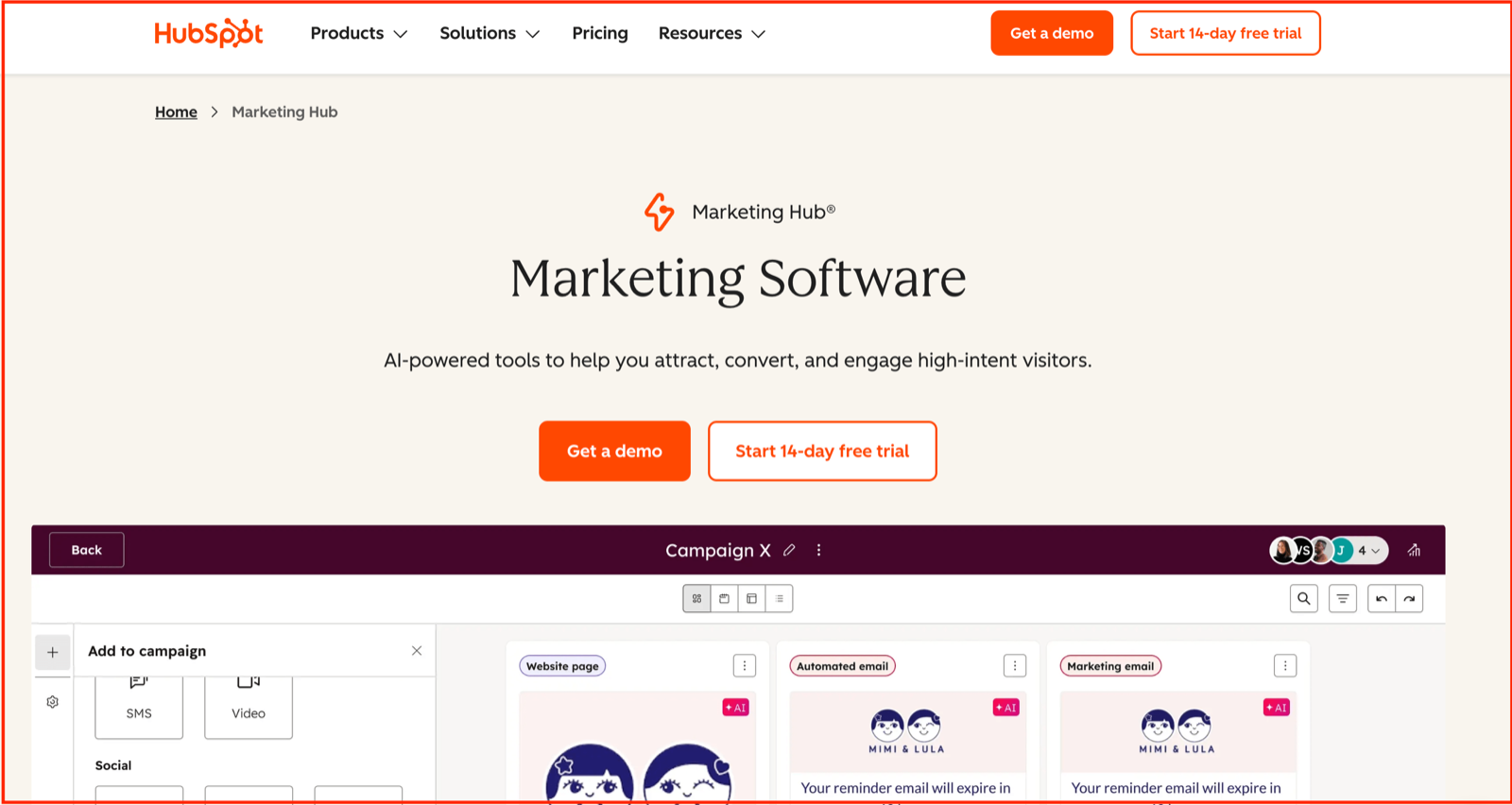
Best for: B2B SaaS teams that want the full funnel, first touch to closed-won, on a single platform.
HubSpot is the all-in-one platform for B2B SaaS teams that want CRM, marketing automation, and reporting on one data model instead of a stack of disconnected tools.
It solves a familiar problem. Your CRM lives in one place, email in another, and forms and analytics are scattered across three more, so no one can say which campaign actually sourced a deal.
Marketing Hub sits on top of a free CRM, which means campaigns, lead scoring, and attribution all read from the same record your sales team already works in. You get pipeline reporting that traces back to the source without exporting anything.
Key features:
- Free CRM for unlimited users — the shared record every other HubSpot tool reads from.
- Marketing automation and workflows — nurture sequences and lead scoring off any CRM property.
- Campaign and revenue reporting — attribute pipeline to its source without a separate analytics tool.
- Landing pages, forms, and email — build the full capture-to-nurture path in one place.
- 1,500-plus native integrations — connect the rest of your stack without custom builds.
Pricing:
- Free CRM for unlimited users
- Marketing Hub Starter from $9 per seat/month annually ($15 monthly)
- Professional $800/month annually, 3 seats, plus $3,000 onboarding
- Enterprise from $3,600/month
2. Ahrefs — Organic Acquisition–SEO
Best for: Content and SEO teams driving organic pipeline who need real competitive data, not surface metrics.
For SaaS teams that treat organic as a pipeline channel rather than a traffic vanity metric, Ahrefs is the SEO platform to build around.
Most SEO work fails at the same point. You can see rankings, but not which keywords a buyer actually searches on the way to a purchase, or why a competitor outranks you on the pages that convert.
Ahrefs runs on one of the largest backlink and keyword indexes in the category, so you can find the terms worth targeting, audit what is holding a page back, and watch where competitors are winning links you are not. For a SaaS team, that turns SEO from guesswork into a repeatable way to grow the content engine.
Brand Radar is one of 2026's most in-demand features. It tracks how often your brand shows up in AI answers, so the same tool now covers both organic search and AI search visibility.
Key features:
- Site Explorer — see any domain's backlinks, top pages, and traffic to reverse-engineer what works.
- Keywords Explorer — find and prioritize the terms buyers search across the funnel.
- Site Audit — catch the technical issues quietly capping your rankings.
- Rank Tracker — monitor position changes on the keywords tied to pipeline.
- Brand Radar — track brand mentions across AI search engines, not just blue links.
Pricing:
- Starter from $29/month (monthly billing only)
- Lite $129/month, Standard $249/month, Advanced $449/month
- Enterprise $1,499/month (annual)
3. Mixpanel — Product Analytics
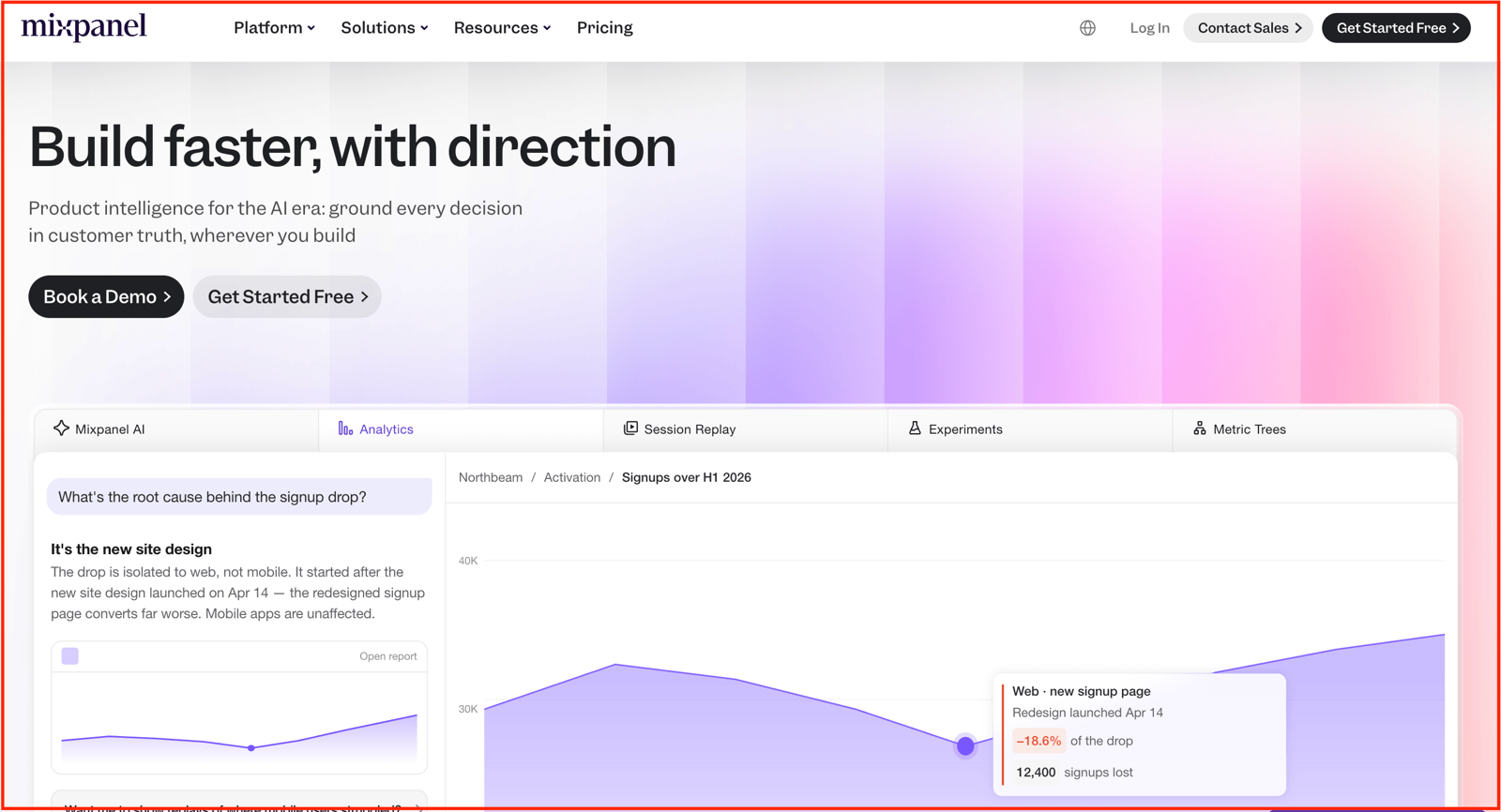
Best for: SaaS teams tying marketing campaigns to in-product activation and retention.
When SaaS marketing needs to connect campaigns to what users do inside the product, Mixpanel closes the gap.
Traffic and signups tell you nothing about whether a campaign brought in users who activate and stick.
Mixpanel tracks events, the specific actions users take in your product, so you can build funnels, measure retention, and break cohorts down by the channel that acquired them. For a SaaS team, that is how you learn which campaigns drive activation, not just clicks, and where users drop off before they reach value.
Billing is event-based rather than per seat, which keeps it generous at the low end and gives you unlimited seats even on the free plan. The upside is a data model flexible enough that most teams start here and never need to move.
Key features:
- Event tracking — capture every in-product action to analyze behavior, not just page views.
- Funnels — see exactly where users drop off on the path to activation.
- Retention reports — measure whether acquired users come back and stay.
- Cohort analysis — segment users by acquisition channel or behavior.
Pricing:
- Free up to 1M events/month, unlimited seats
- Growth from $0.28 per 1,000 events above the free tier
- Enterprise custom, from $20,000/year
4. Supergrow — LinkedIn Employee Advocacy (that's us)
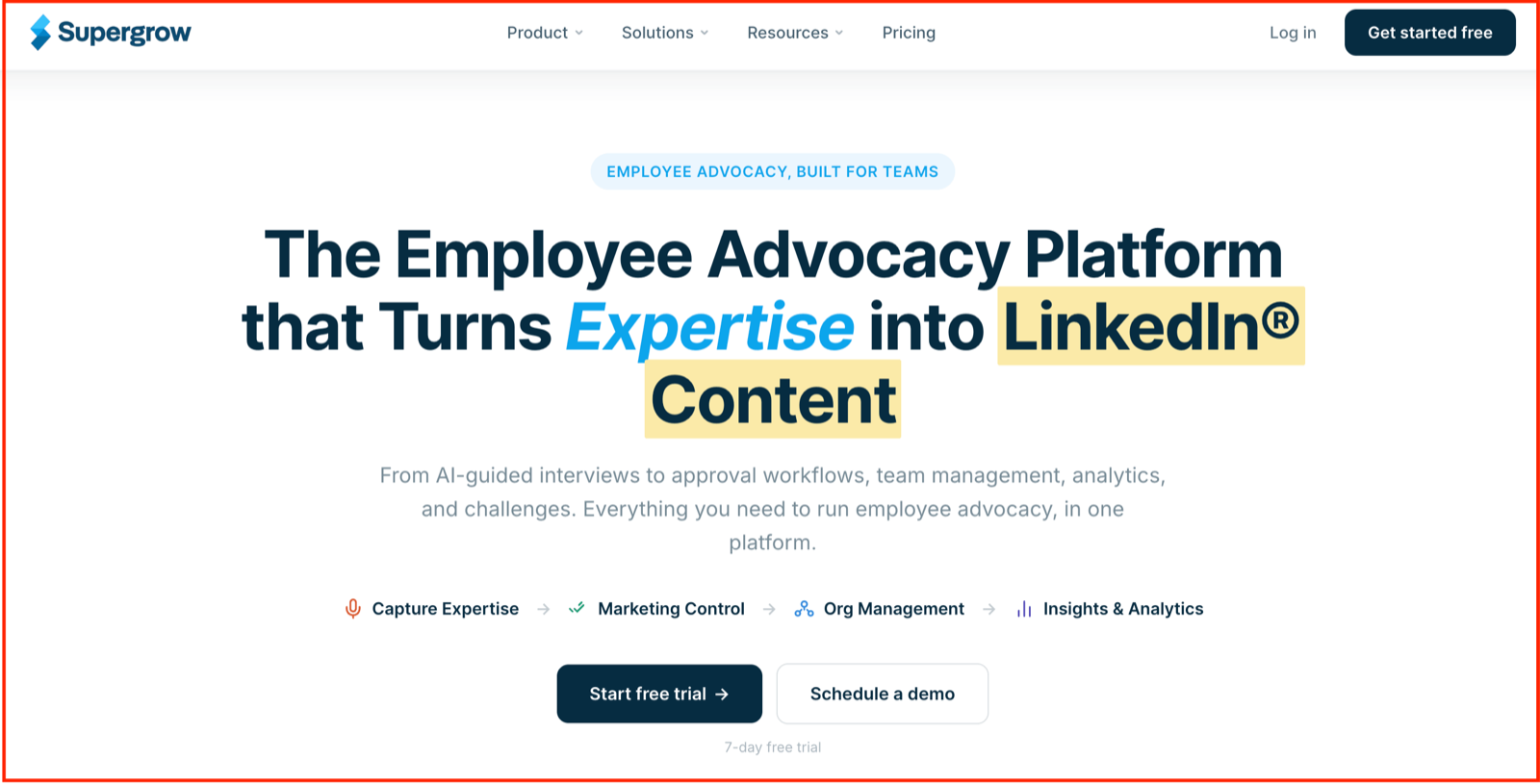
Best for: B2B marketing teams turning employees into consistent LinkedIn creators, and individuals building a personal brand.
Supergrow is the LinkedIn-first platform for B2B teams that want employees creating authentic content in their own voice, not just resharing company posts.
Most advocacy programs stall for the same reason. The content sounds corporate, employees do not know what to post, and marketing ends up chasing everyone through Slack.
Supergrow treats this as a creation problem, not a distribution one. Each employee shares their expertise in a short, AI-guided interview, and the platform turns it into LinkedIn-ready drafts that sound like them, so marketing can run employee advocacy as a system with review, approval, scheduling, and adoption tracking in one place.
The same engine works for individuals building a personal brand. Founders, marketers, and creators use Supergrow to stay consistent on LinkedIn without staring at a blank page, which is how many teams first land on it before rolling it out company-wide.
It is built only for LinkedIn, which is the point. That focus makes it stronger for thought leadership and advocacy than a multi-platform scheduler, though teams needing coverage across six networks will pair it with something broader.
Key features:
- PostCast — employees talk through ideas and get drafts back, no writing required.
- Content DNA — learns each person's voice so AI output does not sound generic.
- Content Board — manage every employee's drafts, reviews, and approvals from one view.
- Approval workflows — keep feedback on the post instead of buried in Slack.
- Team analytics — see who is active, what is working, and where adoption needs support.
- Teams from $139/month (billed annually), includes 4 accounts
- Individual plans from $19/month; Enterprise custom
- 7-day free trial, no card required
Turn your SaaS marketing team into a LinkedIn growth engine. Start a 7-day free trial, or book a demo to see how advocacy runs across your whole team.
5. Profound — AI Search–GEO Visibility
Best for: SaaS teams treating AI search as a real acquisition channel, not an experiment.
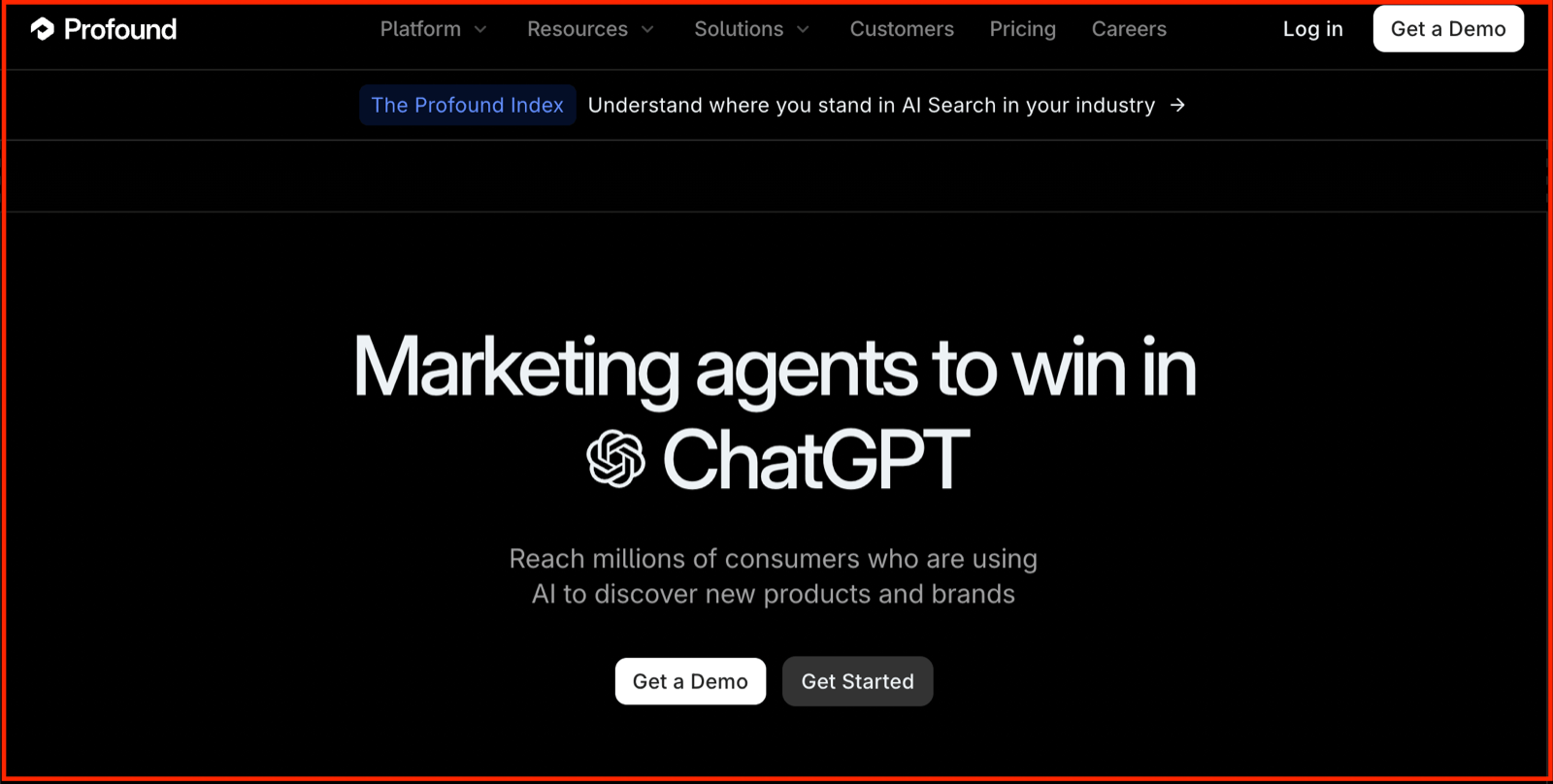
Profound is the category leader for tracking how your brand shows up when buyers ask ChatGPT, Perplexity, and Google's AI answers about your space.
Buyers now start research inside AI assistants, and those answers either mention you or they do not. Traditional SEO tools cannot see this, because there is no blue-link ranking to measure.
Profound tracks whether AI engines cite your brand, how they describe it, and where competitors get named instead, which turns AI search from a blind spot into something you can actually manage. This is the newest must-have category in the stack, and Profound is the most funded and validated tool in it.
Key features:
- AI answer tracking — monitor brand mentions across ChatGPT, Perplexity, Gemini, and more.
- Prompt Volumes — see real AI-search demand by topic to guide content.
- Citation analysis — learn which sources AI engines pull from to describe your category.
- Competitor benchmarking — track share of voice against rivals in AI answers.
- Content agents — generate briefs and drafts aimed at AI visibility.
Pricing:
- Starter from $99/month (ChatGPT only)
- Growth $399/month (three engines); Enterprise custom
6. HockeyStack — Attribution Revenue Analytics
Best for: Growth-stage B2B SaaS teams connecting marketing spend to pipeline in long sales cycles.
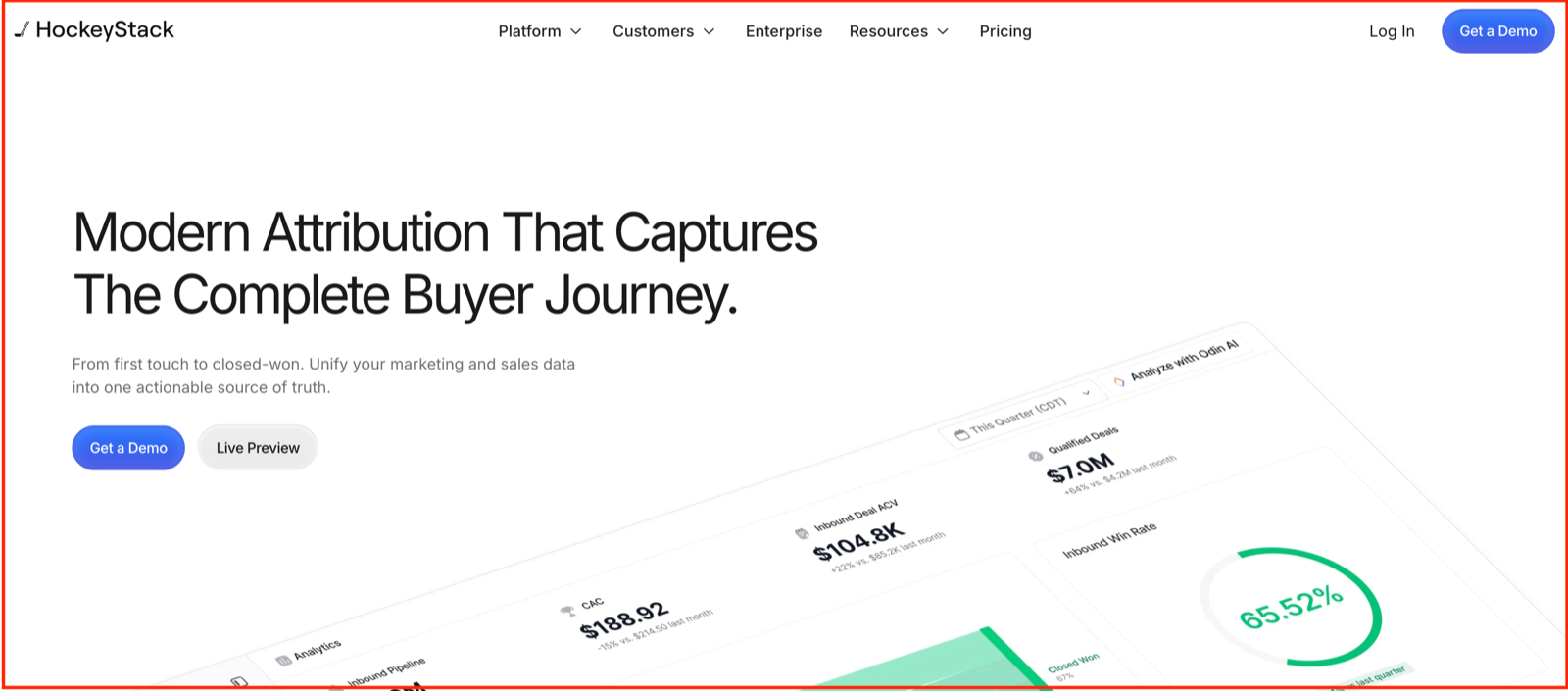
HockeyStack is the attribution platform for B2B SaaS teams that need to prove which marketing spend actually drives pipeline and closed revenue.
The reporting gap in B2B is real. Sales cycles run for months across dozens of touchpoints, so last-click attribution credits the wrong channel and finance stops trusting the marketing number.
HockeyStack pulls website, CRM, and ad data into one view and maps the full buyer journey at the account level, so you can see which campaigns influenced pipeline and which just spent budget. For a team defending its spend to the board, that connection between activity and revenue is the whole point.
It has grown from an attribution tool into a broader GTM platform, adding an AI analyst that answers pipeline questions in plain language.
Key features:
- Multi-touch attribution — credit every touchpoint across a long B2B buying cycle.
- Account-level journeys — see how named accounts move from first touch to deal.
- Ad and CRM integration — unify paid, web, and pipeline data in one report.
- Odin AI analyst — ask attribution questions in plain language.
- Pipeline and revenue reporting — tie spend directly to closed-won.
Pricing:
- No free tier; quote-based
- Reported from ~$1,399/month (GTM Intelligence tier); higher tiers from ~$2,200/month
7. Intercom — Conversational–PLG Messaging
Best for: Product-led SaaS teams driving activation and support through in-app messaging.
Intercom is the messaging and support platform for product-led SaaS teams that convert and retain users through in-app conversations, not just email.
For a product-led motion, the moment that matters is when a user is stuck inside the product. Intercom puts messaging, live chat, and support where activation actually happens, so you can onboard users, answer questions in-app, and nudge them toward value before they churn.
Its Fin AI agent resolves a large share of support conversations on its own, which lets a lean team handle volume without adding headcount.
Key features:
- Fin AI agent — autonomously resolves most support conversations.
- In-app messaging — reach users inside the product at the moment of friction.
- Shared inbox — manage support, sales, and success conversations in one place.
- Product tours and onboarding — guide new users toward activation.
- Workflow automation — route and trigger messages based on user behavior.
Pricing:
- Essential from $29/seat/month (annual, $39 monthly)
- Advanced $85/seat/month; Expert $132/seat/month
- Fin AI billed separately at $0.99 per resolution
8. Jasper — AI Content Generation
Best for: SaaS marketing teams producing on-brand content at scale across channels.
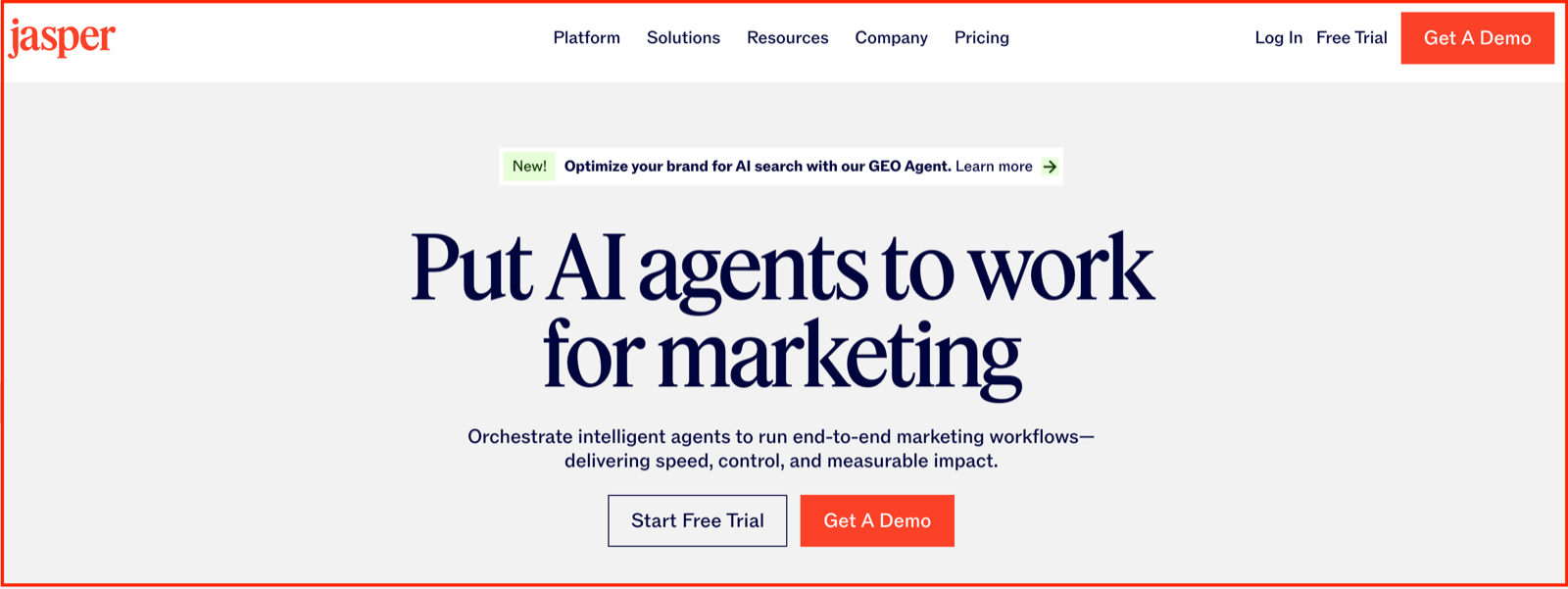
Jasper is the AI content platform for SaaS marketing teams that need on-brand copy at scale, not generic output they have to rewrite.
Every team has tried a general AI writer and hit the same wall. The output is fast but off-voice, so editors spend as long fixing it as writing from scratch.
Jasper solves this with Brand Voice and Knowledge assets that train on your materials, so drafts sound like your brand across blog, social, email, and ads. For a marketing team shipping content weekly, that is the difference between AI that saves time and AI that adds an editing step.
It is built for marketing teams, not casual users, and priced accordingly.
Key features:
- Brand Voice — train Jasper on your voice so output stays on-brand.
- Knowledge assets — feed it brand facts and positioning to keep drafts accurate.
- Campaign generation — produce a full campaign from a single brief.
- Marketing templates — formats built for blog, social, email, and ad copy.
- AI-search features — optimize content to appear in AI answers, priced separately.
Pricing:
- Pro from $59/month billed annually ($69 monthly), 1 seat
- Business custom, for teams and collaboration
- 7-day trial, no free plan.
9. Clay — GTM Data–Enrichment
Best for: SaaS GTM teams building and enriching targeted lead lists for outbound.
Clay is the data enrichment engine for SaaS go-to-market teams that need accurate, targeted lead lists instead of stale CRM records.
Outbound and targeting break down when the underlying data is thin or wrong. Most tools pull from a single provider, so coverage gaps leave you guessing on emails, titles, and company details.
Clay runs waterfall enrichment across more than 100 data sources, trying one after another until it finds a match, which typically returns far more complete records than any single vendor.
Its AI agent, Claygent, goes further by researching prospects the way a person would, pulling context from the web to score accounts and personalize outreach.
Key features:
- Waterfall enrichment — chain 100-plus providers to maximize data coverage.
- Claygent — an AI agent that researches accounts and writes personalized context.
- List building — source and filter targeted prospect lists in one place.
- CRM sync — push enriched data into Salesforce or HubSpot on Growth.
- Unlimited seats — give the whole team access on every plan.
Pricing:
- Free with 100 data credits and 500 actions per month
- Launch from $185/month ($167 annual)
- Growth $495/month (adds CRM sync); Enterprise custom
10. Artisan — AI SDR–Outbound
Best for: SaaS sales teams automating outbound prospecting at volume.
Artisan is the AI sales rep for SaaS teams that want to automate outbound prospecting without hiring and managing a full SDR bench.
Outbound is expensive to staff and slow to ramp, and most teams stitch together a data tool, a sequencer, and deliverability infrastructure to run it.
Artisan consolidates that into one platform built around Ava, an AI SDR that sources leads from a 300-million-contact database, writes personalized emails, runs multichannel sequences, and books meetings.
The pitch is that Ava handles roughly 80% of the outbound motion, so your reps spend their time closing rather than prospecting.
Key features:
- Ava, the AI SDR — automates sourcing, outreach, and follow-up end-to-end.
- 300M-contact database — built-in lead data, no separate enrichment tool.
- Multichannel sequencing — run coordinated email and outreach campaigns.
- Deliverability infrastructure — mailboxes and warmup handled in-platform.
- CRM sync — push activity and replies into your existing CRM.
Pricing:
- Free trial with 10,000 credits, no card required
- Self-serve from ~$250/month (Intern tier)
- Employee $600/month; Enterprise custom
11. Mailercloud — Email Marketing Campaigns
Best for: SaaS teams that need cost-efficient broadcast and lifecycle email at scale.
Mailercloud is the budget email platform for SaaS teams that need reliable newsletters, campaigns, and lifecycle sends without paying incumbent prices.
Email marketing cost creeps up fast as your list grows, and tools like Mailchimp start charging serious money for what is still basic sending.
Mailercloud covers the core work, campaigns, automation, segmentation, and reporting, at a fraction of the price, with a genuinely usable free tier to start. For a team that needs dependable broadcast and nurture email but does not need a heavy enterprise suite, it hits the value sweet spot.
Key features:
- Drag-and-drop builder — create responsive emails without code.
- Automation — drip campaigns and lifecycle sequences on every plan.
- Segmentation — target sends by subscriber attributes and behavior.
- Campaign analytics — track opens, clicks, and engagement.
- Transactional email API — send system and lifecycle emails programmatically.
Pricing:
- Free for 12,000 emails/month and up to 1,000 contacts
- Paid from $10/month with unlimited emails
- Enterprise custom.
12. Predis.ai — AI Social Video Creative
Best for: SaaS teams producing high-volume, multi-platform social content fast.
Predis.ai is the AI content generator for SaaS teams that need a steady stream of social posts, carousels, and short videos without a design or video team.
Keeping social channels fed is a grind, and most AI tools stop at the caption, leaving you to create the visual elsewhere.
Predis generates the finished asset from a single prompt — the image, carousel, or short video — along with copy and hashtags, then schedules it across platforms. For a lean SaaS team trying to stay consistent on Instagram, TikTok, LinkedIn, and more, that removes the production bottleneck that usually kills social output.
Key features:
- AI post generation — create posts, carousels, and ad creatives from a prompt.
- AI video and reels — produce short-form video without an editor.
- Multi-platform scheduling — publish across Instagram, TikTok, LinkedIn, and more.
- Competitor analysis — see what content works for rivals.
- Bulk content creation — generate a batch of posts at once.
Pricing:
- Free tier and free trial available
- Lite from $32/month (60 AI posts, 5 channels)
- Higher credit-based tiers scale with usage.
13. Venngage — Design Visual Assets
Best for: SaaS marketers turning data and research into shareable visual content.
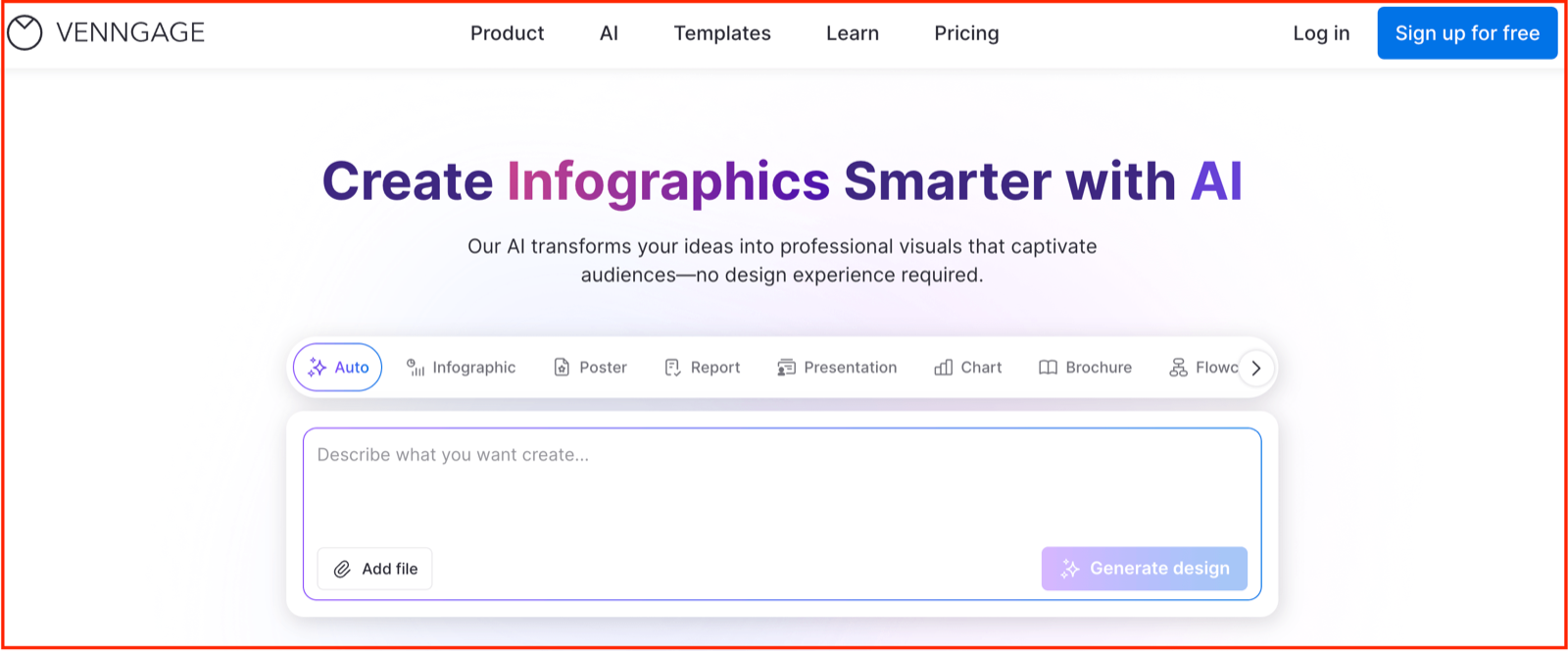
Venngage is the design tool for SaaS marketers who need professional infographics, reports, and data visuals without hiring a designer.
Marketing teams sit on data and research that would earn attention if it were visual, but turning a spreadsheet into a shareable infographic usually means waiting on design or fighting a blank canvas.
Venngage is built for non-designers, with a large template library focused on infographics, reports, and data visualization. You drop in your numbers, pick a template, and get an on-brand visual you can publish or drop into a deck.
Its focus is as much a limitation as a strength. It is purpose-built for informational and data-heavy visuals, so teams wanting deep, freeform design control will find it more constrained than a general design tool. For turning data into thought leadership, that focus is exactly the point.
Key features:
- Infographic templates — hundreds of layouts built for data storytelling.
- Data visualization — turn spreadsheets into charts and visual reports.
- Brand Kit — apply your colors, fonts, and logo across designs.
- Drag-and-drop editor — build visuals without design skills.
- Team collaboration — share and edit designs across the team.
Pricing:
- Free version available
- Premium from $19/user/month; Business $49/user/month
- Enterprise $499/month for 10 users.
14. Storydoc — Proposal Automation Tool
Best for: SaaS sales and marketing teams generating and automating trackable proposals.
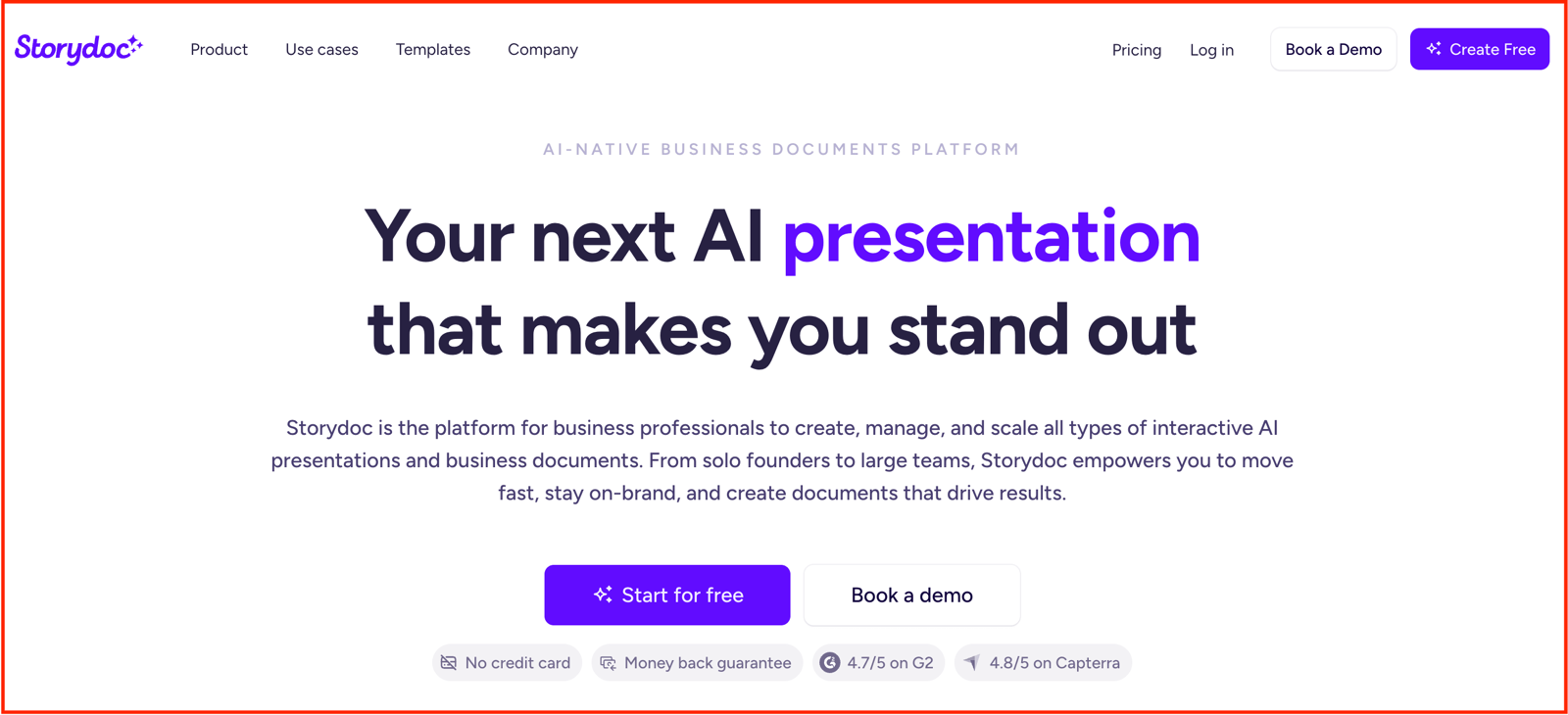
Storydoc is the collateral tool for SaaS teams that want pitch decks, proposals, and one-pagers people actually engage with, and that you can track.
A PDF deck is a black box. You send it, and you have no idea whether the prospect opened it, which slides they read, or where they dropped off.
Storydoc turns static decks into interactive, web-based documents that scroll and respond like a landing page, then tells you exactly how each recipient engaged with them. For sales and marketing teams, that means collateral that holds attention and doubles as an intent signal you can act on.
Key features:
- CRM integration — highly personalized proposals from HubSpot and Salesforce.
- Engagement analytics — see who viewed what, slide by slide.
- Powerful embeds — e-signing tools, forms, calendars, and videos.
- Automated follow-ups — get engagement alerts and easily generate follow-up decks.
Pricing:
- No free plan; free trial available
- Starter from $19.80/month
- Pro $36/month
15. Zapier — Automation Glue
Best for: SaaS teams connecting tools that lack native integrations, without engineering.
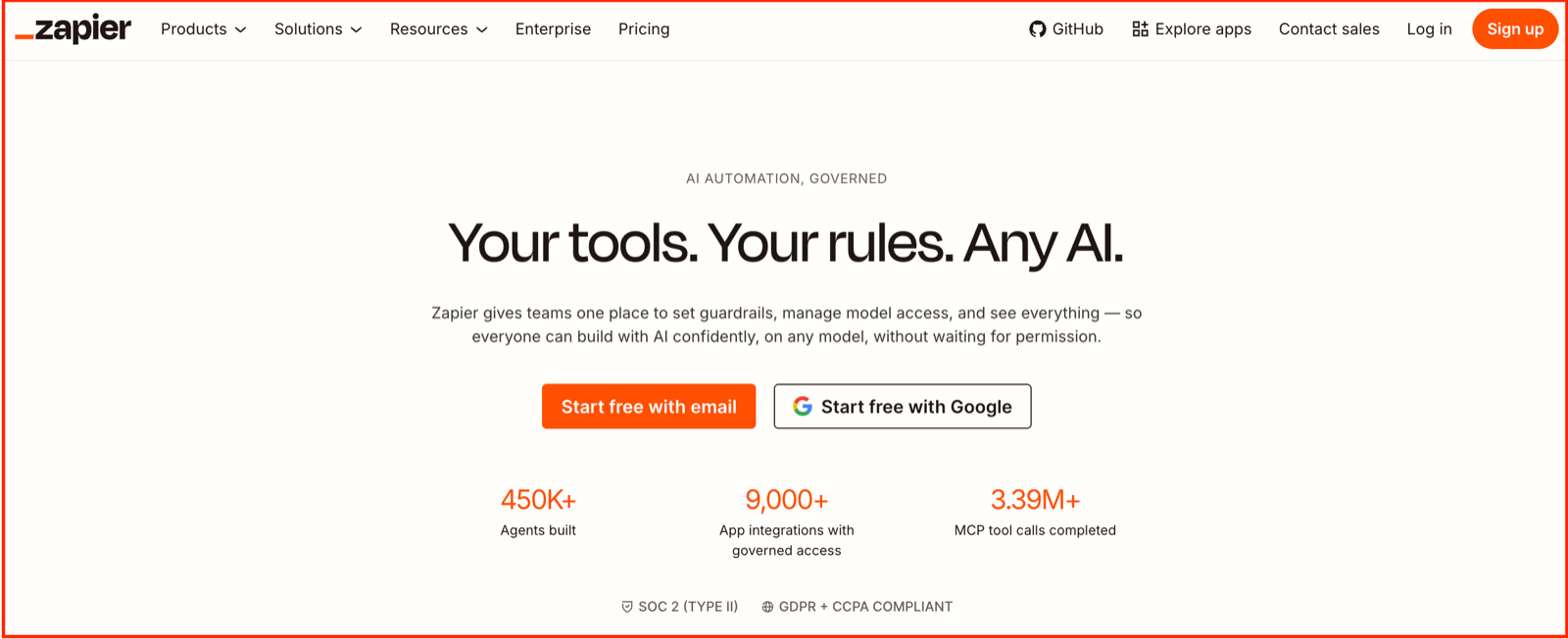
Zapier is the automation layer that connects every other tool in your stack, so data moves between them without anyone copying it by hand.
A modern SaaS stack is only as good as the handoffs between its tools, and those handoffs are where things quietly break. A lead fills a form but never reaches the CRM, or a closed deal never triggers the onboarding email.
Zapier links more than 8,000 apps through simple triggers and actions, so a form submission can create a CRM record, ping Slack, and start a sequence automatically. For a lean team, it replaces the manual busywork that eats hours and drops data between systems.
Key features:
- 8,000-plus app integrations — the widest connector library available.
- Multi-step Zaps — chain several actions into one automated workflow.
- Triggers and actions — automate handoffs off any app event.
- Filters and paths — add conditional logic to workflows.
- No-code builder — set up automations without engineering.
Pricing:
- Free for 100 tasks/month, 2-step Zaps
- Professional from $19.99/month annually (750 tasks)
- Team $69/month annually; Enterprise custom.
Build Your 2026 SaaS Marketing Stack
Don't try to buy all marketing tools at once. Start with the foundation: a CRM, an SEO platform, and product analytics, then add the layers your motion actually depends on. A product-led team should fund activation and attribution early. An outbound-heavy team should prioritize data and an AI SDR. Audit what you already run, find the job no tool currently owns, and fill that gap first.
Keep one rule as you build. Every tool should own a distinct job and connect cleanly to the rest, or it becomes overlapping spend instead of an engine.
If LinkedIn is where your buyers pay attention, employee advocacy is one of the highest-leverage places to start. Start your free trial with Supergrow today and get your first posts live this week.