
Loads of B2B teams are frustrated that social selling "doesn't work" for them.
They post content five days a week, comment diligently on others' posts and send cold outreach messages that sound optimistic but often fall flat.
The challenge isn't effort—it's lack of system. Social selling today feels manual, fragmented, and difficult to scale across teams. A few individuals may see success, but there's rarely a system that turns everyday activity into measurable revenue impact.
Without a structured system, even the most active teams struggle to get conversions. This guide will provide a clear blueprint for turning employee advocacy into a repeatable social selling engine.
The Real Problem: Why Social Selling Doesn't Generate Pipeline
Many B2B teams want to use social selling for lead generation, but they don't understand the nuances of what they might be doing wrong. So, let's understand why social selling isn't generating pipeline for your business:
Activity Without Outcomes
Activity is seductive because it's visible, countable, and easy to report. We "posted 12 LinkedIn posts, ran targeted outbound campaigns, and held 47 conversations".
None of this tells you if the business comes from social selling. Activity creates the illusion of momentum. Outcomes are quieter—and harder.
When there's no structured way to answer "If we stopped this next week, would any outcome change?", you've found activity masquerading as progress.
Social selling is not about training teams to become LinkedIn influencers. It's about marketing enabling sales with the right content, research, signals, and playbooks so sellers can build relationships that turn into pipelines.
Without a clear path, social selling becomes a set of disconnected actions. Teams stay busy, but the impact remains invisible, and ultimately, negligible.
Conversations Are Happening But Not Captured
High-intent prospects rarely convert immediately. They research. They compare. They interact. So, if you ignore them, you'll miss the easiest wins.
Social selling isn't just about creating loads of content or spamming DMs; it's about understanding signals that could lead to conversions.
Most social selling fails because they focus more on creating content than capturing insights, such as:
-
Comments without followup
-
Repeated engagement from the same people
-
Profile views from ICP accounts
-
Conversations start but aren't nurtured
-
No tracking of conversation-to-pipeline journey
If you want a consistent flow of leads every week, you need to understand what actually moves the needle, and for that, you need to capture the above social selling insights.
Employee Advocacy Is Treated as Content, Not a System
Posting regularly on LinkedIn feels productive. You show up daily, follow advice, share content, and engage. But the leads don’t come.
Why? Because visibility without relevance doesn’t create opportunities.
When everyone is encouraged to post "anything," content becomes noisy, repetitive, and uncertain. People hesitate, second-guess themselves, or default to resharing corporate posts.
So, when there's no coordination among employee voices, your business starts from zero with every post, far from sparking conversations that convert engagement into a pipeline.
The Shift: From Posting Content to Driving Conversations
B2B teams that actually pull off social selling have figured out a secret. Social media isn't a broadcasting platform; it's a conversation starter. People don't necessarily want to be sold anymore. They crave authenticity, personalization, and two-way interactions with the brands they follow.
The shift from posting content to driving conversations is pretty evident.
Content Alone Doesn't Drive Social Selling
Informational content might get you visibility, but the visibility isn’t the same as traction. You can rack up impressions, views, and even the occasional like, yet see no zero pipeline impact.
That’s because most content today is consumed passively. Most online communities follow the 90-9-1 rule for participation where 90% of the audience are lurkers (passive consumers), 9% of users contribute from time to time and only 1% of users participate a lot.
The problem? Passive consumption doesn’t create intent. It doesn’t start a dialogue, uncover a need, or move someone closer to a decision.
Social selling at its core is about creating engagement. It helps prompt replies, DMs, and meaningful back-and-forth, so trust is formed, and opportunities actually take shape.
Conversations Are the Starting Point of the Pipeline
Comments aren’t just vanity metrics, they’re early signals of awareness turning into interest. When someone takes the time to respond, they’re moving from passive consumption to active consideration.
Questions go a level deeper. They reveal context, challenges, and intent. When a prospect asks “how does this work for X?” or “can this integrate with Y?”, they’re not just engaging, they’re mapping your solution to their problem.
And, this is where repetitive engagement builds momentum. When the same person shows up across multiple posts, replies, or threads, it signals growing trust and buying readiness. At this stage, conversations can naturally transition into DMs, demos, or even sales discussions.
Employee Advocacy Becomes Powerful When It Drives Interaction
Real employee advocacy isn't about turning your team into content distribution channels. It's about enabling them to develop their own voice, credibility, and networks—benefiting your brand in a far more authentic, organic way.
This is the employee advocacy loop.
Every post they share, every comment they respond to, and every relationship they nurture builds momentum, compounding into long-term brand equity.
Over time, that consistency pays off:
-
In weeks, it increases visibility
-
In months, it strengthens the reputation
-
In years, it creates brand gravity—the kind of recognition no algorithm shift can take away
When employees actively express your brand values, engage in meaningful industry conversations, and grow through real-world feedback, they build a presence that traditional marketing efforts often take years to achieve.
How to Turn Employee Advocacy Into a Social Selling Engine
Most companies treat employee advocacy as a visibility play. But visibility alone doesn't drive revenue. Instead of one company voice reaching a small audience, you create a network of authentic voices, creating a distribution engine that grows stronger over time.
Let's explore an employee advocacy framework where employees' voices are treated as part of an editorial strategy – creating a compounding effect.
Step 1: Select the Right Employee Voices
Here's the thing every marketer should keep in mind: not every employee can be an ideal advocate. Some of them might not use social media, and others may not be interested in building a personal brand.
Look for people who meet these criteria:
-
Subject matter expertise: They know their domain deeply and can teach others. This sets the base for expert positioning.
-
Willingness to be visible: The first people you call on should be those already active. If they're talking about your company, their work, or posting on LinkedIn, they're your ideal candidates for employee advocacy.
-
Client-facing roles: People in sales, customer success, product or leadership interact with your ICP daily. They understand the problems your ICP faces.
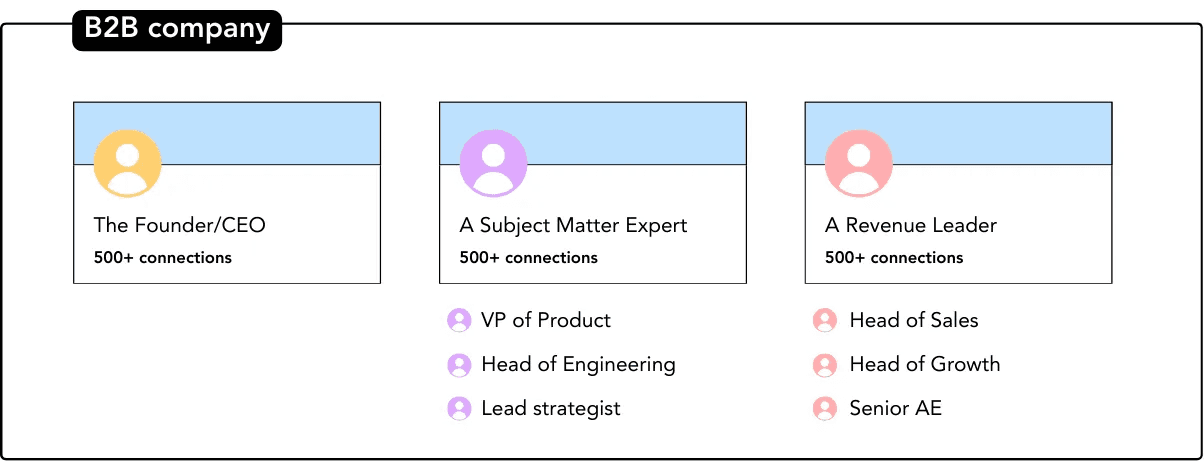
For most B2B companies, here's the ideal team composition:
-
The Founder/ CEO: Study reveals that CEOs can achieve the same level of engagement as a company page, even with 98% fewer followers. They set the vision, share company-building stories, and represent the brand's point of view on the market.
-
A subject matter expert: This could be your VP of product, Head of Engineering or lead strategist. They can go deep on technical topics your audience cares about.
-
A revenue leader: Head of growth, head of sales or a senior AE. They share buying patterns, customer stories and practical insights.
If you're starting from scratch, don't try to launch 5 profiles at once. Start with your founder and one team member. Get the process right, see results and scale. We've seen more companies fail from trying to do too much too fast than from going too slow.
Step 2: Define Content That Sparks Conversations
Once you've chosen your team, you need to map out what each person will talk about.
Different types of content have different goals and varying levels of effectiveness. This can range from how engaging the content is to how likely employees are to share the content with their networks.
Start with 3-4 core themes per person. These are broad categories your content will fall into. Further, break these themes into 5-10 sub-topics. These are more specific angles you'll create.
Example topical map for a Head of Sales:
| Core Theme | Substopics | Content Angles |
|---|---|---|
| Revenue Growth | Forecasting, quota planning, deal velocity | “Why your forecasts are always wrong” / “How to increase deal velocity by 30%” |
| Outbound Strategy | Cold outreach, personalization, sequencing | “Why your cold emails don’t convert” / “The outbound playbook for 2026” |
| Sales Tech Stack | CRM tools, automation, AI in sales | “Your sales stack is bloated” / “3 tools that replaced 10 in my team” |
Avoid general educational content and focus on opinions, insights, and real experiences. But to properly cover your market, you need three levels.
-
Strategic content speaks to C-levels, VPs, and investors by sharing high-level insights, industry trends, vision, and point of view.
-
Tactical content includes frameworks, playbooks, step-by-step strategies, and decision frameworks that resonate with managers and senior ICs.
-
Operational content serves the teams doing the work every day through tutorials, templates, workflows, tool walkthroughs, and checklists.
Instead of one person trying to cover everything, which sounds inconsistent, each voice naturally owns the level that matches their expertise.
The result: complete alignment across all three layers, creating a brand that resonates with every level of your buyer's organization.
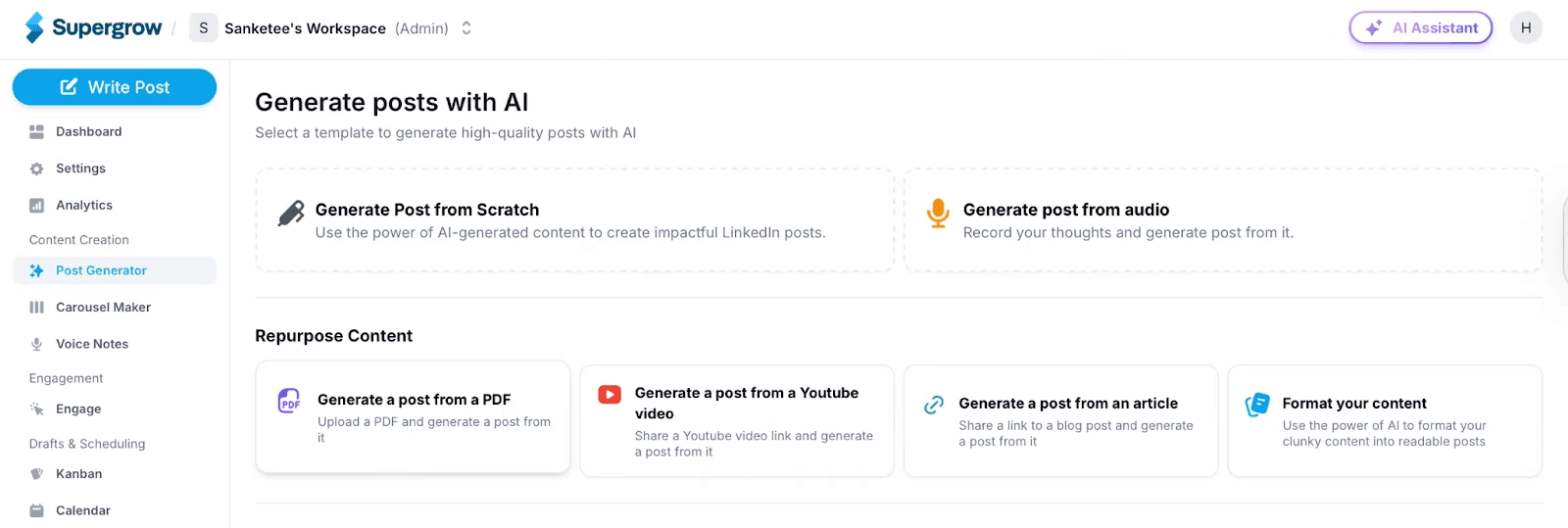
But if your team struggles to write their own posts, Supergrow can be trained on your past posts or your favorite LinkedIn influencer to help you generate content that mirrors your authentic voice, so every story is distinctly yours.
Step 3: Build a Consistent Publishing System
Most teams make this one mistake of just posting when they feel like it. That's the fastest way to be inconsistent. An employee advocacy content calendar doesn't need to be complicated. It just needs to answer three simple questions:
-
Who is publishing
-
what format
-
and when
We recommend 2-3 posts per week per person, as this is enough to stay visible without burning out.
Your employee advocacy program can follow the 4-1-1 content rule for every 6 pieces of content you share with employees: 4 should be personal/authority-based, 1 should be owned/company-related, and 1 should be promotional.
To streamline the approval process, you can use Supergrow's Content Board to track your posts from draft to published. It lets you see all scheduled content across team members and approve, request changes, or publish with one click—without leaving the app.
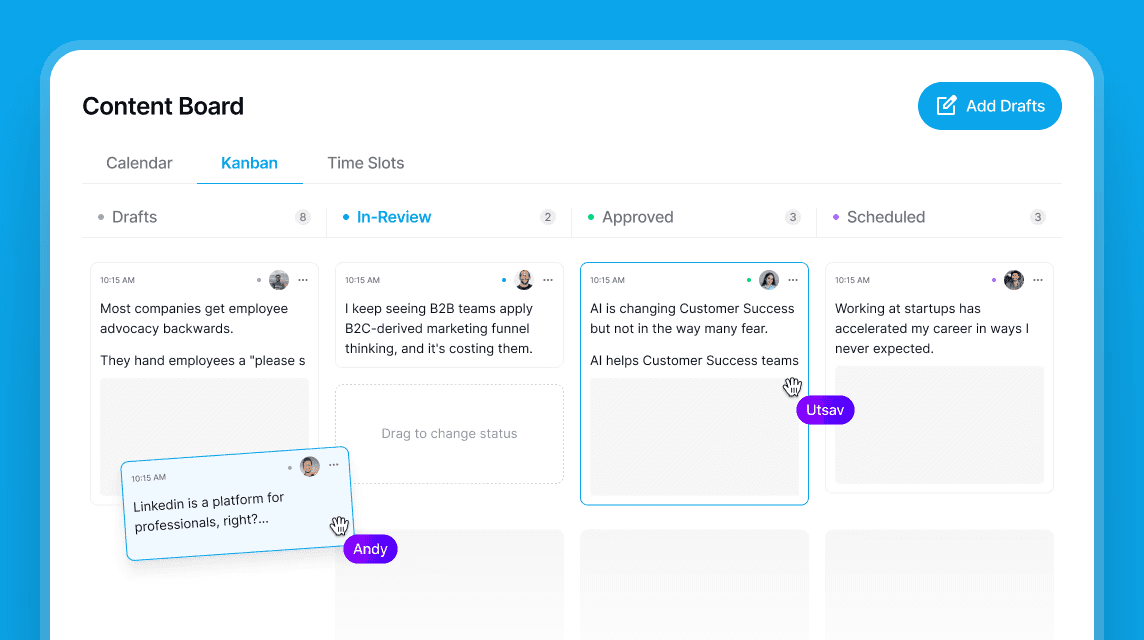
The result? Total coherence across teams and brands that are trying to be consistent on LinkedIn without it becoming another burdensome task.
Step 4: Turn Engagement Into Active Conversations
Engaging on LinkedIn isn't about likes, followers, or impressions. It's about starting conversations.
Influ2 analyzed 2M targets and found that when teams run engagement at the contact level, pipeline conversion increases by up to 118% (among other things).
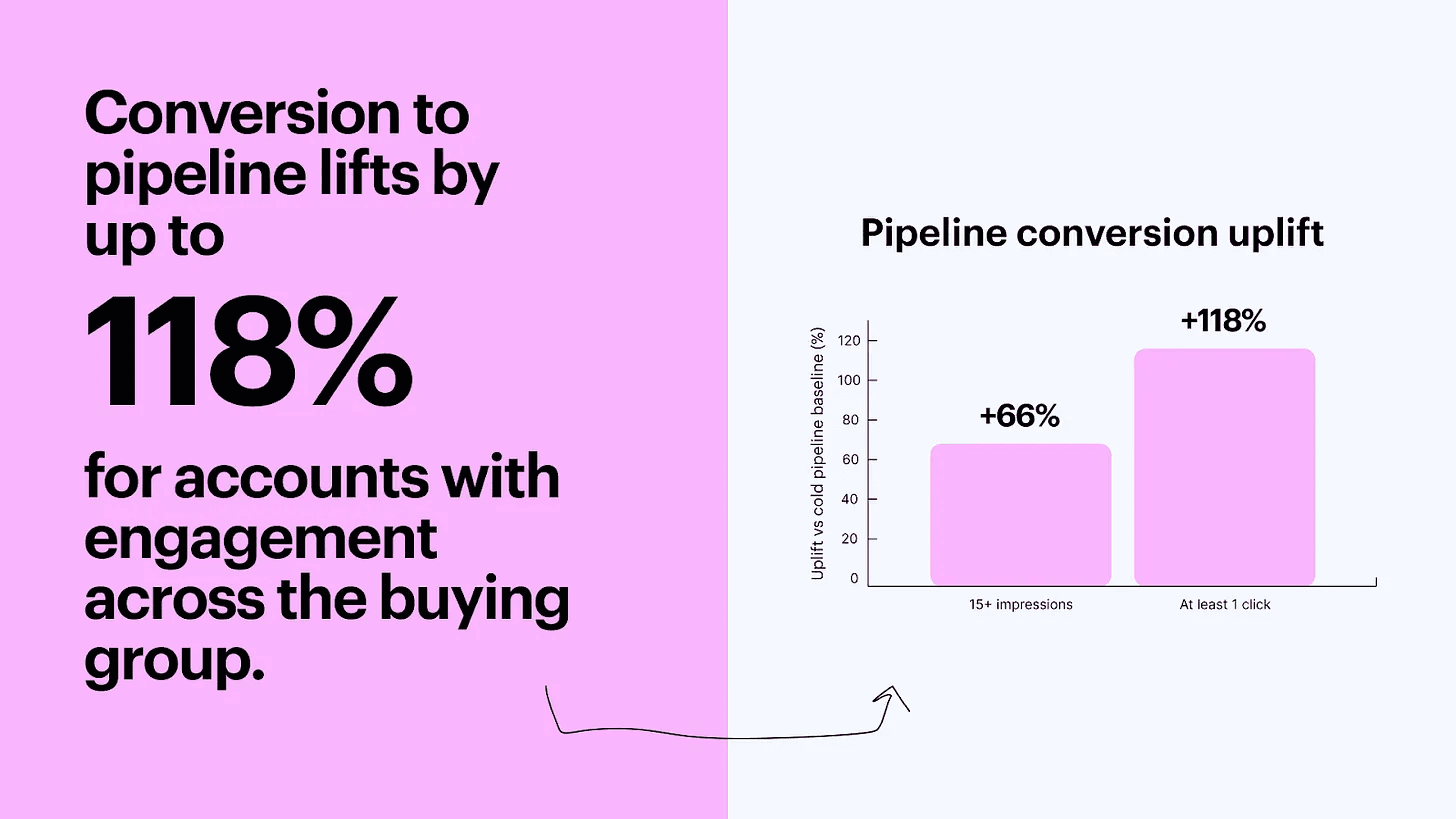
But the lift doesn't come from sending more DMs or targeting more accounts; it comes from catching the first moments of real buyer interest and knowing exactly who's behind it.
The goal of every conversation should be: "Wait, how did you know this is exactly my problem? "
Here's how you can turn engagement into active conversations:
-
When someone comments, timing matters. Responding quickly signals attentiveness and keeps the interaction alive while the context is still fresh.
-
Ask follow-up questions with thoughtful responses in your comments that continue the conversation. You can give examples, challenge their point, or explain how they applied it.
-
Posting is only half the job. Whenever you comment on other people's posts, you're "inviting" others to visit your profile. Each executive needs to spend 30 minutes per week engaging with their own posts and publishing 3 comments on posts from respected leaders in the space.
Step 5: Identify High-Intent Signals From Conversations
Your content ecosystem creates signals everywhere. If you're not tracking these signals, you're flying blind: you've warm prospects waiting to be contacted, but you don't know who they are.
A prospect who attended your webinar, downloaded your guide, and liked 3 posts is a warm lead waiting to be converted. Rank your signals by importance and focus your efforts on the prospects with the highest intent scores.
| Action | Intent level | Suggested points |
|---|---|---|
| Likes a post | Low | 2 |
| Comment or share | Medium | 5 |
| Visits your profile | Medium | 7 |
| Downloads a resource | High | 10 |
| Clicks on the offer link | High | 12 |
| Attends a webinar | Very High | 15 |
| Replies to message or email | Hot | 20 |
Remember, not every signal has the same weight. A company hiring a new VP is interesting, but someone who visited your pricing page 5 times (engaged signal) is much stronger.
Engaged signals show the prospect already knows you and is actively exploring your offer. They have a higher chance of conversions because they're familiar with your brand.
Step 6: Convert Conversations Into Warm Outreach
For high-value accounts, a single DM or email won't cut it. You need a coordinated approach across multiple touchpoints. This is where account-based marketing comes in.
ABM works well when you connect your content to the intent system. Your content creates demand. Your intent system identifies which accounts are warming up. Then you can initiate conversations that turn intent into a pipeline.
Here are some examples:
Scenario A: Known account, existing relationship with a champion
Let's say you saw your ICP registering for a webinar through your LinkedIn post. You already know them and have had some conversations. You have context on where they are.
Instead of cold messaging like, "Hey, I saw you registered on the webinar, if you'd like to check our product?" (i.e., "please, please look at it, see how talented I am and book me").
Instead, connect the webinar as an opportunity to understand the current context. Here's an example of a message Andrei Zinkevich sends to his ICP to build a repo.
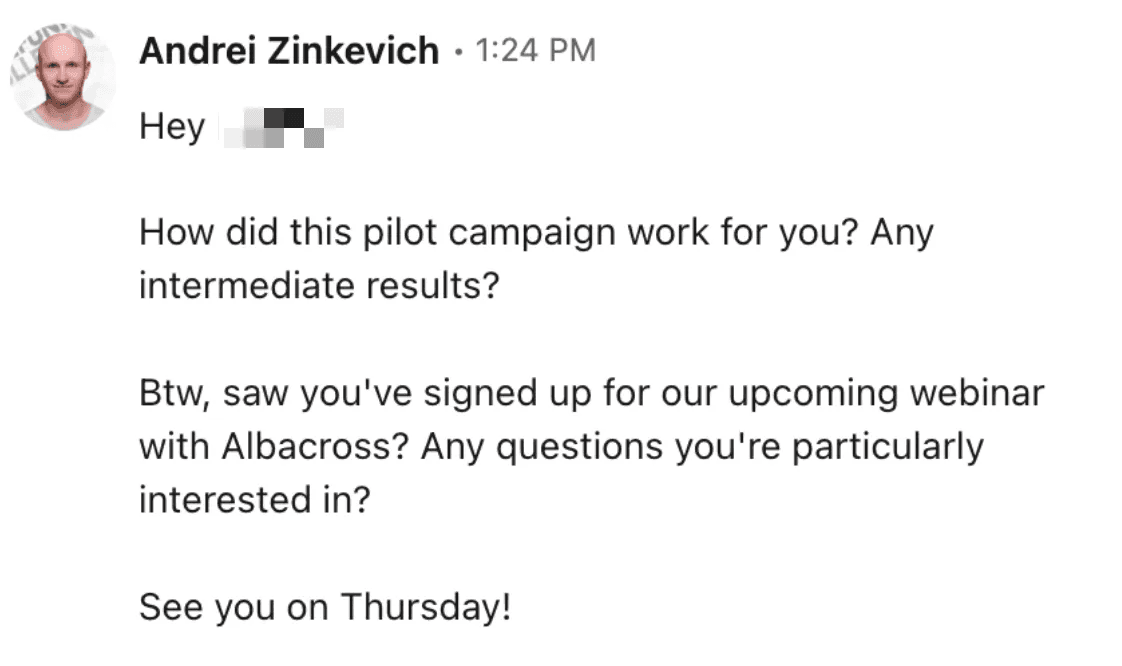
Two sentences. No pitch. Picks up the thread of an existing relationship.
Scenario B — Unknown account, no existing relationship
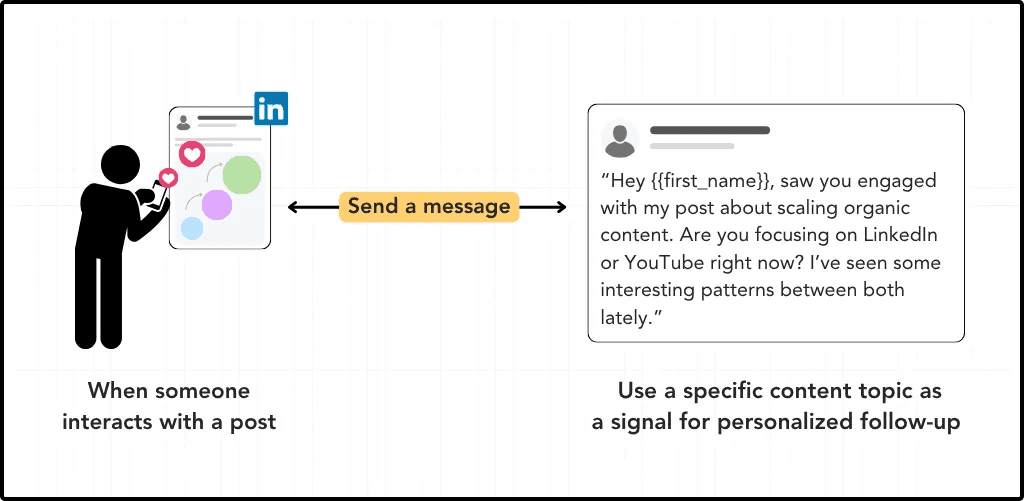
If someone engaged publicly, you might follow up with a light, value-driven message. If they show multiple intent signals, you can reach out with a personalized conversion-focused sequence.
Instead of pitching with "Saw you visited our website, we help…", start a conversation to understand their current interests.
Here is an example of a message from Pierre Herbul's warm outreach on LinkedIn:
Scenario C — Known company, new known buyer without a relationship
This is the most common scenario that most teams handle incorrectly.
A new contact from your ICP, you're already working and engaging with your content. The worst possible thing you can do is to start a parallel outreach sequence to this new contact.
Instead of immediately pitching a new contact, use the signal as an opportunity to learn more about the level of intent. A simple message you can send is "I noticed someone from your team engaged with our outreach guide. Do you know who owns lead generation in your org?"
When you get a response, use it to move closer to the right stakeholder and ask for a warm introduction. A new contact within a target account isn't a lead yet; it's valuable insight. Treat it as intelligence, not conversion.
Step 7: Build a Feedback Loop Between Content and Sales
Employees are more likely to engage when they believe their input is acknowledged and acted upon. In the early stages, begin small with internal channels like Slack groups where advocates get content prompts and feedback.
Sales teams are closest to customers to understand their objections, buying triggers and resources they seek. When those learnings flow back into content, your messaging sharpens naturally. A combination of LinkedIn insight and personal experience can help your advocacy team to bring together the best content ideas.
-
Which topics spark conversations (not just impressions)
-
What formats drive replies vs passive likes
-
Who keeps engaging repeatedly (early buying signals)
Over time, this loop reduces friction across the funnel by attracting more relevant audiences, making sales conversations warmer, and shortening conversion cycles.
Another great option would be to use an advocacyapp like Supergrow to share content ideas, track who shares what, and simplify your content distribution.
From Social Selling to Employee Advocacy
Employee advocacy becomes powerful when it's treated as a system, not a one-off tactic.
Sustained advocacy helps employees feel heard, leaders see measurable ROI, and your brand story spreads organically through networks that matter most.
This makes employee advocacy compounding.
One meaningful conversation leads to another. One signal, when acted upon, builds trust. Over time, these small interactions stack, expanding networks, deepening relationships, and increasing the likelihood of inbound opportunities.
Want to help employees stay consistent, schedule posts, and scale advocacy? Supergrow makes the process effortless!