
LinkedIn is no longer just a place to park your resume. It has become the world's largest professional content platform, a real-time hiring engine, and the dominant channel for B2B demand generation — all at once. In 2026, the platform hosts over 1.3 billion members, publishes more than 1.8 million feed updates every minute, and generates 80% of all B2B leads from social media.
Whether you're a marketer, recruiter, job seeker, founder, or content creator, LinkedIn's data tells a story that's hard to ignore. The platform rewards those who show up consistently, build trust, and create content that educates — not just broadcasts.
In this post, I've compiled the most comprehensive collection of LinkedIn statistics for 2026 — covering users, engagement, content performance, video, B2B marketing, thought leadership, recruiting, advertising, employee advocacy, and revenue.
LinkedIn Statistics 2026: Data, Trends & Growth Insights
Top LinkedIn Statistics for 2026
Before diving into the full breakdown, here are the headline numbers that define LinkedIn in 2026.
LinkedIn Has Crossed 1.3 Billion Members Worldwide
LinkedIn officially crossed 1.3 billion total members in 2025, confirmed by Microsoft CEO Satya Nadella during the company's Q4 FY2025 earnings call. That makes it the largest professional network ever built — by a significant margin over any competitor. (Microsoft Earnings Q4 FY2025)
The Platform Sees 1.8 Million Feed Updates Viewed Every Minute
LinkedIn is not a passive directory. Every minute, over 1.8 million feed updates and posts are viewed, more than 17,000 new connections are made, and over 8,200 job applications are submitted. This level of real-time activity puts it firmly in the category of a live content network, not a professional filing cabinet. (LinkedIn Newsroom)
LinkedIn Generates 80% of All B2B Leads From Social Media
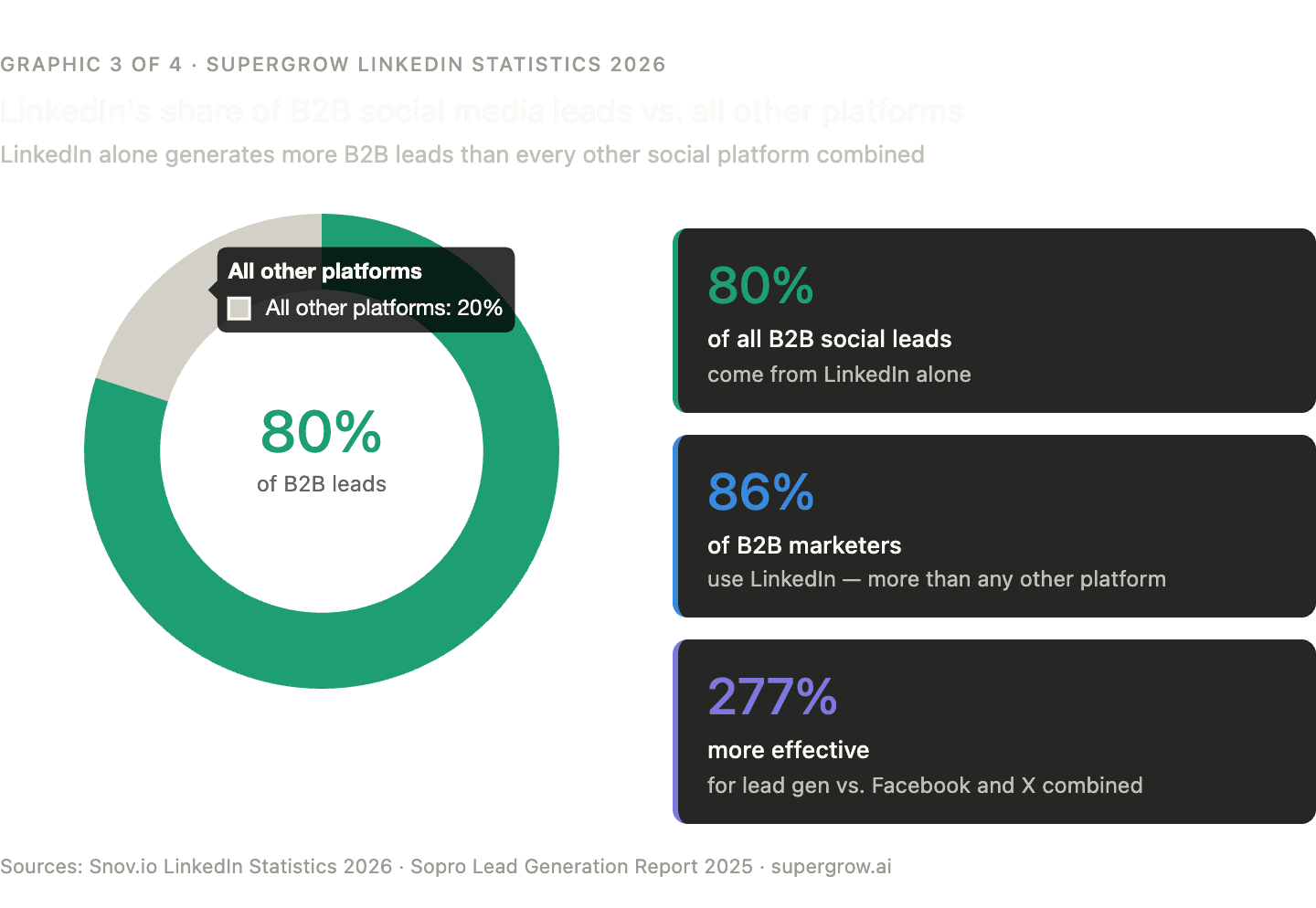
Of every ten B2B leads generated across social media — Facebook, Instagram, X, YouTube, and every other platform combined — eight of them come from LinkedIn. That is not a marginal advantage. It is structural dominance in a market that every B2B company competes in. (Snov.io)
LinkedIn's Revenue Hit $17.81 Billion in Fiscal Year 2025
LinkedIn's revenue has more than tripled since 2018, when it sat at $5.26 billion. By fiscal year 2025, it reached $17.81 billion — a 9% year-over-year increase — driven by Premium subscriptions, advertising, and talent solutions. The platform crossed the $5 billion quarterly revenue milestone for the first time in Q4 2025. (Microsoft SEC Form 8-K, Q4 FY2025)
The Average LinkedIn Engagement Rate Outperforms Every Major Social Platform
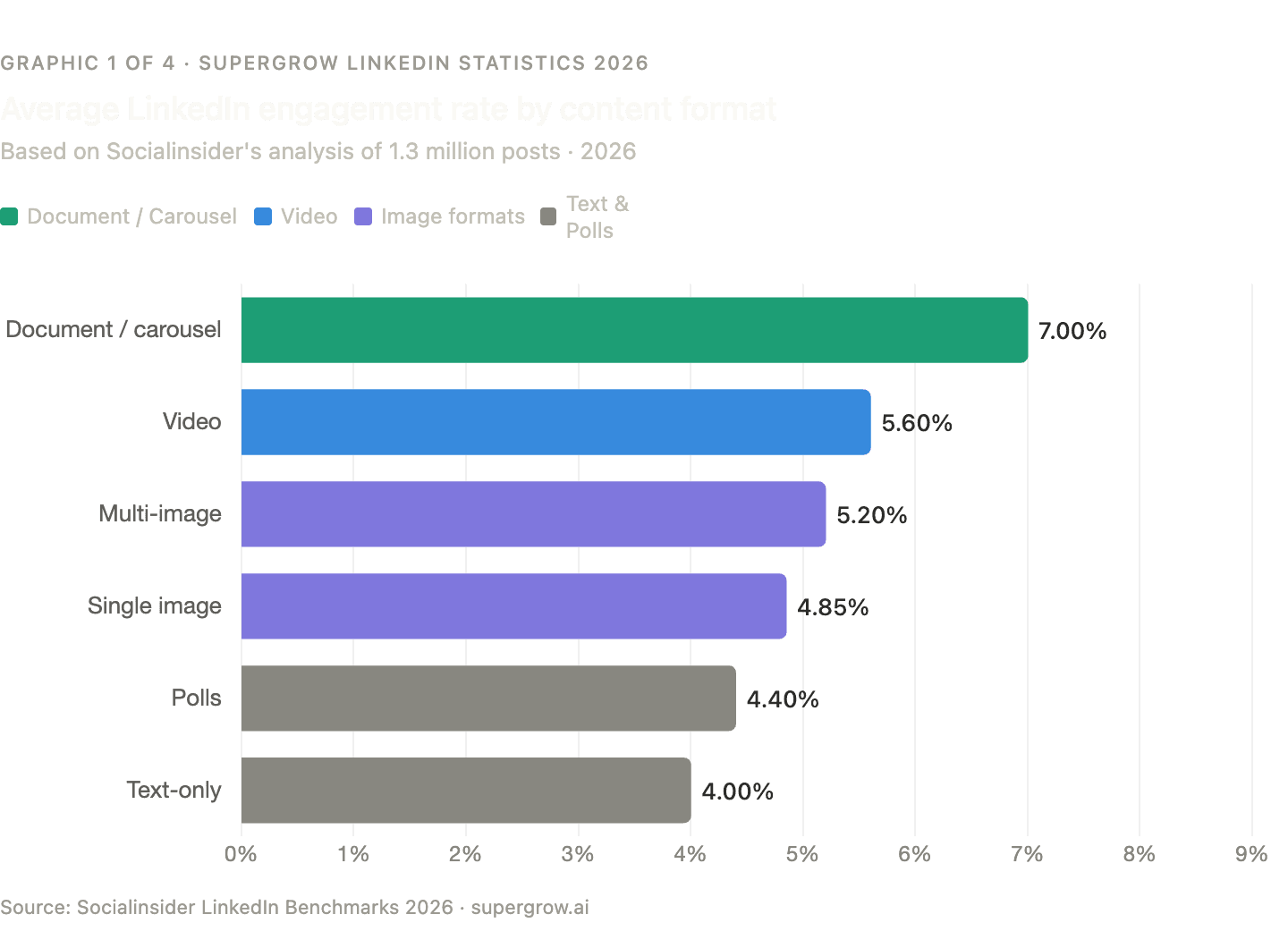
LinkedIn's average engagement rate across all post types stood at 5.20% in 2026, based on Socialinsider's benchmark analysis of 1.3 million posts. For comparison, Facebook averages 1.52% for B2B content and Instagram averages 1.94%. LinkedIn's lead is not close — it reflects how differently professionals engage with content they find relevant and useful. (Socialinsider LinkedIn Benchmarks 2026)
LinkedIn User Statistics
LinkedIn's growth is often reduced to a headline member count. But the more revealing story is in the velocity of that growth and the activity density behind it.
LinkedIn Is Adding 5 to 8 Million New Members Every Month
The platform adds between 5 and 8 million new members per month — approximately 2 to 3 new users joining every single second. At this pace, projections indicate continued 9% year-over-year growth through 2026, making LinkedIn one of the fastest-growing platforms among users aged 25+. (Wave Connect)
LinkedIn's Ad Reach Grew by 176 Million Members in a Single Year
Between January 2024 and January 2025, the number of members marketers could reach with LinkedIn ads increased by 176 million — a 17.1% jump year-over-year. On a quarterly basis, ad reach grew by an additional 47.4 million (+4.1%) between October 2024 and January 2025 alone. (DataReportal)
LinkedIn Now Reaches 14.7% of Every Person on Earth
LinkedIn's advertising audience accounts for 14.7% of the global population, according to UN population data from January 2025. Among adults aged 18 and over — the eligible user base — the platform reaches 27.5% of the world. That's more than one in four adults globally who are reachable on a single professional network. (DataReportal)
Over 69 Million Companies Are Active on LinkedIn
More than 69 million companies have established a presence on LinkedIn, alongside 141,000 schools and a directory of 42,000 listed professional skills. The platform has become the default digital infrastructure for organizational identity — used simultaneously for hiring, marketing, sales, and corporate communications. (Snov.io)
LinkedIn Operates in 36 Languages Across 200+ Countries
The platform is available in 36 languages and spans more than 200 countries and regions, with 38 offices globally — 12 of them in the United States. This global footprint means that regardless of industry or geography, LinkedIn's reach extends into virtually every professional market on the planet. (LinkedIn Newsroom)
Top Countries by LinkedIn Users (2025):
-
🇺🇸 United States — ~250 million
-
🇮🇳 India — ~150 million
-
🇧🇷 Brazil — ~81 million
-
🇬🇧 United Kingdom — ~45 million
Regional Distribution:
-
EMEA (Europe, Middle East & Africa) — 407M+
-
APAC (Asia Pacific) — 385M+
-
North America — ~280M+
LinkedIn Demographics Statistics
Understanding who uses LinkedIn is just as important as knowing how many people do. The platform's audience skews younger, wealthier, and more educated than most people assume.
Millennials Make Up Nearly Half of All LinkedIn Users
Users aged 25–34 are the single largest demographic on LinkedIn, representing 47–51% of the total user base, depending on the measurement. Gen Z users aged 18–24 follow at approximately 25–28%. Together, these two groups account for more than 75% of all LinkedIn activity — making the platform far more youth-driven than its corporate reputation suggests. (Sprout Social; Wave Connect)
56.8% of LinkedIn's Global Users Are Male
As of October 2025, 56.8% of LinkedIn's global user base identifies as male and 43.2% as female, according to Statista data. The gap has been narrowing incrementally year over year, and Sprout Social's 2026 Social Media Content Strategy Report notes that age and gender distribution are gradually evening out as the platform matures. (Sprout Social)
Over Half of LinkedIn Users Come From High-Income Households
More than 54% of LinkedIn users belong to households earning $100,000 or more per year. In the United States specifically, one-third of members hold a bachelor's degree, and 18% hold a master's degree or equivalent. This income and education profile is what allows LinkedIn to command premium advertising rates that smaller platforms cannot justify. (Wave Connect; DataReportal)
LinkedIn Reaches More Than 70% of the U.S. Adult Population
In the United States — LinkedIn's largest single market with approximately 250 million members — the platform reaches more than 70% of the adult population. This penetration rate, concentrated among senior professionals, decision-makers, and high-income consumers, makes it the most commercially valuable national audience on any professional platform. (DemandSage)
Google Is the Most-Followed Organisation on LinkedIn With 39M+ Followers
Google leads all organizations with over 39 million LinkedIn followers, followed by Amazon with 35 million. On the individual side, Bill Gates has the largest following on the platform, with 38.9 million followers. These numbers reflect how LinkedIn has evolved into a primary channel for brand visibility at the highest level. (The Social Shepherd)
LinkedIn Engagement Statistics
LinkedIn's engagement metrics have been strengthening, not plateauing — an unusual phenomenon that reflects the platform's ongoing shift toward content-first professional identity.
LinkedIn's Median Engagement Rate Grew From 6% to 8% in a Single Year
Buffer's analysis of one million LinkedIn posts found that median engagement grew from 6.00% in January 2024 to 8.01% in January 2025 — a 34% improvement in twelve months. The platform's overall average engagement rate of 6.50% outperforms those of Instagram (1.94%) and Facebook (1.52%) for B2B content by a factor of 3 or more. (Buffer)
40% of Monthly LinkedIn Users Log In Every Day
Approximately 134.5 million users actively use LinkedIn each day, and 40% of monthly active users open the app at least once daily. That level of habitual access — in a professional context — makes LinkedIn's audience measurably more attentive than those of entertainment-first platforms where daily opens are passive and reflexive. (The Social Shepherd)
The Average LinkedIn Session Lasts Nearly 11 Minutes
In February 2025, the average LinkedIn session lasted 10 minutes and 48 seconds, with users viewing an average of 7.98 pages per session. The platform's bounce rate sat at 30.45% — well within healthy benchmarks — suggesting that users are actively finding and consuming content rather than arriving and immediately leaving. (Sopro)
LinkedIn Received 1.4 Billion Visits in February 2026
Semrush data cited by Sprout Social recorded 1.4 billion visits to LinkedIn in February 2026, with organic search traffic growing 1.35% month over month. This traffic volume places LinkedIn among the most-visited properties on the internet — not just in the professional category, but across the web as a whole. (Sprout Social)
78% of Users Visit LinkedIn to Keep Up With Industry News
According to Sopro's State of Prospecting research, 78% of LinkedIn members use the platform to stay current on industry news, while 73% use it specifically to discover new ideas and perspectives. This intent-driven usage pattern is what separates LinkedIn from scroll-driven platforms — users come with a purpose, and they engage with content that serves it. (Sopro)
Tuesday to Thursday Is When LinkedIn Engagement Peaks
Across multiple independent studies, engagement consistently peaks on Tuesday, Wednesday, and Thursday — the middle of the working week. The optimal posting windows are 9 a.m.–12 p.m. and 1–4 p.m. in the audience's local time zone, with Thursday mid-morning emerging as the strongest window for company pages specifically. (Wave Connect)
LinkedIn Content Statistics
Content on LinkedIn is not created equal. The platform's algorithm now distributes reach based on format, dwell time, and early engagement signals — making format choice one of the most important strategic decisions a creator or brand can make.
Only 1% of LinkedIn Users Create Content — But They Generate 9 Billion Impressions
Just 1% of LinkedIn's 1.3 billion members actively create content on the platform. That 1% generates approximately 9 billion impressions. For professionals willing to post consistently, the competitive landscape is far less crowded than it appears — and the ceiling for organic reach remains very high. (LiGo)
Document and Carousel Posts Have the Highest Engagement Rate at 7%
Socialinsider's 2026 benchmark analysis of 1.3 million posts confirmed that native document posts — PDFs uploaded directly to LinkedIn — achieve the highest average engagement rate of any format at 7.00%, with a 14% year-over-year increase. Carousel posts drive 3x more reach than standard posts and generate significantly more saves and shares than any text-only equivalent. (Socialinsider)
Posts With Images Generate 2x More Comments Than Text-Only Posts
Images posted alongside LinkedIn content generate approximately twice as many comments as text-only posts. Custom image collages — particularly sets of 3–4 images in a single post — perform especially well, delivering 2x higher comment rates than single-image posts. Visuals that feel authentic and contextual consistently outperform polished corporate graphics. (Buffer)
Long-Form Posts of 1,900–2,000 Characters Achieve the Best Reach
An analysis of 3,000 LinkedIn posts by Search Wilderness found that posts in the 1,900–2,000-character range achieve excellent reach, as do very short posts in the 150–300-character range. The worst-performing posts tend to fall in the middle — long enough to feel like effort, but not substantive enough to hold attention. If you're going long, go long. (Wave Connect)
LinkedIn's Algorithm Prioritizes Dwell Time Over Like Count
LinkedIn's feed algorithm in 2026 uses dwell time as its primary content quality signal — the duration a user spends reading or engaging with a post before scrolling. Posts generating 11–30 seconds of dwell time receive extended distribution; those with 31–60+ seconds achieve maximum algorithmic reach. This single insight explains why shallow content underperforms even when it gets likes. (meet-lea.com)
Pages That Post Weekly See 5.6x More Follower Growth
LinkedIn's own data shows that company pages posting at least once per week see 5.6x more follower growth than those posting less frequently. Engagement doubles for companies that post weekly rather than sporadically. For individual creators, the pattern holds — consistency signals relevance to both the algorithm and the audience. (Buffer)
Posts With a Personal Story Get 38% More Engagement Than Promotional Content
Content structured around a personal story or a lesson learned generates 38% more engagement than promotional posts on LinkedIn. "How I..." style posts generate 3x more saves than listicles, and educational posts consistently outperform sales-oriented content across every metric the algorithm tracks. (Wave Connect)
LinkedIn Video Statistics
Video is the defining format shift on LinkedIn in 2025 and 2026. Watch time, upload volume, and impression growth are all accelerating simultaneously — a combination that signals a platform-level algorithmic shift, not just a user trend.
LinkedIn Video Watch Time Rose 36% Year-Over-Year
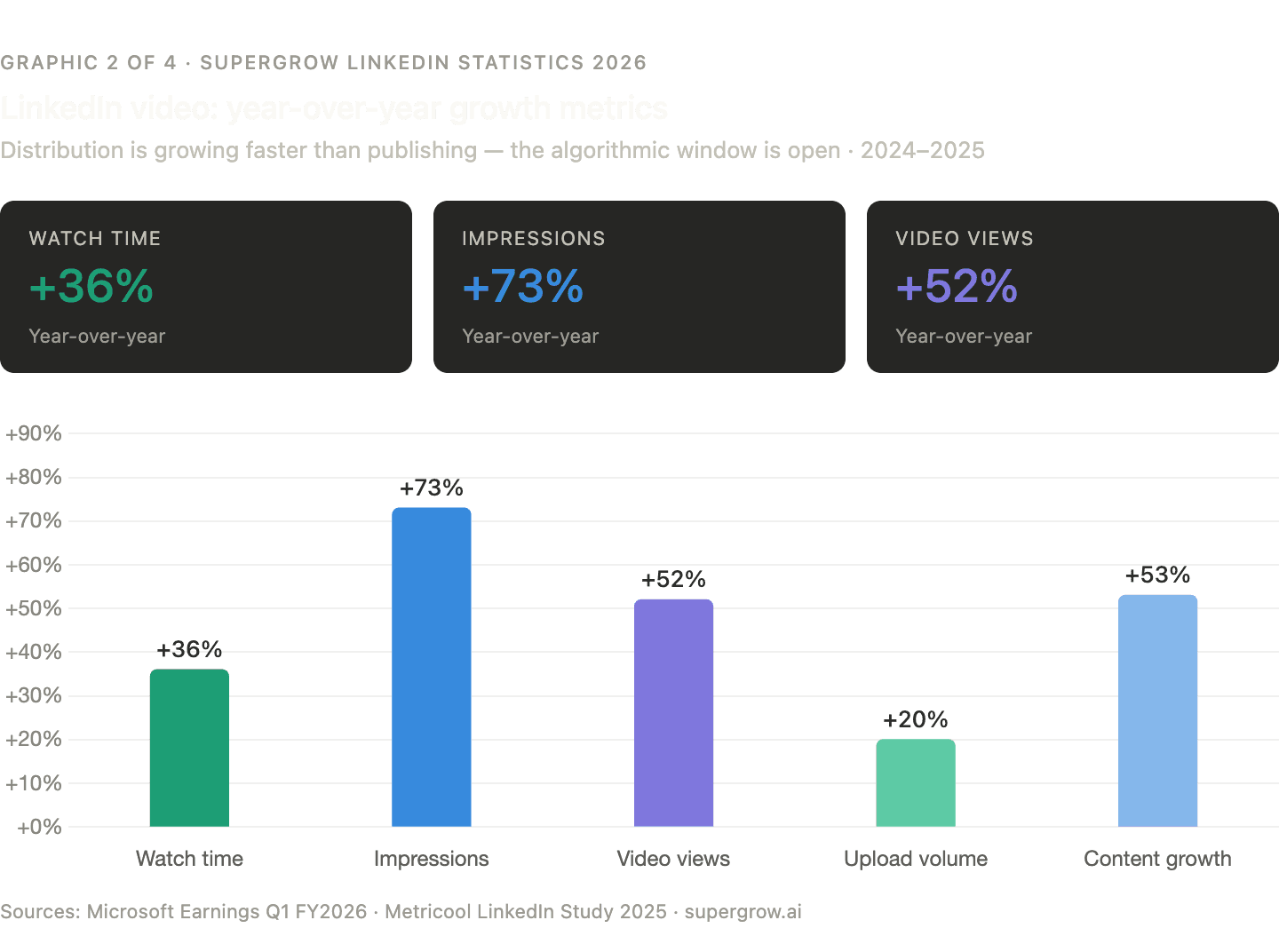
LinkedIn officially reported that video watch time increased 36% year-over-year in 2024, with short-form video creation growing at twice the rate of all other post formats combined. In Q4 2025, LinkedIn confirmed three consecutive quarters of double-digit video upload growth, with uploads rising 20% year-over-year. (Social Media Today)
Video Impressions on LinkedIn Grew 73% in a Single Year
Between 2024 and 2025, LinkedIn video impressions rose 73.39% and video views rose 52.17% — growing significantly faster than the number of videos being published. When distribution outpaces publishing volume, it signals that the algorithm is actively rewarding the format. That window is open right now. (Teleprompter.com via Metricool)
LinkedIn Live Video Gets 7x More Reactions and 24x More Comments
LinkedIn Live — the platform's real-time video format — generates 7x more reactions and 24x more comments than pre-recorded native video. For brands and creators trying to build genuine community rather than passive audiences, there is currently no higher-performing format on the platform. (Buffer)
73% of LinkedIn Video Views Happen on Mobile
Nearly three-quarters of all LinkedIn video views occur on mobile devices, and mobile users are 2.4x more likely to engage with autoplay videos than desktop users. Videos designed for mobile-first consumption — vertical format, captions enabled, hook delivered in the first 8 seconds — consistently outperform those built for desktop viewing. (Zebracat)
Videos Under 30 Seconds Are Most Likely to Be Watched to Completion
Short-form video under 30 seconds achieves the highest completion rates on LinkedIn. Educational videos generate 3x more engagement than promotional videos, and emotionally resonant video ads achieve 44% higher view-through rates and double completion rates compared to standard brand content. (Wave Connect; LinkedIn + Ipsos 2025 B2B Marketing Benchmark)
Videos With Subtitles Generate 40% More Engagement
Adding captions or subtitles to LinkedIn video posts generates 40% more engagement than uncaptioned equivalents. Given that 73% of views happen on mobile — many of them in professional settings where sound is off — subtitles are not an accessibility enhancement. They are a reach strategy. (meet-lea.com)
Video Posts Are Shared 20x More Than Any Other Content Type
Video content on LinkedIn is shared 20 times more than any other post format, according to Microsoft's earnings data. This virality coefficient — unique to video — is what makes it the most scalable format for organic reach on the platform, particularly when combined with a topic that is genuinely relevant to the viewer's professional context. (Microsoft Earnings)
LinkedIn B2B Marketing Statistics
LinkedIn's commercial infrastructure for B2B marketing is unlike anything available on consumer platforms. The combination of professional intent, demographic precision, and decision-maker density creates outcomes that other channels simply cannot replicate.
86% of B2B Marketers Use LinkedIn — More Than Any Other Platform
LinkedIn is the most widely adopted social media platform for B2B marketing, used by 86% of B2B marketers — more than Facebook, Instagram, or X. 85% say LinkedIn delivers the best value for their organization compared to all alternatives, and 95% either increased or maintained their LinkedIn usage over the past year. (Sales So; LinkedIn / Content Marketing Institute)
LinkedIn Is 277% More Effective for Lead Generation Than Facebook and X
LinkedIn generates 277% more leads per impression than Facebook and X combined for B2B campaigns. 89% of B2B marketers use LinkedIn specifically for lead generation, and the platform accounts for 80% of all social media B2B leads — leaving the combined output of every other major platform at just 20%. (Sopro)
4 Out of 5 LinkedIn Members Drive Business Decisions at Their Companies
80% of LinkedIn's membership is involved in business decision-making within their organizations. The platform also hosts 65 million decision-makers and 10 million C-level executives. When a professional logs into LinkedIn, they are in work mode — thinking about problems, evaluating solutions, and weighing vendors. That mindset is what makes LinkedIn advertising convert. (Sales So)
Brands Using LinkedIn Creators Saw a +39 Point Lift in Brand Awareness
The LinkedIn and Ipsos 2025 B2B Marketing Benchmark — which surveyed 1,500 marketing professionals across six countries — found that brands partnering with LinkedIn creators achieved a 39 percentage point lift in brand awareness goals, a 30 point lift in lead generation, and a 30 point lift in revenue growth compared to organizations using traditional marketing alone. (LinkedIn + Ipsos 2025 B2B Marketing Benchmark)
78% of B2B Marketers Now Use Video in Their LinkedIn Strategy
Video has crossed the threshold from "emerging format" to standard practice in B2B LinkedIn marketing, with 78% of marketers now incorporating it. 56% plan to increase their video investment further in the coming year, and short-form social video leads all formats with a 41% ROI — ahead of brand storytelling (38%) and testimonials and demos (34%). (LinkedIn + Ipsos 2025 B2B Marketing Benchmark)
94% of B2B Marketers Say Trust Is the Most Important Success Factor
The LinkedIn–Ipsos 2025 B2B Marketing Benchmark established that 94% of B2B marketing professionals consider building trust the single most important factor for achieving brand success. In a landscape where AI-generated content has made authenticity harder to signal and easier to fake, trust is no longer a brand aspiration — it is the primary driver of conversion. (LinkedIn + Ipsos 2025 B2B Marketing Benchmark)
LinkedIn Thought Leadership Statistics
Thought leadership on LinkedIn has moved well beyond brand awareness. The data now shows that expert content directly influences buying decisions, deal velocity, and vendor trust — making it a sales function as much as a marketing one.
95% of Decision-Makers Are Influenced by Thought Leadership
The Edelman–LinkedIn 2025 B2B Thought Leadership Impact Report — drawing on nearly 2,000 global professionals, including hidden decision-makers — found that 95% say thought leadership directly influences their purchasing decisions. 71% say it outperforms traditional marketing for building consideration, and 64% say they trust it more than product sheets or standard case studies. (Edelman–LinkedIn 2025 Thought Leadership Report)
65% of Decision-Makers Prefer Less Formal, More Human Content
Nearly two-thirds of B2B decision-makers say they prefer thought leadership that is less formal and more human in tone. 60% value unique formats and genuine perspectives over standard explainer content. The buyer who reads thought leadership in 2026 is not looking for a polished brand voice — they are looking for a real point of view from a person who has earned credibility in the field. (Edelman–LinkedIn 2025 Thought Leadership Report)
75% of Decision-Makers Researched a Product After Reading Thought Leadership
More than 75% of decision-makers and C-suite executives say a single piece of thought leadership content led them to research a product or service they had never previously considered. This makes LinkedIn thought leadership one of the highest-ROI top-of-funnel activities available to B2B companies — especially those with long sales cycles and high-consideration products. (The Borden Group)
52% of Executives Spend Over an Hour a Week Reading Thought Leadership
52% of decision-makers and 54% of C-suite executives spend at least one hour per week actively reading thought leadership content. This is not passive scroll behavior — these are deliberate reading sessions by people who are evaluating vendors, forming opinions, and building trust signals. The professional who shows up consistently in that reading time wins. (The Borden Group)
LinkedIn Newsletters Have an Average Open Rate of 30–50%
LinkedIn newsletters — the platform's native long-form subscription format — deliver average open rates of 30–50%, far exceeding typical email marketing benchmarks of 20–25%. Over 150,000 newsletters are currently published on LinkedIn, making it one of the fastest-growing owned content channels for thought leaders and B2B brands. (Voketa)
LinkedIn Algorithm & Reach Statistics
LinkedIn's algorithm has one clear preference in 2026: people over pages, and depth over volume. Understanding how reach is distributed is essential for anyone investing time in the platform.
Company Pages Appear in Less Than 1 in 20 Feed Slots
DSMN8's investigation of LinkedIn feed distribution found that company pages appear in approximately 5.37% of feed slots — less than 1 in every 20 posts a user sees. First-degree connections, by contrast, account for 42.44% of feed visibility. The algorithm has built a structural preference for human voices that no amount of company page posting can override. (DSMN8)
A CEO With 5,000 Followers Matches a Company Page With 300,000
DSMN8's study of 11,107 LinkedIn posts found that a CEO with just 5,000 LinkedIn connections achieved the same level of engagement as a company page with 300,000 followers. The algorithm's trust in personal credibility signals effectively closes a 98% follower gap. For brands, this means your executives are your most powerful distribution channel — more valuable than any ad budget. (DSMN8)
Employee Posts Written From Scratch Outperform Reshared Content by 9x
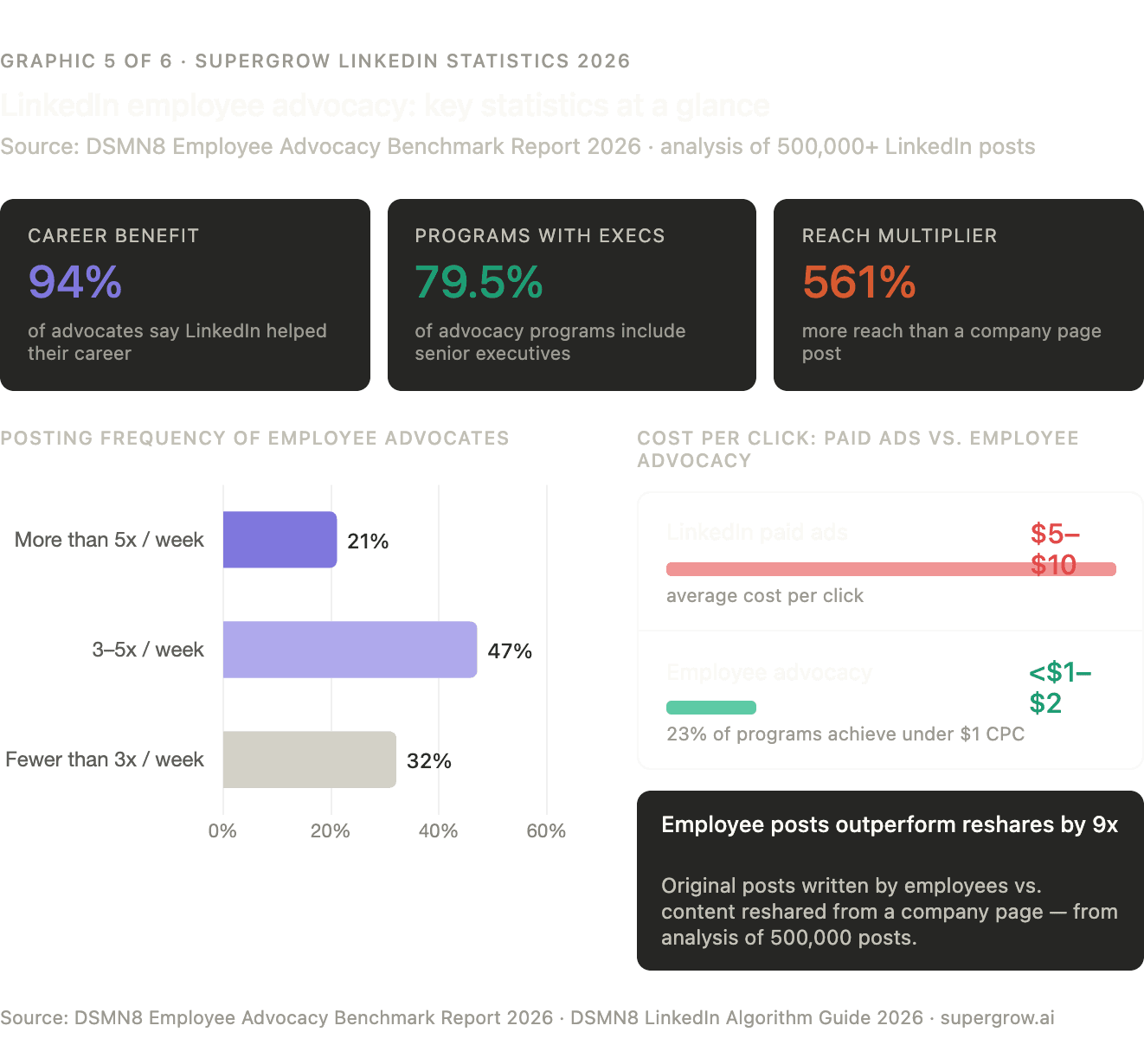
DSMN8's analysis of over 500,000 employee LinkedIn posts found that original employee posts outperform pre-written content shared from a company page by more than 9x. Authenticity is not just a tone preference — it is an algorithmic advantage. The platform can distinguish between content that sounds like a person and content that sounds like a marketing team, and it distributes accordingly. (DSMN8)
Early Engagement in the First Hour Makes a Post 4.1x More Likely to Go Wide
LinkedIn's algorithm evaluates content in its first hour of publication to determine distribution priority. Posts that generate early comments, likes, and genuine conversation in that window are 4.1x more likely to receive extended algorithmic reach. This makes the publishing moment — and having a real network that responds — more valuable than any posting frequency hack. (Wave Connect)
Personal Profiles Generate 5x More Engagement Than Company Pages
According to research from Refine Labs, personal profile posts generate 5x more engagement than equivalent posts from company pages. Employee-shared content achieves 561% greater reach and 2.75x more impressions than company page content. The most effective brand presence on LinkedIn in 2026 runs through its people — not its logo. (meet-lea.com)
LinkedIn Employee Advocacy Statistics
Employee advocacy has evolved from an amplification tactic into a structured growth channel with documented ROI.
In 2026, organizations with active advocacy programs are building the most cost-efficient organic distribution available on any platform.
94% of Employee Advocates Say LinkedIn Has Benefited Their Careers
DSMN8's 2026 Employee Advocacy Benchmark Report — surveying over 200 programs, including data from Cisco, Capgemini, Nissan, and Toyota — found that 94% of employee advocates say posting on LinkedIn has directly benefited their careers. This bilateral value is what sustains advocacy programs over time: employees are not sharing for the company's benefit; they are sharing for their own, which makes the content more authentic and the outcomes more durable. (DSMN8)
68% of Employee Advocates Now Post 3 or More Times Per Week
In 2026, 68% of employee advocates post three or more times weekly on LinkedIn, and 21% post more than five times per week. This increase is directly tied to better training, clearer expectations, and access to pre-approved content through advocacy platforms. Participation drives itself once the infrastructure is in place. (DSMN8)
79.5% of Advocacy Programs Now Include Senior Executives
Nearly 80% of employee advocacy programs now involve senior executives, a figure that has grown by 40% since 2025. Programs that include leadership consistently report stronger participation and measurably greater impact. When the CEO posts, it signals that advocacy is part of the company culture — and that signal cascades down through the organization. (DSMN8)
Employee Advocacy Reduces LinkedIn CPC From $5–$10 to Under $2
LinkedIn paid advertising costs an average of $5–$10 per click. Companies running structured employee advocacy programs achieve a cost-per-click of $1–$2, with 23% of programs achieving a CPC under $1. At scale, this is not an incremental improvement — it is an 80–90% reduction in distribution cost for the same professional audience. (DSMN8)
Employee-Shared Content Reaches 561% More People Than Company Page Posts
When an employee shares content on LinkedIn, it reaches 561% more people than the equivalent post from the company's official page. The mechanism is simple: employees have personal networks, and personal networks have algorithmic trust. A company with 200 employees, each sharing monthly, is running a distribution network that no paid alternative can replicate at the same cost. (DSMN8)
LinkedIn Advertising Statistics
LinkedIn advertising is expensive by social media standards. The business case for paying those rates is built on audience quality, targeting precision, and documented B2B conversion outcomes that consumer platforms consistently fail to match.
LinkedIn Ads Drive 3x More Qualified Leads Than Other Social Platforms for B2B
LinkedIn advertising generates 3x more qualified leads than Facebook Ads for B2B campaigns, and delivers a visitor-to-lead conversion rate that is 3x higher than other major social platforms. 58% of marketers report LinkedIn Ads as their best-performing paid channel for B2B outcomes. (Marketing LTB)
The Average LinkedIn CPC Is $5–$9, With CPM Around $33
LinkedIn's average cost-per-click ranges from $5 to $9, and its average CPM (cost per thousand impressions) is approximately $33. These rates are high by social media standards but justified by the audience: decision-makers with purchasing authority, in a professional mindset, actively seeking information relevant to their work. (Marketing LTB)
LinkedIn Lead Gen Forms Have a 13% Average Conversion Rate
LinkedIn's native Lead Gen Forms — which pre-fill user data from their profiles — achieve an average conversion rate of 13%. Sponsored InMail campaigns achieve open rates of 50–60%. Both figures significantly exceed benchmarks for email marketing and standard display advertising, reflecting the intent signal embedded in a professional platform visit. (Marketing LTB)
Narrowing Audience to 30K–100K Reduces Cost-Per-Lead by Nearly 50%
Research from the European LinkedIn Ad Benchmarks 2025–2026 report found that campaigns targeting audiences above 500,000 can waste up to 90% of the budget on irrelevant users. Reducing audience size to 30,000–100,000 high-intent job titles can reduce cost-per-lead by nearly 50% — the single most impactful optimization available to LinkedIn advertisers. (Pettauer.net)
Carousel Ads Increase Click-Through Rates by 2x Over Single-Image Ads
LinkedIn Carousel Ads generate 2x higher click-through rates than single-image ads, and Video Ads produce 5x more engagement than static creative. Native document ads — PDFs uploaded as sponsored content — increase engagement by 2.5x compared to standard display formats. Format matters in LinkedIn advertising as much as it does in organic content. (Marketing LTB)
LinkedIn Recruiting Statistics
LinkedIn was built for hiring, and it still owns that market. But the platform's role in recruiting has evolved far beyond job posting — it is now an intelligence layer for talent decisions, skills assessment, and long-term workforce planning.
87% of Recruiters Use LinkedIn to Find Candidates
87% of recruiters use LinkedIn to scout and source new employees, making it by far the most widely adopted professional hiring tool in the world. Over 10,000 job applications are submitted on LinkedIn every minute, and 49 million people use the platform to search for jobs every single week. (Go Beyond; Buffer)
Profiles With Multiple Skill Endorsements Receive 17x More Recruiter Views
LinkedIn profiles with multiple skill endorsements receive 17 times as many recruiter views as profiles without them. Adding the "Open to Work" banner increases recruiter response rates by 37%, and complete profiles receive 30% more weekly views than incomplete ones. On LinkedIn, profile completeness directly translates to career opportunities. (Amra and Elma; Sales So)
89% of Talent Leaders Say Quality-of-Hire Measurement Is Becoming Critical
LinkedIn's 2025 Future of Recruiting Report — based on platform data and a survey of over 1,000 talent professionals — found that 89% of talent acquisition leaders say measuring quality of hire is becoming increasingly critical. Only 25% feel highly confident in their current ability to measure it. 61% believe AI will improve how they track hiring outcomes, shifting recruitment from intuition to data. (LinkedIn Future of Recruiting 2025)
Skills-Based Hiring Makes Recruiters 12% More Likely to Find a Quality Match
Recruiters who search by skills rather than credentials are 12% more likely to hire the right person for the role. The share of paid LinkedIn job postings that do not require a degree grew from 22% in 2020 to 26% in 2024 — a 16% shift in four years that reflects the accelerating move away from credential-based screening toward competency-based hiring. (Wave Connect)
Employees With AI Skills Are 5x More Likely to Develop High-Value Capabilities
LinkedIn's Global Talent Trends data shows that employees who have added generative AI skills to their profiles are 5x more likely to develop capabilities in creative ideation, design thinking, and emotional intelligence than those who haven't. Companies with more AI-skilled employees also see 4x higher leadership promotion rates and 5x higher overall promotion rates. (LinkedIn Global Talent Trends)
Internal Mobility Increased 6% Year-Over-Year Across LinkedIn's Member Base
LinkedIn's platform data show that internal mobility — employees taking new positions within the same company — has increased 6% year-over-year. This trend reflects a broader shift toward talent retention and development over constant external hiring, particularly in industries where skill continuity outweighs the cost and disruption of turnover. (LinkedIn Global Talent Trends)
LinkedIn Revenue & Financial Statistics
LinkedIn's financial trajectory tells the story of a platform that has grown from a professional networking utility to a core enterprise software stack — with revenue to match.
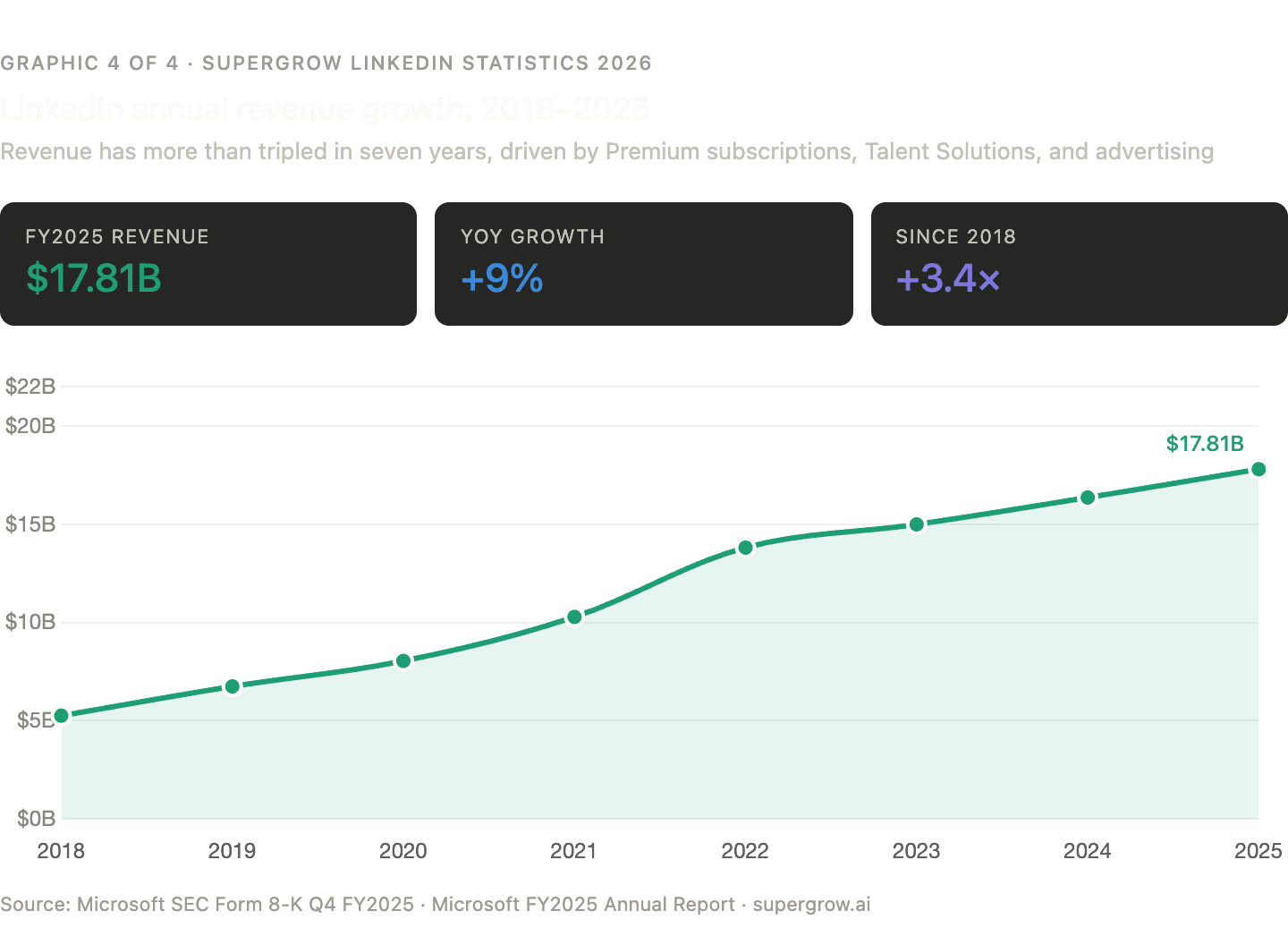
LinkedIn Revenue Has More Than Tripled Since 2018
LinkedIn generated $17.81 billion in fiscal year 2025, up from $5.26 billion in 2018 — a more than 3x increase in seven years. This growth has been driven by three revenue streams that have all expanded simultaneously: Premium subscriptions, Talent Solutions, and Marketing Solutions. (Microsoft SEC Form 8-K, Q4 FY2025)
LinkedIn Crossed the $5 Billion Quarterly Revenue Milestone for the First Time
In Q4 FY2025 (the quarter ending June 30, 2025), LinkedIn's quarterly revenue reached $4.62 billion, crossing the $5 billion annualized quarterly threshold for the first time. In Q1 FY2026 (ending September 30, 2025), revenue grew a further 10% year-over-year — one of the platform's strongest quarterly performances on record. (Microsoft SEC Form 8-K, Q1 FY2026)
LinkedIn Premium Passed $2 Billion in Annual Revenue
LinkedIn Premium subscriptions surpassed $2 billion in annual revenue in the 12 months through January 2025, confirmed in Microsoft's Q2 FY2025 earnings call. By Q3 2025, there were 175 million Premium subscribers — up from 154 million in 2022, representing a 50% increase in three years. The premium tier's growth signals how many professionals now see LinkedIn as a tool worth paying for, not just a free network. (TechCrunch)
LinkedIn's Advertising Revenue Reached $5.9 Billion in 2024
LinkedIn's advertising business generated $5.9 billion in 2024 and is projected to reach $10 billion by 2027 — a trajectory that would make it one of the largest B2B advertising markets in the world. This growth is driven by B2B marketers' increasing willingness to pay premium rates for access to LinkedIn's high-intent professional audience. (Digital Web Solutions)
LinkedIn Has Seen Four Consecutive Years of Double-Digit Member Growth
Microsoft CEO Satya Nadella confirmed in remarks during Q4 FY2025 earnings that LinkedIn has now delivered four consecutive years of double-digit member growth. No other professional platform has sustained this pace of expansion. At the current trajectory, LinkedIn is projected to reach 1.3 billion members through 2026. (Microsoft Earnings Q4 FY2025)
LinkedIn Personal Branding & Creator Statistics
Personal branding on LinkedIn has shifted from optional to consequential. The creator economy on the platform is maturing — and the data shows that individuals who build in public are measurably outperforming those who don't.
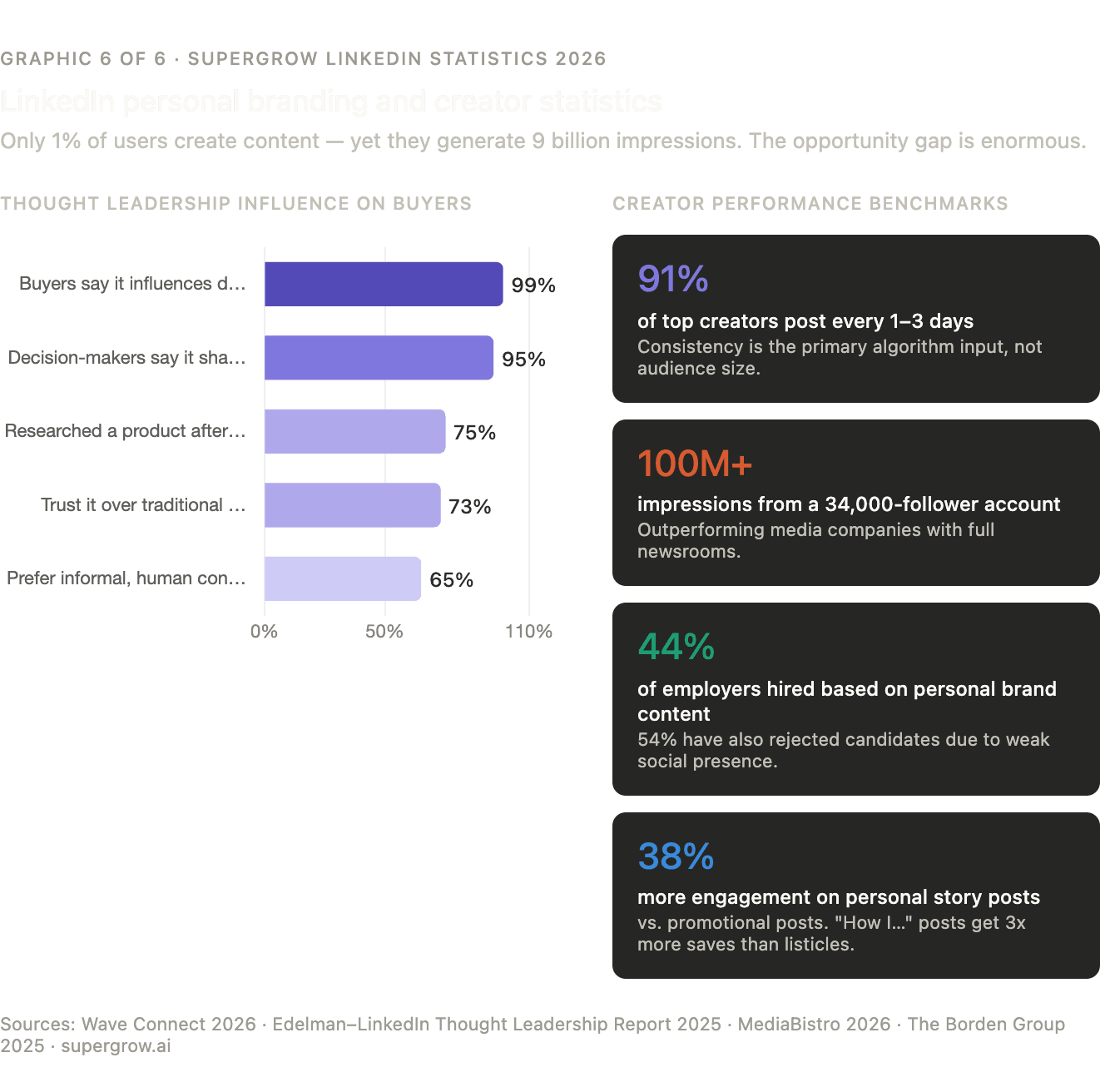
91% of Top LinkedIn Creators Post Every 1–3 Days
91% of top-performing LinkedIn creators post at least once every three days to maintain strong personal brand visibility. Consistency is not just a productivity habit — it is the input that LinkedIn's algorithm uses to categorize creators as active and relevant. Irregular posting, even of high-quality content, is penalized by reduced distribution. (Wave Connect)
Creators With Small Audiences Can Generate 100M+ Impressions
A creator with 34,000 LinkedIn followers generated over 100 million impressions in 2025 — more than the average media company page backed by a full newsroom. Follower count is one of the least reliable predictors of LinkedIn reach. What the algorithm rewards is relevance, engagement depth, and consistency of voice — not audience size. (MediaBistro)
44% of Employers Have Hired Candidates Based on Their Personal Brand Content
44% of employers have hired candidates based on content they discovered through a candidate's online personal brand presence. 54% have rejected candidates due to poor or absent social media presence. On LinkedIn, your content is your professional portfolio — and it is being evaluated before, during, and after the formal hiring process. (The Borden Group)
99% of Buyers Say Thought Leadership Influences Their Decisions
99% of buyers say thought leadership is a factor in their decision-making process, and 73% say they trust it more than traditional marketing. For professionals building a LinkedIn presence, this statistic reframes what it means to post: every piece of expert content is part of the commercial infrastructure that either builds or erodes trust with a potential buyer. (Wave Connect)
Final Thoughts
What these LinkedIn statistics collectively show is not just a platform growing in size — it's a platform growing in importance. The numbers across every section point in the same direction: LinkedIn has become the most valuable piece of real estate on the professional internet.
The professionals who understand its mechanics — who show up consistently, create content with genuine depth, and let individuals carry the brand's voice — are building an asymmetric advantage that compounds with every post and every week. The gap between those who are active and those who are watching from the sidelines is widening, not narrowing.