
Most employee advocacy platforms promise the same thing. More reach. More visibility. Employees sharing content without the friction of figuring out what to post.
DSMN8 delivers on that promise for a specific type of organization, running a specific type of program. If you are evaluating it, the real question is not whether it works. It is whether it solves the right problem for your team.
I built Supergrow, a direct competitor in the employee advocacy space. That is worth knowing upfront.
What I found was a platform that enterprise teams trust with serious budgets. And one that its own users quietly admit delivers less engagement than the posts they write themselves. That gap is not a coincidence. It is structural. And it is the thing nobody talks about when evaluating DSMN8.
That is what this DSMN8 review covers.
What Is DSMN8?
DSMN8 is an employee advocacy and influence platform founded in 2016 by Bradley Keenan. It is one of the oldest platforms in the employee advocacy category. Purpose-built for one job — helping companies distribute content through employee networks at scale.
The platform works in three steps.
-
Marketing centralizes brand-approved content in a custom feed.
-
Employees receive it, personalize it, and share it to their social networks.
-
Admins track reach, engagement, and ROI through the analytics suite.
That three-step model is the foundation of everything DSMN8 does well. It is also the foundation of the tension this review is going to unpack.
Trusted by McKinsey, Nokia, General Motors, Dropbox, AkzoNobel, and Bayer. With 1,121 reviews and a 4.6 out of 5 rating on G2, the platform has earned its place as the enterprise default in the category.
The question is not whether it is credible.
The question is whether the model it is built on matches what your program actually needs.
What DSMN8 Actually Gives You
DSMN8 centers on three things: activating employees, managing the program, and measuring results.
Here is what each core feature delivers in practice and where the gaps show up.
- Content Feed and Distribution
The operational heart of the platform. Marketing teams push brand-approved content into a centralized feed. Employees receive it filtered by their role, team, department, location, and interest. They share to LinkedIn, Facebook, and X with one click.
The personalization layer is real. A sales team in Germany sees different content from an HR team in Singapore.
What it cannot do is narrow content down to what an individual employee genuinely knows and would credibly say. That gap is structural, not a configuration problem.
- Dynamic Display
When every employee shares the same caption and image, LinkedIn's algorithm detects the duplication and suppresses their reach. Dynamic Display solves this by allowing admins to load multiple caption variations, image options, and link preview titles for the same post.
Employees choose the version that fits them, or the auto-scheduler randomly selects a unique combination. It makes shared content look less identical. It does not change the fact that the content was written by marketing.
- Personal Voice AI
Launched December 2025. Analyses an employee's existing LinkedIn posts and writing samples to build an individual voice profile. When an employee is about to share brand-approved content, one click adapts the caption to match their personal tone and style.
It is a genuine step toward authenticity and a precise one to understand. Personal Voice AI personalizes marketing-written captions.
However, it still does not help employees generate original ideas, capture their expertise, or build posts from their own perspective from scratch.
- Boost Post
One-click amplification of company or executive LinkedIn posts directly to employee networks. Designed for speed of reach on important announcements. Functional, clean, and draws minimal friction from users.
- Gamification: Leaderboards and Rewards
Points-based engine with daily, weekly, and monthly leaderboards. Admins set reward incentives. The system tracks participation and ranks advocates. This is one of DSMN8's most consistently praised features. It drives early adoption and creates competition, making advocacy feel less like a mandate.
The honest caveat: gamification sustains participation when the content feed stays fresh and relevant. When the feed becomes repetitive, competition becomes harder to maintain because employees have less reason to engage.
- User Segmentation: Groups and Teams
Segment employees by team, department, region, and interest so each person's feed reflects their professional context. For large, diverse global organizations, this is a genuinely strong capability.
One admin can serve a sales team in North America, a recruitment team in the UK, and a marketing team in APAC — each seeing content appropriate to their audience.
- Analytics Dashboard
Tracks reach, engagement, shares, clicks, conversions, and earned media value across the full program. Integrates with Salesforce, Marketo, Adobe Analytics, Google Analytics 360, and Microsoft Azure. UTM tracking, customizable dashboards, and CSV export.
For enterprise teams that need to report program ROI to leadership, this is one of DSMN8's strongest assets.
- Executive Influencer Platform
A separate product layer dedicated to C-suite LinkedIn presence. Helps executives build thought leadership and securely delegate access to content. It is not included in the core advocacy platform by default — enterprise buyers who need both employee advocacy and executive influence from a single vendor should factor this into their evaluation conversations.
- Enterprise Integrations and Managed Services
Slack, Microsoft Teams, Salesforce, Marketo, Adobe Analytics, Okta, OneLogin, Google Workspace, Microsoft 365, and Microsoft Azure.
For organizations without internal bandwidth to run the program, DSMN8 also offers a managed services option where their team designs, launches, and operates the program on the client's behalf.
DSMN8 Pricing — What It Actually Costs
DSMN8's own website does not publish pricing. Every buyer is directed to request a custom quote.
From their pricing page: "We tailor every DSMN8 plan to your goals, ensuring they are achieved within your budget."
What they do not say on their own site is what that budget needs to be.
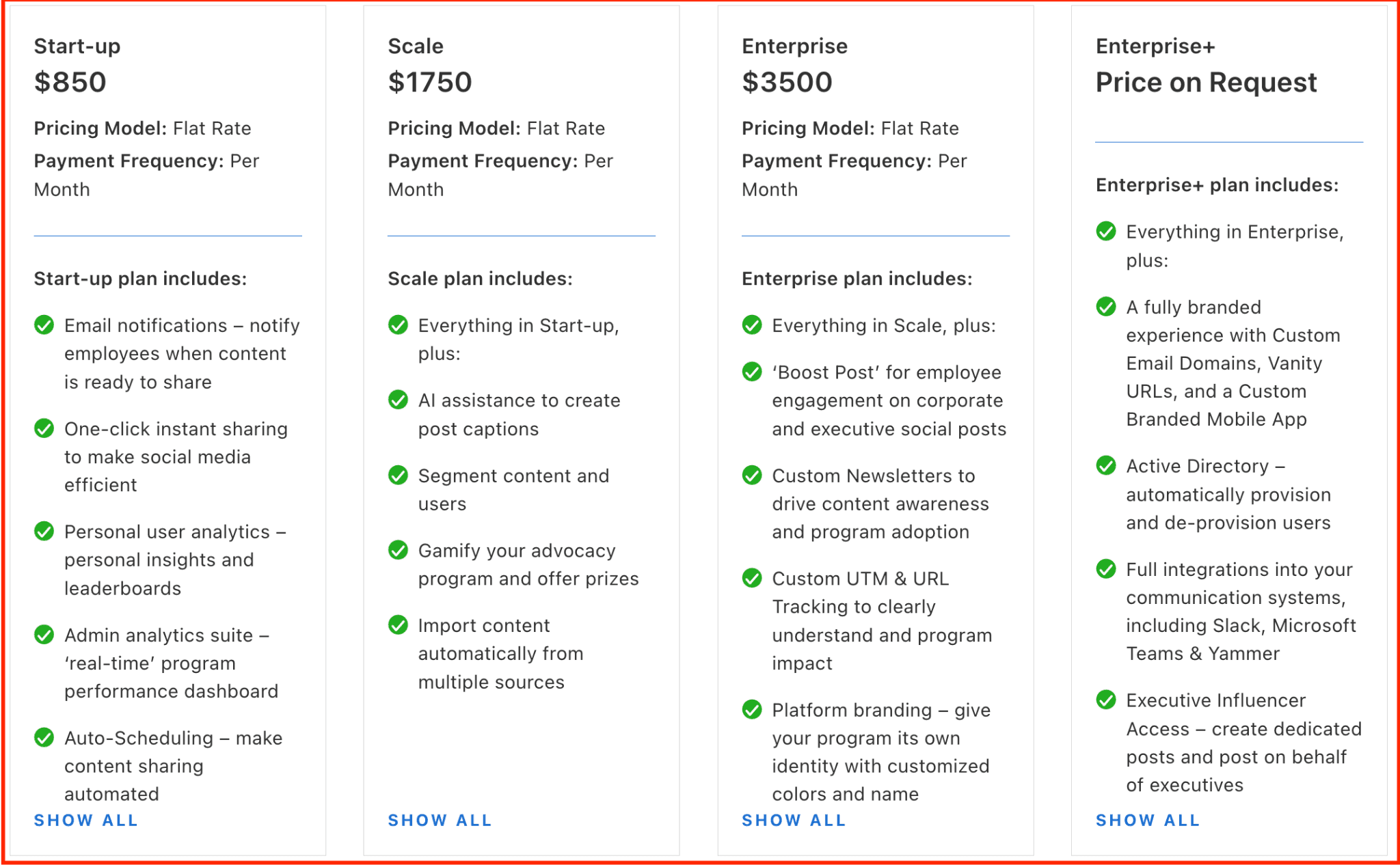
Source: Capterra pricing
What the numbers reveal
The entry plan at $850 per month is a content distribution tool with basic analytics.
The features most advocacy programs genuinely need — AI caption assistance, user segmentation, and gamification — only unlock at $1,750 per month. The capabilities that make DSMN8 a serious enterprise platform start at $3,500 per month.
Every contract is annual. DSMN8 confirms this on their pricing page. You are committing to a full year before you know whether employee participation holds beyond the first few weeks.
For organizations with the budget and the program infrastructure to match — a dedicated advocacy manager, an active content team, and a multi-department rollout — the investment can be justified. For teams still building that infrastructure, committing $1,750 to $3,500 per month before proving the model is a significant risk.
For comparison with the Supergrow employee advocacy tool.
Supergrow Teams starts at $111 per month, billed annually, for up to 4 LinkedIn workspaces. That includes Content DNA per member, so every employee's content sounds like them; approval workflows; PostCast for voice-to-content capture; Challenges and leaderboards; weekly performance reports; and Slack notifications.
No demo cycle required. No annual commitment needed to evaluate.
For B2B teams focused specifically on LinkedIn employee advocacy in 2026 — where the goal is employees creating and publishing their own authentic content, not distributing marketing-approved posts — Supergrow gives you a complete system at a fraction of the entry cost of DSMN8's Scale plan.
A 7-day free trial with no credit card lets you test the full platform before committing to anything.
Start your free 7-day trial →What Real Users Say About DSMN8
With over 1,121 reviews on G2 and 86 on Capterra, DSMN8 has one of the largest review footprints in the employee advocacy category. The volume matters. Patterns that repeat across hundreds of reviews are not isolated complaints — they are structural signals about how the platform performs in practice.
Where users consistently praise it
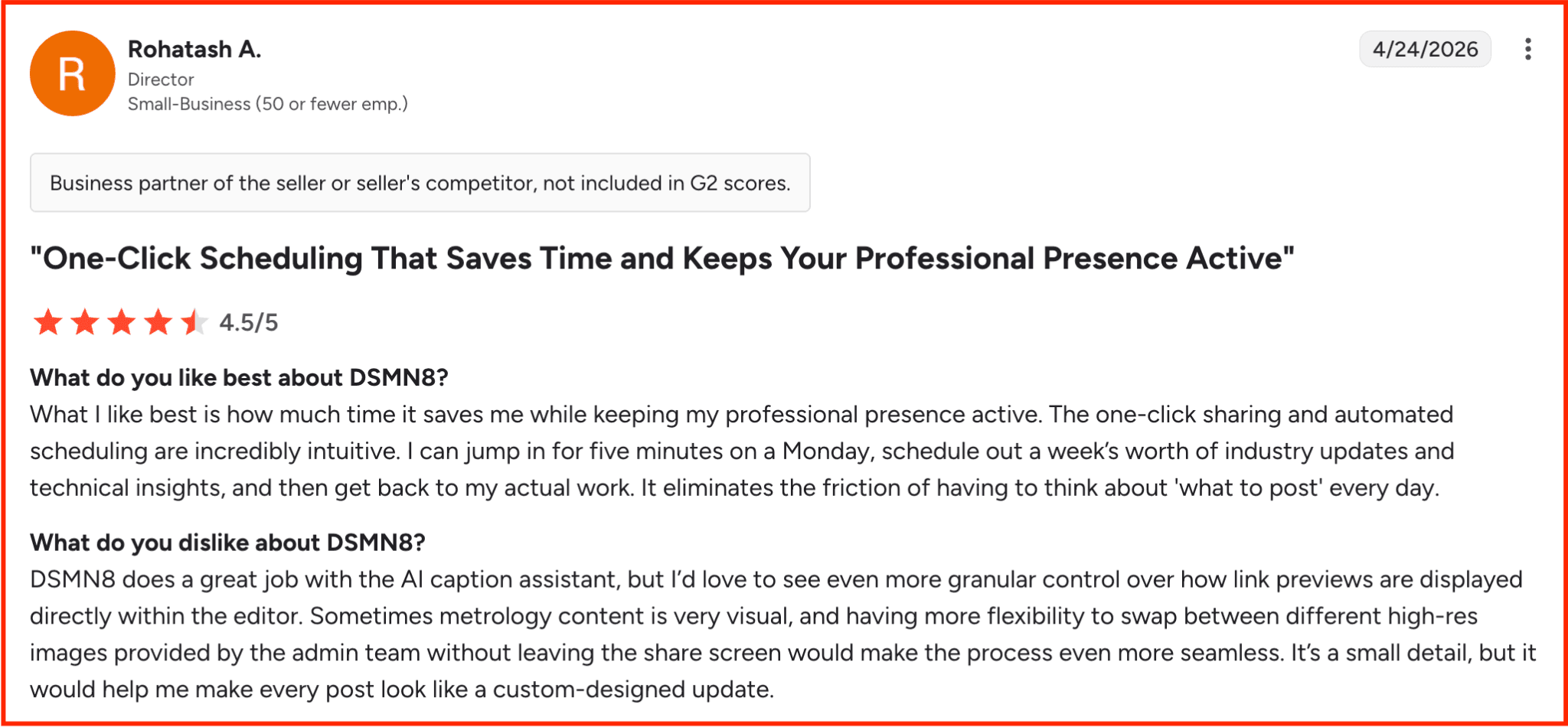
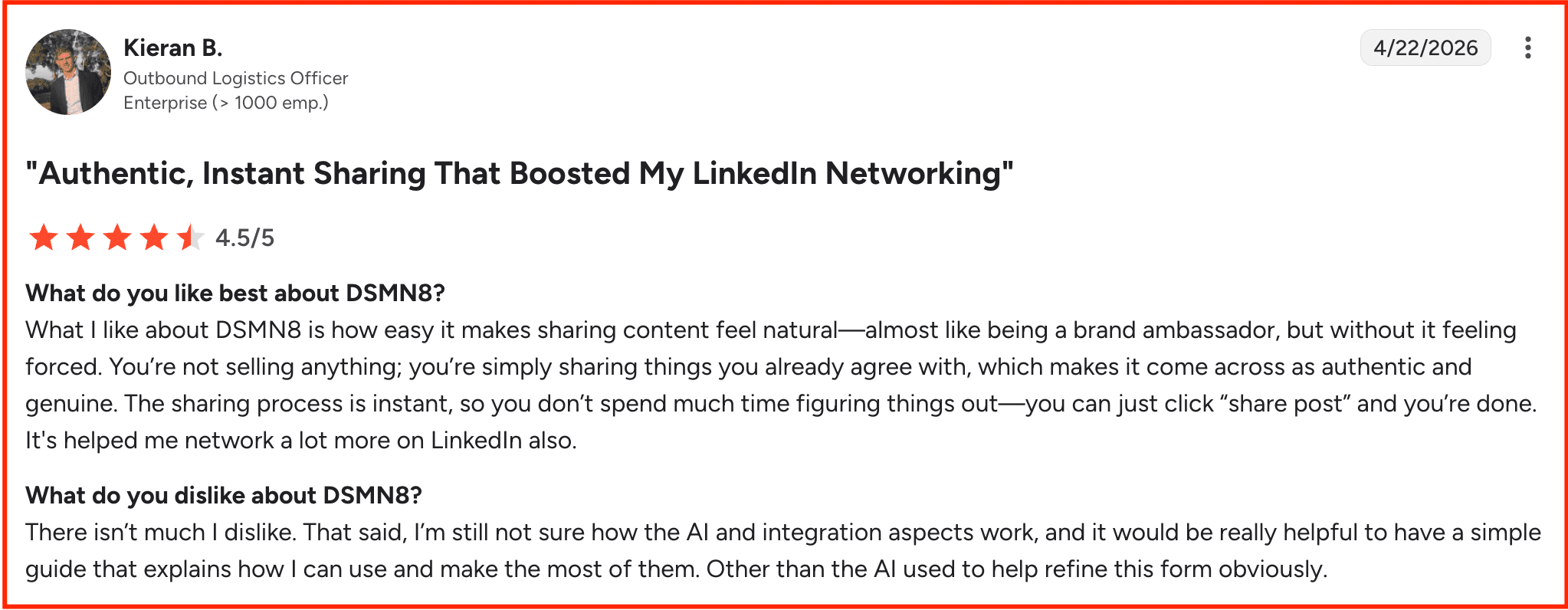
The ease of getting started comes up in almost every positive review. Employees describe connecting LinkedIn, choosing content preferences, and having posts go live within minutes.
For organizations whose goal is simply to get employees to share brand content regularly without friction, that experience is exactly what was promised.
Where it consistently breaks down
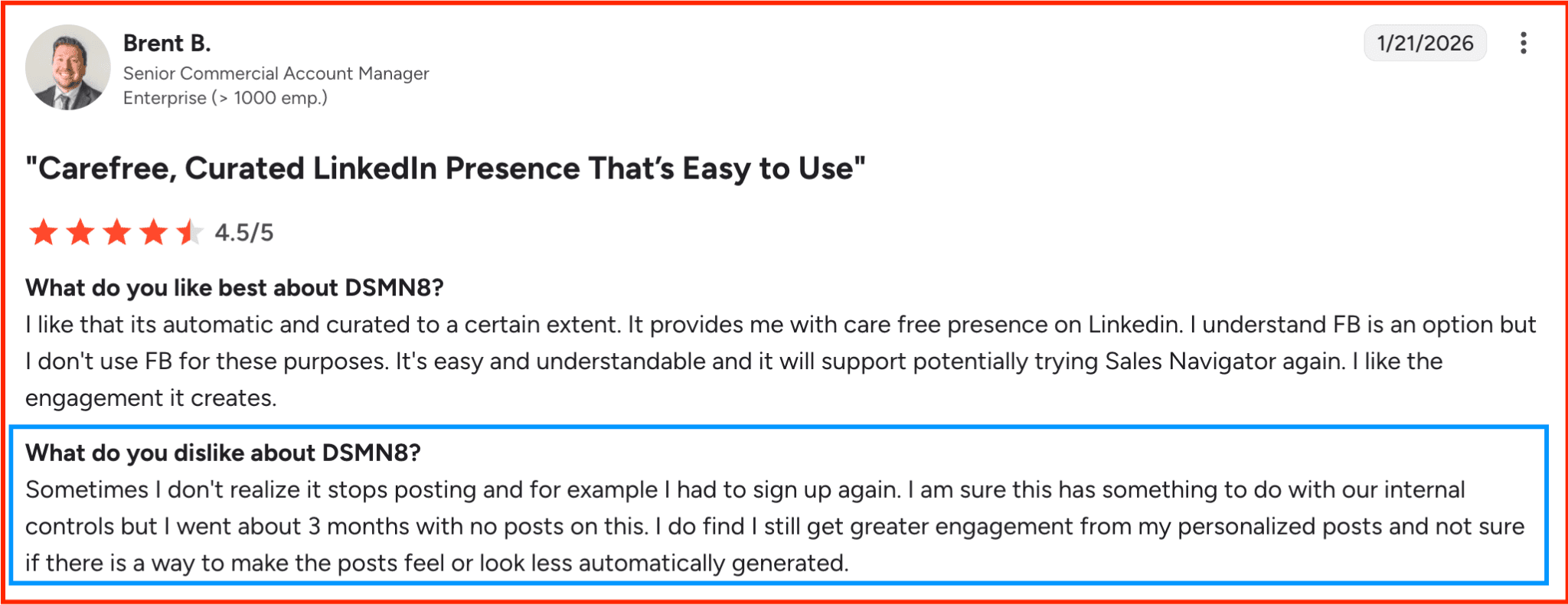
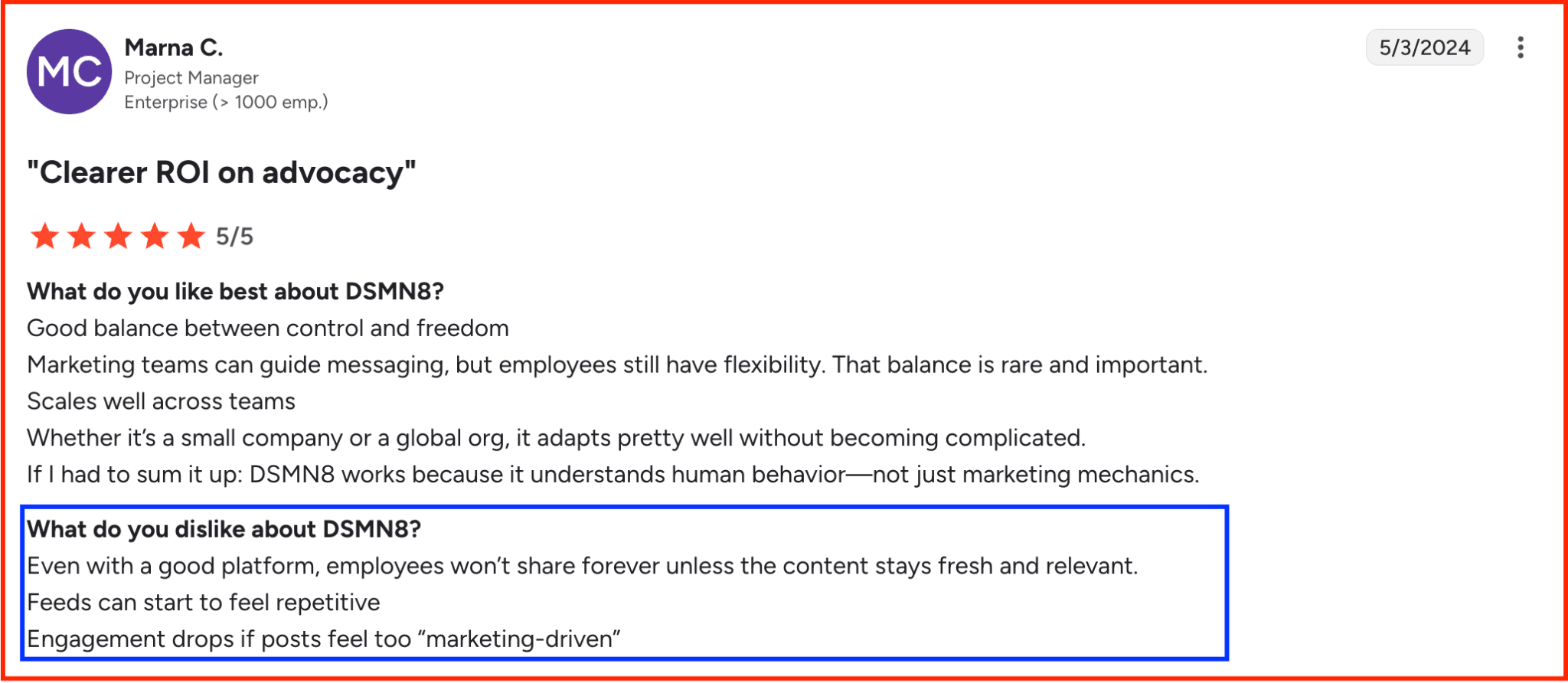
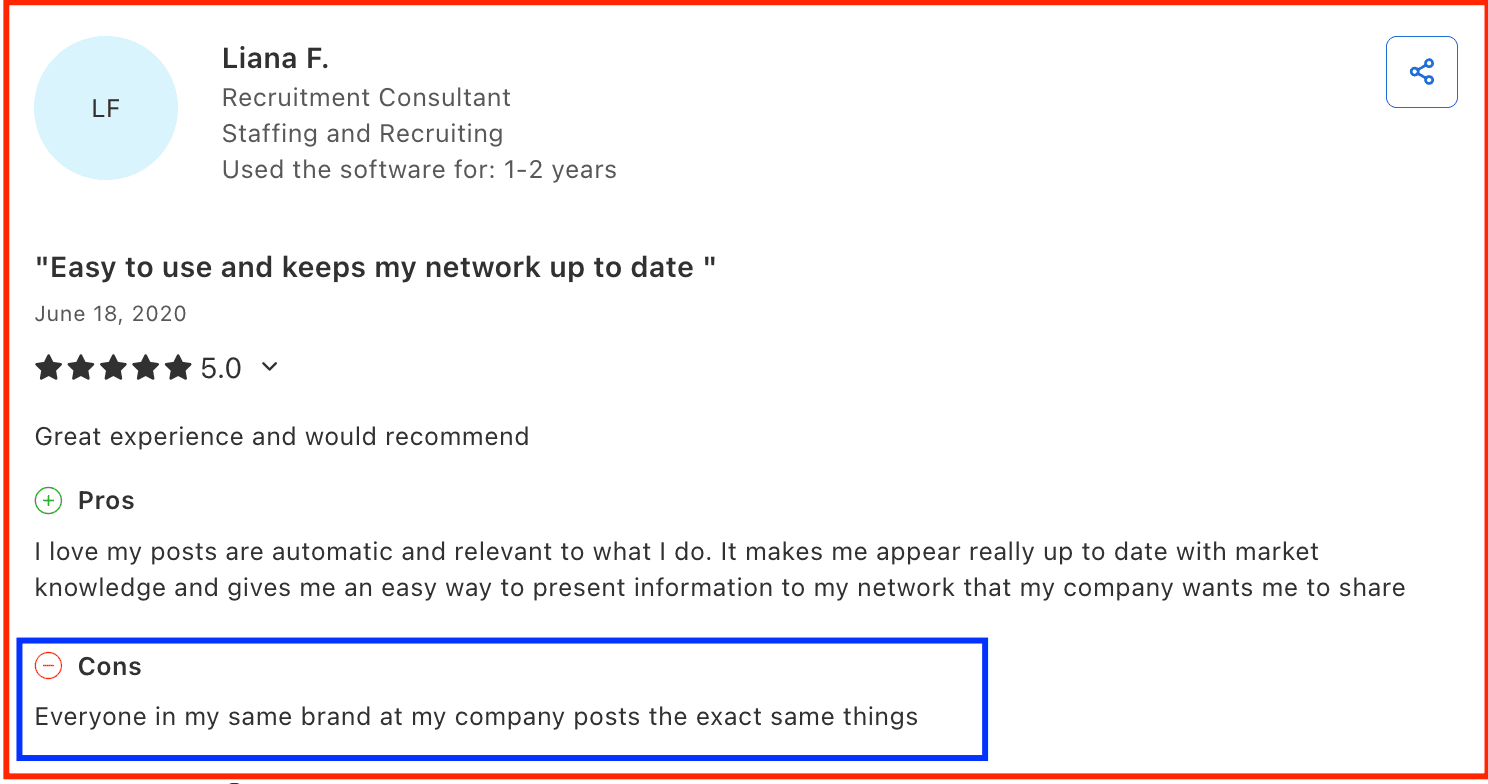
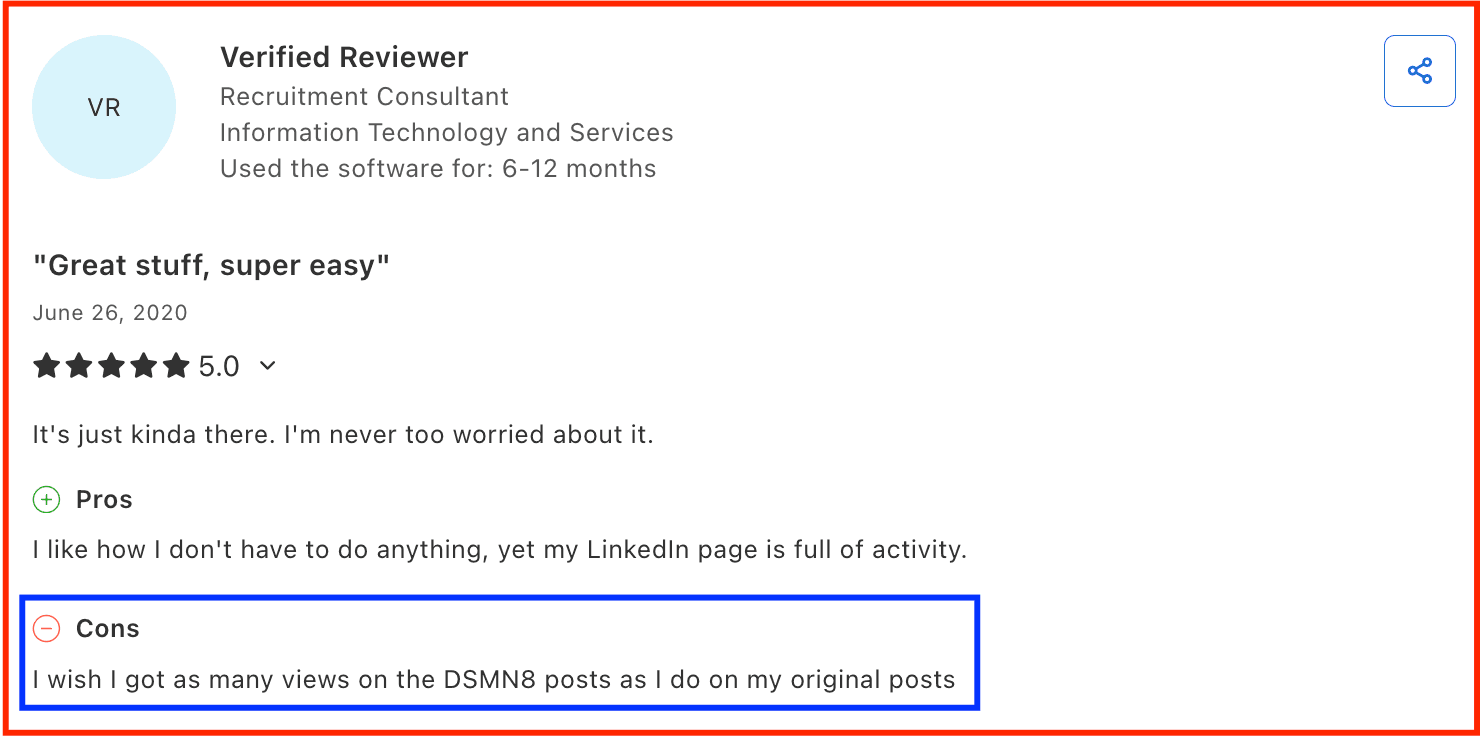
The friction appears at the same point across hundreds of reviews. Employees get more engagement from their own original posts than from DSMN8-distributed content. The feed becomes repetitive. Content feels marketing-driven rather than personal. Participation that started strong quietly fades.
The re-authentication problem
A recurring operational complaint that does not get enough attention.
Employees must reconnect their LinkedIn accounts periodically—every 90 days in certain configurations. Multiple reviewers describe quietly going months without posting because the connection lapsed and nobody noticed.
Brent B. also says — "Sometimes I don't realize it stops posting and for example I had to sign up again. I went about 3 months with no posts on this."
For an enterprise program built on the promise of consistent employee visibility, going dark for months without an alert is not a minor inconvenience. It is a program integrity problem.
The Real Problem With DSMN8 And Why Most Advocacy Programs Built On It Stall
Let me be direct about something.
DSMN8 is a well-built platform. The engineering is solid. The enterprise integrations are real. The client list is legitimate. None of that is in question.
What is in question is whether the model on which it is built actually solves the problem that advocacy programs are hired to solve in 2026.
Here is the model. Marketing creates content. Employees receive it. Employees share it. Repeat.
LinkedIn's algorithm now suppresses duplicate content. Buyers scroll past posts that read like press releases. And employees quietly stop participating when they feel like a distribution channel rather than a voice. The window where this model reliably worked has closed.
DSMN8 knows this. Their own blog published it in January 2026:
"Under a traditional model, marketing sends approved copy by email or Slack. Employees post it verbatim. Algorithms detect duplication. Reach drops. Participation fades."
That is DSMN8 describing what happens inside the programs their own platform runs. Read that sentence again.
Their answer is Personal Voice AI — adapting marketing-written captions to sound more like the individual sharing them. It is a genuine improvement. But adapting a caption someone else wrote is not the same as helping an employee figure out what they actually want to say. The blank page problem is still entirely theirs to solve.
Programs that build real LinkedIn authority in 2026 run on employee-generated content — original perspectives, real expertise, genuine voices. Building that on DSMN8 means you have to solve the content creation problem yourself. You need a process for capturing what employees actually know, a system for turning it into posts that sound like them, and a way to keep them engaged when the leaderboard novelty fades after week three.
DSMN8 gives you the distribution infrastructure. The harder job remains yours.
Supergrow Teams is built from the ground up for that harder job.
Employees capture ideas by speaking. Content DNA turns their voice into posts that sound like them. Approval workflows and Challenges keep the program alive past the launch week. The entire system is oriented around one outcome — employees consistently creating content in their own voice.
That is not a feature difference. It is a fundamentally different philosophy about what employee advocacy should produce.
See how Supergrow Teams employee advocacy works.
Who DSMN8 Is Actually Built For And Who Should Look Elsewhere
DSMN8 is not a bad platform. It is a mismatched one for most teams considering it.
Buy it if this is you:
-
Running advocacy across 500 or more employees.
-
Have a full-time program manager whose entire job is this.
-
The marketing team produces enough content to keep a daily feed relevant across multiple departments.
-
Have a formal procurement process, an annual budget approved in advance, and the patience for a custom quote cycle before you see a single employee post.
That is a real buyer. DSMN8 was built for them.
Walk away if this is you:
-
Team is under 200 people.
-
Do not have a dedicated advocacy manager. Employees are still figuring out what to post — let alone sharing pre-approved content at scale.
-
Want to test the program before locking into a $1,750 monthly annual contract.
-
Need employees to sound like themselves, not like the marketing team cleaned up their caption.
Most B2B teams reading this are in the second group. Not because they are not serious — because they are at the stage where the program needs to earn its budget, not start with one.
The brutal truth is this. DSMN8's Scale plan — the one where the platform actually becomes useful — starts at $1,750 a month. Annually.
Before you know if your employees will show up consistently. Before you know if the content resonates. Before you know if the program works at all.
That is an expensive way to find out the model does not fit.
Know what program you are actually running before you sign a contract designed for a completely different one.
Why B2B Teams Running LinkedIn Advocacy Are Switching to Supergrow
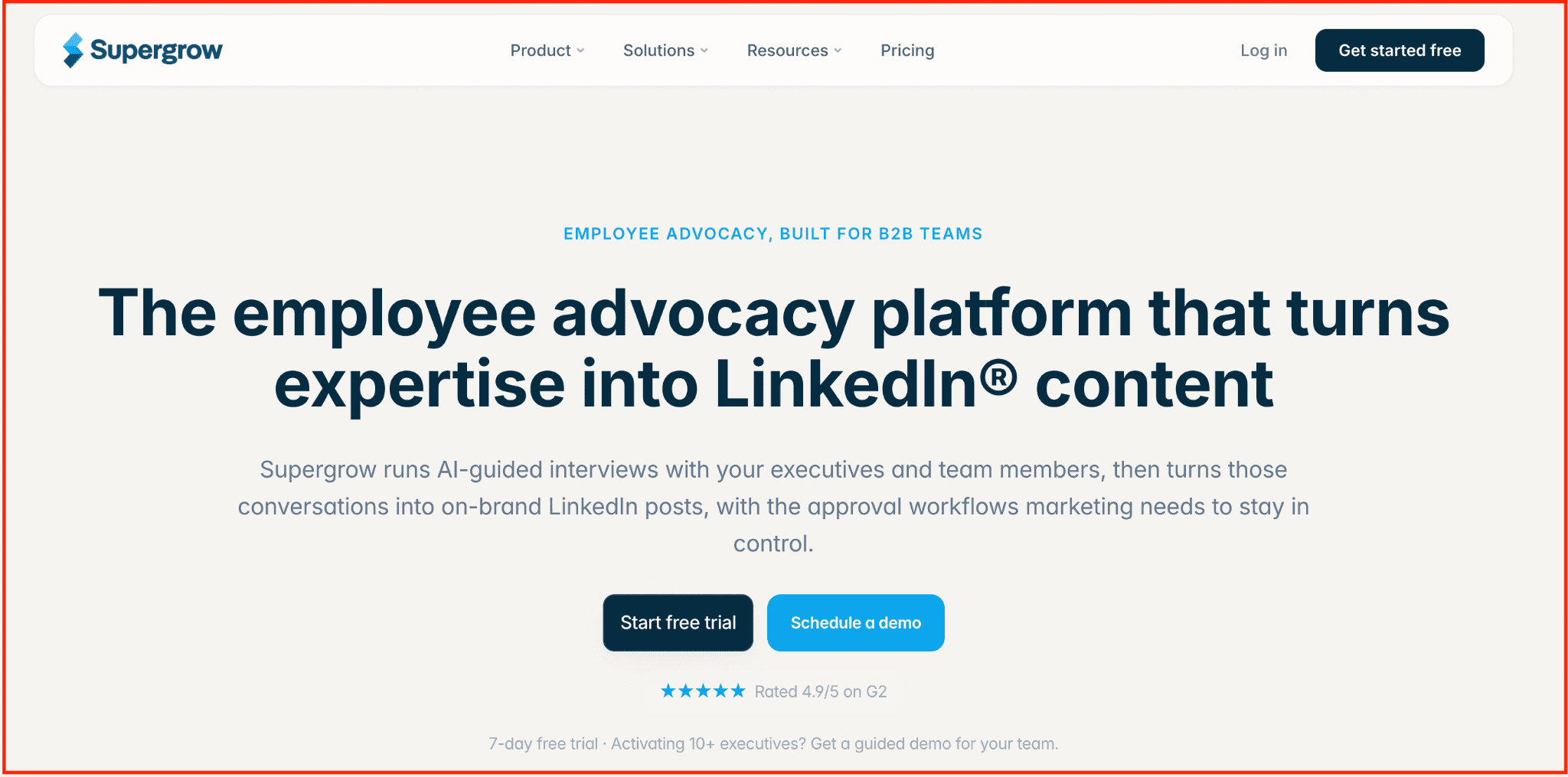
DSMN8 distributes content. Supergrow creates it.
That single distinction determines whether your advocacy program builds genuine LinkedIn authority — or just generates sharing activity that nobody can explain the ROI of twelve months later.
Here is what Supergrow Teams brings to the table for B2B teams serious about LinkedIn employee advocacy in 2026.
- Every Employee Sounds Like Themselves — Not Like Marketing
Generic AI content is killing employee advocacy programs. When every post sounds the same, LinkedIn's algorithm buries it, and buyers ignore it.
Content DNA builds an individual voice profile for each team member — their tone, vocabulary, and natural writing style. Every post generated starts from who they are. Not from a brand guidelines document.
- Employees Create Content. Not Just Share It.
The blank page is the number one reason employees stop posting after week two.
PostCast removes it entirely. Employees speak their ideas — a lesson from a customer call, a take on an industry shift, a perspective from a deal they just closed. Supergrow turns it into a publish-ready LinkedIn post. No writing required. No staring at a cursor.
- Marketing Stays in Control Without Becoming the Bottleneck
Approval workflows move content from employee draft to published post through a structured review process — inside the platform. No Slack threads. No emailed docs. No chasing people across three tools to get one post live.
Push ideas to specific members. Distribute content across the team. Publish on behalf of busy executives. Marketing runs the program without manually posting every post.
- Participation Does Not Die After Launch Week
Every advocacy program starts strong. Most stall by week four.
Challenges and leaderboards keep employees engaged consistently, not just when the excitement is fresh. Weekly performance reports show each member what worked, what to repeat, and what to try next. The system builds the habit. Not just the launch.
- One Dashboard. Full Program Visibility.
Admins see every workspace, every member, every scheduled post, and every performance metric from a single view. Track who is active. Identify who needs a nudge. Measure what the program is actually producing.
No spreadsheets. No status update meetings. No guessing.
Supergrow Teams is not a content distribution tool with advocacy features bolted on. It is a system built from the ground up to solve the problem DSMN8 leaves on the table — employees consistently creating content in their own voice at a scale that moves the needle.
B2B buyers trust people. Not brand pages.
Give your people the system to show up as themselves — and keep showing up long after the novelty wears off.
See why B2B teams are making the switch — explore Supergrow Teams.
Final Verdict — Is DSMN8 Worth It?
DSMN8 is a capable platform for large enterprises with the budget, the infrastructure, and a dedicated program manager to run it. If that describes you, it deserves serious evaluation.
If it does not — if your team is still figuring out how to get employees posting consistently in their own voice — you are buying a distribution engine for a problem that requires a creation system.
At a $1,750-per-month minimum on an annual contract, that is an expensive lesson to learn twelve months in.
Know the difference before you sign.
Supergrow Teams is built to address exactly what DSMN8 leaves unsolved — employee-led content creation, authentic voices, and consistent participation — at a price B2B teams can actually justify.
Start your free 7-day trial — no credit card required.