
Right now, a buyer with a problem you solve is searching it into ChatGPT instead of Google.
The answer names a few companies and explains why each one fits. If you are not in it, you were never considered.
That answer is built entirely from sources the model trusts. For B2B related questions, LinkedIn is increasingly one of them. Getting your LinkedIn posts cited in AI search is how buyers meet your thinking before they reach a vendor list.
LinkedIn is the second most cited domain across the major AI tools, in around 11% of responses, and climbing to near 13% month over month.
Posting more on LinkedIn is not the lever. Here is what earns a citation, how to write one, and how to run it across a team.
LinkedIn Is Now A Primary Source For AI Answers
Marketers have spent years treating LinkedIn as a reach channel.
The data now says it is something else. It is a retrieval surface that AI tools pull from when they answer professional questions, which changes what your content is actually for.
1. The Numbers Worth Knowing
Four studies from 2026 tell the same story from different angles:
- LinkedIn is the second most cited domain across ChatGPT Search, Google AI Mode, and Perplexity, appearing in about 11% of responses.
- It is the single most cited domain for professional queries, across six different models.
- It ranks in the top five cited domains in all 14 B2B categories one study measured.
- Citation rate varies sharply by tool, from 5.3% on Perplexity to 14.3% on ChatGPT Search.
The takeaway is not that LinkedIn is popular. It is that a model researching your category is already reading LinkedIn to build its answer.
2. Why A Citation Beats A Click
A citation looks like a vanity metric until you follow what it does to buyer behaviour. When an AI tool recommends a brand, people go looking for it.
Brands recommended in an AI answer were 2.5 times more likely to get a site visit within seven days, and most of that traffic arrived through branded search rather than a trackable AI link.
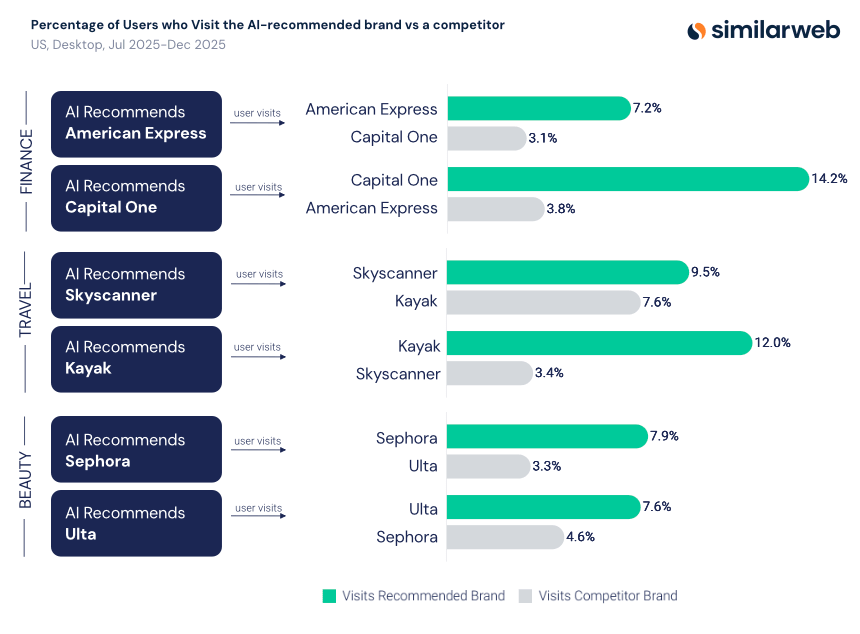
The visit shows up in your analytics as direct or organic, days later, disconnected from the answer that caused it.
3. But Only For Professional Topics
This is where honesty protects your effort. LinkedIn's citation strength is real for professional and B2B questions and thin everywhere else.
In one analysis spanning 9 consumer verticals, every social platform except Reddit and YouTube sat below 1% of citations.
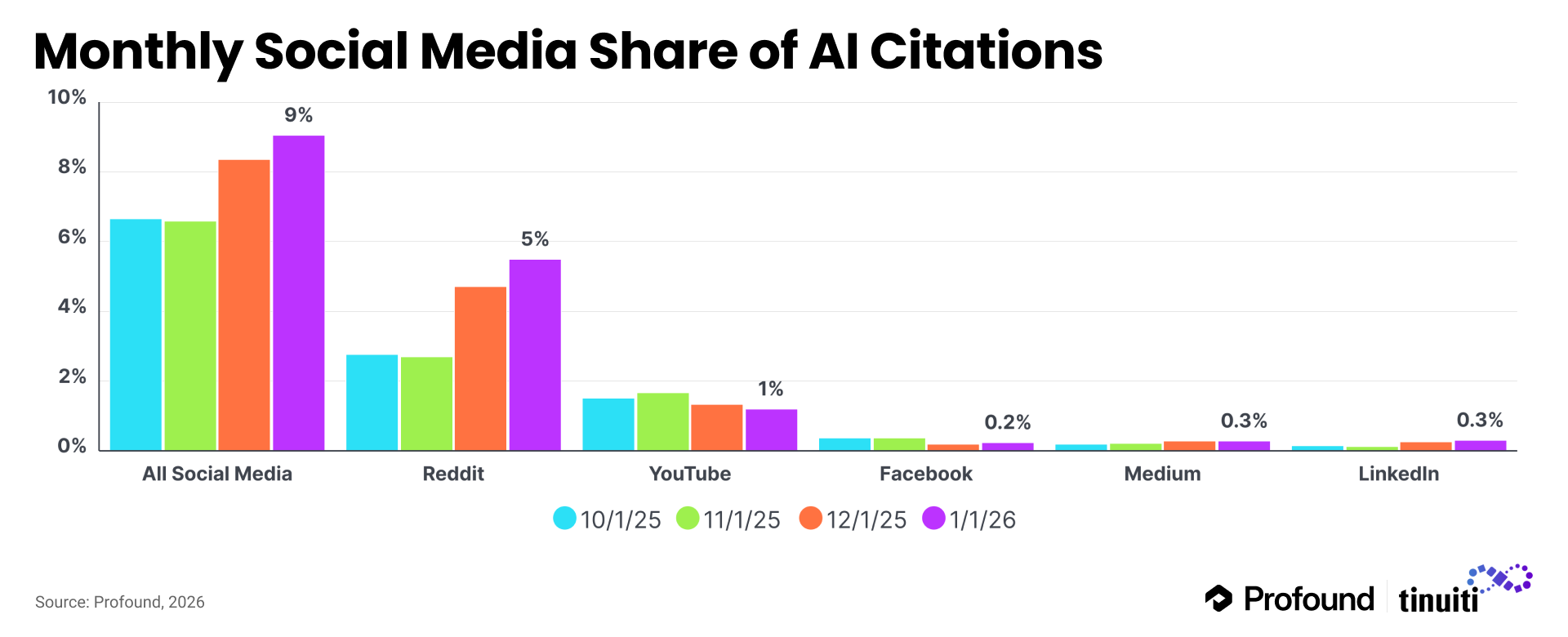
If your buyers ask professional questions, LinkedIn is worth engineering for. If they ask consumer questions, your effort belongs somewhere else.
What Actually Earns A Citation in AI Search
Scrunch analyzed 12,000 LinkedIn posts that ChatGPT considered while answering real questions, including the ones it looked at and passed over, then used a causal method to isolate the effect of each factor.
1. Depth Beats Reach
The single largest effect Scrunch measured was technical detail. Posts carrying specific, practitioner-level detail were 77% more likely to be cited, and that same detail did almost nothing for likes.
Reaction count, meanwhile, had near-zero power to predict a citation. A post with 100 reactions and a post with 10,000 were cited at close to the same rate. Depth is not about writing code in your feed. It is about showing the specificity of what you actually know.
2. Name Names
Vague content gets paraphrased into generic language. Specific content gets quoted.
Naming concrete companies, people, products, and frameworks made a post 33% more likely to be cited, and lifted reactions 5% as well.
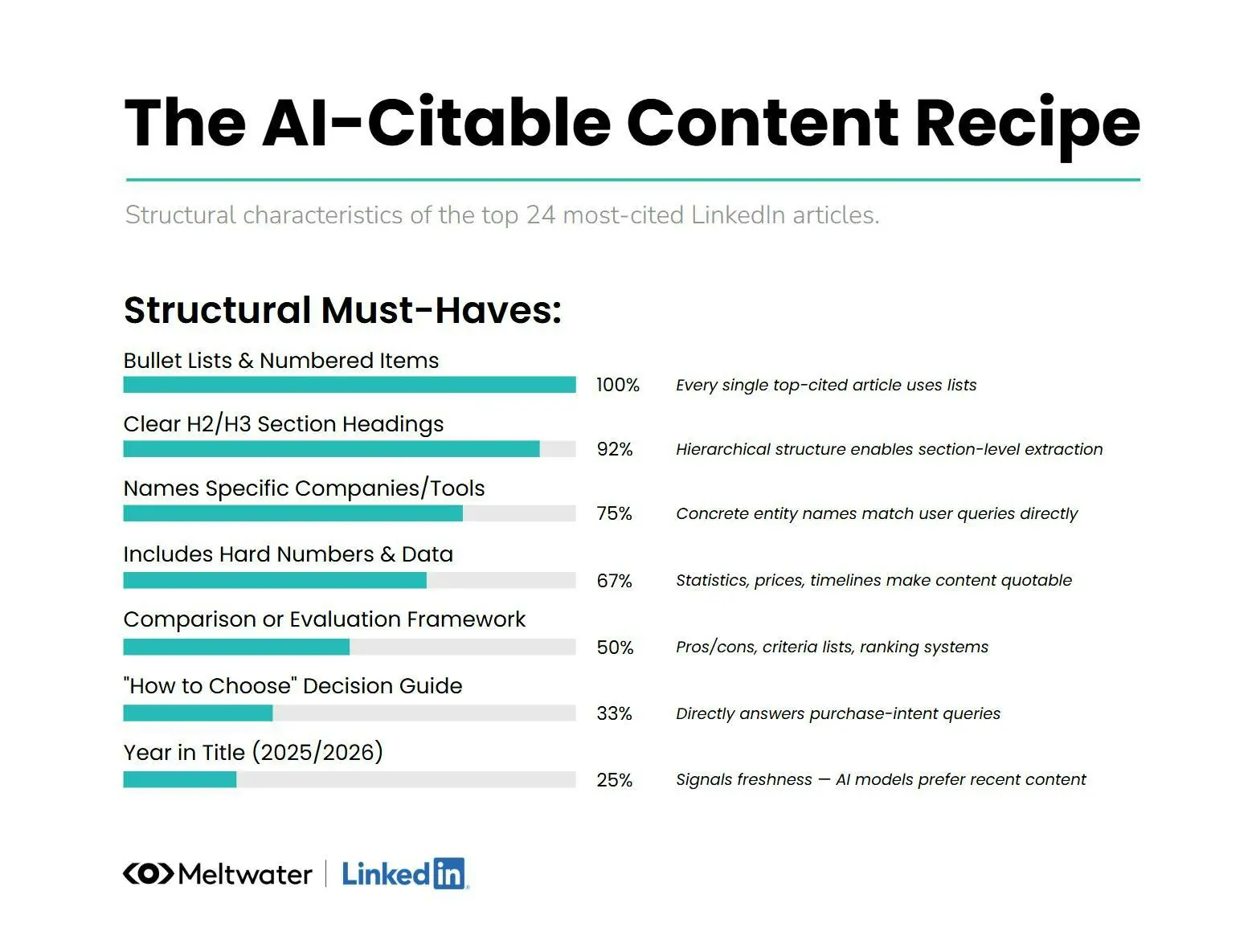
The model reads the text of your post, not the tag graph, so typing a name in plain text counts. Meltwater found the same pattern in its own data, where 75% of the most cited LinkedIn articles named specific entities.
3. Get Specific About One Narrow Topic
Breadth makes you interchangeable. Narrow focus makes you the obvious source. Topic-specific posts were 18% more likely to be cited and 13% more likely to earn reactions, one of the few moves that wins both games.
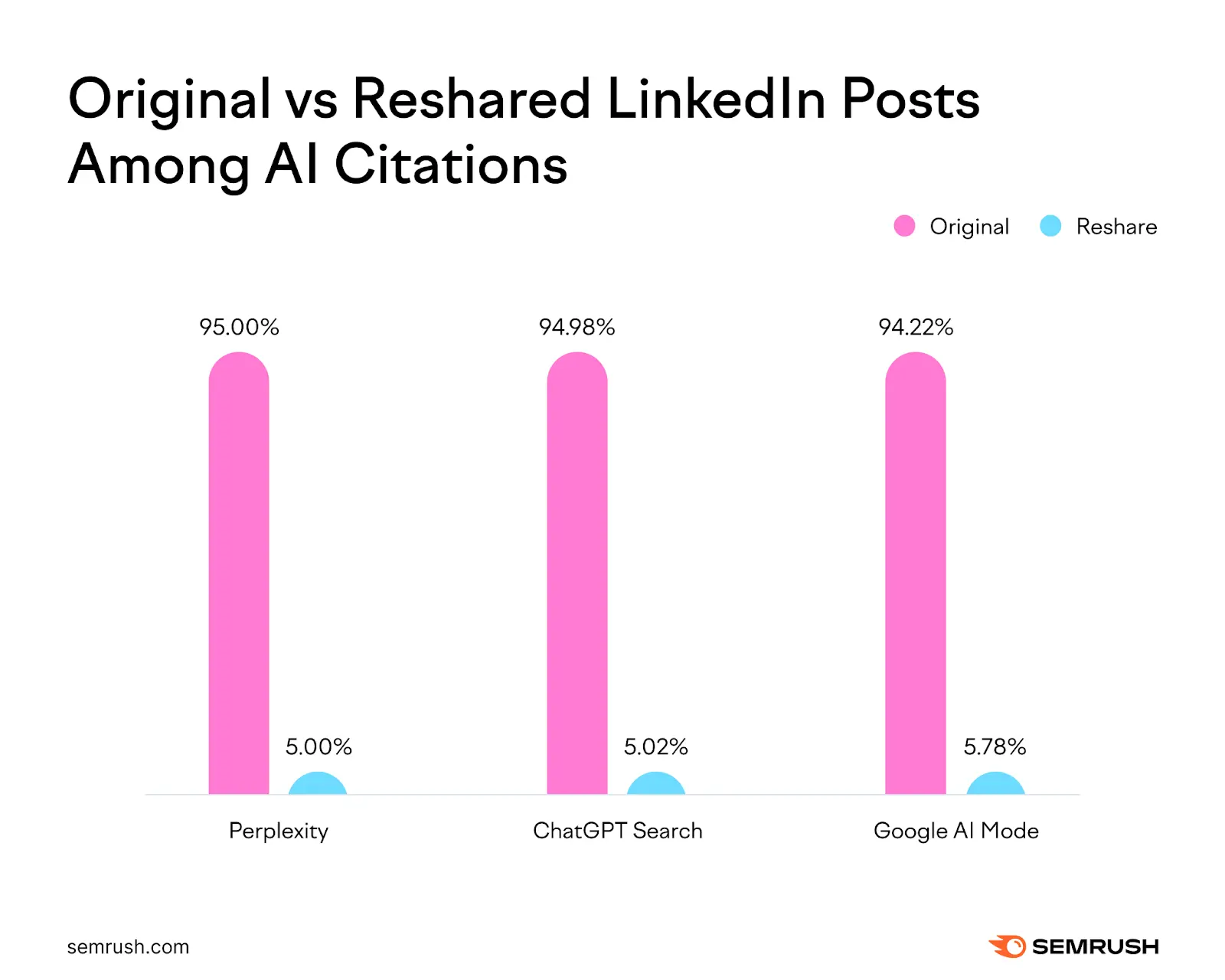
This lines up with what gets cited overall. Between 54% and 64% of cited posts were knowledge- or advice-driven, and roughly 95% were original rather than reshares. The model is looking for a clear answer from someone who knows the subject, not a repost of someone else's.
4. A Quick Word On What Not To Bother With
The tactics that win the feed mostly do nothing for citations. Personal anecdotes, first-person hooks, and follow-for-more calls to action reliably lift reactions and leave citation rates flat.
Two common tactics actively cost you. Unicode bold and italic text made a post 58% less likely to be cited, and the link-in-comments tactic dropped its citation odds by 31%.
Both still lift reactions, which is exactly why they persist.
How to Create LinkedIn Posts That Get Cited in AI Search
Everything above tells you what the data rewards. This is how you put it into a single post.
An AI system rarely cites a whole post. It lifts the one paragraph that answers the question in front of it. So the unit you are writing for is not the post. It is the paragraph.
A post earns a citation when any single paragraph, read on its own with nothing around it, still delivers a complete and specific claim.
Every move below makes your paragraphs easier to lift and harder to doubt.
1. Write the First Line as a URL, Not a Hook
LinkedIn builds your post's URL from its first line the moment you publish, and that URL is locked. Editing later will not change it. The opening line you write for humans is also the address AI systems use to retrieve the post.
Open with a hashtag, and you waste it. "#ContentMarketing has never been more competitive" generates a slug about nothing.
"Drive social media engagement" generates /drive-social-media-engagement, a URL that tells a retrieval system exactly what the post is about.
You can see this on cited content. John Shehata's article on SEO newsletters, one of the most cited LinkedIn URLs in Semrush's study, carries the slug /best-seo-news-newsletters-i-actually-read-every-week.
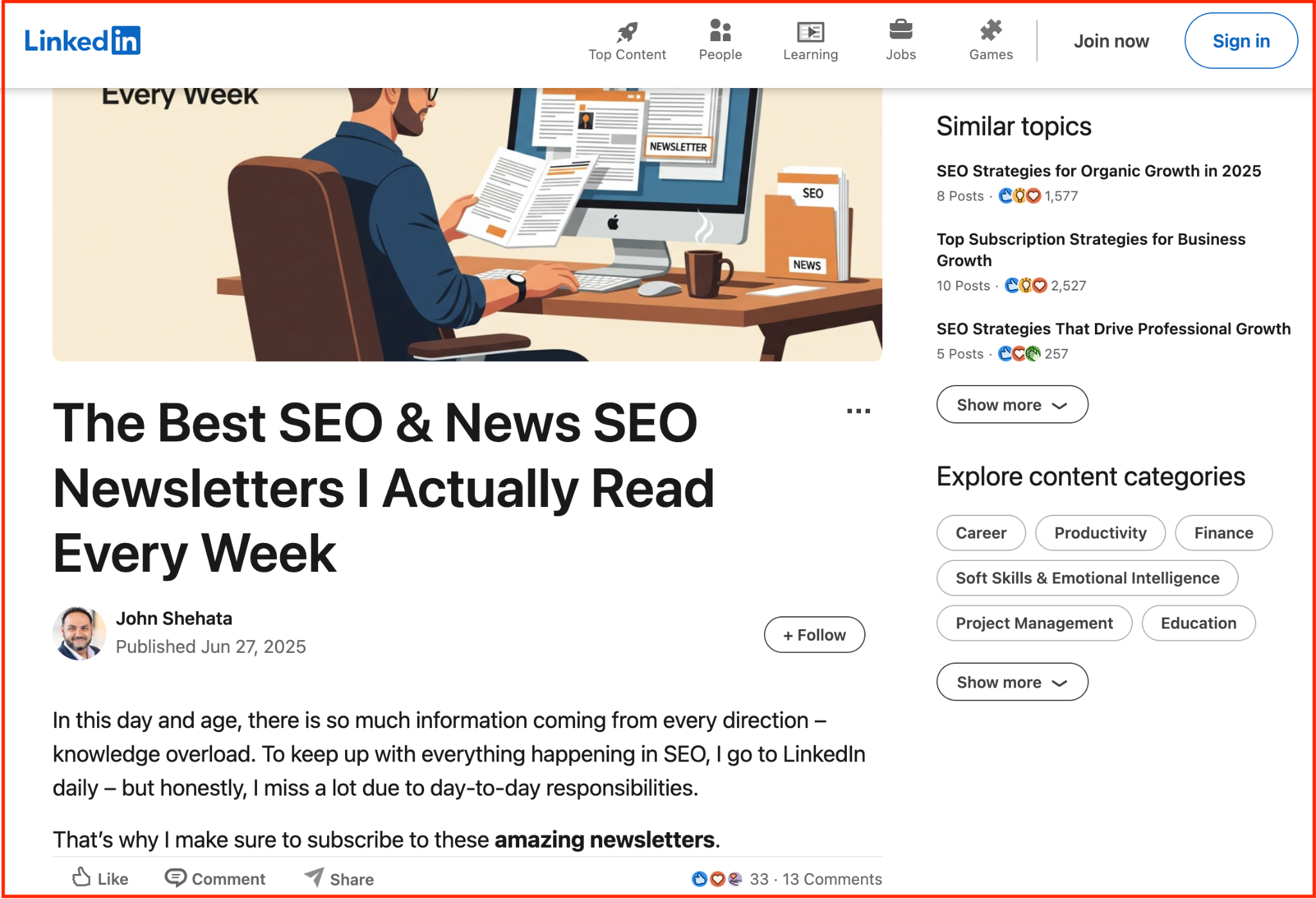
The topic and the angle are in the address before a reader sees a word.
Before you publish:
- Lead the first line with the keyword phrase your buyer would type, not a hashtag.
- Check the slug in the share preview.
- Treat this as the one non-negotiable check, because it is the only step you cannot undo.
2. Make Every Paragraph Stand on Its Own
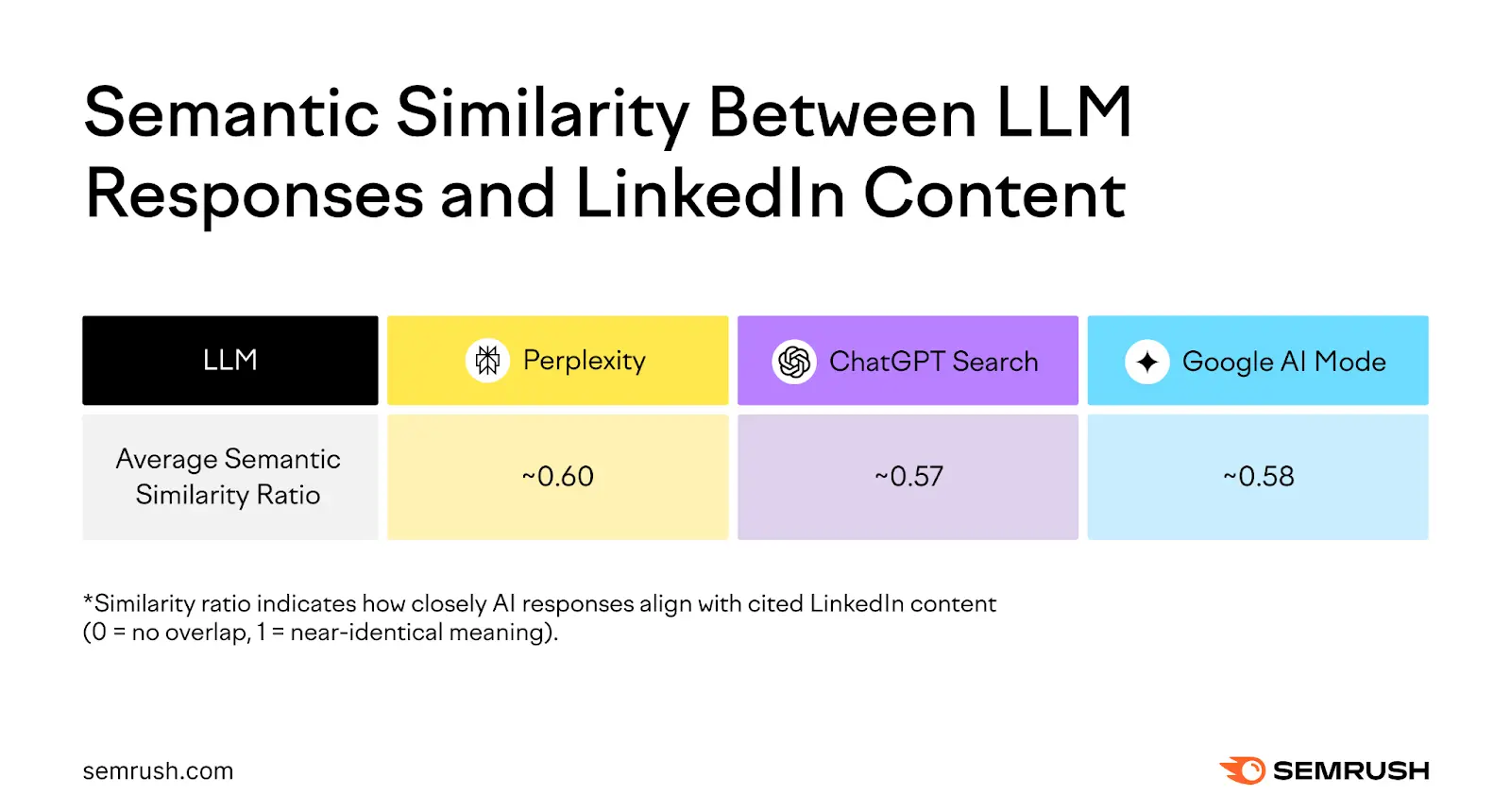
When an AI tool cites LinkedIn, it does not paraphrase loosely. Semrush found a semantic similarity of 0.57 to 0.60 between the answer and the source, higher than Reddit or Quora. The model lifts your wording almost intact, so the passage it grabs has to work on its own.
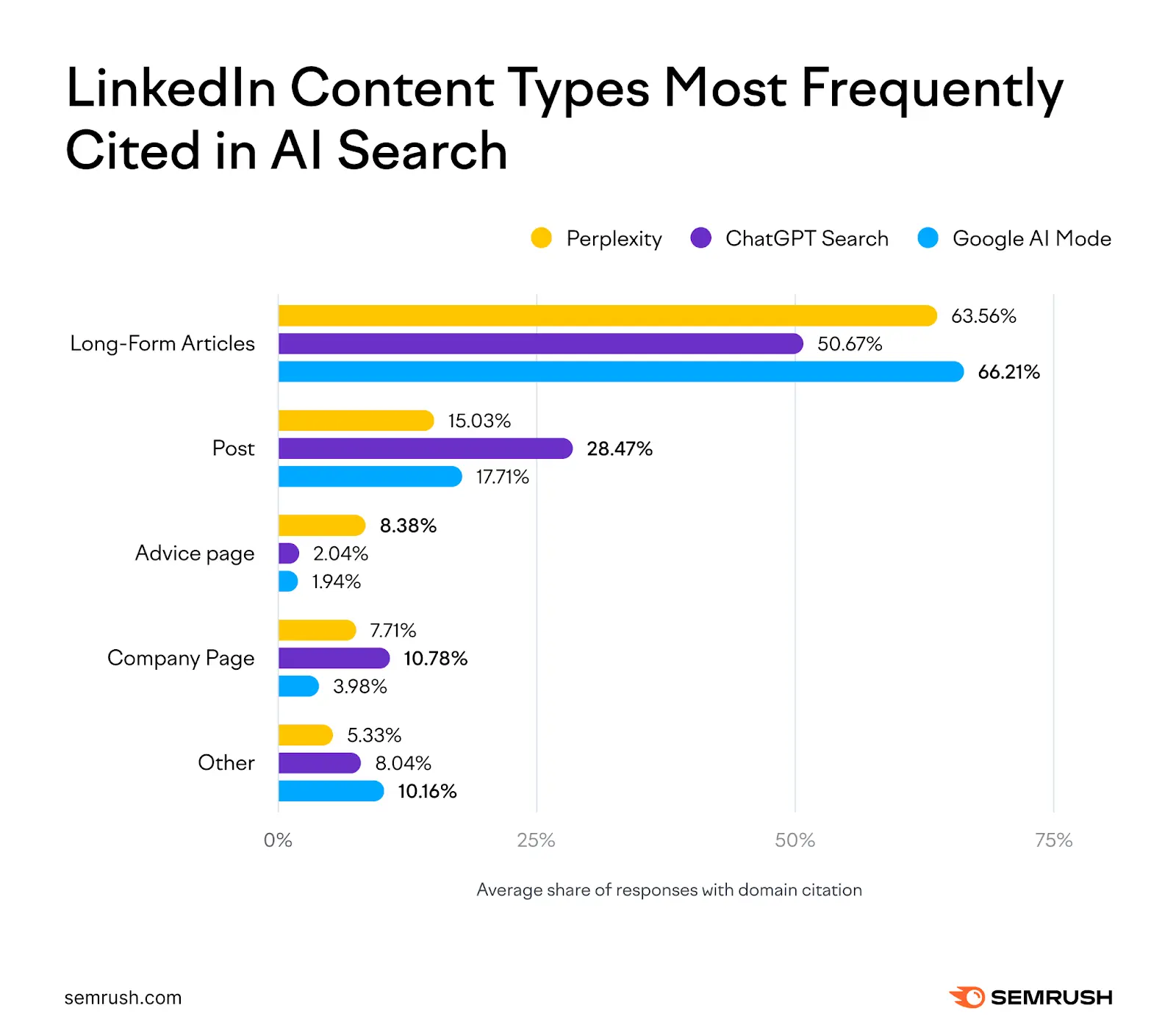
This is why articles pull ahead. They account for 50 to 66% of cited LinkedIn content, because their structure makes each section easy to isolate.
John Shehata's newsletter article shows what that looks like in practice. Each newsletter gets its own block: the name, what it covers, why he reads it.
A model answering "best SEO newsletters" can lift any single block, and it still makes complete sense with nothing above it. That structure is why the piece surfaced across 45 ChatGPT prompts on just 31 likes. The reach did not carry it. The structure did.
Write your posts the same way. Draft it, then read each paragraph cold. If it leans on the sentence before it, rewrite it until it stands up by itself.
3. Lead With Depth Only a Practitioner Has
The biggest single lever in the dataset is technical depth. Posts carrying specific, practitioner-level detail were 77% more likely to be cited, and that detail barely moved likes. The model is not rewarding polish. It is rewarding the specificity of someone who has done the work.
This is where most company content falls down. A marketer writing for the brand rounds the edges off until the post could have come from anyone in the category.
That gap is worth solving directly. The goal is to pull what an expert already knows into a draft without making them start from a blank page, and to keep it in their own words instead of flattening it into house style.
This is the job Supergrow's PostCast and Content DNA are built for. An expert talks through what they know, PostCast turns it into a draft, and Content DNA keeps the wording theirs.
Before you publish anything, ask one question. Could only someone who does this work have written it? If the answer is no, it will earn citations for the category, not for you.
4. Name Every Entity in Plain Text
Vague content gets paraphrased into nothing. Specific content gets quoted. Naming concrete companies, people, products, and frameworks made a post 33% more likely to be cited, and lifted reactions 5%.
The model reads the words in your post, not the tag graph, so a name typed in plain text counts. You do not need to @-mention anyone. Meltwater saw the same at the article level, where 75% of the most cited articles named specific entities.
Ina Nikolova is the clearest example. She writes about privileged access management and gets cited across multiple AI engines on articles with only a handful of likes.
She owns a tight vocabulary lane, the same terms in every piece: PAM, managed services, identity, defined every time. That repetition teaches a model to connect her to the category.
Do the same in your drafts:
- Trade "leading tools" for the actual product names.
- Trade "a recent study" for the named source and the number.
- Spell out each acronym the first time it appears.
5. Get Specific About One Narrow Topic
Breadth makes you interchangeable. A post on "the future of fintech" competes with ten thousand others saying the same thing, and the model has no reason to pick yours.
Narrow focus does the opposite. Scrunch suggests topic-specific posts were 18% more likely to be cited, and lifted reactions 13% too, one of the few moves that wins the feed and the model at once.
The narrower the topic, the more exactly it matches the question a buyer types.
"Embedded lending economics for vertical SaaS" gets reached for when someone asks about exactly that. "The future of fintech" gets reached for by no one.
Semrush found this is also what the model rewards across the board, where 54 to 64% of cited posts are knowledge- or advice-driven.
Owning a lane is not a one-post decision. Write on the same narrow topic again and again, and you build the entity association that connects your name to that subject. That is topical authority, and it compounds.
For a team, assign each expert a distinct lane, so two people are not diluting each other on the same category term.
6. Publish the Article, Then Break It Into Posts
One strong article is worth more to a model than a week of standalone posts. Articles make up 50 to 66% of cited LinkedIn content, because their length and structure give a model more to extract.
Consistency matters alongside depth. Roughly 75% of cited authors published five or more times in the four weeks before their citation.
The system that satisfies both is simple:
- Write one anchor article on your narrow topic.
- Break it into three to five posts, each carrying a single idea from it.
- Link a post back to the article, so the model uses that link as context and routes retrieval toward your deeper content.
Krazy Coupon Lady ran this play with one research asset, their 2025 State of Couponing survey, distributed across company and employee accounts. Semrush found that the survey post alone is cited in at least 26 ChatGPT prompts.
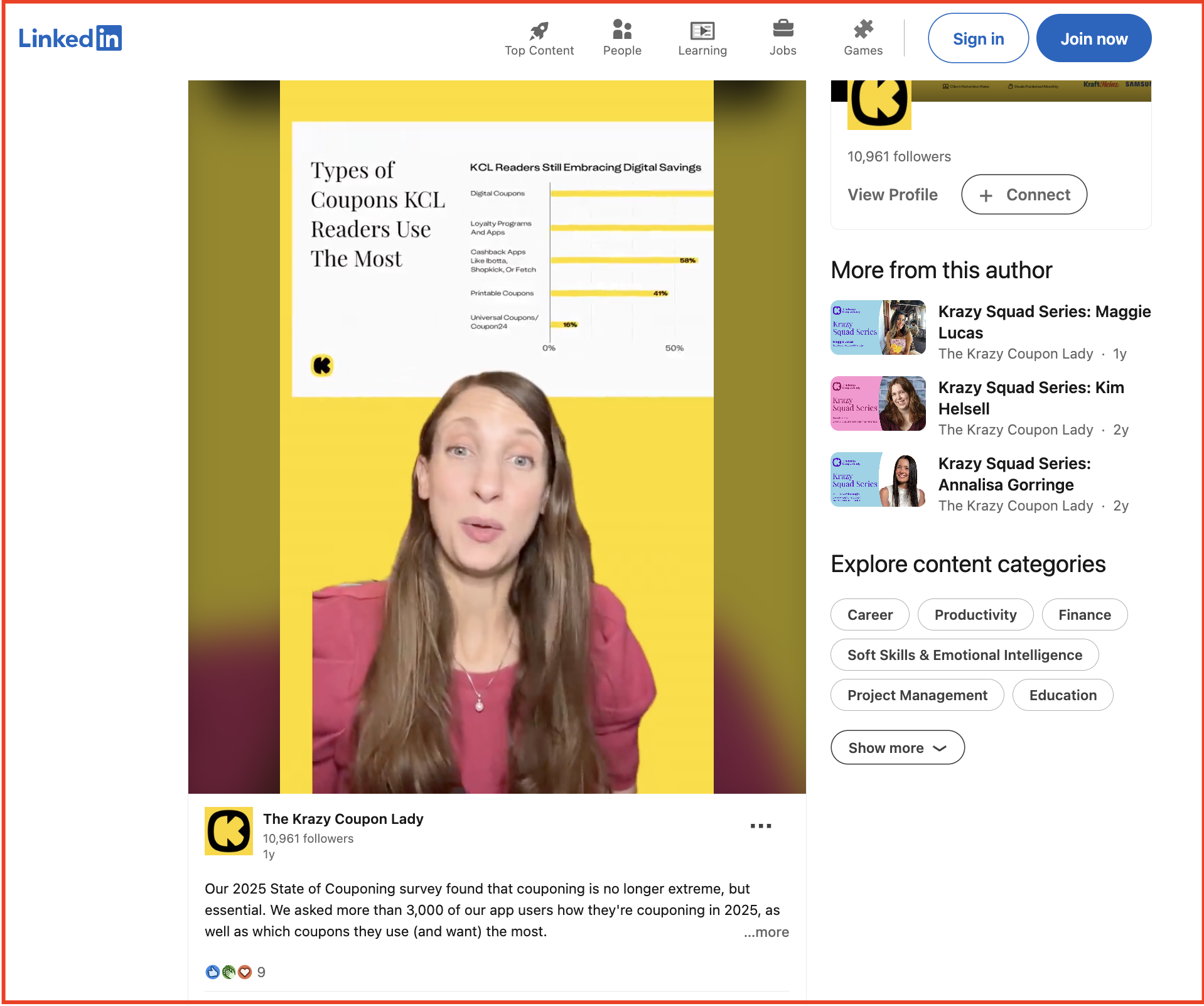
One asset, many surfaces, many chances to be the source. For a team, that is the model to copy: build the research once, then put it in the hands of every employee who can carry it.
7. Write in Plain Text and Place Links on Purpose
Two habits that win the feed quietly cost you citations.
The first is Unicode styling. Those 𝗯𝗼𝗹𝗱 and 𝘪𝘵𝘢𝘭𝘪𝘤 characters are not real letters.
According to Scrunch, they are math symbols dressed up to look like text, and a post using them was 58% less likely to be cited.
A headline styled as 𝗗𝗮𝘁𝗮 𝗟𝗲𝗮𝗱𝗲𝗿 looks sharp and is a string no model can read. Write in plain text, including your profile name and headline.
The second is link-in-comments. Moving your link to the comments drops the post's own citation odds by 31%. There is a real trade hidden in it, though.
The URL in the comment still gets cited around 47% of the time, so it can be a deliberate way to push AI toward your own site instead of the post. Decide which one you want before you publish.
Each move is simple when one person writes one post. The hard part is getting a dozen people to do all seven, every week, without a single URL slipping through. That is a team problem.
Running This Across A Team With an Employee Advocacy Program
One person following these moves is a tactic. A dozen people following them every week is a program, and programs break in different places than posts do.
The data points to where the leverage is: who publishes, what gets checked before it ships, and what you actually measure. Get those three right and the citations compound. Get them wrong, and the effort leaks out quietly.
1. The Math Changes With More Creators
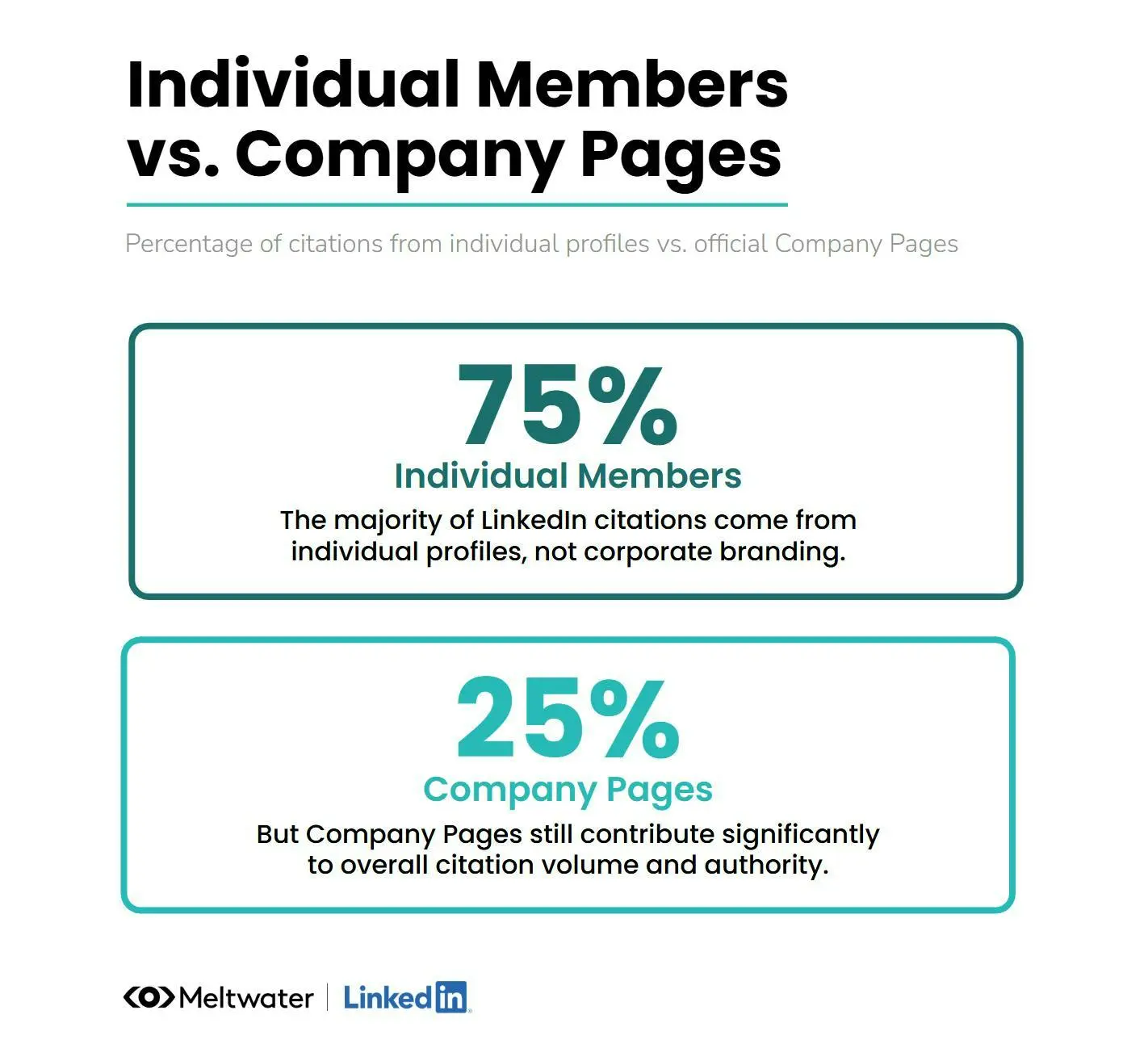
A company page cannot carry this on its own. AI tools cite individuals far more than brand accounts, with 75% of citations going to people and only 25% to Company Pages. The people who hold the depth are the ones who get cited, which means your reach depends on how many of them are publishing.
You still need both, because the engines split:
- Perplexity cites Company Pages 59% of the time.
- ChatGPT Search and Google AI Mode cite individual creators 59% of the time.
Publish only from the brand account, and you are absent from the two larger tools.
The fix is a roster of named experts publishing under their own profiles, which is the practical work of activating a team with Supergrow.
2. Structure Has to Survive the Handoff
Every rule in this article is easy to hold in your own head and easy to lose across a team. The URL is the sharpest example. It locks the moment a post publishes, so a weak first line cannot be fixed after the fact. With one person, you catch it. With 12 publishing every week, some slip through.
That is why the check has to sit before publish, not after. A shared board where drafts move from review to approved gives you one place to catch what cannot be undone:
- The first line, so the slug carries the keyword.
- Plain text in the headline and body, no Unicode.
- The named entities and the link placement.
Supergrow's Content Board and approval workflow are built for exactly this handoff.
3. Measure Citations, Not Reactions
If you take one number away from this article, make it this one. Reaction count has near-zero power to predict whether a post gets cited.
A team optimizing for likes is optimizing for the wrong scoreboard, and the report that looks healthy can hide a program that no AI tool is quoting.
Track the outcome that actually matters instead:
- Whether your brand shows up in AI answers for the questions your buyers ask.
- Which posts and authors earn those citations.
- Branded search volume against your publish dates.
Google added generative AI performance reports to Search Console in June 2026, covering AI Overviews and AI Mode. That gives you a starting point that reactions never did.
Write Your LinkedIn Post AI Can Cite
Go back to that buyer typing a question into ChatGPT. The answer they read is built from whoever published the clearest, most specific thinking on the subject. That is the opening, and it is still wide open.
Winning it does not take reach. It takes the people who actually know things putting that knowledge into words a model can lift. Your engineers, your CSMs, your founders. The expertise is already in the building. The only gap is getting it published, consistently, in their own voice.
This shift is early and moving fast. The teams that start now are the ones AI will be quoting when everyone else catches on.
Turn your team's expertise into content that AI cites. Start free with Supergrow.