
Most people should post on LinkedIn 2 to 4 times a week in 2026, and consistency matters more than raw volume.
The right number depends on who is posting. Founders and solopreneurs do well with 2 to 3 posts a week, consultants and experts with 3 to 4, active creators with 4 to 5 when they can hold the quality, and job seekers with 1 to 2 focused posts.
What changed in 2026 is that LinkedIn’s feed now reads the post itself. The real limit is no longer how many times you can hit publish, but how much good content you can sustain. Post past that line, and the reach you were chasing goes the other way.
How Often Should You Post On LinkedIn In 2026?
The short answer gives a range. Where you land in that range depends on who you are and how much quality you can maintain.
How often to post by goal and experience level
Posting frequency works best when it tracks your goal rather than a universal rule. The platform data supports the 2-to-4 range: personal profiles now average about 3 posts a week. A LinkedIn algorithm researcher
Richard van der Blom recommends 2 to 3 posts a week for the average creator.
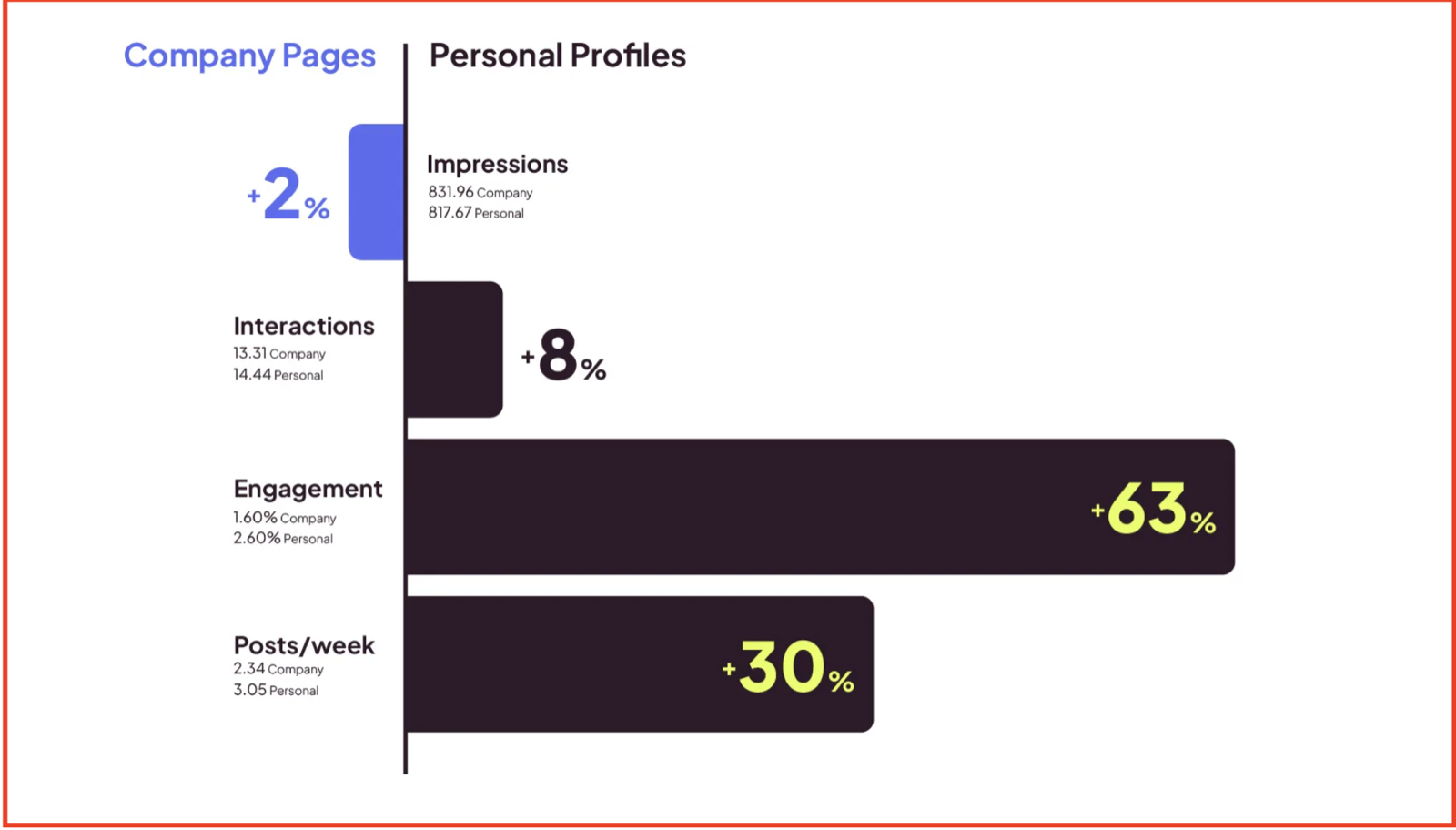
Treat the numbers in the short answer as floors you can hold, not targets to chase. A founder protecting time for the business is right to sit at the low end, while an active creator can push to the top of the range only if the quality survives the pace.
B2B teams are the one case where no single number fits, because the useful unit there is each person’s sustainable cadence rather than a quota handed to the group, which is the whole design behind structured employee advocacy tools.
A cadence you can sustain for six months beats a burst you abandon in three weeks.
Why there is no single magic number
Search for this question, and the advice contradicts itself. One study says post more, another warns of a penalty, a third insists on a fixed daily habit. Most of that disagreement comes from pages built on different years of data and different goals.
The honest answer is that the ceiling is not a number LinkedIn sets. It is the point where your own quality starts to slip. Publish below that line and extra posts help below. Publish above it, and they work against you, for a reason that did not exist in full force until 2026.
What Changed In 2026, And Why Old Cadence Advice Is Wrong
For years, posting frequency was a numbers game. Post more, show up in more feeds, win more reach. Two changes in 2026 broke that logic, which is why most cadence advice online is now out of date.
The feed stopped counting and started reading
In March 2026, LinkedIn rebuilt its feed ranking from the ground up, replacing separate engagement signals with large language models that read what a post actually says.
LinkedIn’s engineering team describes a model that understands a post by its meaning, not by its surface metrics.
That one change retired a decade of tactics. Posting at the perfect hour, rotating hashtags, and running engagement pods used to move reach because the old system counted those signals. When the model reads the writing instead, the writing becomes the only lever that still works.
LinkedIn started penalizing volume without quality
In July 2026, LinkedIn shipped a “seems like AI slop” report button, and members clicked it more than 1 million times in 2 weeks. Content the platform classified as AI slop saw 40% fewer views than it had a few weeks earlier.
The problem it targets is real and large. One detection study found more than 40% of LinkedIn long-form posts were fully AI-generated. For anyone posting more just to post more, this is the turn. Filler no longer fills space quietly. It gets flagged, and it loses reach.
2025 vs 2026: people post less and reach more
Put the two years side by side, and the shift is clear. Van der Blom reports that active creators have lost about 60% of their reach over two years, with engagement down 20% to 25%. Reach is harder to earn, and brute-force posting is not the way back to it.
Yet the quality signal is rising. Platform data for 2026 shows the average engagement rate climbed to 13.9% even as likes fell 13%, comments fell 17%, and shares fell 10%, with people posting about 10% less often than the year before.
Read together, those numbers tell one story. In 2025, higher volume still bought visible likes and held reach. In 2026, people post less, the vanity metrics are quieter, and the engagement rate is higher on the content that actually lands.
LinkedIn is rewarding fewer, better, more substantive posts, which is why the real cadence question is not how many times you can post, but how many good posts you can sustain.
Does Posting More Actually Help Your Reach?
This is where the advice splits hardest. Some studies say more posts always win; others warn of a penalty for posting too often. Both describe a real effect, and the way to reconcile them is to stop asking about volume and start asking about what you can sustain.
The myth of “just post more”
The “post more” rule comes from a specific place. Buffer’s analysis of more than 2 million posts found that moving from 1 post a week to several raised both reach and engagement, with no ceiling in the data.
It was true for the feed that existed then.
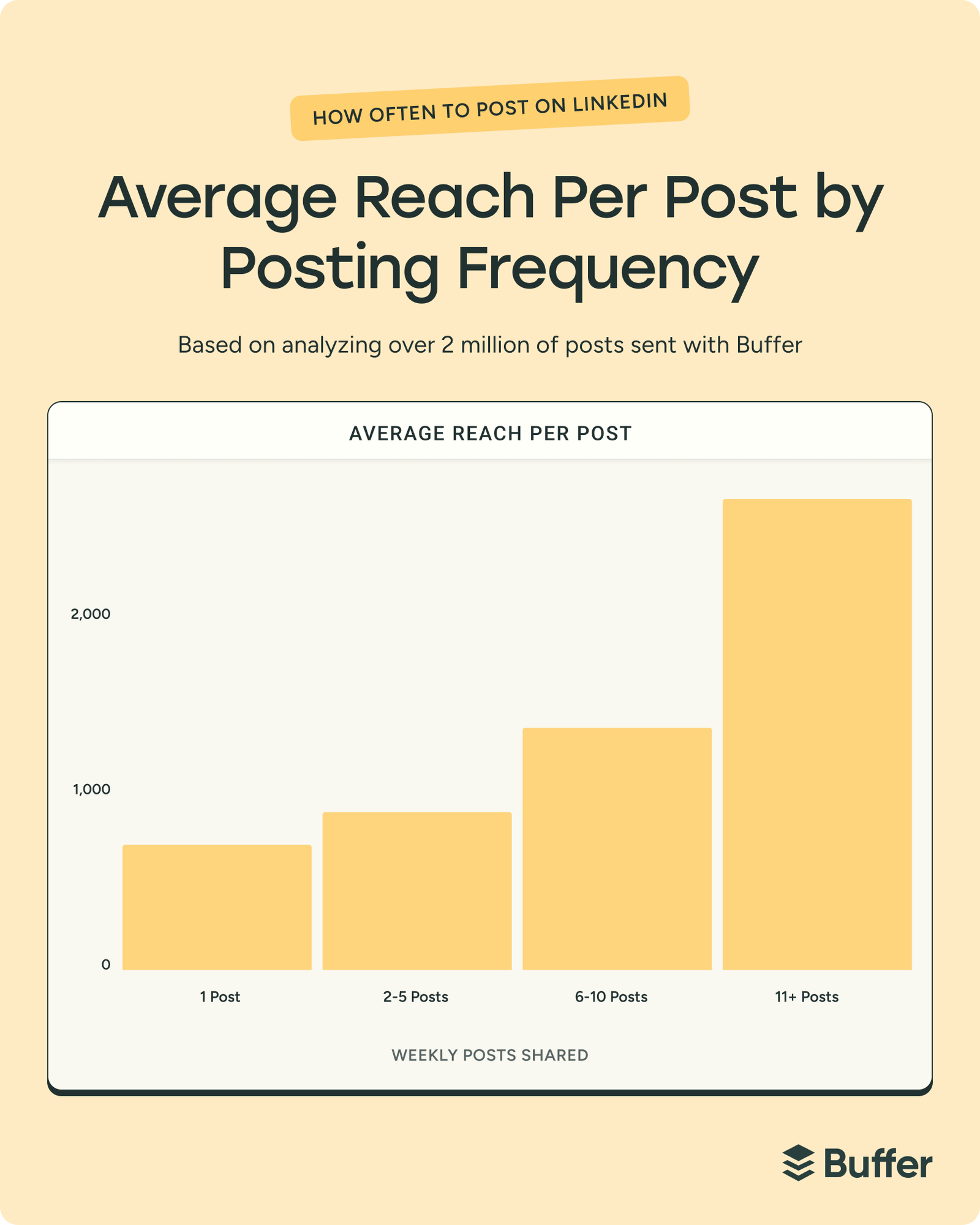
In 2026, with the model reading each post, the rule holds only as long as your quality holds. Extra posts lift your total reach up to the point where the writing starts to thin out. Past that point, each weak post drags the average down and trains the feed to expect less from you.
Is it bad to post every day on LinkedIn?
Not inherently. Daily posting is bad only when you cannot keep the quality daily, which is true for most people. The question is not whether daily works in theory, but whether your tenth post this week is as sharp as your first.
The data points the same way. Van der Blom found that creators who post when they genuinely have something to say, rather than on a forced daily schedule, saw reach rise 10% to 15%.
Daily posting tends to lower each post’s average reach and speed up audience fatigue. It earns its place only when you have a deep supply of ideas and a tight niche that can carry that pace without repeating itself.
Your quality ceiling is your real posting frequency
So the real cadence limit is not a rule LinkedIn publishes. It is the point where your quality slips, set by how much good content you can actually produce week after week.
This is why so few people post at all. Only 1% to 3% of LinkedIn members post content regularly, and the reason is rarely a lack of ideas. Turning ideas into finished posts is what proves hard to sustain. The same pattern shows up in sales conversations: people have the intent, sometimes even the drafts sitting ready, and the posting still does not happen, because the week fills up and the habit quietly stops.
That gap is a creation problem, not a motivation problem. People who keep a steady cadence have removed the friction between having an idea and publishing it.
This is the specific job Supergrow’s post generator is built for, turning a short spoken answer into a finished draft in your own voice so a busy week does not go silent.
How To Choose And Sustain Your Posting Frequency
Knowing the range is easy. Holding a cadence through a busy quarter is the hard part, and it turns on two things most frequency advice skips: the formats you choose and the consistency you can actually keep.
Match your cadence to the format you can sustain
Not every post costs the same to make, and not every format travels the same distance. In 2026 data, carousels earn 17 times more interactions than images, while video, the most-used format on the platform, underperforms in engagement relative to the effort it takes. A format that performs but drains you isn't a cadence you can sustain.
So choose formats by what you can produce at quality, not by what ranks highest in a benchmark. Three strong carousels a month can outwork four rushed text posts a week. The creators who keep a high cadence rarely write more. They get several posts out of one idea, reshaping a single piece of thinking into a carousel, a short video, and a text post.
Consistency beats bursts
The 2026 feed rewards showing up on a rhythm more than it rewards any single big week. Half of a post’s lifetime impressions arrive in the first 48 hours, and close to 40% of interactions land on day one, so each post rises or falls fast. A steady stream keeps you in the feed as those short windows open and close.
Consistency is easier to engineer than to will. Deciding each morning whether to post is how rhythms break, because a full calendar quietly wins that decision every time. The collapse is rarely dramatic: the intent is there, the week gets loud, and the posting simply stops.
Planning a week at once and scheduling it in advance removes the daily decision, which is the entire point of a scheduler.
Find your sustainable number
The method is simple to state but harder to stick to. Start at the floor for your goal, keep it for 3 to 4 weeks, and watch your median reach per post rather than your best post. If the median holds or rises, you have room to add one. If it falls while your effort climbs, you have crossed your quality ceiling and should trade a post for more care on the ones that remain.
Tracking that median is easier when the numbers sit in one place instead of scattered across exports, which is what LinkedIn analytics tools are for. The honest test is whether your next post can be as good as your last at that pace.
When the answer is no, the fix is almost never discipline. It is capturing ideas before they evaporate and turning them into drafts fast enough that a full week does not cost you your rhythm.
What LinkedIn Recommends, And The Rules People Ask About
What LinkedIn itself recommends
LinkedIn’s own guidance lands close to the independent data. The platform advises starting with 2 to 5 posts a week and adjusting based on what your audience responds to. That range brackets the 2-to-4 zone the rest of this piece points to.
When the platform’s own advice and outside research agree on a sustainable mid-single-digit cadence, the signal is strong: both silence and flooding cost you.
The point LinkedIn keeps making underneath the number is that regular posting signals an active, contributing account. Frequency earns distribution only when paired with content worth distributing, the same conclusion the 2026 data reaches from the other direction.
The 4-1-1, 3-2-1, and golden-hour rules, explained
A few posting rules circulate widely enough to deserve a plain definition, with one caveat: these are heuristics for balance, not laws the algorithm enforces.
The 4-1-1 rule says that for every 6 posts, 4 should share or build on other people’s ideas, 1 should be original, and 1 can promote your own work, a mix meant to keep a feed from reading as constant self-promotion.
The 3-2-1 rule is a lighter take on the same balance, commonly framed as 3 value posts, 2 that invite interaction, and 1 promotional, though the exact split shifts depending on who is describing it.
The golden hour refers to the short window right after you publish, when early engagement tells the feed whether to push your post wider, which is why replying to comments quickly often does more for a single post than adding another post to your week.
Timing still plays a smaller supporting role, and a dedicated guide to the best time to post on LinkedIn covers that piece.
Treat all three as tools for shaping a healthy mix, not targets that override the basics. None of them changes the core 2026 rule: quality and consistency decide reach, and a ratio is only useful once the posts themselves are worth reading.
Conclusion
Pick one number from the range and commit to it for a month. Not the number you wish you could hit, the one you can hit with posts you are not embarrassed by. Protect that line even in a week that falls apart, because the 2026 feed rewards a cadence held at quality, not a burst you cannot repeat.
Most people lose the cadence at the same place. The ideas are there, the week gets loud, and the posting stops. If that is where you keep slipping, the answer isn't to find more willpower, it's to take the writing off your plate.
Try Supergrow free for 7 days and turn a 10-minute idea into a week of posts that sound like you.