
Employee advocacy software helps a company's people post about their work on their own social profiles, usually LinkedIn, while marketing keeps track of what goes out and how it performs. The category now covers reshare libraries, internal comms suites, social media management add-ons, and tools built around helping employees write their own posts.
These platforms give employees approved content, make sharing quick, and report on reach. Participation often drops after launch when employees don't know what to post or don't have time to write.
This guide compares 10 employee advocacy tools on how each one gets employees to post, how approvals work, how each connects to LinkedIn for analytics, and what each costs. Here is the short version first.
Best Employee Advocacy Software in 2026 at a Glance
The right employee advocacy software depends on how you want employees to take part. For LinkedIn-first B2B teams that want employees to create original posts in their own voice, Supergrow is the closest fit. For company-wide resharing with strict governance, EveryoneSocial and DSMN8 are a better fit, and teams already managing social in Hootsuite can use Parliament (formerly Hootsuite Amplify).
- Supergrow: Best for LinkedIn-first B2B teams that want employees to create original posts in their own voice, because drafting starts from interviews and per-person voice profiles.
- DSMN8: Best for structured, campaign-driven advocacy with strong central control, because content is curated centrally and sent out through set campaigns.
- EveryoneSocial: Best for large enterprises running advocacy at a company-wide scale, because one plan includes SSO, SCIM, and enterprise permissions.
- Oktopost: Best for B2B enterprises with complex social and compliance requirements, because advocacy sits next to publishing, approvals, and CRM attribution.
- Haiilo: Best for internal comms-led advocacy tied to culture and messaging, because advocacy runs alongside its intranet and employee app.
- Sociabble (now Poppulo Experience Platform): Best for global organizations combining advocacy with internal comms and recognition, because sharing, rewards, and gamification sit in one platform.
- PostBeyond: Best for content distribution at scale, because employees can share approved content with very little effort.
- GaggleAMP: Best for companies that want to invite every employee, because it prices by company size instead of per seat.
- ClearView Social: Best for smaller teams that want a published price, because plans start at $425/month with one-click sharing from email, Slack, or Teams.
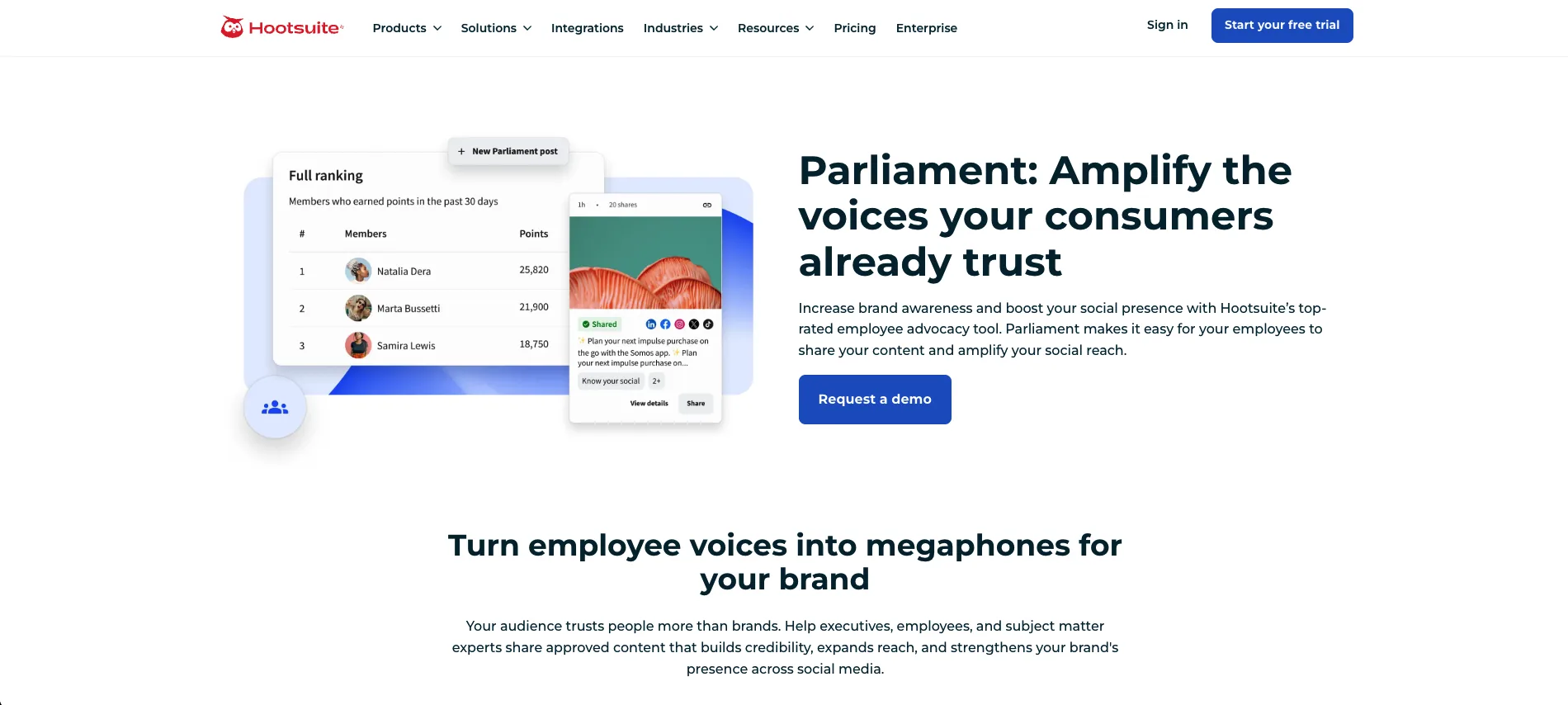
- Parliament by Hootsuite: Best for teams that already manage social media in Hootsuite, because advocacy sits inside the same Social OS.
How We Compared These Tools
We evaluated each platform against the same five criteria:
- Adoption: Does the tool help employees create posts in their own voice, or does it mainly help them reshare company content?
- Approvals: Is there a review and approval workflow, and does the vendor explain how it works?
- LinkedIn analytics: Does the vendor publicly state that it connects to LinkedIn through LinkedIn's official API?
- Voice: Can each person's tone and topics be kept when content is drafted or adapted?
- Price transparency: Does the vendor publish a price, or is every plan quote only?
LinkedIn prohibits third-party bots, scrapers, and browser extensions that automate activity on the site. Accounts that use them risk restriction, and tools built on them can stop working without notice.
The Member Post Analytics API, launched in July 2025, lets members see post performance, follower growth, and video metrics inside approved social media tools. Hootsuite and Oktopost were among its launch partners. Before you sign with any vendor, ask how it connects to LinkedIn and whether it uses the official API.
Employee Advocacy Tools Compared Side by Side
The table compares every tool on who it suits, its operating model, and its approval workflow.
| Tool | Best for | Operating model | Approval workflow |
|---|---|---|---|
| Supergrow | LinkedIn-first B2B teams | Creation-led | Yes, multi-stage review on the Content Board |
| DSMN8 | Campaign-driven programs | Reshare library | Central curation and governance; steps not stated publicly |
| EveryoneSocial | Company-wide enterprise programs | Reshare library | Admin curation with approvals; steps not stated publicly |
| Oktopost | Complex B2B social operations | Social suite add-on | Yes, on the Advanced plan |
| Haiilo | Comms-led advocacy | Comms suite | Admin-curated feeds; steps not stated publicly |
| Sociabble (Poppulo) | Global comms and recognition | Comms suite | Approved content; steps not stated publicly |
| PostBeyond | Distribution at scale | Reshare library | Approved content hub; steps not stated publicly |
| GaggleAMP | Inviting every employee | Reshare library | Pre-approved content; steps not stated publicly |
| ClearView Social | Smaller teams wanting a set price | Reshare library | Yes, on Business and Enterprise |
| Parliament by Hootsuite | Existing Hootsuite customers | Social suite add-on | Pre-approved content; steps not stated publicly |
The 10 Best Employee Advocacy Tools in 2026
Each tool below is reviewed for how employees use it after launch.
1. Supergrow
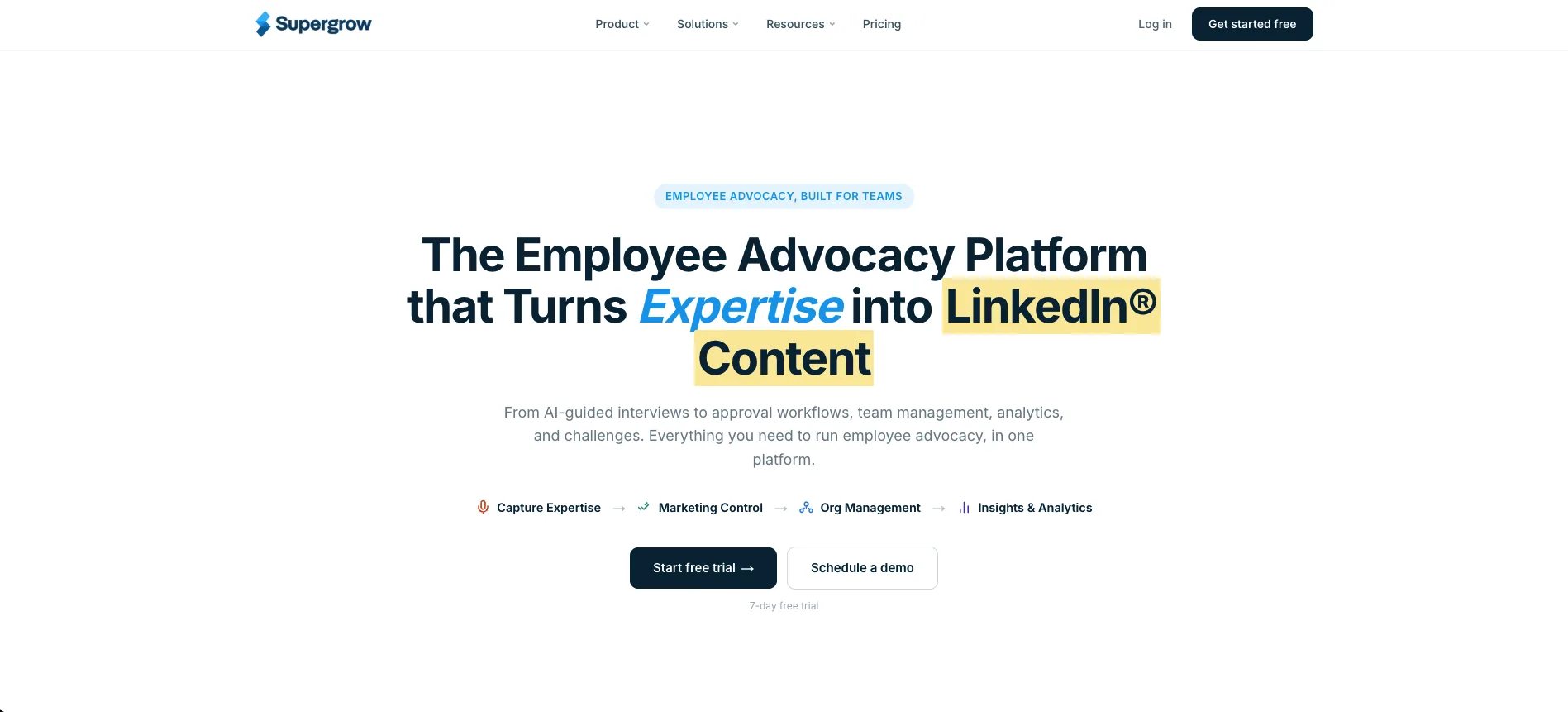
Best for: B2B marketing teams that want employees across sales, product, and engineering to publish original LinkedIn content, with brand control and per-person performance data.
How it works: Supergrow is an employee advocacy platform built around content creation. It is designed for employees who find it hard to start a post from a blank page. PostCast runs a 30-minute AI-guided interview with each employee and turns the conversation into LinkedIn drafts. Content DNA stores each person's tone, topics, and audience, so the drafts sound like the person who will publish them.
Marketing can also adapt a campaign post from the Content Library to each person's Content DNA before distributing it, so company messages still sound like the individual who shares them.
Approvals and reporting: Posts move through review stages on the Content Board, including In Review, Changes Needed, Approved, and Scheduled. The account owner, a manager, or an admin can approve, depending on workspace permissions. Supergrow connects through LinkedIn's official API and follows LinkedIn's terms of service. Team Analytics shows each member's performance, a weekly report arrives in Slack every Monday, and leaders can open a shareable live report without logging in. Challenges and leaderboards add a participation incentive.
Pricing: The Teams plan costs $199/month billed monthly or $189/month billed annually, with 5 LinkedIn accounts and the admin dashboard included. Enterprise pricing is custom for organizations with more than 5 executives. Every plan includes a 7-day free trial.
Pros
- Employees create original posts rather than only resharing company content
- Per-person voice profiles keep posts personal while marketing keeps control
- Real-time tracking for every member
- Quick leadership reporting through Slack and shareable links
Cons
- Challenge prize fulfilment is manual and happens outside the platform
- Supports LinkedIn only
2. DSMN8
Best for: Teams running structured, campaign-led programs with strong internal comms oversight.
How it works: DSMN8 uses a campaign-first model. A central team curates content in a content hub and distributes it to employees through defined campaigns, with scheduling and engagement tracking. It sells separate modules for Advocacy, Executive Influence, Boost Post, and Newsletters, and integrates with Slack, Microsoft Teams, Adobe Analytics, Salesforce, and Marketo. The model suits regulated or large organizations where message control matters more than individual expression.
Approvals and reporting: DSMN8 provides brand governance and compliance controls over curated content, and each campaign includes engagement tracking.
Pricing: DSMN8 doesn't publish a price. Quotes are custom, contracts are annual, and the price depends on the number of users and the modules you choose. Every package includes unlimited admin seats, onboarding and training, and live chat support.
Teams that want more room for employees to write their own posts often look at DSMN8 alternatives built around content creation.
Pros
- Strong brand safety and governance
- Suits large and regulated teams
- Clear campaign structure, with unlimited admin seats
Cons
- Limited room for employees to create or personalize content
- Participation often depends on incentives or internal pushes
3. EveryoneSocial
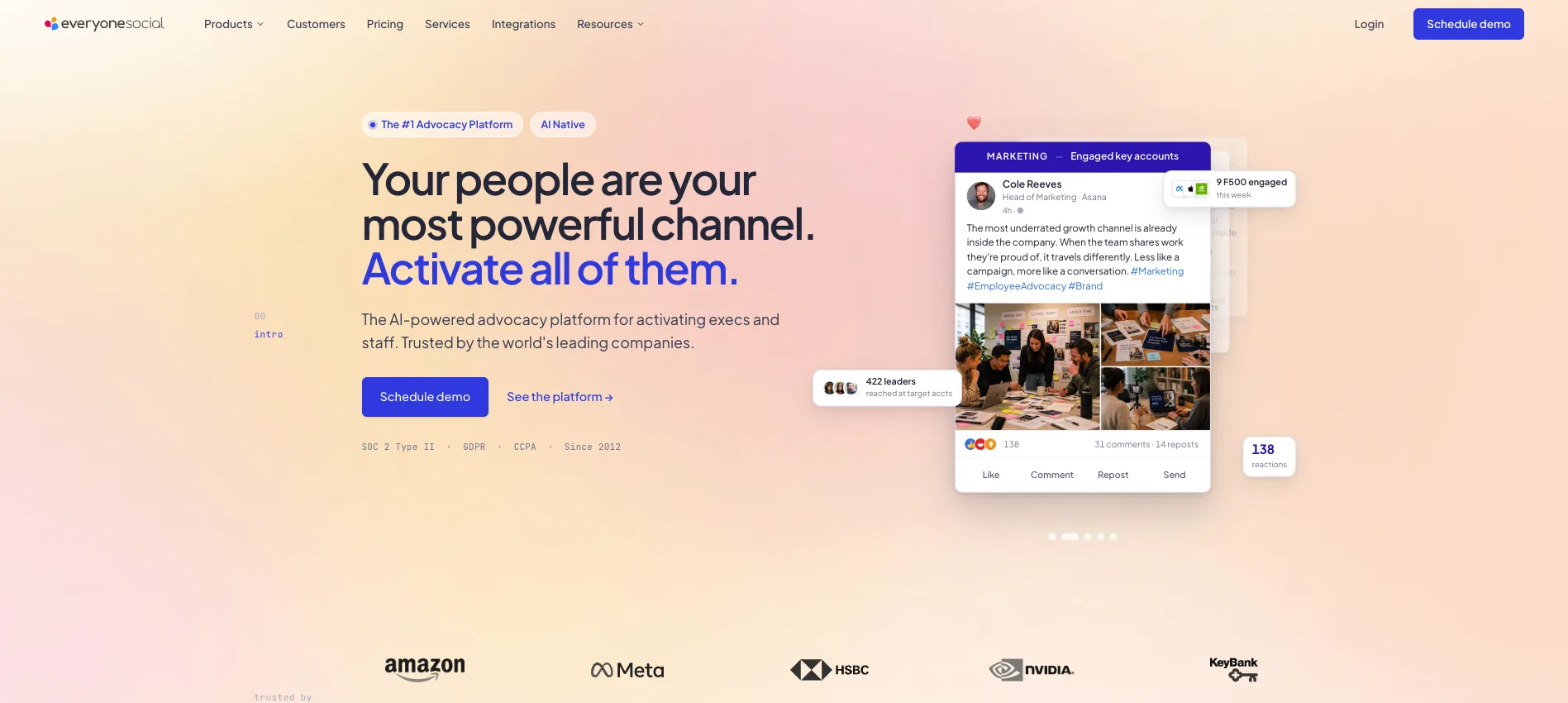
Best for: Enterprises running organization-wide advocacy that need governance and integrations.
How it works: EveryoneSocial is an enterprise hub where admins curate posts into department-specific feeds, track performance, and manage permissions. It handles both top-down company content and posts submitted by employees, and it suits programs from about 500 users to more than 50,000.
Approvals and reporting: Admins manage scheduling and approvals through enterprise roles and permissions, and SOC 2, SSO, and SCIM are standard on every plan. Its analytics cover engagement and attribution for shared content.
Pricing: EveryoneSocial offers one plan with every feature included, priced by the number of registered users. Terms are annual, with multi-year discounts, and you need a quote to see a price. Because every feature comes in that one plan, it is a larger commitment than many EveryoneSocial alternatives built for smaller teams.
Pros
- Built for enterprise security and scale
- Detailed engagement and attribution analytics
- Supports both top-down and employee-submitted content
Cons
- Setup and onboarding take more effort than lighter tools
- Participation can skew toward teams that are already active
4. Oktopost
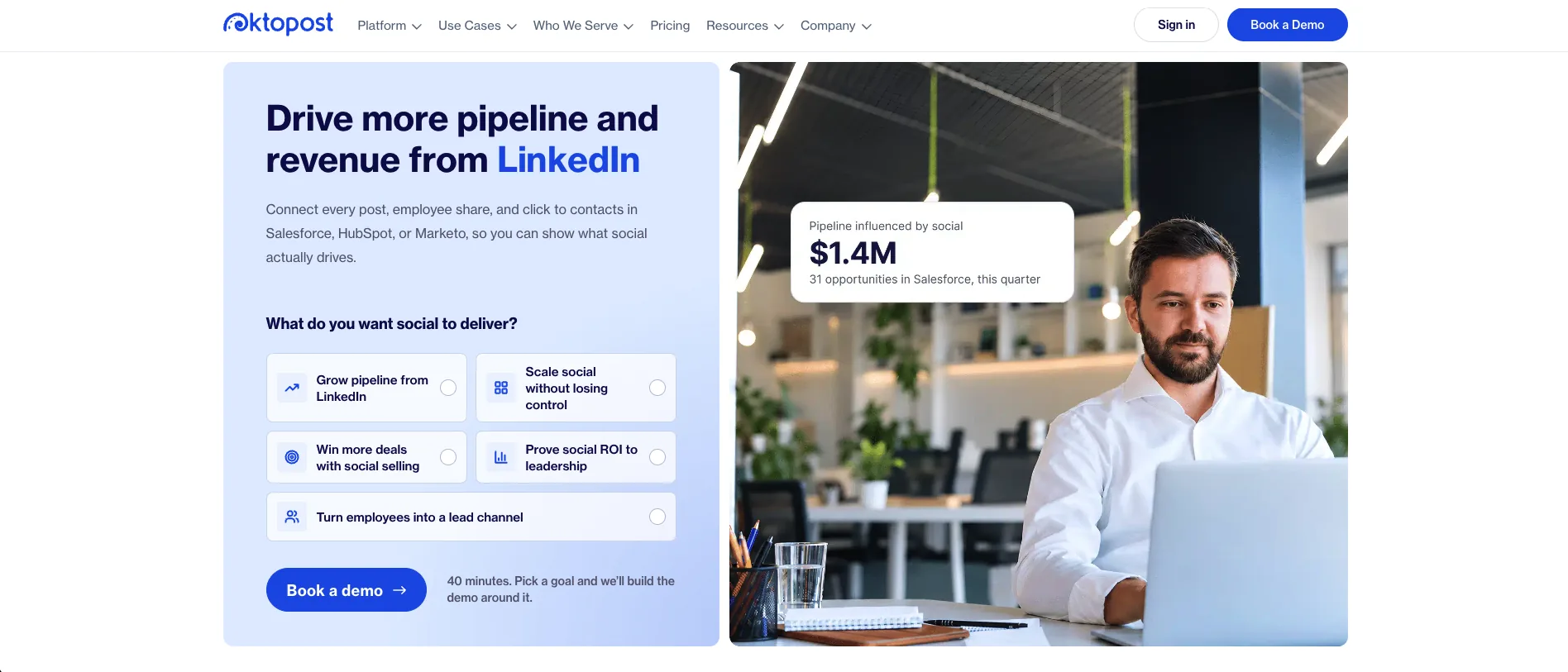
Best for: Multi-brand, multi-region B2B organizations with advanced social operations and compliance requirements.
How it works: Oktopost is a B2B social media management platform that offers an employee advocacy product alongside publishing, a social inbox, and listening. Admins manage a central content library with role-based access, and employees share from an advocacy portal. Its integrations with CRM and marketing automation tools let teams attribute social activity to pipeline.
Approvals and reporting: The Advanced plan includes approvals and compliance controls, along with SSO, provisioning, and API access. Oktopost was named a launch partner for LinkedIn's Member Post Analytics API in July 2025.
Pricing: Oktopost offers two annual plans, Professional and Advanced, both quote-only, with the price set by team size and add-ons. Ask whether employee advocacy is included in your plan or sold as an add-on, since that changes how Oktopost compares with Supergrow and other dedicated advocacy tools.
Pros
- Close integration with CRM and marketing automation for pipeline attribution
- Strong permissions and approvals on the Advanced plan
- Launch partner for LinkedIn's official post analytics API
Cons
- Not designed for employees creating their own posts
- The interface can feel complex for smaller or first-time teams
- You need to confirm with sales whether advocacy is included
5. Haiilo
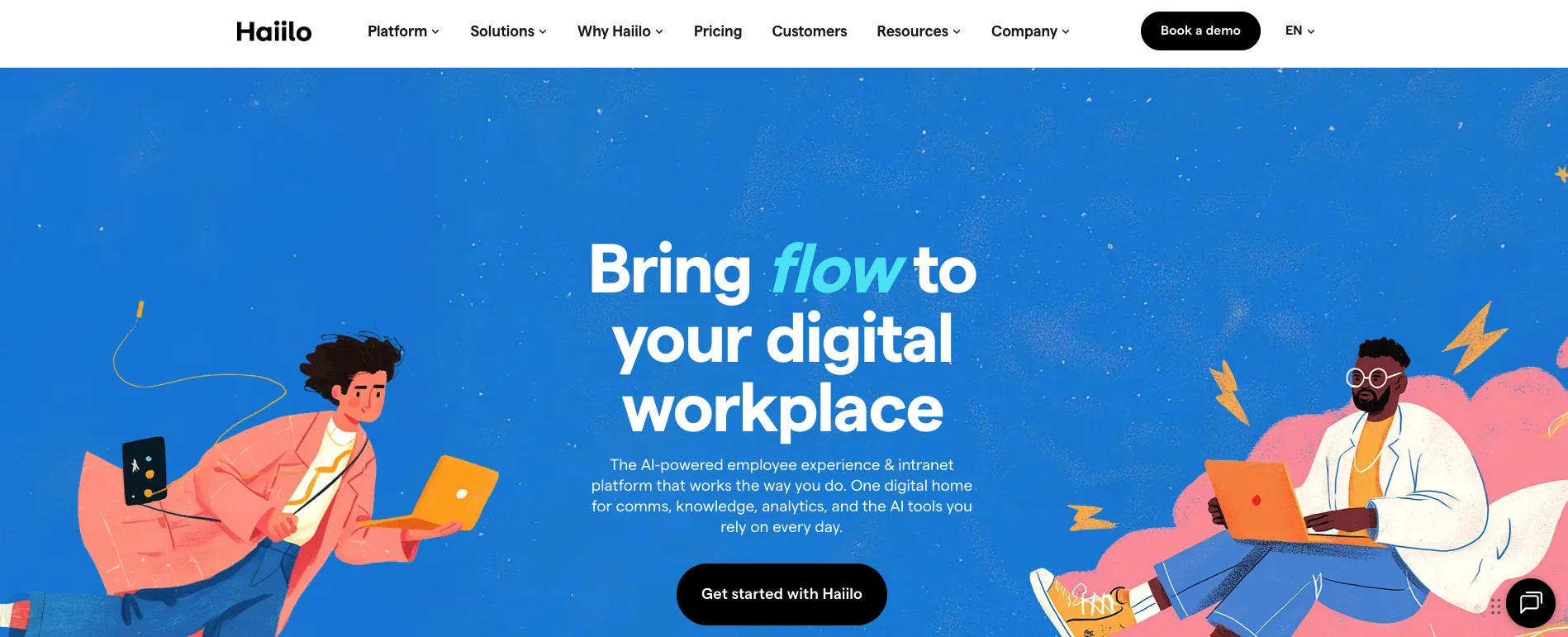
Best for: Companies where advocacy is driven by internal comms and culture initiatives.
How it works: Haiilo is an internal communications platform that combines an intranet, employee news and messaging, and employee advocacy. Advocacy is sold as a separate product with its own tiers. Admins curate shareable feeds, and employees share from Haiilo's web and mobile apps. The setup works well where leadership messaging drives employer brand or change management.
Approvals and reporting: Admins curate the feeds that employees share from. LinkedIn analytics are available from the Scaling tier upward.
Pricing: Haiilo's advocacy Starter tier costs from $15 per seat per month and includes the web and mobile apps, social sharing, and analytics. Scaling adds Smart Share, UTM tagging, LinkedIn analytics, and content import, and Enterprise adds AI features, SSO, white labelling, and rewards. Neither tier has a published price.
Pros
- Brings internal messaging and advocacy into one platform
- Builds alignment across teams
- Publishes a starting price for advocacy
Cons
- Limited support for employees creating their own content
- Less suited to LinkedIn-first or creator-led programs
- The Starter tier's seat minimum may be too high for small teams
6. Sociabble (Now Poppulo Experience Platform)

Best for: Global organizations combining advocacy with internal communications and recognition across regions and business units.
How it works: Poppulo acquired Sociabble in May 2026 and renamed the product the Poppulo Experience Platform. The product, login, data, and customer success team stay the same. The platform combines employee communications, engagement, and advocacy, and it reaches employees through mobile, web, Microsoft Teams, and digital signage. Employees share approved company content to their own networks in one click, and recognition, rewards, and gamification encourage regular participation.
Approvals and reporting: Its advocacy features include AI-powered sharing, leadership advocacy, a social media calendar, and metrics on reach and buyer intent.
Pricing: Poppulo doesn't publish a price, so you need to book a demo to get a quote.
Pros
- Combines internal comms, engagement, and advocacy
- Recognition and gamification are built in
- Tracks reach, engagement, and buyer intent from shared content
Cons
- The broad feature set can feel complex for small teams
- Takes time to learn before teams use it fully
7. PostBeyond
Best for: Organizations scaling employee advocacy through structured content distribution.
How it works: PostBeyond helps employees find, share, and amplify approved content, especially on LinkedIn, with little effort from participants. It is designed for marketing and comms teams running structured, campaign-driven programs.
Approvals and reporting: Admins approve content before it reaches employees. Reporting covers the whole program, each post, and each user, including earned media value.
Pricing: PostBeyond doesn't publish a price. You can request a demo for a quote or start a free trial on its website.
Pros
- Simple sharing workflow for employees
- Reach, engagement, and earned media value reporting
- Scales across distributed organizations
Cons
- Limited support for employee-generated content
- Largely top-down, so engagement can depend on incentives
8. GaggleAMP
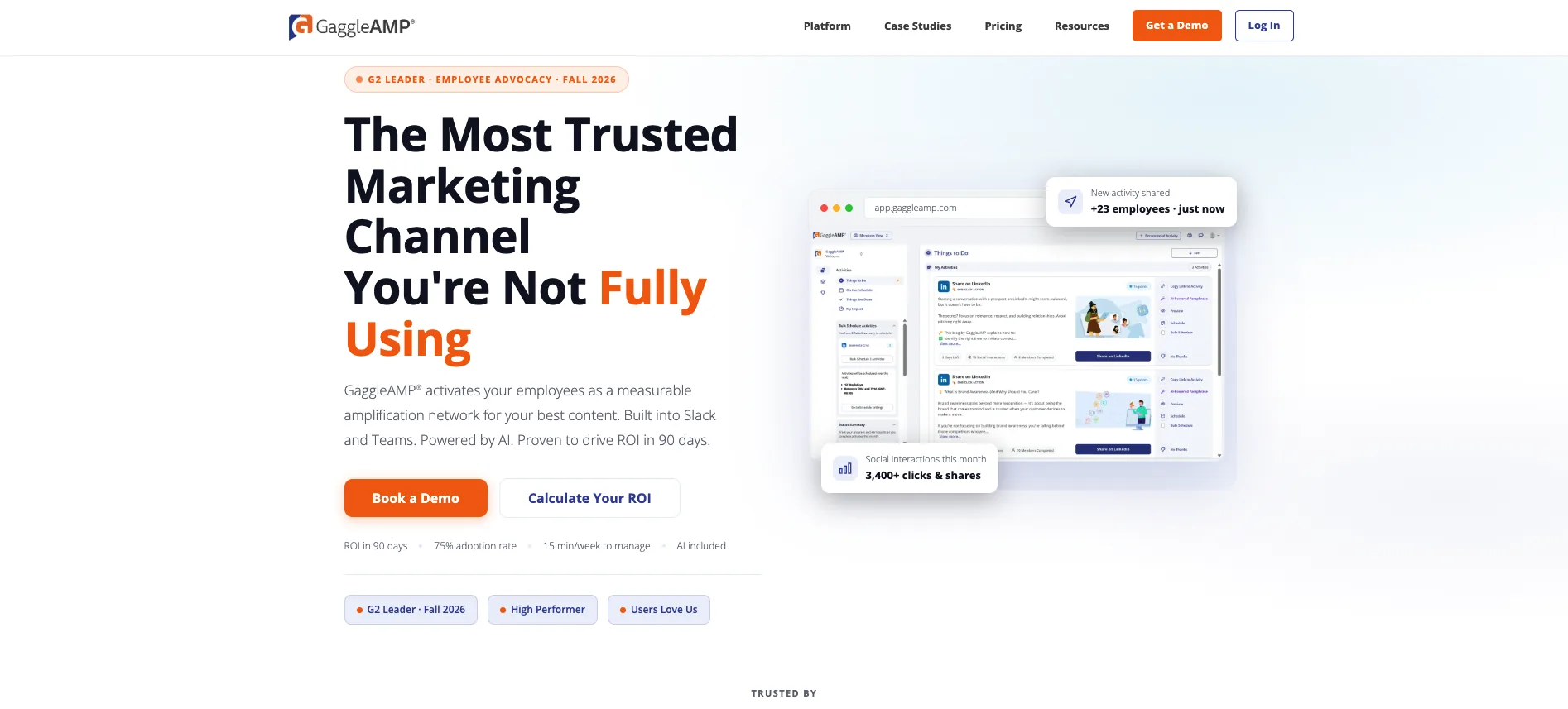
Best for: Companies that want to invite every employee into the program without paying per seat.
How it works: GaggleAMP is an employee advocacy platform built around "activities" that admins create and assign by role, region, or product line. Employees receive these activities in Slack, Microsoft Teams, or the GaggleAMP app and complete them in one click. Its AI suite writes a different version of the copy for each advocate and lets employees paraphrase pre-approved content, which reduces the number of identical posts going out at once. A Members List shows participation, completed activities, and network reach.
Approvals and reporting: Admins pre-approve content before employees share it. Analytics track shares, clicks, and reach, along with UTM attribution to website traffic and leads, earned media value, and cost per thousand impressions.
Pricing: GaggleAMP prices by company size rather than by seat, and every quote is custom. Each plan includes unlimited members, the full AI suite, and Slack and Teams integration. Contracts are billed annually on 1-, 2-, or 3-year terms. A 1-year term costs 10% more than the 2-year base rate, and a 3-year term costs 5% less, so teams that prefer shorter commitments often compare GaggleAMP alternatives as well.
Pros
- Unlimited members, so adoption is not capped by seat count
- Employees can act from Slack or Teams without another login
- AI copy variations help shared posts read less alike
- UTM attribution connects shares to traffic and leads
Cons
- Content still starts with admins rather than employees
- The best rate requires a multi-year contract
9. ClearView Social
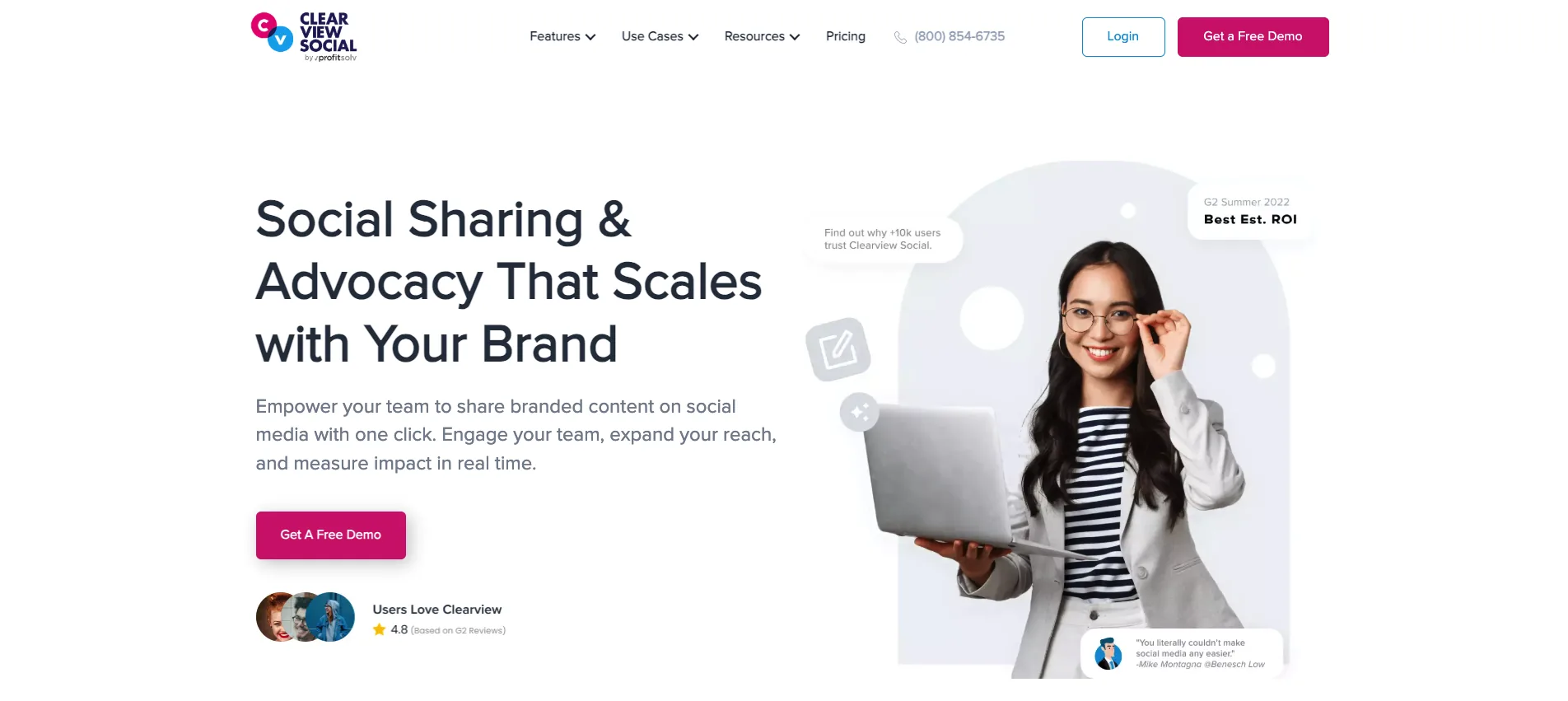
Best for: Smaller teams and firms that want a published price and one-click sharing from email, Slack, or Teams.
How it works: ClearView Social is employee advocacy software built for simple, low-effort sharing. Admins upload the team's email addresses once, and the tool sends queues of approved content to employees by email, Slack, or Microsoft Teams. Employees share to LinkedIn, Facebook, Instagram, and X in one click. A Virtual Assistant can post to employee profiles automatically, and PeakTime AI picks posting times and schedules posts. Its case studies include several accounting and law firms.
Approvals and reporting: Approval workflows are included on the Business and Enterprise plans. Reporting covers clicks, engagement, referrals, campaigns, and earned media value, along with employee adoption rates and top performers.
Pricing: ClearView Social is one of the few tools on this list with published prices. Both paid plans are billed annually.
- Team: $425/month for 1 admin, 3 social accounts, and up to 50 employee users
- Business: $675/month for 3 admins, 10 social accounts, and up to 100 employee users, with approval workflows, tagging, referral and campaign tracking, and branded emails
- Enterprise: Custom pricing for more than 100 users, adding single sign-on
Pros
- Published, predictable pricing
- Low-effort sharing from email, Slack, or Teams
- Supports four social networks
Cons
- Approval workflows are not included on the Team plan
- Focused on resharing rather than employee-created posts
- Automatic posting through the Virtual Assistant means some posts carry little personal input
10. Parliament by Hootsuite (Formerly Hootsuite Amplify)
Best for: Teams that already manage their social media in Hootsuite.
How it works: Hootsuite Amplify has evolved into Parliament, and its core advocacy features remain. Parliament is one of five products in Hootsuite's Social OS, alongside Perch for publishing, Nest for the social inbox, Lumen for insights, and Wisdom for AI. Employees, executives, and subject matter experts share pre-approved content in a few clicks, and a built-in AI writer drafts captions they can edit. Employees can also share from Microsoft Teams, Slack, or AI assistants such as ChatGPT, Claude, and Gemini through the Parliament MCP.
Approvals and reporting: Admins pre-approve the content that employees share. Parliament tracks participation, reach, engagement, clicks, shares, and earned amplification, with leaderboards for top advocates. Hootsuite was named a launch partner for LinkedIn's Member Post Analytics API in July 2025.
Pricing: Hootsuite doesn't publish a price for Parliament, but it offers a free trial and a demo.
Pros
- Fits naturally into an existing Hootsuite setup
- Hootsuite is a launch partner for LinkedIn's official post analytics API
- AI caption writer and MCP access for employees who work in chat tools
Cons
- Most useful for teams already paying for Hootsuite
- Pricing is only available on request
- Content still starts with admins rather than employees
These 10 tools fall into four broad types, and knowing which type suits your program narrows the shortlist quickly.
Which Type of Employee Advocacy Tool Fits Your Team?
Start by deciding how you expect employees to take part, since each type of tool is built around a different answer.
- Reshare library (EveryoneSocial, DSMN8, PostBeyond, ClearView Social, GaggleAMP): Marketing or comms prepares content, and employees share it with optional edits. This suits companies that want consistent messaging across a large workforce.
- Comms suite (Haiilo, Poppulo Experience Platform): Advocacy sits inside an internal communications platform with an intranet or employee app. This suits organizations where internal comms owns the program.
- Social suite add-on (Parliament by Hootsuite, Oktopost): Advocacy is part of a social media management tool that also handles publishing, inbox, and listening. This suits teams that want advocacy in the same tool as their brand channels.
- Creation-led (Supergrow): Employees create original posts in their own voice, with help from interviews and voice profiles. This suits LinkedIn-first B2B teams whose experts have knowledge but little time to write.
If you are still planning the program itself, settle the goal, owner, and first cohort before choosing a tool, using a week-by-week plan to launch an employee advocacy program. Once you know the type, price is usually the next filter.
What Employee Advocacy Software Costs
Supergrow and ClearView Social publish full plan prices, and Haiilo publishes a starting price for its advocacy Starter tier. The other seven vendors quote on request, most on annual contracts.
| Tool | Published price | Billing | What the price covers |
|---|---|---|---|
| Supergrow Teams | $199/month, or $189/month billed annually | Monthly or annual | 5 LinkedIn accounts and the admin dashboard |
| ClearView Social Team | $425/month | Annual | Up to 50 employee users, 1 admin |
| ClearView Social Business | $675/month | Annual | Up to 100 employee users, 3 admins, approval workflows |
| Haiilo Advocacy Starter | From $15/seat/month | Not stated | Web and mobile apps, social sharing, analytics; 100-seat minimum listed |
For the quote-only vendors, contract terms can still help you plan:
- DSMN8: Annual contracts, custom quote
- EveryoneSocial: One plan priced by registered users, annual term with multi-year discounts
- GaggleAMP: Priced by company size, billed annually on 1, 2 or 3 year terms
- Oktopost: Two annual plans, quote only
Headline prices are hard to compare because each tool counts users differently. For example, ClearView Social's Team plan works out to $8.50 per employee per month if all 50 seats are used ($425 ÷ 50). Haiilo's Starter tier at its listed 100-seat minimum comes to at least $1,500 per month (100 × $15). Supergrow's annual Teams price works out to $37.80 per LinkedIn account per month ($189 ÷ 5), because each account gets interview-based drafting, a voice profile and individual analytics rather than a shared content feed.
The right comparison is cost per active participant, not cost per invited user. Before you book demos, decide how many people you expect to post each month and ask each vendor to quote for that number.
Advocacy Works When Employees Actually Show Up
Most tools on this list put approved content in front of employees and make sharing fast. Employees usually stop posting when they lack a clear voice on LinkedIn or an easy way to turn their expertise into a post.
The tool you choose should match where your program loses momentum. If the problem is reach for company content, a reshare library or social suite add-on may be enough. If the problem is that your experts have knowledge but never publish, look for a tool that helps them create. Supergrow is built around that second problem, and the comparison table above shows how it differs from the reshare-led tools.
Book a demo to see how your experts can turn an interview into LinkedIn posts in their own voice.