
More B2B teams now ask employees to post about their work on LinkedIn, because people tend to engage with a colleague's post in a way they rarely do with a company page. The trouble is that "employee content" can mean very different things. A sales rep resharing a product announcement and an engineer writing about a bug they spent months fixing both get called employee advocacy, even though the two posts work in completely different ways.
This guide defines employee-generated content (EGC) and separates it from user-generated content, employee advocacy, and employee-led content. It then walks through real B2B examples by role and ends with a five-step workflow that takes an idea from an employee's head to a published LinkedIn post.
What is Employee-Generated Content?
Employee-generated content is the one created by employees themselves, in their own words, about their own work, and published on their own profiles. In B2B, that usually means LinkedIn posts about decisions, lessons, customer conversations, and projects. A company-written post that employees reshare is not EGC, even when an employee adds a line of their own on top.
EGC is one aspect of employee advocacy, which covers every way employees help a company reach more people. What sets EGC apart is ownership. The employee decides what to say, writes or approves every word, and publishes under their own name, so the post reads as their professional view instead of a company message.
Because these terms are often used as if they mean the same thing, it helps to see them side by side.
EGC vs UGC vs Employee Advocacy vs Employee-Led Content
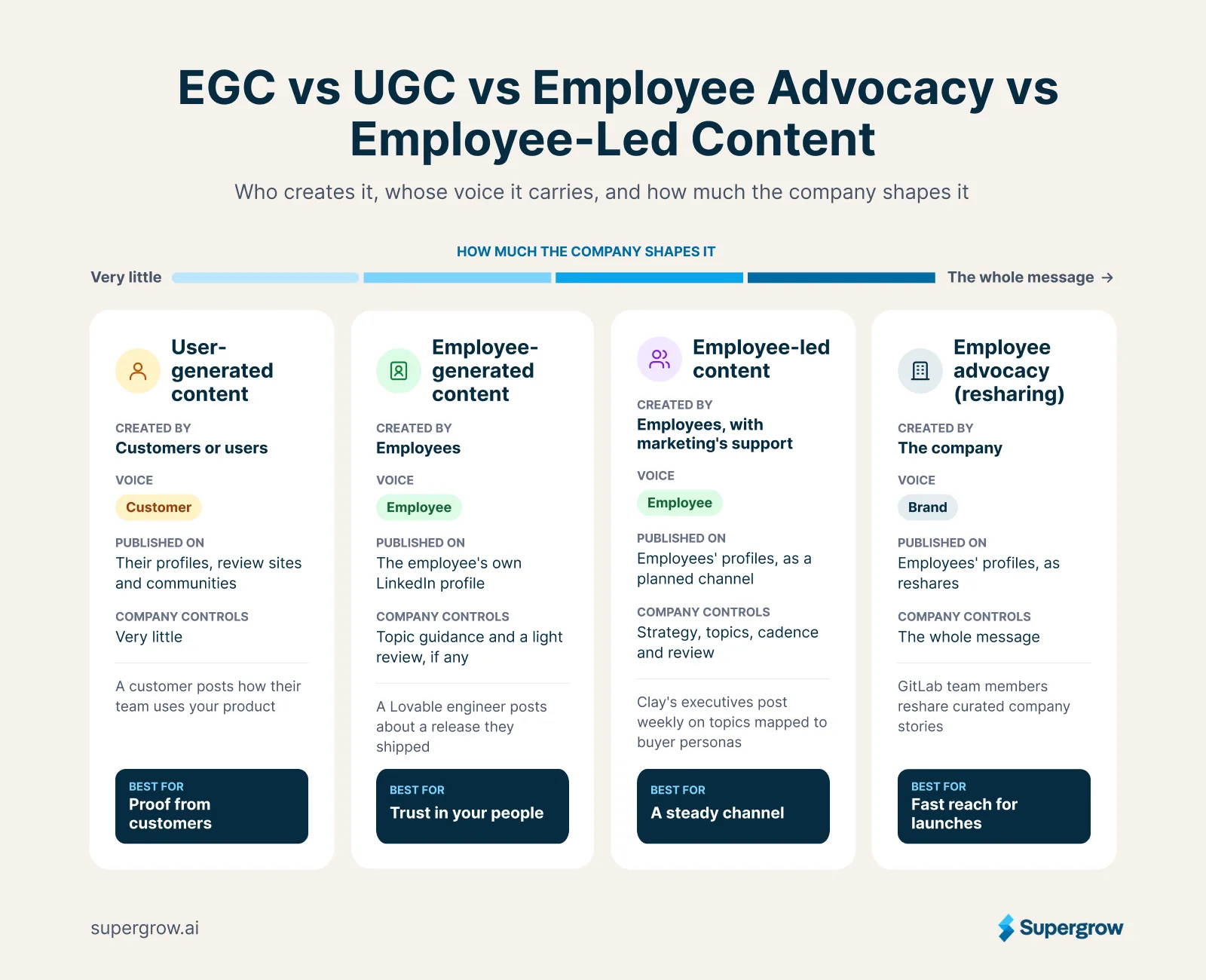
The four terms differ in who creates the content, whose voice it carries, and how much the company shapes it.
| Term | Who creates it | Whose voice | Where it's published | What the company controls | Example |
|---|---|---|---|---|---|
| User-generated content (UGC) | Customers or users | Customer | Their own profiles, review sites and communities | Very little, beyond asking for it and resharing it | A customer posts how their team uses your product |
| Employee-generated content (EGC) | Employees | Employee | The employee's own LinkedIn profile | The topic guidance and a light review, if any | A Lovable engineer posts about a release they shipped |
| Employee advocacy (resharing) | The company | Brand | Employees' profiles, as reshares | The whole message | GitLab team members reshare curated company stories through a voluntary program |
| Employee-led content | Employees, with support from marketing | Employee | Employees' profiles, as a planned channel | Strategy, topics, cadence and review | Clay's executives post weekly on topics mapped to buyer personas |
Each approach does a different job. Resharing is the quickest way to put a launch or event in front of more people, and UGC gives prospects proof from real customers. EGC builds trust in the people behind the company, and employee-led content turns that trust into a steady channel by giving employees topics, support and a weekly rhythm.
Two B2B companies show what that channel can deliver when employees post consistently.
Why B2B Teams Invest in Employee-Generated Content
Warp, which makes HR, payroll and compliance software for startups, uses employee posts to hire. About a third of its employees post on LinkedIn or X at least twice a week, supported by weekly idea sessions with marketing and a small monthly raffle for everyone who posts. Warp hired 30 people in a single quarter, and its Chief People Officer found that almost every candidate who joined a call had first seen the company on LinkedIn.
Clay took a more structured route. Its executives post weekly on topics mapped to the company's buyer personas, and one person leads the effort across the team. In one quarter, Clay's executive content earned about 6 million LinkedIn impressions and 80,000 new followers.
Warp hires from the same startup audience it sells to, and Clay sells to people who spend much of their working day on LinkedIn. Your results will depend on your audience and the effort behind the program, so treat these numbers as examples of what is possible, not as targets to promise your leadership team.
The posts behind numbers like these are easier to understand when you look at them one role at a time.
Employee-Generated Content Examples by Role
The employee advocacy examples below come from real B2B LinkedIn posts, one for each type of role on a typical team. Each one covers who posted it, what the post is about, and why it works, so you can share them with your team as a reference before they write their own.
Engineering: Shipping Updates in the Engineer's Own Words
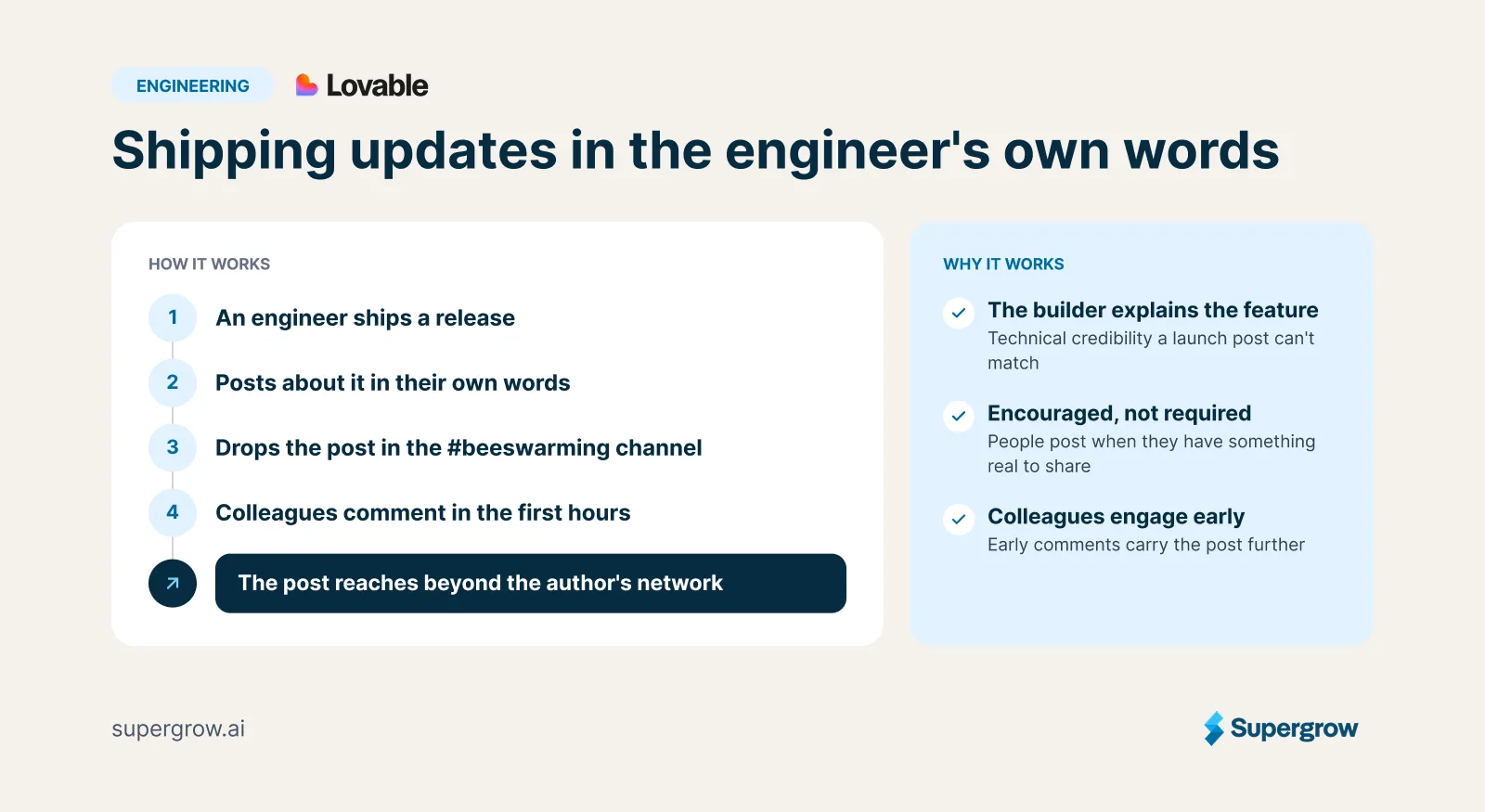
At Lovable, the AI app builder, every employee is encouraged to post on social media to build their own brand. Engineers post about the releases they ship, and marketing steps in mainly for the largest launches. When someone publishes, they drop the post into an internal channel called "beeswarming," where colleagues comment on it early. Head of Growth Elena Verna explained the approach on 20VC in March 2026 and summed up the goal as making "a marketer out of every single engineer."
Why it works:
-
The builder explains the feature: A post from the engineer who shipped it carries technical credibility a launch announcement can't match.
-
Posting is encouraged, not required: People write when they have something real to share, which keeps posts genuine.
-
Colleagues engage early: Comments in the first hours help each post reach people beyond the author's network.
Sales Development: A Rep's Career Story Becomes a Series
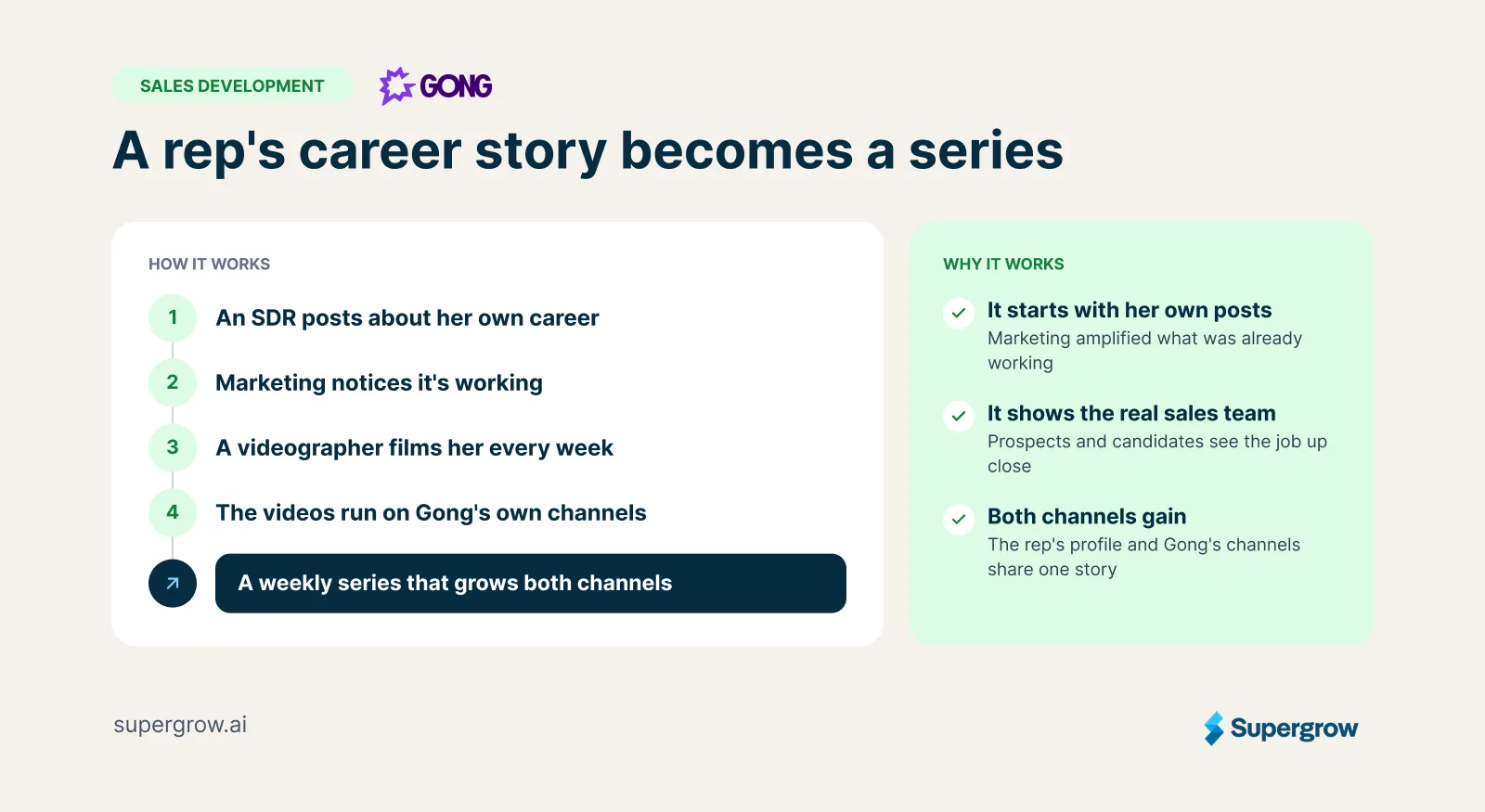
Gong's marketing team noticed one of its SDRs posting on LinkedIn about her own career. The team liked what she was doing, so it brought in a videographer to film her every week and published the videos on Gong's own channels. Udi Ledergor, now Gong's Chief Evangelist, described the result as "a really, really popular mini series" on The Campaign podcast in March 2026.
Why it works:
-
It starts with her own posts: Marketing amplified content that was already working instead of scripting something new.
-
It shows the real sales team: Prospects and candidates see the job through the person doing it.
-
Both channels gain: The rep's profile and Gong's own channels benefit from the same story.
Sales: A Company Announcement in the Employee's Own Voice
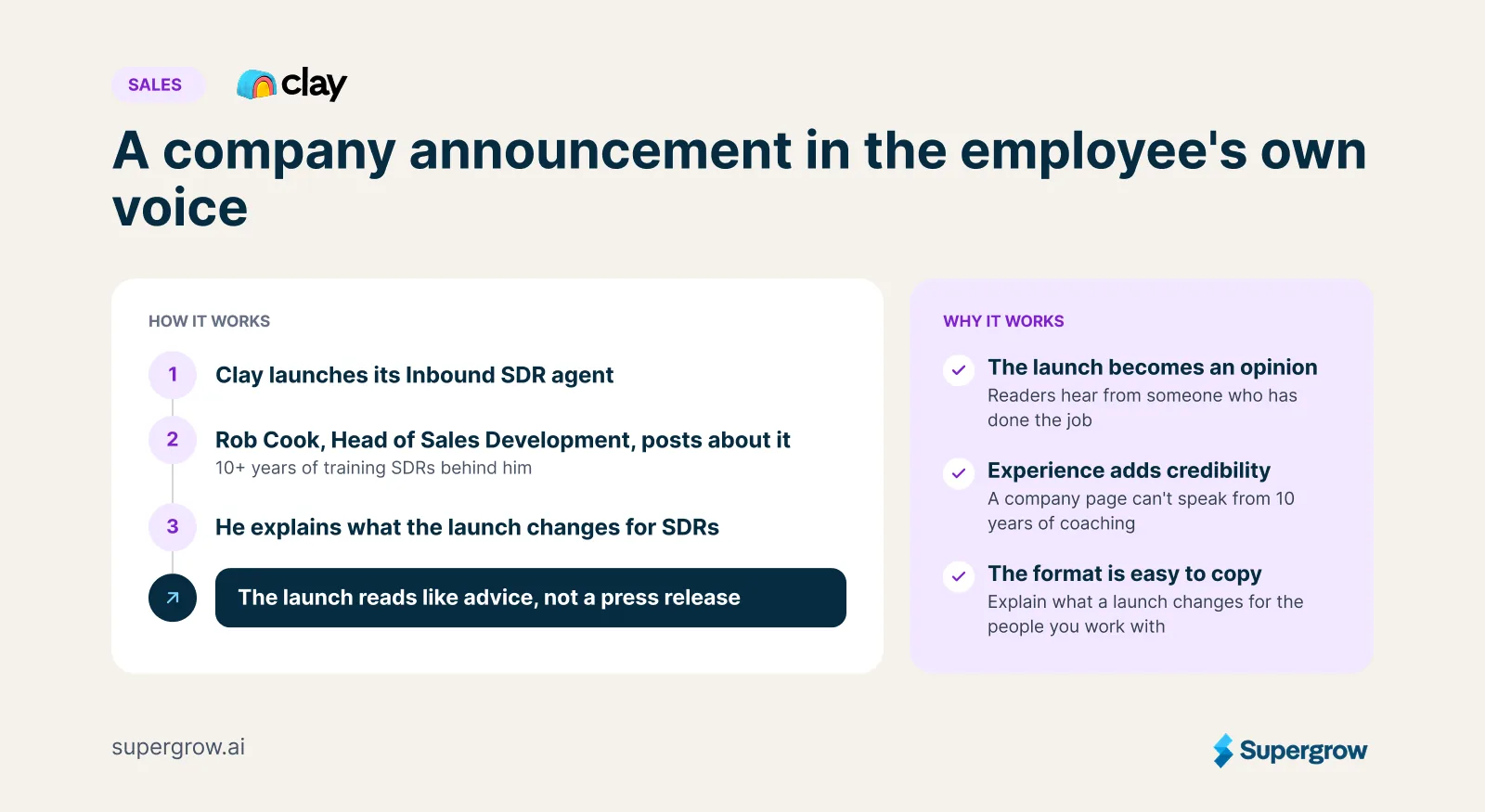
Rob Cook, Head of Sales Development at Clay, has spent more than 10 years training SDRs. On October 13, 2026, he used that experience to introduce Clay's Inbound SDR agent, explaining what the launch changes for the people who do the job every day.
Why it works:
-
The launch becomes an opinion: Readers hear from someone who has done the job, so the post feels like advice, not a press release.
-
Experience adds credibility: A company page can announce a product, but it can't speak from 10 years of coaching SDRs.
-
The format is easy to copy: Any salesperson can share a launch by explaining what it changes for the people they work with.
Leadership: Executives Speaking for the Company in Their Own Voice
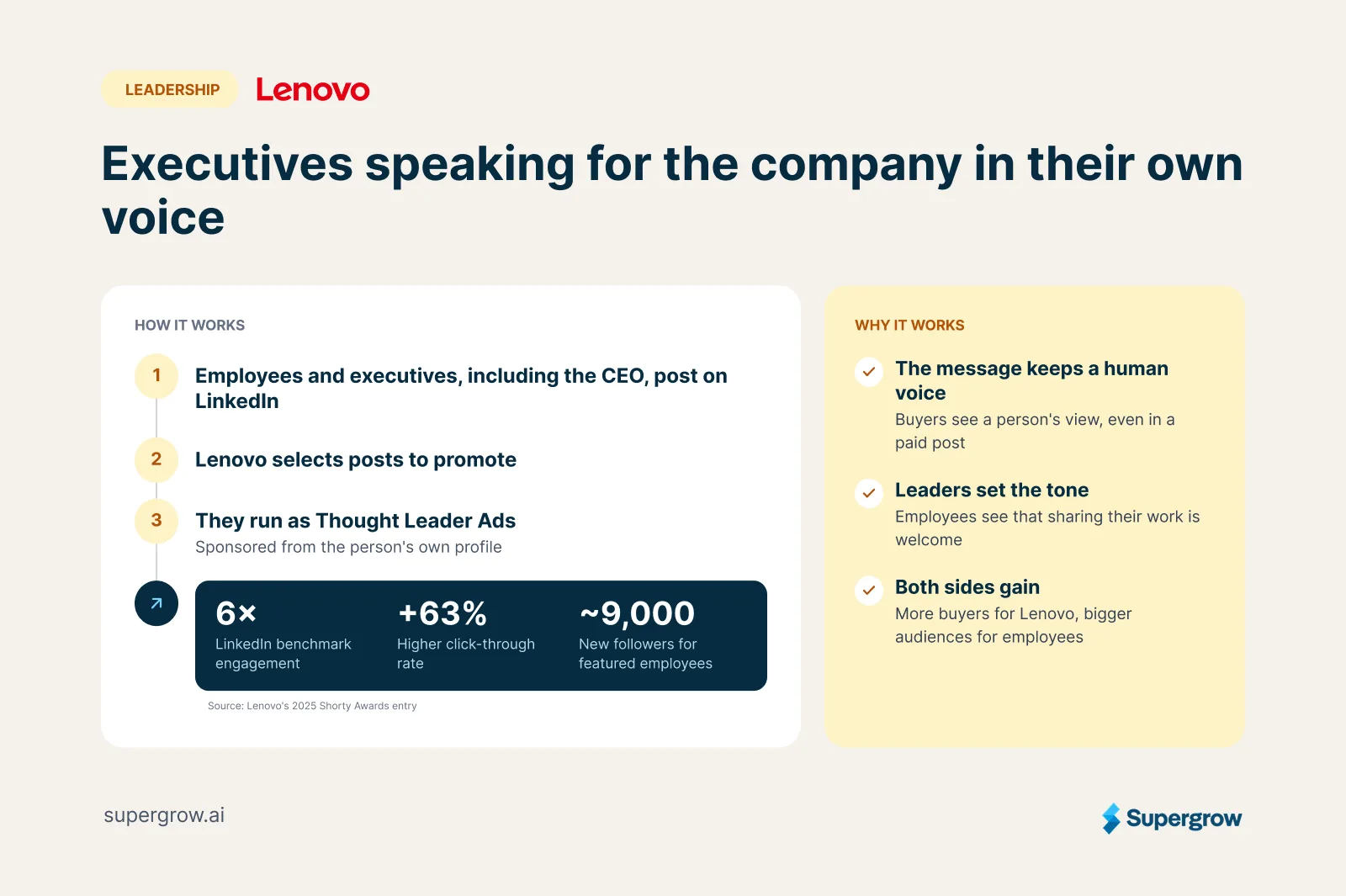
Lenovo selects LinkedIn posts from its employees and executives, including its CEO, and promotes them as Thought Leader Ads, a format that sponsors a post from a person's own profile. In Lenovo's 2025 Shorty Awards entry, the company reported engagement six times above LinkedIn's benchmarks and a 63% higher click-through rate. One CEO post reached a 7.79% engagement rate, and the featured employees gained about 9,000 new followers between them.
Why it works:
-
The message keeps a human voice: Buyers see a person's view, even when the company pays to extend its reach.
-
Leaders set the tone: When executives post in their own words, employees can see that sharing their work is welcome.
-
Both sides gain: The company reaches more buyers, and each employee builds a larger professional audience.
Employer Brand: Employees Covering the Company's Biggest Event
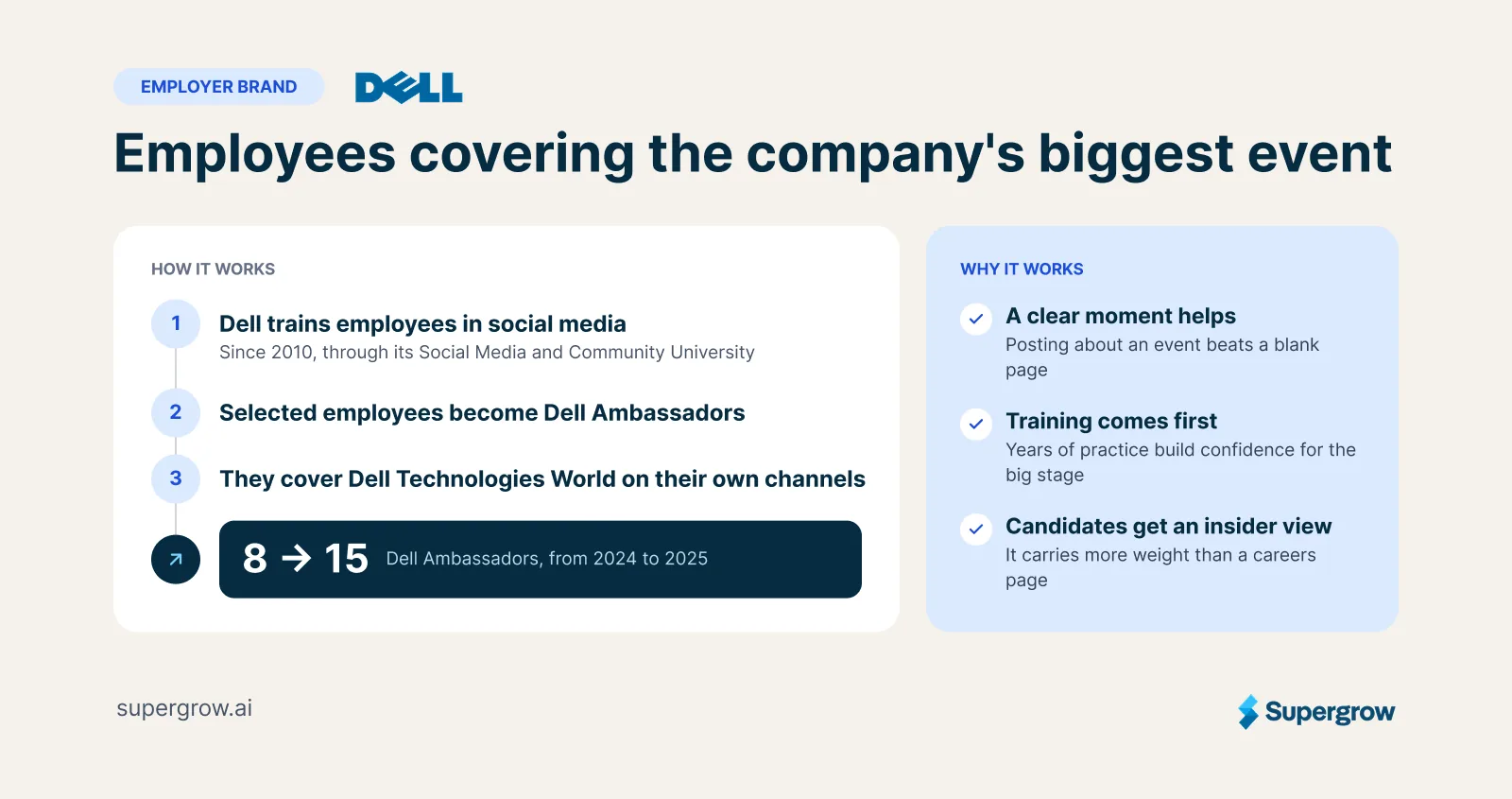
Dell has trained employees in social media since 2010 through its Social Media and Community University. Since 2023, a group of selected employees called Dell Ambassadors has covered Dell Technologies World on their own social channels, and the group grew from 8 ambassadors in 2024 to 15 in 2025. In its May 2025 post on the program, Dell describes the aim as "authentic, real-time coverage of Dell's biggest event of the year."
Why it works:
-
A clear moment helps: Employees post about what they see and learn at the event, which is easier than starting from a blank page.
-
Training comes first: Years of social media training give employees the confidence to post on the company's biggest stage.
-
Candidates get an insider view: Seeing the event through employees' eyes carries more weight than a careers page.
Whole Teams: Sales and Customer Success Posting at Scale
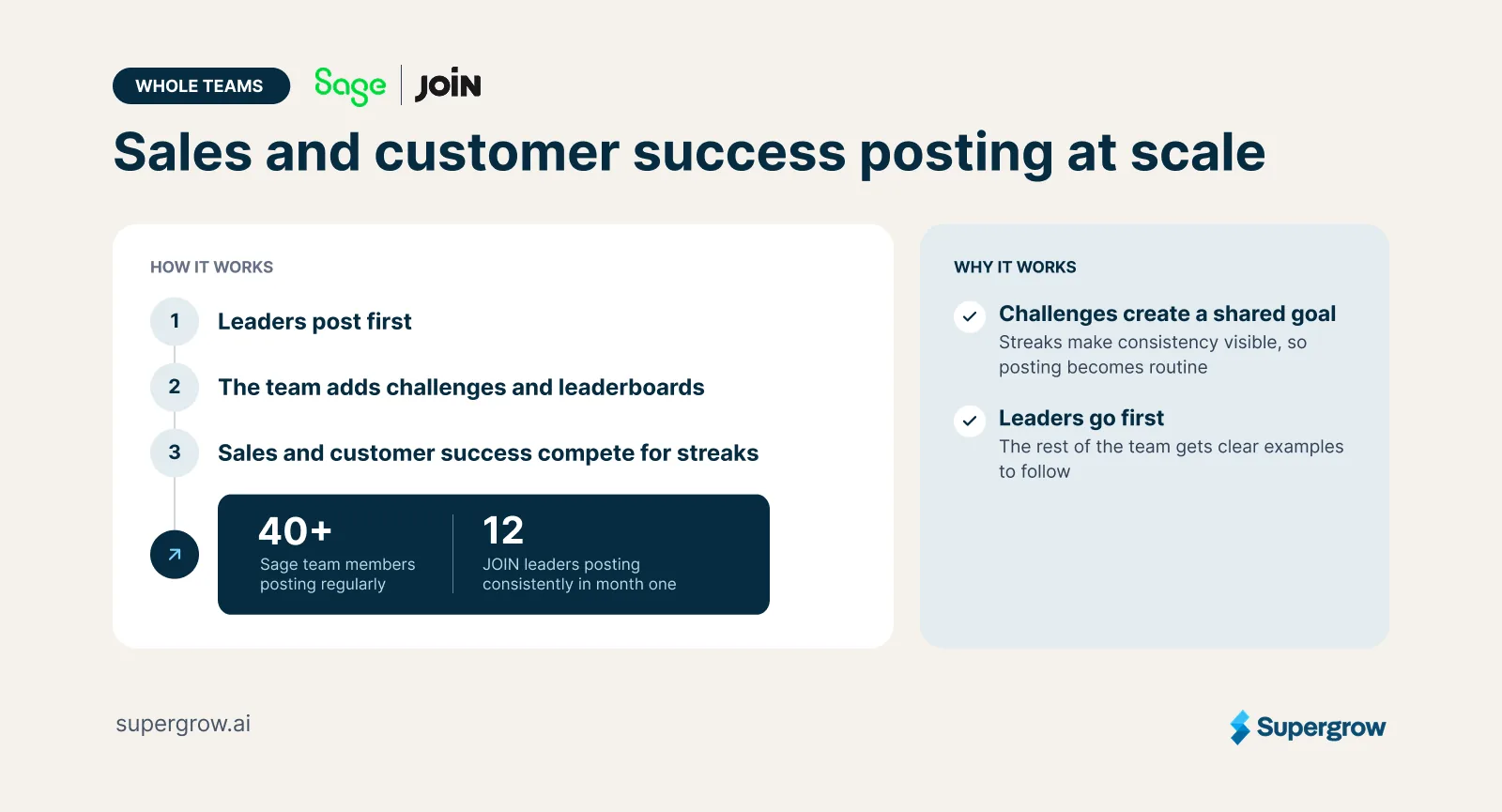
Some companies run EGC across whole departments. At Sage, a Supergrow customer, over 40 team members, including people in sales and customer success, now post regularly and compete for streaks after the team introduced challenges with leaderboards. At JOIN, another Supergrow customer, 12 leaders were posting consistently within the first month.
Why it works:
-
Challenges create a shared goal: Streaks and leaderboards make consistency visible, so posting becomes part of the team's routine.
-
Leaders go first: Starting with leaders gives the rest of the team clear examples to follow.
Examples like these are much easier to repeat when there is a simple process behind them.
A B2B LinkedIn Workflow for Employee-Generated Content
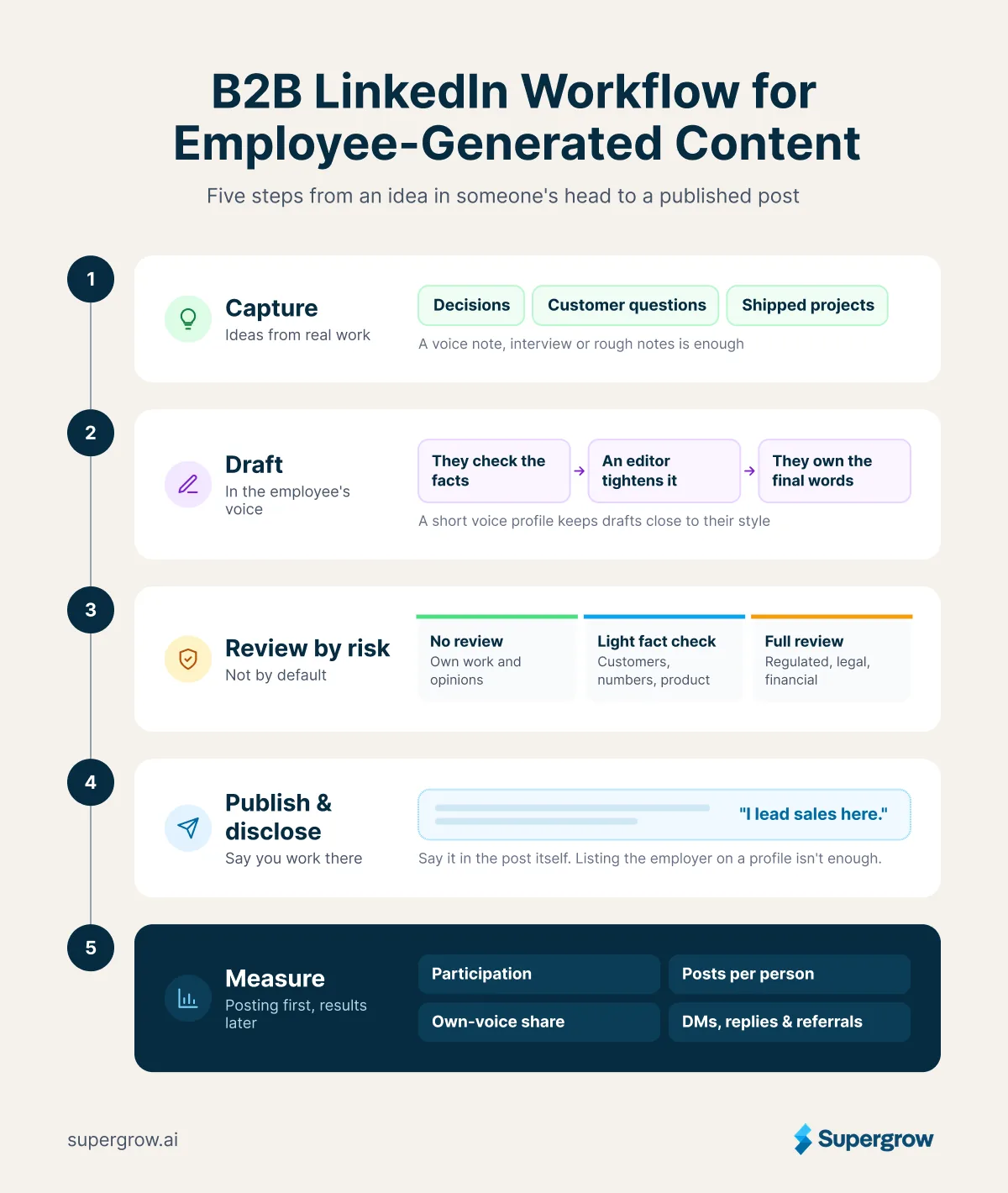
The five steps below take an idea from an employee's head to a published LinkedIn post. They work for a single team testing EGC or for a company-wide program.
1. Capture Ideas From Real Work
Good EGC starts with the work employees already do every week. The strongest ideas usually come from:
-
A decision or trade-off they made, and the reasoning behind it
-
A question customers keep asking
-
A process or checklist they rely on
-
A belief about their field that they can defend
-
A project they recently shipped
-
A company announcement, translated into what it means for their role
Capture each idea while it's fresh. A short interview, a voice note or a few rough notes is enough, because an editor can shape the idea later. Warp, for example, runs weekly brainstorms where marketing helps employees turn their work into post ideas. Group ideas under 2 to 3 themes per person, so each employee builds a recognizable point of view over time, and use your employee advocacy content strategy to keep those themes tied to company priorities.
2. Draft in the Employee's Voice
Turn the captured idea into a first draft that sounds like the employee, not like marketing. If an editor writes the draft, the employee checks the substance first. Are the facts right, and is this what they actually think? Once the substance is right, the editor can tighten the structure and wording.
The final wording is always the employee's call, because the post goes out under their name. Keeping a short voice profile for each person, with the words they use, the topics they avoid and how they like to open a post, helps every new draft start closer to their style.
3. Review by Risk, Not by Default
Most EGC doesn't need formal approval. Match the level of review to the risk of the post:
-
No review: Personal experience, lessons and opinions about the employee's own work
-
A light fact check: Posts that mention customers, numbers or the product
-
Full review: Regulated, legal or financial topics, checked with the relevant expert
Agree on these levels before anyone posts, and track how long reviews take. When reviews are quick and predictable, approval never becomes the reason a good post goes out late or not at all.
4. Publish and Disclose
When employees mention their employer's products or services, they should make the relationship clear in the post itself. Under the FTC's guidance on endorsements, listing the employer on a profile isn't enough, because people who only read the post won't see it. A short, plain line in the post, such as "I lead sales here," makes the connection clear.
Employees should also follow the company's social media policy. This is general guidance, not legal advice, so check the details with your legal team.
5. Measure What Matters
Measure whether people are posting before you measure what the posts achieve. Track these four things each week:
-
Participation: Who has posted at least once
-
Posts per person: How often each employee posts
-
Own-voice share: The share of posts written in the employee's own words, not reshared
-
Qualitative signals: DMs, replies, referrals and sales conversations that start from a post
Lenovo, for example, tracks engagement, click-through rate and follower growth for each employee post it promotes. As the program grows, add later-stage employee advocacy metrics such as reach quality and pipeline influence. Impressions are worth watching, but a single DM from the right prospect can matter more than thousands of passive views.
Even with a clear workflow, a few common mistakes can hold EGC back.
Common Employee-Generated Content Mistakes
Each mistake below has a fix in one of the five workflow steps.
-
Calling reshares EGC: A company post with one added line is still company content. Count only posts the employee wrote from their own work (step 1).
-
Requiring sign-off on every post: Blanket approval slows everyone down and signals distrust. Review by risk instead (step 3).
-
Making every post mention the company: Posts that always plug the company read like ads. Let most posts focus on the employee's own work and expertise (step 1).
-
Skipping disclosure: When a post mentions the company's products, the employee should say they work there (step 4).
-
Judging success by impressions alone: Impressions miss the conversations that lead to deals and hires. Track participation and qualitative signals as well (step 5).
If your team wants help running these steps week after week, Supergrow covers most of them in one place.
Running Employee-Generated Content in Supergrow
A shared document can hold ideas, but someone still has to capture them, turn them into drafts and keep reviews moving. Supergrow supports each step of the workflow above.
-
Capture: Content interviews, built on PostCast, let each employee talk through an idea with an AI interviewer, and Supergrow turns the conversation into LinkedIn drafts.
-
Draft: Content DNA stores each person's tone, topics and audience, so drafts sound like the employee who will publish them.
-
Review: Approval workflows on the Content Board send each draft to the right reviewer at the level your team agreed on.
-
Measure: Challenges and leaderboards keep posting consistent, and team analytics with weekly reports show participation and results for every member.
Book a demo to see how your team can turn its everyday work into LinkedIn posts in each person's own voice.
Start With One Idea Per Person
Employee-generated content works when employees share their own work in their own words, with a simple system behind them. Start small, help each person capture one real idea from their week, and keep reviews light so good posts go out on time. When you're ready to run it as a program, the 8-week employee advocacy launch plan gives you the weekly tasks, the numbers to track, and a free template to copy.